SYBAU Meaning In Text: Mostly People Keep It Secret
SYBAU meaning in text is “Shut Your Bitch Ass Up” a blunt way to tell someone to stop talking, usually fired off during an argument or a joke among friends. A softer variant, Shut Your Boring Ass Up, floats around too, mostly used when someone wants the same punch without the harsher wording.
The phrase works like a verbal slam of a door. It’s short, it’s aggressive by design, and it ends a back and forth instead of extending it. That finality is exactly why it caught on in comment sections and group chats where people want the last word without typing out a whole paragraph.
Related Meaning :GBTS Meaning In Text

Origin and Cultural Footprints
SYBAU traces back more than two decades, showing up in early online chat rooms and forums where arguments moved fast and people needed sharp comebacks on demand. The phrase itself pulls from street talk and hip hop influenced slang, the same roots that shaped a lot of blunt internet insults still floating around today. Early adopters shortened it into an acronym mostly to type faster during heated exchanges, not to soften the meaning.
As gaming communities and social platforms grew, SYBAU rode along into Discord servers, Twitter threads, and eventually TikTok comment sections. The jump to TikTok pushed it into a much bigger spotlight, since the platform’s comment culture thrives on quick, cutting one liners. It stuck around because it does exactly one job well, shutting a conversation down fast, whether that’s genuinely aggressive or just for laughs.
Other Meanings of SYBAU
SYBAU mostly holds one core meaning, but the tone and exact wording shift depending on who’s typing it and why. Depending on the context, those six letters can land in a couple of slightly different ways.
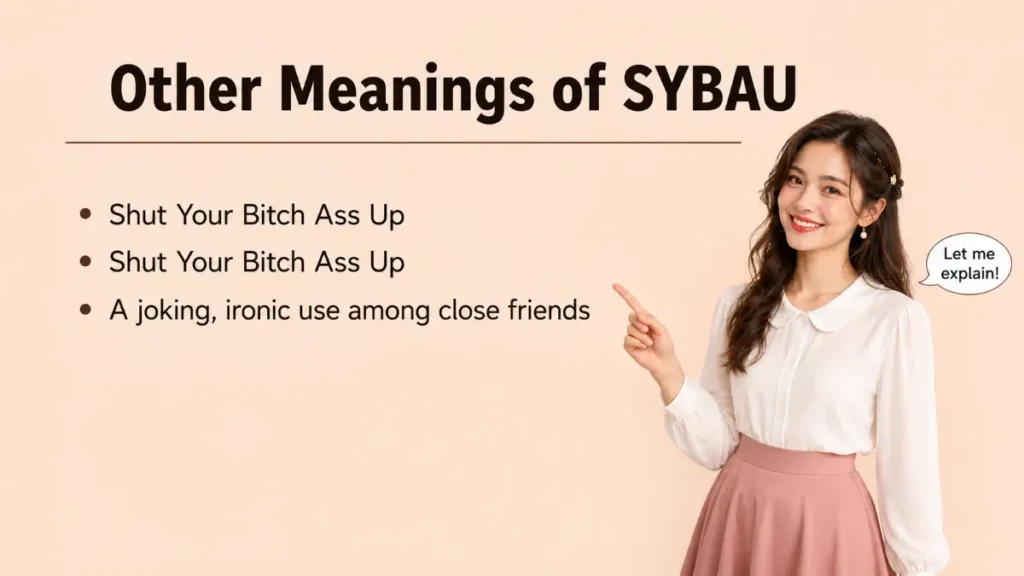
- Shut Your Bitch Ass Up- the original and harshest version, used in genuine arguments or heated online exchanges.
- Shut Your Bitch Ass Up– a softened variant people use when they want the acronym’s punch without the vulgar wording.
- A joking, ironic use among close friends- where the phrase carries almost no real hostility despite sounding harsh on paper.
Why Does SYBAU Have So Many Different Definitions
Short abbreviations behave like open containers, and different crowds pour their own tone into them depending on the relationship behind the message. Six letters can’t communicate intent on their own, so the reader has to lean on context, tone, and history with the sender to figure out how seriously to take it. That’s not confusion, that’s just how loaded slang survives once it spreads far beyond its original setting.
Close friend groups often reshape a harsh phrase into something almost affectionate through repeated joking use, the same way people turn insults into inside jokes over time. Strangers arguing online, though, tend to use SYBAU exactly as harshly as it reads on paper, since there’s no relationship softening the blow. Both crowds keep typing the same six letters without any shared agreement on tone, and the phrase ends up carrying wildly different weight depending on who sent it.
Does SYBAU Mean The Same Thing Outside The US
Mostly yes, since the phrase spread through English language internet spaces that cross borders easily. American slang influenced by hip hop culture shaped the original wording, but platforms like TikTok and Twitter carried SYBAU into UK, Australian, and Canadian online spaces without much translation needed. English speaking internet culture tends to share blunt insults like this quickly, regardless of country.
In non English speaking countries, the phrase usually stays in its original English form rather than getting translated, since local slang already has its own equally blunt ways of telling someone to be quiet. The concept behind SYBAU, a sharp verbal shutdown, exists in basically every language and culture. The specific six letters, though, remain tied closely to English speaking internet communities rather than becoming a universal acronym.
Who Uses It Most
SYBAU doesn’t spread evenly across every group of internet users. Some crowds throw it around constantly, others avoid it almost entirely.
| Group | How Often They Use SYBAU | Typical Reason |
|---|---|---|
| Gen Z texters | Very often | Sharp comebacks in arguments or jokes |
| Gamers | Often | Shutting down trash talk mid match |
| Content creators | Sometimes | Comment replies to hate or criticism |
| Professionals | Rarely | Far too vulgar for any formal setting |
Real Conversation Examples Using SYBAU
Here’s how this plays out with actual people typing, not just sitting flat in a definition.
Example one, sent as a reply in a heated comment thread after someone repeatedly criticizes a creator’s video. Message: this video was mid honestly, you’re losing your touch. Reply: sybau, nobody asked. This lands as a genuine shutdown aimed at ending unwanted criticism, so anyone jumping in should read the room and either back off or escalate knowingly.
Example two, ‘sent between two close friends joking around after one teases the other about a bad haircut’. Message: ‘bro what happened to your hair, did you do that yourself‘. Reply:‘ sybau lmao, it’s growing out‘. This one carries zero real hostility, wrapped entirely in humor between people who already trust each other, so the ideal follow up keeps the joke going rather than taking offense.
Usage of SYBAU in Different Contexts
Meaning stays fairly consistent, but tone shifts hard depending on who’s involved and what led up to the message. The same six letters can feel completely different depending on the relationship behind them.
In genuine online arguments between strangers, SYBAU usually lands as a real insult meant to end the exchange harshly. Sybau, you clearly don’t know what you’re talking about.
In friend group texts, it often shows up as playful teasing with zero actual anger behind it. Sybau, we all know you cried during that movie too.
How Gen Z Uses SYBAU Today
For younger internet users, SYBAU carries a strange duality that older generations sometimes miss entirely. It can be genuinely aggressive one moment and completely affectionate the next, sometimes within the same friend group depending purely on tone and timing. That flexibility is part of what makes it so widely used despite how harsh it reads on the surface.
It also functions as a kind of identity signal within comment culture. Typing SYBAU instead of a longer insult shows fluency in how fast paced online arguments and jokes actually move, not a formal or careful way of speaking. It’s shorthand that proves you’re plugged into the rhythm of platforms like TikTok, where quick cutting replies carry real social currency.
Does SYBAU Mean Shut Your Bag Already Up
This mix up occasionally shows up among people encountering the acronym cold, usually guessing at something totally unrelated since the real phrase feels too vulgar to assume at first glance. Shut Your Bag Already Up isn’t an established meaning tied to this term at all, just a confused guess from someone unfamiliar with the actual wording.
SYBAU as Shut Your Bitch Ass Up has nothing to do with bags or belongings in any context. The confusion mostly comes from people trying to soften or reinterpret an acronym that sounds harsher than they expect once they learn the real meaning. If SYBAU shows up during an argument or a joke among friends, it’s almost always the original blunt phrase, not some watered down alternative.
Meaning Across Social Media
Every platform shapes how harsh or playful SYBAU feels, and tone shifts depending on where it lands.
| Platform | SYBAU Meaning | How Its Used |
|---|---|---|
| TikTok comments | Shut your bitch ass up | Sharp replies in heated comment threads |
| Twitter or X | Shut your bitch ass up | Ending arguments during online debates |
| Discord | Shut your bitch ass up | Trash talk shutdowns during gaming sessions |
| Instagram comments | Shut your boring ass up | Playful teasing among friends |
| Shut your bitch ass up | Cutting replies in contentious threads | |
| Snapchat | Shut your boring ass up | Joking exchanges in private chats |
Common Confusions
Because SYBAU sounds unfamiliar to a lot of readers, mix ups and misreadings happen fairly often. A few patterns repeat constantly.
- Assuming SYBAU is always aggressive-when among close friends it frequently carries zero real hostility.
- Confusing SYBAU with STFU– since both demand silence but SYBAU tends to feel more personal and pointed.
- Missing the softened Shut Your Boring Ass Up variant– which changes the entire tone from vulgar insult to lighthearted teasing.
Related Slang Terms
- STFU– meaning Shut The actual word you already know Up.
- GTFO– meaning Get The actual word you already know Out.
- IDGAF– meaning I Don’t Give A actual word you already know.
- NGL– meaning Not Gonna Lie.
- SMH– meaning Shaking My Head.
How To Reply When Someone Says SYBAU
Scenario one, when SYBAU shows up during a genuinely heated argument with a stranger online. Decide quickly if the conversation is worth continuing at all, since escalating usually just invites more hostility, something like fine, done here often ends things faster than fighting back.
Scenario two, when SYBAU appears as a joke from a close friend during playful teasing. Match the same energy instead of taking it seriously, since the whole exchange is built on humor, something like never, I’m never letting this go keeps the joke alive naturally.
There’s a small human layer buried in this term too. Sometimes people reach for a harsh phrase like SYBAU specifically because they’re tired of being talked over or dismissed, and the bluntness is less about cruelty and more about finally setting a hard line. Not every sharp reply is really about anger, sometimes it’s just someone asking to be left alone.
When Did SYBAU Go Mainstream
SYBAU didn’t explode overnight, it built up slowly across two decades of online arguments and gaming chats before finally breaking into wider mainstream visibility. Early evidence traces back to the early 2000s, but the phrase stayed mostly contained to chat rooms and forums for years. TikTok’s rise pushed it into a genuinely viral spotlight, turning a once niche insult into something millions of users now recognize instantly.
Its mainstream arrival happened through platform amplification rather than a single dramatic moment. That pattern fits how a lot of older internet slang eventually breaks through, sitting quietly for years before a new platform gives it a much bigger stage. Once TikTok comment culture embraced it, SYBAU became common enough that most active internet users understand it without any explanation needed.
Conclusion
SYBAU means “Shut Your Bitch Ass Up” in nearly every context you’ll come across online. Tone still shifts everything, turning the same phrase from genuine hostility into harmless teasing among friends. It’s blunt, it’s vulgar, and it ends conversations fast by design. Once you understand the pattern, you’ll read the intent behind it correctly every time.
FAQs
What does SYBAU mean?
SYBAU stands for “Shut Your Bitch Ass Up.” It is a rude slang phrase used to tell someone to stop talking or be quiet.
What does SYBAU mean in chat?
In chat, SYBAU is used as a harsh way to silence someone. Depending on the context, it can be joking between friends or genuinely insulting.
What does SYBAU mean on Instagram?
On Instagram, SYBAU appears in comments, captions, and DMs as a rude expression. It is often used during arguments, jokes, or sarcastic exchanges.
What does SYBAU mean in UK slang?
SYBAU is internet slang rather than UK-specific slang. People in the UK may use it online, but its meaning remains the same.
What does SYBAU mean from a girl?
If a girl says SYBAU, she is usually telling someone to be quiet in a blunt or joking way. The tone depends on the relationship and conversation.
What does SYBAU mean on social media?
SYBAU stands for “Shut Your Bitch Ass Up.” It is a rude slang phrase commonly used on social media to tell someone to stop talking, often in jokes, arguments, or sarcastic posts.
Is SYBAU a Gen Z slang?
Yes. SYBAU is commonly recognized as Gen Z internet slang and is mostly seen on social media and in online chats.

Sophia Bennett writes educational content about English vocabulary, grammar, slang, and communication. She is passionate about making complex language topics accessible to students, professionals, and curious readers around the world.