WS Meaning in Text That Changes Who You Think Sent It
WS meaning in text is “Warm Smile” or “Wrong Spot”, but its meaning shifts considerably depending on the platform, relationship, and context it appears in. Two letters that seem simple until you realize how many worlds are using them simultaneously.
Context is everything here. The same WS in a sweet personal text and a technical gaming message are operating in completely different universes without either sender realizing the other exists.
Related Meaning: BTS Meaning In Text
Origin and Cultural Footprints
WS meaning in text doesn’t trace back to a single defining moment or community. It emerged across multiple spaces at roughly the same time, which is exactly why it carries so many different interpretations today. Early online chat culture used WS as a quick emotional signal when typing full words felt like too much effort for a simple warm moment.
Gaming communities adopted it separately for tactical communication, where quick two-letter signals during active gameplay could mean the difference between winning and losing a round. Both uses built their presence independently through the 2000s and into the social media era, living comfortably in separate spaces until platforms started merging audiences and the collision of meanings became something people actually had to navigate.
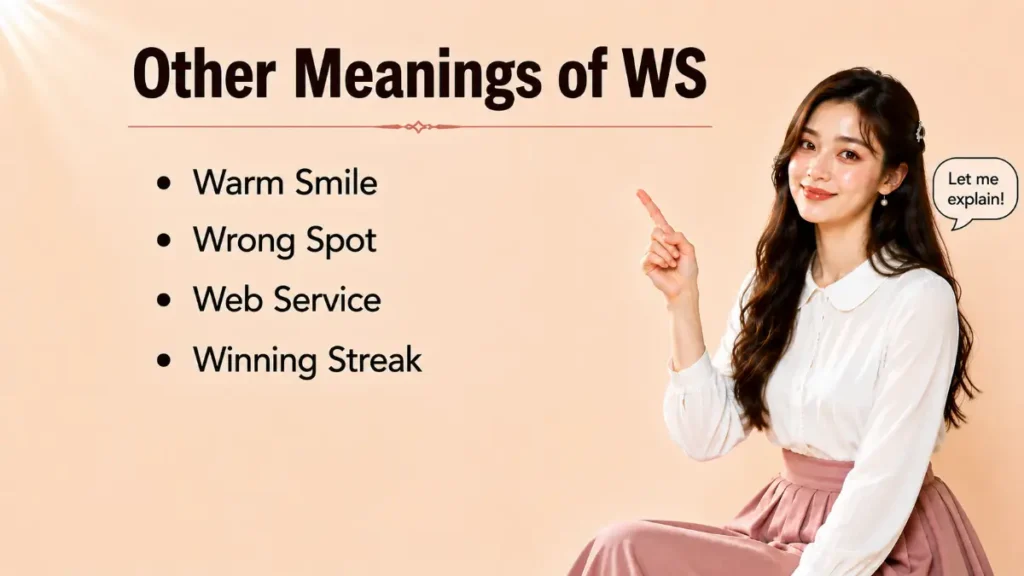
Other Meanings of WS
WS carries more alternate meanings than most two-letter acronyms manage to hold without causing constant confusion. Each one belongs to a specific world and rarely bleeds into the others.
- Warm Smile — used in personal, affectionate, or emotionally warm text exchanges as a gentle, low-key expression of friendliness and care
- Wrong Spot — used in gaming, navigation, and practical contexts when someone or something is in the incorrect location or position
In professional and technical spaces, WS takes on additional meanings entirely.
- Web Service — a technical term used by developers and IT professionals referencing software systems that communicate over the internet
- Winning Streak — used in gaming, sports fan communities, and competitive contexts to reference a consecutive run of victories
Why Does WS Have So Many Different Definitions?
Two letters cover almost no semantic ground on their own. They’re essentially empty containers that communities fill with whatever meaning they need most urgently. W and S individually begin dozens of common English words, which means any combination of the two attracts competing definitions from communities working with completely different vocabularies.
The personal affection meaning and the gaming tactical meaning developed without any awareness of each other because the people using them weren’t on the same platforms or in the same conversations. When those platforms eventually merged into spaces like Discord and Twitter where gamers, friends, and professionals all coexist, WS suddenly needed context to do its job. That’s not a problem with the acronym. That’s just what happens when language scales faster than coordination.
Does WS Mean the Same Thing Outside the US?
In the UK and Australia, WS as “Warm Smile” carries the same gentle affectionate meaning in personal texting. The emotional register of a warm, understated expression of care translates perfectly across English-speaking cultures because the feeling itself needs no cultural translation.
Gaming meanings like Wrong Spot and Winning Streak are genuinely international because competitive gaming culture operates in a shared global vocabulary regardless of geography. A player in South Korea and a player in Brazil both understand tactical shorthand in the same games the same way. Web Service as a technical meaning is equally global since software development is an internationally standardized field. Outside English-speaking countries, WS in personal texting is understood by anyone embedded in English-language digital communication, which covers an enormous and still-growing international audience.
Who Uses It Most?
WS has a wide and fragmented user base because its different meanings serve communities that rarely share conversations.
| Group | How They Use WS |
|---|---|
| Personal Texters | Warm Smile in affectionate or gentle exchanges |
| Competitive Gamers | Wrong Spot or Winning Streak in gameplay communication |
| Developers and IT Professionals | Web Service in technical discussions |
| Sports and Gaming Fan Communities | Winning Streak references in performance discussions |
None of these groups overlap significantly in their WS usage, which is exactly why the acronym manages to carry multiple meanings without causing constant real-world confusion. The communities using it stay in their own lanes most of the time.
Real Conversation Examples Using WS
Example 1: In a personal affectionate text exchange
Context: Two friends who haven’t seen each other in months are texting late at night, catching up on life, and one of them wants to close the conversation with something warm without making it heavy.
“This conversation genuinely made my whole week. Sending you a WS across the miles. Sleep well.”
How to reply: “Same right back at you. WS and all the good energy I have. Talk soon.”
Example 2: In a competitive gaming session
Context: A team is playing an online multiplayer game and one player is covering the wrong area of the map, leaving a critical position exposed during a key moment in the match.
“WS bro you need to be at B not A right now, rotate immediately before they push.”
How to reply: “Rotating now, my bad. Covering B. Call the push when you’re ready.”
Usage of WS in Different Contexts
WS shifts emotional register completely depending on the world it’s operating in. In a warm personal conversation it carries gentleness and care. In a competitive gaming context it carries urgency and tactical precision. The same two letters, completely different heartbeats behind them.
Example: “You’ve been so kind to me through all of this and I just want to say WS, genuinely, from somewhere deep” — here it functions as a tender, understated expression of gratitude and warmth, the kind that doesn’t need to be loud to land with real weight on the person receiving it.
In a performance context the same acronym celebrates something entirely different. “Fourteen game WS and the season isn’t even halfway done, this team is genuinely something special this year.” Same two letters, zero personal warmth, pure competitive pride. The word is a vessel and the conversation fills it with whatever it needs.
How Gen Z Uses WS Today
Gen Z uses WS less frequently than older acronyms in personal texting, partly because they tend to use emojis for warm low-key expressions rather than letter-based shorthand. A warm smile in Gen Z communication is more likely to be a specific emoji combination than a two-letter acronym. That doesn’t mean they don’t use WS, it just means they reach for it in specific contexts rather than as a default.
In gaming spaces, Gen Z gamers use WS with complete fluency as part of the tactical shorthand vocabulary that experienced players treat as second nature. They also use Winning Streak references in gaming and sports contexts freely, often pairing it with other performance vocabulary in ways that reflect how deeply embedded competitive culture is in how they communicate about success and momentum.
Does WS Mean “Whatever Suits”?
No. That interpretation appears occasionally on slang aggregator sites that generate meanings algorithmically without checking real usage patterns. Nobody abbreviates “whatever suits” into two letters in regular conversation because the phrase itself doesn’t appear frequently enough in natural speech to generate reliable shorthand.
The confusion happens when people encounter WS in a context that feels casual or accommodating and reach for a meaning that matches that flexibility. But real usage patterns don’t support “whatever suits” as a genuine WS meaning in any consistent community. If you encounter WS in a personal text, it’s almost certainly Warm Smile. In a gaming context, Wrong Spot or Winning Streak. Neither of those is “whatever suits” and the surrounding message will make the right interpretation clear within a single reading.
WS Meaning Across Social Media
| Platform | WS Meaning | How It’s Used |
|---|---|---|
| Twitter / X | Warm Smile or Winning Streak | Personal warm exchanges and sports performance discussions |
| Discord | Wrong Spot or Winning Streak | Gaming server tactical communication and competitive threads |
| Warm Smile | Personal DMs and affectionate story replies | |
| Web Service or Winning Streak | Tech subreddits and gaming or sports performance threads | |
| Snapchat | Warm Smile | Personal snaps in close affectionate relationships |
| TikTok | Warm Smile or Winning Streak | Comments on emotional content and sports highlight videos |
Common Confusions
WS meaning in text creates confusion most reliably when people move between personal and gaming contexts without realizing the interpretation needs to shift entirely.
- WS as Warm Smile vs Wrong Spot — an affectionate personal text and a gaming tactical message using the same two letters in completely different emotional universes; relationship and platform context separates them immediately
- WS as Winning Streak vs Web Service — both legitimate meanings but living in entirely separate professional worlds; a sports fan and a developer are not having the same conversation
- WS as Warm Smile vs a typo — WS is close enough to other two-letter combinations that people sometimes wonder if it was a mistyped word; context always clarifies
- WS platform mismatch — using the gaming meaning in a personal text or the affectionate meaning in a gaming server creates genuine confusion because neither community expects the other’s vocabulary
Reading who sent it and what platform the conversation is on resolves every WS confusion before it becomes a real problem.
Related Slang Terms
- GG — Good Game, the standard gaming sportsmanship sign-off
- GL — Good Luck, said before a competitive match or challenge
- WP — Well Played, acknowledging strong performance from anyone in a game
- IRL — In Real Life, distinguishing physical reality from digital spaces
- HMU — Hit Me Up, casual invitation to reach out
- LMK — Let Me Know, waiting for input or a decision
- TBH — To Be Honest, signals a candid personal statement coming
- NGL — Not Gonna Lie, honest observation without deflection
How to Reply When Someone Says WS
If someone sends you WS in a personal warm context, match that gentleness without overthinking the response. “WS right back, genuinely” or “that means more than you know, thank you” lands with exactly the right warmth and keeps the emotional tone of the conversation exactly where both people want it.
If WS arrives in a gaming or competitive context pointing out a tactical error, don’t take it personally and don’t linger on it. A clean “rotating now” or “my bad, adjusting” keeps the team moving forward without letting a two-letter correction turn into a longer distraction than the situation actually warrants. WS in gaming is about fixing something fast, and the best reply is the one that demonstrates you’re already doing that.
The WS That Arrived on the Hardest Day
A woman going through chemotherapy received a text from an old college friend she hadn’t spoken to in almost three years. No long message. No attempt to explain the absence or fill in the gap of lost time. Just: “Thinking of you. WS.”
She stared at it for a long time. She didn’t know what WS meant at first and had to look it up. When she found it she started crying. Not because of the warmth of the meaning, though that was part of it. Because someone who had been out of her life for years had reached across that distance with something so quiet and so specific that it felt more like presence than any long message would have.
She replied two days later. They’ve been talking regularly ever since. Sometimes the smallest thing carries the most weight, and two letters sent at the right moment can rebuild something that years of silence almost buried completely.
When Did WS Go Mainstream?
WS as a personal text expression never achieved the viral mainstream saturation of acronyms like OMG or LOL. It built its presence quietly through personal exchanges between people who found it useful for expressing warmth without drama, and it stayed in that intimate space rather than expanding into public social media culture in any significant way.
The gaming meanings built mainstream recognition through the rise of competitive online gaming in the 2010s, when tactical shorthand became a standardized part of how serious players communicated during matches. Winning Streak as WS found additional traction through sports fan communities on Twitter and Reddit where performance tracking vocabulary became its own genre of content. Both gaming meanings are stable and well-established today in their respective communities.
Conclusion
WS meaning in text covers more emotional and practical ground than two letters have any right to manage. It means Warm Smile when someone wants to express gentle care, Wrong Spot when a gamer needs a fast correction, and Winning Streak when someone is celebrating momentum. Now you know exactly which one is which and how to respond to all of them.
Read the room first. The right WS is always right there in the conversation around it.
FAQs
What Does WS Mean in Text?
WS meaning in text can mean “Warm Smile” or “Wrong Spot,” depending on the context.
What Does WS Mean in UK Slang?
In UK slang, WS can have different meanings, so the intended meaning depends on the conversation.
What Does WS Mean on Social Media?
On social media, WS may mean “Warm Smile” in personal posts or messages, but context determines the meaning.
What Does WS Mean in Chat?
In chat, WS can mean “Warm Smile” when talking personally or “Wrong Spot” when discussing gaming.
What Does WS Mean on Instagram?
On Instagram, WS can mean “Warm Smile” in casual conversations, though other meanings are possible.
What Does WS Stand For?
WS can stand for “Warm Smile” or “Wrong Spot.” The surrounding conversation usually makes the meaning clear.
What Does WS Mean in a Text Message?
WS can mean “Warm Smile” or “Wrong Spot” in text messages, depending on the context.
The intended meaning usually becomes clear from the conversation or situation.

Sophia Bennett writes educational content about English vocabulary, grammar, slang, and communication. She is passionate about making complex language topics accessible to students, professionals, and curious readers around the world.