STSU Meaning in Text That Hits Harder Than You Expect
STSU stands for “Shut The S* Up,” and people use it when patience has run out and the message needs to land without any softening around it.** It’s blunt by design. That’s the whole point.
Between close friends it reads as comedic exasperation. In a heated exchange it lands exactly as sharp as it sounds. The relationship decides everything.
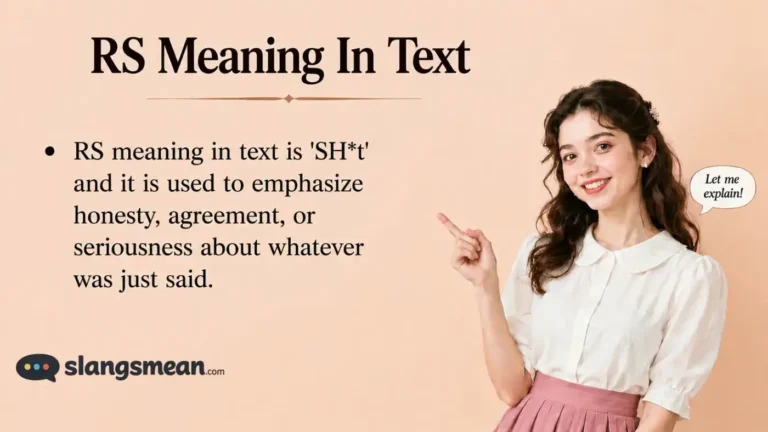
Related Meaning: RS Meaning In Text
Origin and Cultural Footprints
STSU meaning in text grew from the same culture that gave us STFU, WTF, and a whole alphabet of compressed frustration. People needed something faster than a full sentence when emotions were running high. Four letters did the job perfectly.
It carved out its own space alongside STFU rather than replacing it. Some people encountered STSU first and stuck with it. Others preferred the variation for reasons they couldn’t fully explain. Either way, the emotional weight behind both is identical.
Other Meanings of STSU
STSU stays remarkably close to its primary meaning compared to most acronyms. But a couple of alternate interpretations are worth knowing.
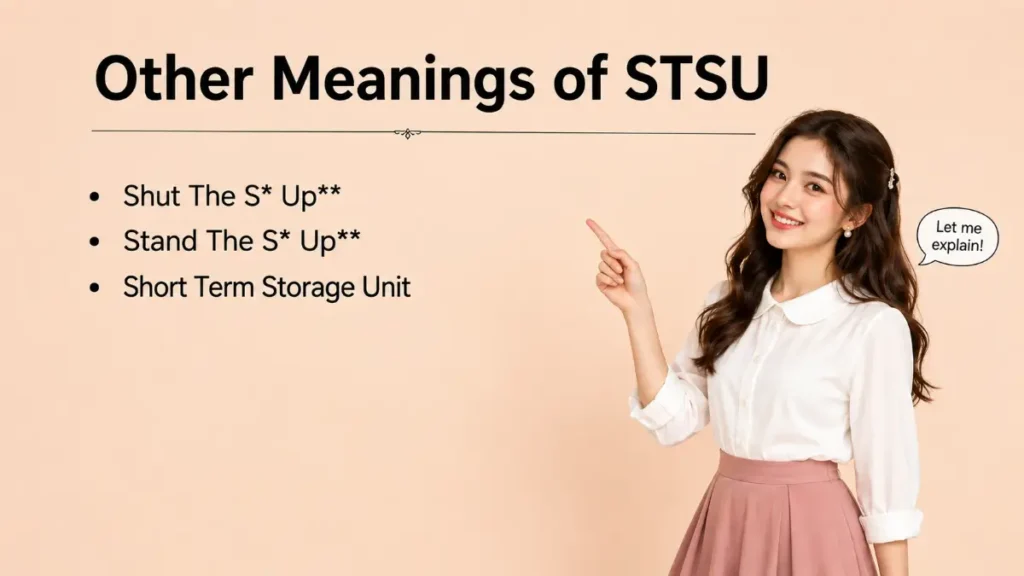
- Shut The S* Up** — the dominant meaning, used across virtually every platform and community that uses it at all
- Stand The S* Up** — a less common variation used in motivational or confrontational moments, telling someone to stop being passive and take a position
In some logistics and supply chain contexts, STSU appears as something entirely different.
- Short Term Storage Unit — a warehouse and inventory abbreviation, completely unrelated to texting slang and unlikely to cause confusion in any personal conversation
Why Does STSU Have So Many Different Definitions?
Profanity-laced acronyms attract alternate interpretations more than clean ones do. People in different communities reframe them to fit audiences where the original meaning feels too aggressive or too crude. That reframing creates parallel definitions without anyone coordinating it.
The logistics meaning developed completely independently. Four-letter combinations are limited, and warehouse terminology gets assigned without any awareness of existing slang. A supply chain manager using STSU on an inventory spreadsheet and a teenager firing it off in a group chat have nothing in common except the letters themselves.
Does STSU Mean the Same Thing Outside the US?
In the UK, Australia, and Canada, STSU carries exactly the same emotional force as it does in the US. Strong feelings compressed into capital letters don’t require cultural translation. Frustration sounds the same in every English dialect.
Outside English-speaking countries, STSU is recognized by anyone fluent in English-language internet slang. That covers a large international audience, particularly people embedded in American gaming, social media, and music culture. The profanity behind the letters is universally understood even by non-native speakers who’ve spent significant time in English digital spaces.
Who Uses It Most?
STSU has a specific kind of user. It belongs to people who communicate with directness and have relationships that can absorb that directness without collateral damage.
| Group | How They Use STSU |
|---|---|
| Close Friend Groups | Comedic disbelief reactions in private chats |
| Competitive Gamers | Frustration at teammates or opponents mid-match |
| Gen Z on Social Media | Exasperated reactions to repetitive or annoying content |
| Older Millennials | Direct venting when something has genuinely pushed too far |
The people who reach for STSU most naturally are the ones whose closest relationships are built on mutual directness. Four letters of exasperation land as honest communication rather than an attack when both sides understand each other well enough.
Real Conversation Examples Using STSU
Example 1: Between close friends after the same story for the third time
Context: A friend has been venting about the same situation for three weeks straight, and the person listening finally responds with affectionate exasperation rather than another round of careful empathy.
“Okay I love you but STSU about him for five minutes and then we’re making an actual plan. Deal?”
How to reply: “FAIR. Five minutes. Maybe ten. Then plan. I hear myself, I promise.”
Example 2: In a competitive gaming session
Context: A teammate keeps arguing about strategy instead of executing it, costing the team valuable time during a live match.
“STSU and rotate to B like we said. Stop arguing and just play.”
How to reply: “Rotating. My bad. Ready when you are.”
Usage of STSU in Different Contexts
STSU moves between genuine frustration and comedic exaggeration depending on the relationship and the conversation surrounding it. Reading which one is operating makes the difference between understanding the message and completely misreading it.
Example: “If one more person gives me unsolicited advice today I’m going to STSU myself before I say something I actually regret” — here it’s self-directed, used as pressure-release humor about a situation that has hit its limit without targeting anyone specific.
In a more outward moment it does different work entirely. “STSU with the excuses, we both know what happened, so let’s just talk about it directly.” Same acronym, higher stakes, intentional directness. The person using it has decided to cut through whatever is obscuring the real conversation.
How Gen Z Uses STSU Today
Gen Z deploys STSU strategically rather than reflexively. They understand that profanity-laden acronyms carry weight and they use that weight deliberately, either for comedic effect or for genuine emotional release.
There’s also an ironic layer worth noting. Sending STSU about something genuinely exciting, like a show renewal or unexpected good news, uses the aggressive energy of the acronym to express overwhelming positive emotion that normal words struggle to contain. Anyone in their social circle reads this inversion instantly and correctly.
Does STSU Mean “See The Situation Unfold”?
No. That interpretation appears on some auto-generated slang sites but has no real presence in actual conversation. Nobody abbreviates a passive, observational phrase into four aggressive capital letters.
The confusion happens when people encounter STSU in a context that feels watchful or calm and reach for a meaning that fits that energy. But STSU in any real exchange is almost always an expression of exasperation, never a quiet observation about watching something develop. The surrounding message makes this obvious before the sentence even finishes.
STSU Meaning Across Social Media
| Platform | STSU Meaning | How It’s Used |
|---|---|---|
| Twitter / X | Shut The S*** Up | Exasperated replies to repeated takes or annoying threads |
| Discord | Shut The S*** Up | Gaming frustration and friend group comedic reactions |
| Snapchat | Shut The S*** Up | Private snap reactions to something unbelievable |
| TikTok | Shut The S*** Up | Comment reactions to shocking or repetitive content |
| Shut The S*** Up | DM reactions in close friendships during heated or funny moments | |
| Shut The S*** Up | Comment threads where someone keeps making the same wrong point |
Common Confusions
STSU meaning in text creates confusion most often when people mix it up with STFU or when the emotional register isn’t clear enough to read correctly.
- STSU vs STFU — both mean the same thing but STFU is far more widely recognized; STSU sometimes surprises people who were expecting the more established version
- STSU as aggressive vs comedic — identical letters can signal genuine anger or affectionate exasperation; the relationship and surrounding context tell you which one it is
- STSU directed at a person vs a situation — sometimes it’s aimed at someone specific; other times it’s directed at a situation or even the sender themselves; context clarifies immediately
- STSU vs STS — removing the U changes both the acronym and the meaning entirely; a different word, a different message
Reading the full conversation before reacting to STSU is always the smarter move than responding to the letters alone.
Related Slang Terms
- STFU — Shut The F*** Up, the more widely recognized version of the same sentiment
- WTF — What The F***, used for shock or genuine confusion
- SMH — Shaking My Head, mild disbelief or disappointment
- NGL — Not Gonna Lie, honest statement incoming
- ISTG — I Swear To God, used for emphasis or frustration
- IDC — I Don’t Care, signals indifference or emotional withdrawal
- BYE — used dramatically as a sign-off when something is simply too much
- SYFM — Shut Your F***ing Mouth, a close relative in the blunt expression family
How to Reply When Someone Says STSU
If the tone is clearly comedic or affectionate, lean into it without hesitation. “Okay FINE I’ll stop” or “you’re right, I’ve said it seventeen times, I know” keeps the moment light and shows you understand the dynamic well enough to receive directness without flinching.
If STSU arrives with real frustration behind it, don’t match the heat immediately. A simple “okay, I hear you” gives the conversation room to settle before it escalates into something neither person actually wants. Directness is valuable. Unnecessary escalation almost never is.
The STSU That Saved a Friendship
Two best friends had been running the same circular argument for three hours over text. Going nowhere. Getting more frustrated. Neither willing to drop it. Finally one of them sent: STSU. Then immediately after: both of us. We’re going in circles and it’s 2am.
The other person stared at the screen for a full minute. Then replied: “You’re right. Same time tomorrow when we’re not exhausted?” They both laughed. The argument got resolved in twenty minutes the next afternoon with fresh eyes and nobody’s dignity on the line.
Sometimes the bluntest thing is also the kindest thing. Four letters stopped a conversation that was hurting both people from going any further down the wrong road.
When Did STSU Go Mainstream?
STSU never achieved the mainstream saturation of STFU, which had a significant head start and a much longer runway to build cultural recognition. It exists alongside its more famous cousin, used by people who either encountered it first or simply prefer the variation without being able to explain exactly why.
Its steadiest presence has been in gaming communities and close friend group chats throughout the 2010s and into the 2020s. Direct emotional communication is the norm in both spaces, and the difference between STFU and STSU matters far less than the feeling both of them express. Not a trending acronym. A reliable one.
Conclusion
STSU is four letters carrying a very specific kind of exhausted directness that lands hard when it’s serious and lands funny when it isn’t. It means Shut The S*** Up and it says so clearly every single time.
Read the relationship first. The tone is always in the context around it, never just in the letters themselves.
FAQs
What Does STSU Mean in Text?
STSU means “Shut The S Up.”* It’s a rude abbreviation used online to tell someone to stop talking.
What Does STSU Mean in UK Slang?
In UK slang, STSU can mean “Shut The S Up.”* The meaning depends on the conversation and context.
What Does STSU Mean on Social Media?
On social media, STSU is used as a blunt way to tell someone to stop talking or posting.
What Does STSU Mean in Chat?
In chat, STSU means “Shut The S Up.”* It can sound aggressive, insulting, or joking depending on who uses it.
What Does STSU Mean on Instagram?
On Instagram, STSU can mean “Shut The S Up.”* People may use it in comments, DMs, or replies.
What Does STSU Stand For?
STSU stands for “Shut The S Up.”* It’s an informal and offensive texting abbreviation.
What Does STSU Mean on TikTok?
On TikTok, STSU can be used to tell someone to stop talking, often as a blunt reaction or joke.
What Is SFTU?
SFTU is commonly used as another variation meaning “Shut the f* up.”** It’s vulgar and can sound harsh.
What Is the Full Form of SFTU?
SFTU stands for “Shut the f* up.”** It’s an offensive slang expression telling someone to be quiet.
What Does STTU Mean in Text?
STTU doesn’t have one widely accepted texting meaning. Its interpretation can vary, so the surrounding conversation matters.

Sophia Bennett writes educational content about English vocabulary, grammar, slang, and communication. She is passionate about making complex language topics accessible to students, professionals, and curious readers around the world.