WRYD Meaning In Text: The Question That Wants Your Attention
WRYD meaning in text “What Are You Doing,” a casual check-in question people use to start a conversation, gauge someone’s availability, or simply reach out to someone they want to connect with in that moment. Four letters that open a door without specifying what’s on the other side of it.
It’s one of the most common conversation starters in personal texting. Low pressure, open-ended, and genuinely curious about the other person’s current moment.
Related Meaning: PPM Meaning In Text
Origin and Cultural Footprints
WRYD meaning in text grew from the same family as WYD, which stands for “What You Doing,” and both emerged from the natural compression of casual check-in language that developed as texting became the primary mode of maintaining daily social connection. The slight variation in spelling reflects different phonetic approaches to the same underlying question.
It spread through personal texting and social media DMs as people discovered that a simple availability check could double as an opening for deeper conversation. The four-letter version felt slightly more complete than WYD while still being fast enough to send without friction, which is exactly the balance that keeps these casual openers in active circulation.
Other Meanings of WRYD
WRYD stays close to its primary check-in meaning. The question format it abbreviates is specific enough that alternate readings don’t develop significant traction.
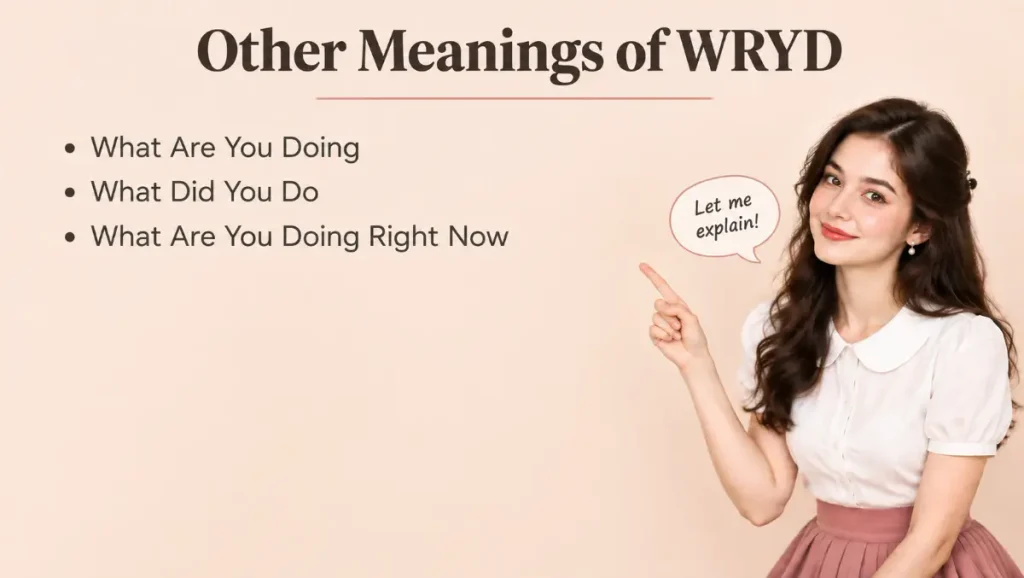
- What Are You Doing — the dominant meaning in personal texting, used as a casual availability check and conversation opener
- What Did You Do — a slight past-tense variation that appears when someone is following up on something the other person mentioned earlier, asking for an update rather than a current status
In some regional text communities, WRYD occasionally functions as a third variation.
- What Are You Doing Right Now — the more time-specific version that emphasizes the immediacy of the question, sometimes used when the sender has a specific plan or invitation in mind
Why Does WRYD Have So Many Different Definitions?
Four-letter check-in abbreviations accumulate slight variations because the underlying question, what are you doing, can point at the present moment, the recent past, or an immediate time window depending on conversational context. WRYD sits at this intersection because the question it abbreviates is flexible enough to carry all three temporal dimensions without changing the letters.
The different readings don’t conflict significantly because they’re all variations of the same basic inquiry. Whether someone is asking what you’re doing right now, what you’ve been doing recently, or what you did earlier, the underlying social function is the same: genuine interest in the other person’s current life and an opening for connection.
Does WRYD Mean the Same Thing Outside the US?
In the UK, Australia, and Canada, WRYD as a casual check-in carries the same friendly opening function as in the US. The underlying question is standard English across all English-speaking cultures, and the social dynamic of texting someone to see what they’re up to exists identically regardless of geography.
Outside English-speaking countries, WRYD reaches anyone embedded in American digital communication culture through social media platforms where these conversational conventions travel through content exposure. The abbreviation itself may be unfamiliar but the social function it performs is globally recognizable.
Who Uses It Most?
WRYD shows up most naturally in relationships where daily casual contact is already established and the check-in is a normal part of how two people maintain connection.
| Group | How They Use WRYD |
|---|---|
| Close Friends in Daily Contact | Casual opening to start a conversation or check availability |
| Romantic Partners in Early Stages | Low-pressure reach-out that keeps communication flowing |
| Friend Groups Planning Casually | Checking availability before proposing something specific |
| Young Adults in Personal Texting | Standard daily check-in in active close relationships |
The people who send WRYD most naturally are those whose relationships already have a rhythm of regular casual contact where the question feels completely natural rather than intrusive.
Real Conversation Examples Using WRYD
Example 1: A casual daily opener between close friends
Context: Two friends text each other most days and one of them reaches out in the afternoon with the standard opening that usually starts their daily catch-up.
“WRYD tonight? I finished early and have no plans which is either a blessing or a disaster depending on how you look at it.”
How to reply: “Nothing yet. If you figure out what to do with a free evening let me know and I’ll either join you or at least have an opinion about it.”
Example 2: A reach-out with something specific behind it
Context: Someone texts a friend with WRYD because they have a specific plan in mind but want to check availability before proposing it rather than leading with the invitation and getting a no before they’ve built any conversational momentum.
“WRYD this afternoon? Asking for a reason but I’ll tell you the reason after you tell me if you’re free.”
How to reply: “That’s suspicious and I’m immediately interested. I’m free after 3. What’s the reason.”
Usage of WRYD in Different Contexts
WRYD works as both a pure check-in and as a setup for something more specific. The difference is usually clear from what follows the initial message or from the relationship context that surrounds it.
Example: “WRYD, I’m in your neighborhood and have an hour to kill if you want company or if you want me to bring you something” — here WRYD is the opener but the actual offer is in the same message, which signals that the sender already had something specific in mind and the check-in was more courtesy than genuine uncertainty.
In a more purely conversational context the same letters do simpler social work. “WRYD, haven’t talked in a few days and wanted to check in.” No agenda beyond the check-in itself, and the honesty of naming that directly is its own form of genuine connection.
How Gen Z Uses WRYD Today
Gen Z uses WRYD with a specific casual ease that reflects how normalized daily digital check-ins have become in their relationship maintenance. For them, sending WRYD isn’t a significant gesture. It’s just how you keep a friendship active when you can’t be physically present with someone every day.
There’s also a timing dimension that Gen Z reads automatically. A WRYD sent at 2pm carries different implicit meaning than one sent at 10pm. The afternoon version is usually genuinely curious about daily activity. The late evening version is more likely fishing for company, conversation, or plans. That temporal subtext is understood without anyone having to explain it.
Does WRYD Mean “Why Are You Doing That”?
No. That reading occasionally surfaces when WRYD appears in a context that feels interrogative or challenging and someone reaches for a meaning that fits that tone. It has no real community behind it as a standard text expression.
The confusion sometimes happens because the letters could technically abbreviate that phrase. But in any real personal conversation, WRYD almost always asks what someone is currently doing rather than questioning their behavior or choices. The surrounding tone and the relationship context make the check-in meaning clear before any alternative reading takes hold.
WRYD Meaning Across Social Media
| Platform | WRYD Meaning | How It’s Used |
|---|---|---|
| iMessage | What Are You Doing | Personal daily check-in between close contacts |
| Snapchat | What Are You Doing | Casual reach-out and availability check |
| What Are You Doing | DM conversation opener between close followers | |
| Twitter / X | What Are You Doing | Casual public check-in or conversation starter |
| Discord | What Are You Doing | Friend server check-in and activity coordination |
| What Are You Doing | Personal and group chat availability checking |
Common Confusions
WRYD meaning in text creates confusion most often around which temporal dimension of the question is being asked and occasionally around tone.
- WRYD as present vs past tense — most commonly asks about current activity, but context sometimes points at recent past; the surrounding conversation tells you which one arrived
- WRYD as neutral check-in vs loaded question — usually casual and friendly; occasionally signals that something specific is coming; the relationship and timing tell you which register is operating
- WRYD vs WYD — functionally identical; the extra letters in WRYD don’t change the meaning; personal preference determines which version someone uses
- WRYD as a genuine question vs a conversation opener — sometimes the sender genuinely wants to know what you’re doing; other times it’s just a way to start talking; both are valid uses and the difference usually reveals itself in the follow-up message
Reading the full message and the relationship context resolves every WRYD ambiguity before it creates a real misunderstanding.
Related Slang Terms
- WYD — What You Doing, the shorter version of the exact same check-in question
- WYO — What You On, similar availability and activity check in the same register
- HYW — How You Doing, the emotional check-in version of the same reaching-out impulse
- NTM — Not Too Much, one of the most common replies to a WRYD question
- HMU — Hit Me Up, an invitation that sometimes follows a WRYD exchange
- LMK — Let Me Know, used to keep a door open after a WRYD conversation
- GTC — Got To Go, sometimes the reply that closes a WRYD conversation unexpectedly
- BRB — Be Right Back, temporary departure signal that sometimes interrupts a WRYD exchange
How to Reply When Someone Says WRYD
If WRYD arrives as a genuine casual check-in, the most natural reply is an honest answer about what you’re actually doing, even if that thing is nothing in particular. “Nothing really, just at home” or “finishing up some work but almost done” gives the other person something to respond to and keeps the conversation moving. The question is an opening, and the reply that serves it best is one that actually opens a door rather than closing it with a one-word answer.
If WRYD arrives at an unusual time or with the feeling that something specific is behind it, it’s completely valid to ask directly. “WRYD or do you want to do something?” or “asking because you have something in mind or just checking in?” invites the sender to say what they actually want, which moves the conversation to what matters faster than dancing around it through several rounds of casual exchange.
The WRYD That Arrived at Exactly the Right Time
A woman had been having one of those weeks where nothing was dramatically wrong but the weight of everything felt heavier than it should. She’d been keeping it together, answering messages normally, showing up to obligations. Nobody knew because she hadn’t said anything and nobody had asked the right question at the right moment.
Then on a Thursday afternoon her closest friend sent four letters. WRYD.
She almost typed the usual answer. Almost. Instead she typed: “Honestly? Not great. Got a minute?”
Her friend called immediately. They talked for two hours. Nothing got solved because nothing was broken in a way that solving could fix. But the weight shifted in the specific way that only happens when someone who knows you asks the right question at the right moment and you finally stop performing fine.
Four letters. One phone call. Sometimes that’s exactly what someone needed without either of you knowing it before the question arrived.
When Did WRYD Go Mainstream?
WRYD built its mainstream presence alongside WYD and similar check-in abbreviations through the early smartphone era as texting became the primary way people maintained daily social relationships. The question “what are you doing” was already one of the most common conversational openers in spoken communication, and its text abbreviation followed naturally as people compressed their daily exchanges into the shorthand that digital communication rewarded.
Social media reinforced its presence by creating contexts where casual check-ins happened publicly and privately across multiple platforms simultaneously. By the mid-2010s, WRYD and its variants were established vocabulary across all demographics that texted regularly, and they remain consistent and universally understood across every platform where personal digital communication happens.
Conclusion
WRYD meaning in text is about the simple, genuine impulse to reach out and know what someone you care about is doing in this particular moment of their day. It means What Are You Doing, and it opens conversations that sometimes stay casual and sometimes go somewhere much more meaningful. Now you know exactly what it means and how to respond when it arrives.
Four letters. One genuine reach. Always worth answering honestly.
FAQs
What does WRYD mean in text?
WRYD means What Are You Doing. It is a casual way to ask someone what they are doing.
What does WRDD mean in text?
WRDD does not have one widely accepted meaning in texting. Its meaning depends on the context.
What does WJD mean in text?
WJD can have different meanings depending on context. There is no single universal texting definition.
What does WRYD mean on Snap?
On Snapchat, WRYD usually means What Are You Doing. It is a casual way to start or continue a conversation.
What does WRYF mean in text?
WRYF can have different meanings depending on context. It is not as standardized as common abbreviations like WRYD or WYD.
What does WRYD mean?
WRYD means What Are You Doing. It is commonly used in casual texts and chats.
What does WYF mean in Gen Z?
WYF commonly means Where You From in Gen Z texting and social media conversations. It is usually asking about someone’s location or hometown.
What does WYFF stand for?
WYFF can have different meanings depending on context. In casual texting, it may be a variation of WYF, but it does not have one universal meaning.
How do Gen Zs say OK?
Gen Z may use casual forms like OK, okay, kk, k, bet, or a simple emoji. The choice depends on the conversation and tone.
What does WYD mean dirty?
WYD simply means What You Doing. It is not inherently dirty, although the surrounding conversation can give any message a different tone.

Sophia Bennett writes educational content about English vocabulary, grammar, slang, and communication. She is passionate about making complex language topics accessible to students, professionals, and curious readers around the world.