IMK Meaning In Text: Origin, Examples and Usage 2026
IMK meaning in text ‘In My Knowledge’ used when someone shares information they believe is true without claiming complete certainty. People drop it right before stating something, signaling that what follows comes from personal awareness rather than confirmed fact.
You will see IMK most when someone answers a question with a reasonable guess based on what they currently know. It works like a built in disclaimer, letting the sender share useful information while leaving room to be wrong.
Origin and Cultural Footprints
IMK grew out of early 2000s internet chatroom and forum culture, emerging alongside similar phrases like IMO and AFAIK as users looked for quick ways to soften statements without sounding overly confident. Typing full sentences felt slow back then, so shortening common qualifying phrases became second nature across early messaging platforms.
The abbreviation followed the same pattern as other uncertainty softening shorthand throughout the 2000s and 2010s, spreading gradually rather than through any single viral moment. Social media platforms eventually carried IMK forward into everyday digital conversation, where it settled comfortably alongside its slightly more formal cousin AFAIK.
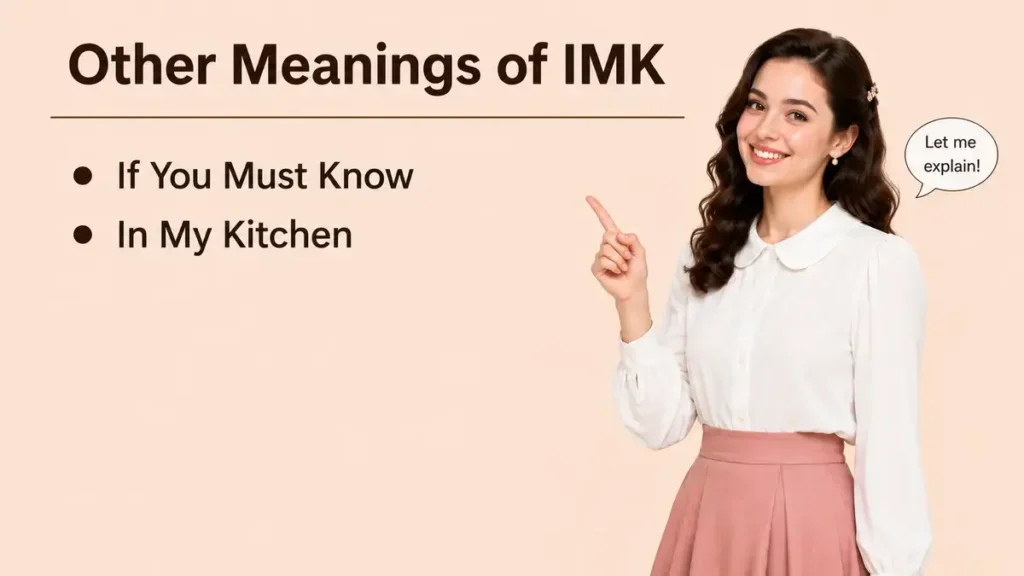
Other Meanings of IMK
A couple of additional readings circulate for IMK, though none come close to matching the dominant In My Knowledge meaning in actual documented usage.
- If You Must Know — A claim describing reluctant or slightly sarcastic disclosure, though this usage shows up far less consistently across reliable sources compared to the knowledge based reading.
- In My Kitchen — A playful variation occasionally used in food blogging and cooking related social media captions, completely unrelated to sharing factual uncertainty.
Why Does IMK Have So Many Different Definitions?
In My Knowledge dominates by a wide margin, confirmed consistently across the majority of slang reference sources including dated examples and genuine usage history stretching back years. That level of agreement gives it real credibility compared to less consistently documented alternatives.
The If You Must Know reading shows up in fewer sources and carries a noticeably different tone, leaning sarcastic rather than humble. Context almost always clarifies which meaning applies, since a knowledge based qualifier reads very differently from a reluctant, slightly annoyed disclosure.
Does IMK Mean the Same Thing Outside the US?
Yes, broadly. In my knowledge as a qualifying phrase translates easily across English speaking texting cultures, since the underlying concept of softening a statement with uncertainty carries no specific cultural reference limiting its reach.
British, Australian, and Canadian texters use similar qualifying language, sometimes favoring the slightly more formal AFAIK in writing while still recognizing IMK readily through shared social media exposure. The phrase’s humble, hedge it your way tone travels comfortably across most English speaking online communities.
Who Uses It Most?
IMK skews toward casual texters and social media users who want to share information politely without sounding overly definitive.
Here’s a quick look at who reaches for IMK the most.
| Group | How They Use IMK |
|---|---|
| Gen Z and younger millennials | Sharing information casually without claiming full certainty |
| Group chat and Discord users | Answering questions with reasonable, hedged guesses |
| Social media commenters | Offering opinions or facts with built in humility |
Real Conversation Examples Using IMK
Here is how IMK plays out answering a question in a school group chat.
Text 1: “is the bus still running tomorrow or are we walking” sent from one student to a class group chat ahead of a planned trip. Text 2: “imk it’s still running, but let’s confirm with the teacher just in case” replied another student moments later, hedging the answer appropriately. This exchange stays helpful and honest, since the reply shares useful information while acknowledging it might need double checking.
Here is a second example inside a Discord server discussing a game update.
Text 1: “did they fix that bug from last patch” sent from one player to a gaming Discord server after a recent update dropped. Text 2: “imk yeah, saw a few people say it’s resolved now” replied another player shortly after, sharing secondhand but reasonably confident information. This version shows IMK functioning exactly as intended, passing along useful info without overstating how certain it actually is.
Usage of IMK in Different Contexts
In a casual information sharing context, IMK usually precedes a statement the sender believes is accurate without claiming full confirmation.
“imk the store closes at 9 on weekdays” This kind of message signals helpful honesty, letting the recipient know the information comes from personal awareness rather than a guaranteed fact.
In a slightly more skeptical or sarcastic context, the less common If You Must Know reading can shift the tone entirely toward reluctant disclosure.
“imk, I did forget to invite him” This version leans into mild annoyance or playful secrecy, showing how differently IMK can read depending on which meaning the sender actually intends.
How Gen Z Uses IMK Today
Gen Z treats IMK as a low effort way to share information honestly, appreciating how it avoids sounding overly certain while still being genuinely useful. It fits naturally into fast paced group chats and Discord servers where quick, hedged answers keep conversations moving without unnecessary debate.
There is a quiet practicality behind consistent IMK usage too, since admitting uncertainty upfront tends to feel more trustworthy than confidently stating something that later turns out wrong. Choosing IMK over a flat statement shows some awareness of the gap between what someone knows and what they assume.
Does IMK Mean The Same As IMO?
No, IMK does not mean the same thing as IMO, even though both abbreviations follow a similar shortened structure and often appear in similar casual contexts.
IMO stands for In My Opinion, focused on personal feelings or perspective rather than factual awareness. IMK centers specifically on knowledge or information the sender believes to be true, making it more about facts than feelings, even when that knowledge carries some uncertainty attached.
Meaning Across IMK Social Media
| Platform | IMK Meaning | How It’s Used |
|---|---|---|
| In My Knowledge | Casual messages sharing information with a confidence hedge | |
| In My Knowledge | Comment sharing a fact or detail without full certainty | |
| TikTok | In My Knowledge | Comment discussing trends or info with appropriate hedging |
| Snapchat | In My Knowledge | Quick reply answering a question casually |
| Discord | In My Knowledge | Sharing gaming or community info during group conversations |
| Twitter/X | In My Knowledge | Reply offering information while avoiding overclaiming certainty |
Common Confusions
IMK trips people up against a handful of similar looking abbreviations, especially given how close some of them appear visually.
- LMK means Let Me Know, easily confused with IMK due to similar looking capital I and lowercase L in some fonts.
- IMO stands for In My Opinion, focused on personal views rather than factual knowledge.
- AFAIK means As Far As I Know, nearly identical in meaning but slightly more formal in tone.
- IK alone means I Know, conveying full confidence rather than the hedged uncertainty behind IMK.
Related Slang Terms
- IMO — In My Opinion
- AFAIK — As Far As I Know
- LMK — Let Me Know
- IK — I Know
- FWIW — For What It’s Worth
- TBH — To Be Honest
How to Reply When Someone Says IMK
If a friend shares information starting with IMK, the easiest reply acknowledges the hedge appropriately rather than treating it as a guaranteed fact. A simple “thanks, I’ll double check” respects the uncertainty they already flagged.
If IMK comes up answering something time sensitive or important, following up to confirm the details directly usually helps avoid relying solely on secondhand or uncertain information. Treating it as a helpful starting point rather than a final answer keeps communication clear.
When Did IMK Go Mainstream?
IMK emerged during the early 2000s chatroom era, developing alongside similar abbreviations like IMO and IKR as digital communication pushed people toward shorter, faster typing habits. It never gained the same explosive popularity as terms like LOL or BRB, growing more quietly and steadily instead.
By the 2010s and into the 2020s, IMK had settled into consistent, if moderate, use across nearly every major texting and social media platform. It remains a practical, if somewhat understated, piece of everyday digital shorthand precisely because it solves a real communication need.
Conclusion
IMK means in my knowledge, a polite way to share information without claiming full certainty. It grew out of early internet chatroom culture alongside similar hedging abbreviations.
The meaning stays fairly consistent across most platforms and contexts. Once you read the surrounding conversation, the honest intent behind IMK becomes obvious almost instantly.
FAQs
What does IMK mean in text?
IMK means “In My Knowledge.” It’s used when someone shares information based on what they know or understand.
How do you respond to IMK?
You can respond by thanking the person, asking a follow-up question, or adding more information.
Example: “Thanks, IMK that’s helpful!” or “Got it. or “Got it. Do you know anything else about it?”
What is IMK slang for?
In texting slang, IMK stands for “In My Knowledge.” It signals that the speaker is sharing information they believe is correct.
What is the meaning of IMK in chat?
In chats and messages, IMK means “In My Knowledge” and is used to give advice, facts, or opinions based on personal understanding.
What does LMK mean in dating?
LMK stands for “Let Me Know.” In dating, someone might say, “LMK if you’d like to hang out this weekend,” meaning they want you to tell them your decision.

Sophia Bennett writes educational content about English vocabulary, grammar, slang, and communication. She is passionate about making complex language topics accessible to students, professionals, and curious readers around the world.