

Orgo Meaning in Text: What Does Orgo Mean in College Slang?
Orgo meaning in text is “organic chemistry,” an informal nickname for the college science subject. Students commonly use this shortened word when discussing classes, homework, exams, laboratory assignments, and study schedules.
If someone texts “I have orgo tomorrow,” they are most likely talking about an organic chemistry class. Unlike many internet abbreviations, orgo has a clear academic meaning rather than several unrelated slang definitions.
Related Meaning: WYDM Meaning in Text
What Does Orgo Mean in Text?
Orgo is a casual shortened form of organic chemistry. It is especially familiar in conversations among college students taking chemistry or preparing for careers in science and healthcare.
The word makes everyday messages shorter without changing the subject being discussed.
For example:
Emma: “Are you coming to dinner tonight?”
Alex: “Can’t make it. I have an orgo exam tomorrow.”
Here, Alex is explaining that an upcoming organic chemistry exam is keeping him busy.
The term is informal but widely understandable among students familiar with the course.

Is Orgo an Acronym or a Slang Word?
Orgo is an informal abbreviation rather than an acronym.
An acronym is generally formed from the initial letters of several words. Orgo instead shortens the word “organic” and refers to organic chemistry as a subject.
Students use similar shortened names for other academic subjects, including:
- Bio: Biology
- Psych: Psychology
- Econ: Economics
- Gen chem: General chemistry
- Biochem: Biochemistry
These shortened expressions are useful in casual conversations, but official course catalogs generally use full subject names or institutional course codes.
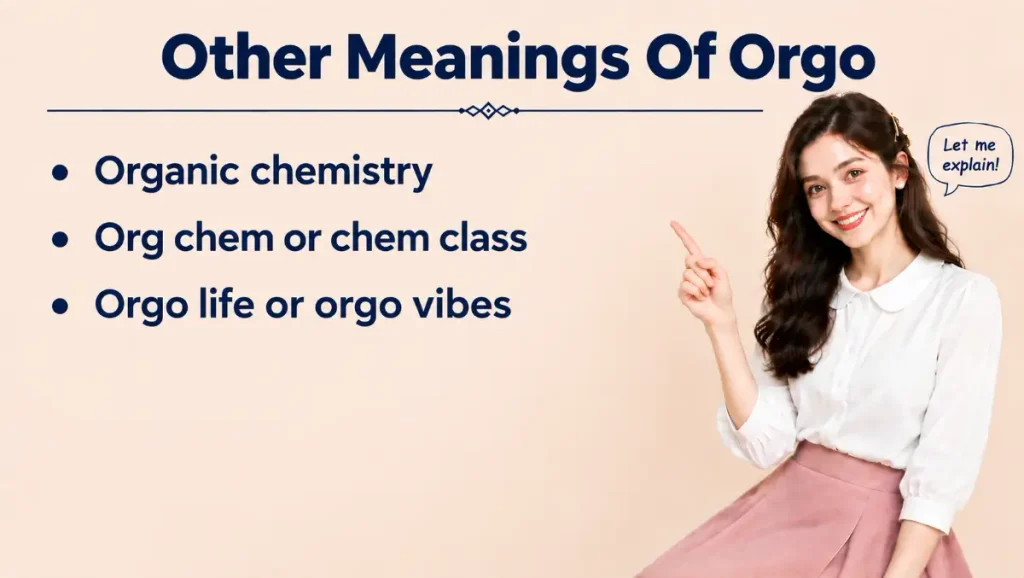
What Is Orgo in College?
In college, orgo refers to organic chemistry, the branch of chemistry concerned primarily with carbon compounds and their structures, properties, and reactions.
Organic chemistry helps explain how molecules are constructed and how they change during chemical reactions.
The subject is important in several academic fields, including chemistry, biology, pharmacy, and medicine.
What Do Students Learn in Orgo?
An organic chemistry course commonly introduces students to the following topics:
- Molecular structure: How atoms connect to form molecules.
- Functional groups: Groups of atoms that influence a molecule’s chemical behavior.
- Organic reactions: How substances change into different compounds.
- Reaction mechanisms: Step-by-step explanations of how chemical reactions occur.
- Stereochemistry: How the three-dimensional arrangement of atoms affects molecules.
- Organic synthesis: Methods used to prepare chemical compounds.
Some courses also include laboratory experiments involving purification, separation, and identification of organic substances.
The exact syllabus depends on the institution and course level.
What Is Orgo 1 and Orgo 2?
Many US colleges divide introductory organic chemistry into two courses.
Orgo 1 generally introduces fundamental concepts such as molecular structure, bonding, functional groups, stereochemistry, and basic reaction mechanisms.
Orgo 2 typically builds on those foundations with additional reactions, synthesis problems, and more advanced chemical concepts.
Course content and sequencing vary between universities.
When a student says “I’m taking Orgo 2,” they usually mean the second course in an organic chemistry sequence.
Why Do Students Call Organic Chemistry Orgo?
Orgo is a convenient nickname that fits the informal language students use when discussing their classes.
Instead of typing “organic chemistry” repeatedly, students can write “orgo” in a message.
Compare these sentences:
Formal: “I have an organic chemistry examination on Friday.”
Casual: “I have an orgo exam Friday.”
Both communicate the same basic information, but the second sounds more natural in a conversation between classmates.
The term also appears in student jokes and discussions about difficult assignments.
However, there is no need to assume that everyone using “orgo” is complaining. Students may simply be referring to the course.
How Is Orgo Used in Text Conversations?
Orgo commonly appears when students discuss their academic responsibilities.
The following illustrative conversations show how the word works in different situations.
Example 1: Preparing for an Exam
Sophia: “Have you started studying for orgo?”
Daniel: “Yeah, I’m reviewing reaction mechanisms tonight.”
Sophia: “Good idea. I’ll work through the practice problems.”
In this conversation, orgo refers to the organic chemistry course.
The reference to reaction mechanisms makes the meaning especially clear.
Example 2: Talking About Homework
Noah: “Did you finish the orgo assignment?”
Olivia: “Almost. I still have two synthesis problems.”
Noah: “Same here. Those questions are taking forever.”
Here, the students are discussing homework from their organic chemistry class.
Example 3: Making Weekend Plans
Ryan: “Want to watch a movie Saturday?”
Emma: “Maybe after lunch. I need to study orgo first.”
Ryan: “No problem. Let me know when you’re done.”
Emma uses orgo to explain why she needs time to study.
The message does not require a special slang interpretation.
Example 4: After a Difficult Test
Alex: “That orgo midterm was harder than I expected.”
Mia: “The reaction questions were tough.”
Alex: “Hopefully the next one goes better.”
This exchange shows how students may use orgo while discussing exams and academic stress.
What Does Orgo Mean on Social Media?
On social media, orgo generally keeps its academic meaning of organic chemistry.
Students may mention it in posts about study routines, exam preparation, laboratory classes, or college experiences.
For example:
“Three chapters of orgo to review before Monday.”
This message indicates that the student has organic chemistry material to study.
Another example is:
“Finally finished my orgo final!”
The writer is celebrating the completion of an organic chemistry examination.
Does Orgo Have a Special TikTok or Instagram Meaning?
There is no well-established separate definition of orgo specific to TikTok or Instagram.
A student might use the word in a humorous video about difficult coursework or in a post about exam preparation.
The platform does not change the underlying meaning.
A caption about studying orgo still refers to organic chemistry unless the surrounding context clearly indicates otherwise.
Why Is Orgo Considered Difficult?
Organic chemistry has a reputation for being challenging because students must learn to apply several connected concepts.
The subject often requires more than memorizing formulas or chemical names.
Students need to understand how molecular structures influence chemical behavior and predict the products of reactions.
Understanding Reaction Mechanisms
Reaction mechanisms describe how chemical bonds break and form during a reaction.
Students may need to identify where electrons move and explain why a particular reaction occurs.
These questions require an understanding of underlying principles.
Learning Three-Dimensional Structures
Molecules are three-dimensional structures, even when represented by flat drawings.
Stereochemistry requires students to understand how the spatial arrangement of atoms affects molecular properties and reactions.
This can take practice because diagrams must be interpreted spatially.
Connecting Earlier Topics With New Material
Organic chemistry concepts often build on one another.
A student who struggles with bonding or functional groups may find later reaction mechanisms more difficult.
Regular practice can help strengthen those connections.
Not every student finds orgo equally challenging. Prior preparation, teaching methods, and study habits can affect the experience.
How to Study for Orgo More Effectively
Understanding the meaning of orgo is simple. Learning the subject itself takes more effort.
Students preparing for organic chemistry exams can benefit from a few practical habits.
Focus on Understanding Reactions
Instead of memorizing every reaction separately, try to understand why the reaction occurs.
Pay attention to electron movement, molecular structure, and the roles of different functional groups.
This approach can make unfamiliar problems easier to analyze.
Practice Drawing Structures
Organic chemistry frequently uses structural formulas.
Practice drawing molecules, identifying functional groups, and representing three-dimensional arrangements.
Repeated practice can improve both accuracy and speed.
Review Material Regularly
Short, consistent study sessions can help students retain earlier concepts.
Waiting until the night before an exam may leave too little time to work through difficult problems.
Work Through Practice Questions
Reading notes is useful, but solving problems helps test understanding.
Try answering questions without looking at the solution first.
Afterward, review any mistakes and identify which concepts need more attention.
Orgo vs. Gen Chem: What’s the Difference?
Students sometimes confuse organic chemistry with general chemistry.
Both subjects are related, but they emphasize different areas.
| Feature | Orgo | Gen Chem |
|---|---|---|
| Full name | Organic chemistry | General chemistry |
| Main focus | Carbon compounds and reactions | Broad chemical principles |
| Common topics | Functional groups, mechanisms, synthesis | Atomic structure, bonding, equilibrium |
| Course sequence | Often follows general chemistry | Often taken earlier |
General chemistry usually introduces foundational concepts that students need for more specialized chemistry courses.
Organic chemistry builds on those foundations while focusing primarily on the chemistry of carbon compounds.
The exact prerequisites depend on the college.
Does Orgo Mean Organic Food or Natural Products?
No. In college conversations, orgo refers to organic chemistry rather than organic food or natural products.
The confusion comes from the shared word “organic.”
In everyday language, organic may describe agricultural products produced according to particular standards.
In chemistry, organic refers primarily to carbon-containing compounds, although some carbon compounds are classified as inorganic.
These meanings belong to different contexts.
For example:
“I have an orgo lab today.”
This sentence refers to an organic chemistry laboratory class.
By comparison:
“I bought organic vegetables.”
The second sentence concerns food rather than a college science subject.
Orgo vs. Org: Are They the Same?
Orgo and org are different abbreviations.
Orgo commonly means organic chemistry in student conversations.
Org often abbreviates organization, especially in workplace or technical writing.
For example:
“My orgo professor assigned another worksheet.”
Here, the speaker is discussing an organic chemistry professor.
Another example:
“Our org is hiring new employees.”
In this sentence, org means organization.
The final letter makes a meaningful difference.
Who Commonly Uses the Word Orgo?
Orgo is particularly relevant to people studying subjects that include organic chemistry.
These may include:
- Chemistry students taking required courses in their major.
- Biology students studying chemical processes relevant to living organisms.
- Pre-med students completing science coursework for medical school preparation.
- Pharmacy students learning chemistry related to pharmaceutical compounds.
- Other college students discussing organic chemistry classes or assignments.
The word is not restricted to a particular age group or academic major.
Someone who completed the course years earlier may still refer to it as orgo.
How to Reply When Someone Says Orgo
The best response depends on what the person is discussing.
When Someone Has an Exam
Message: “I have an orgo exam tomorrow.”
Reply: “Good luck! Have you finished reviewing the chapters?”
This response acknowledges the upcoming exam and keeps the conversation going.
When a Friend Is Stressed
Message: “Orgo is stressing me out this week.”
Reply: “That sounds tough. Want to take a short break?”
A supportive response is more helpful than assuming the person is exaggerating.
When Someone Mentions an Assignment
Message: “I’m stuck on my orgo homework.”
Reply: “Which topic are you working on?”
The question encourages the sender to explain the problem.
When You Don’t Know the Term
Message: “I have orgo at nine.”
Reply: “Do you mean organic chemistry?”
Asking for clarification is completely reasonable if you are unfamiliar with college course nicknames.
Common Misunderstandings About Orgo
Assuming Orgo Is a Secret Texting Code
Orgo is not generally used as a hidden message or romantic abbreviation.
Its established informal meaning is organic chemistry.
Confusing Orgo With Organic Food
The nickname refers to an academic subject rather than food labeling or lifestyle choices.
References to professors, exams, or laboratories usually confirm the intended meaning.
Thinking Orgo Always Means a Difficult Exam
The word identifies the subject itself.
It may refer to a class, textbook, assignment, or exam depending on the sentence.
Assuming Everyone Understands Orgo
The nickname may be familiar to students in science-related programs but unfamiliar to people outside those settings.
Using “organic chemistry” is clearer when writing for a general audience.
Frequently Asked Questions
What Does Orgo Mean in Text?
Orgo means organic chemistry. Students use this informal abbreviation when discussing classes, assignments, exams, and laboratory work.
What Is Orgo in College?
Orgo is the common student nickname for organic chemistry, a subject focused primarily on carbon compounds and their chemical reactions.
Is Orgo a Slang Word?
Yes, orgo can be described as informal student slang. More precisely, it is a shortened nickname for organic chemistry rather than a general internet slang expression.
What Does Orgo Class Mean?
An orgo class is an organic chemistry course. Students commonly study molecular structures, functional groups, reaction mechanisms, and other chemistry topics.
What Does Me Mean in Orgo?
In organic chemistry notation, Me represents a methyl group, CH3. It is a standard chemical abbreviation and does not mean the English pronoun “me” in that context.
Is Orgo the Same as General Chemistry?
No. General chemistry introduces broad chemical principles, while organic chemistry focuses primarily on carbon compounds and their structures and reactions.
Final Takeaway
Orgo means organic chemistry in college slang and casual texting. Students use the nickname when discussing coursework, exams, laboratory sessions, and study plans.
If someone says they are studying orgo, they are almost certainly referring to organic chemistry. The word is a convenient academic abbreviation rather than a mysterious internet expression.

Sophia Bennett writes educational content about English vocabulary, grammar, slang, and communication. She is passionate about making complex language topics accessible to students, professionals, and curious readers around the world.