Yea vs Nay: What’s the Difference?
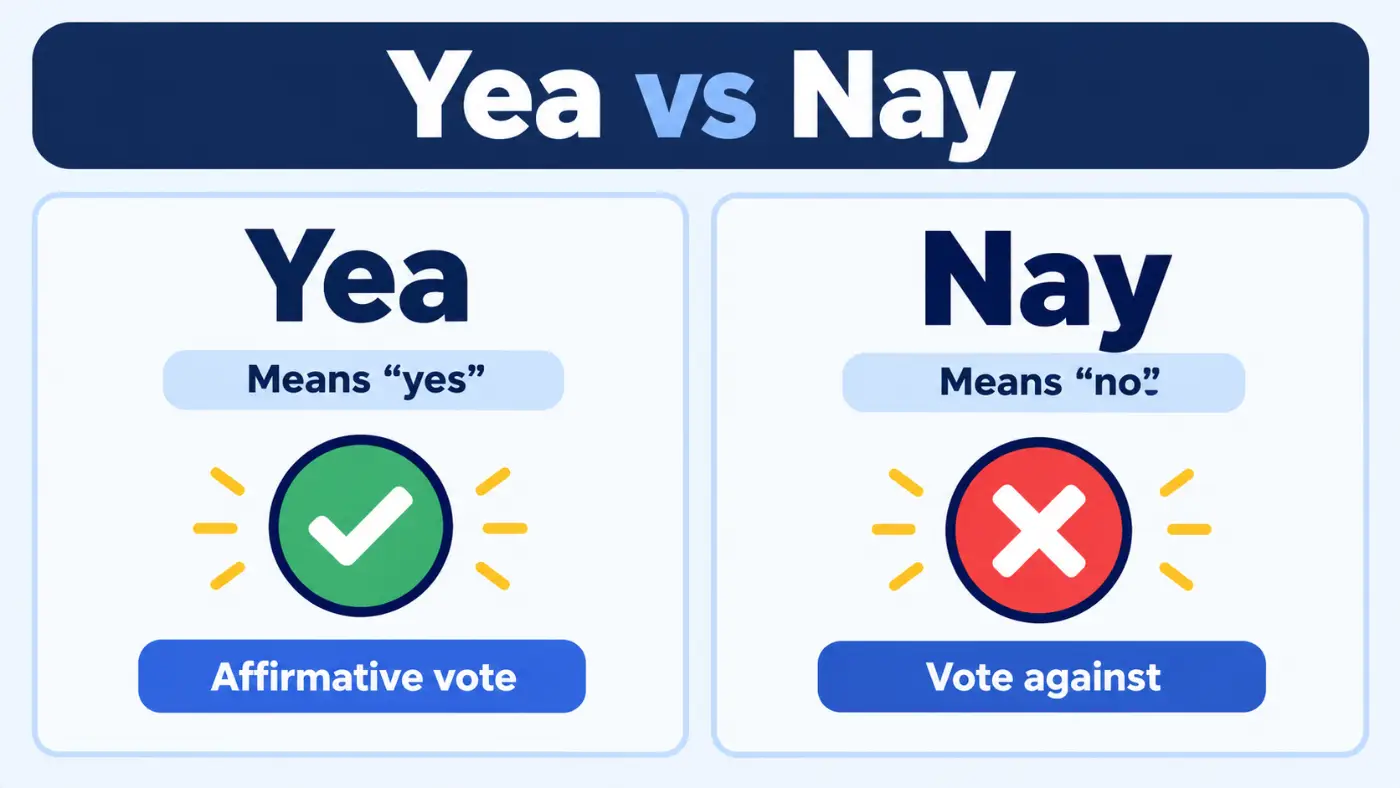
Yea means “yes,” typically used to cast an affirmative vote, while nay means “no,” used to cast a vote against something. They’re opposite terms most often heard together in formal voting settings, like legislative sessions or organizational meetings.
The Short Answer at a Glance
| Form | Meaning | Typical use | Example |
|---|---|---|---|
| yea | An affirmative vote, meaning “yes” | Formal voting, legislative proceedings, ceremonial contexts | The senator cast her vote as a yea on the proposed bill. |
| nay | A negative vote, meaning “no” | Formal voting, legislative proceedings, ceremonial contexts | Three council members voted nay on the zoning change. |
If you’re recording or casting a vote in favor of something, yea is the word. If you’re voting against something, nay is the word.
What Yea Means and How It Works
Yea is an adverb, and in formal contexts, it functions almost like a specialized noun, used specifically to indicate an affirmative response or vote. It’s most commonly encountered in the phrase “yea or nay,” used to describe the two possible outcomes of a formal vote, and in vote tallies themselves, as in “the yeas have it.”
The word carries a distinctly formal, procedural tone. While “yes” is the everyday word for affirmation, yea is reserved almost exclusively for structured voting contexts: legislative sessions, courtroom proceedings, corporate board meetings, and other settings where votes are formally recorded and announced aloud.
Grammatically, yea can function as an interjection when used to actually cast a vote aloud, as in someone simply saying “yea” when their name is called during a roll call vote. It also appears as a noun in vote tallies, as in “the measure passed with 62 yeas and 14 nays,” where “yeas” refers to the individual affirmative votes collectively.
Yea has a long history in English, appearing throughout older texts and formal ceremonial language, which is part of why it retains such a distinctly formal, almost archaic flavor compared to everyday words like “yes” or “yeah.”
What Nay Means and How It Works
Nay is the direct opposite of yea, functioning as a formal word for “no,” specifically in the context of voting or formal refusal. Like yea, it appears most often in structured, procedural settings rather than everyday conversation.
The word functions similarly to yea grammatically: as an interjection when actually voting aloud, and as a noun when referring to negative votes collectively, as in “the nays outnumbered the yeas.” It also appears in the same paired phrase, “yea or nay,” used to describe the binary outcome of a formal vote before it happens.
Nay carries an additional, slightly different use outside strict voting contexts: as a somewhat literary or old-fashioned way of introducing a stronger or corrected statement, similar to “no, in fact” or “or rather.” This usage, as in “he was upset, nay, furious,” is less about voting and more about emphasis, correcting or intensifying a previous statement.
Like yea, nay carries a formal, somewhat old-fashioned tone in modern English, which is exactly why both words tend to show up in specific procedural contexts rather than casual daily speech.
Yea vs Nay: Key Differences Side by Side
| Feature | Yea | Nay |
|---|---|---|
| Part of speech | Interjection/adverb (voting); noun (vote tally) | Interjection/adverb (voting); noun (vote tally); occasionally used for emphasis |
| Core meaning | “Yes,” an affirmative vote | “No,” a negative vote; also “or rather,” for emphasis |
| Typical use | Formal voting, legislative and ceremonial settings | Formal voting, legislative and ceremonial settings, occasional literary emphasis |
| Register | Formal and procedural | Formal and procedural, with an additional literary use |
| Example | The board recorded twelve yeas in favor of the merger. | The board recorded three nays against the merger. |
What the table can’t fully capture is how tightly these two words are bound together in usage. Unlike many word pairs that can appear independently in a wide range of sentences, yea and nay are almost always discussed, taught, and used as a pair, since one rarely appears in a voting context without some reference to the other.
Correct Examples in Real-Life Contexts
Everyday speech
- Someone joked at dinner, “all in favor of pizza, say yea,” and everyone laughed and said it together.
- He voted nay on the family vacation destination, holding out for the beach instead of the mountains.
- The kids held a mock vote on bedtime rules, shouting yea and nay across the living room.
- Honestly, my vote is a firm nay on pineapple pizza.
Workplace writing
- The board recorded eight yeas and two nays on the proposed budget increase.
- Please indicate your vote as yea or nay by end of day Friday.
- The committee’s decision passed with a clear majority of yeas.
- Management noted the nays came primarily from the operations department.
Texting
- yea or nay on grabbing tacos tonight lol
- hard nay from me, I already ate
School and academic
- The mock congress exercise required students to vote yea or nay on each proposed bill.
- Her paper examines how procedural language like yea and nay has persisted in modern legislatures.
- The class debate ended with a formal yea and nay vote on the winning argument.
- Students studied historical vote tallies recorded as yeas and nays in early congressional records.
Formal writing
- The resolution passed with 214 yeas and 198 nays.
- Members are required to state their vote clearly as either yea or nay during roll call.
- The final tally showed a narrow margin between yeas and nays on the controversial measure.
- The court recorded the jury’s informal preliminary vote as a mix of yea and nay responses.
Common Mistakes People Make (and How to Catch Them)
Confusing yea with the informal “yeah”
Wrong: The senator said “yeah” during the formal roll call vote. Right: The senator said “yea” during the formal roll call vote.
Yea and “yeah” sound identical but serve completely different purposes. Yeah is a casual, conversational way of saying yes, while yea is specifically the formal voting term. Using “yeah” in a formal procedural context would be inappropriate, though this is more a matter of register than spelling.
Reversing which word means yes and which means no
Wrong: The council voted yea against the proposal, rejecting it outright. Right: The council voted nay against the proposal, rejecting it outright.
Since both words are used less frequently in everyday speech, some writers genuinely mix up which one indicates approval and which indicates rejection.
Misspelling nay as “neigh”
Wrong: The committee recorded several neighs against the motion. Right: The committee recorded several nays against the motion.
“Neigh” refers to the sound a horse makes, and while it’s pronounced identically to nay, it has nothing to do with voting or formal refusal.
Using yea and nay in casual writing where “yes” and “no” would fit better
Wrong: My yea on dinner plans is Italian food. (in an otherwise casual text) Right: My vote for dinner plans is Italian food, or simply, Yeah, let’s do Italian food.
This isn’t a factual error, but a register mismatch. Yea and nay carry a formal, almost old-fashioned tone that can feel oddly stiff or affected in ordinary casual writing, unless used deliberately for humor or emphasis.
A Fast Trick to Choose the Right One
Remember that yea rhymes with “yay” and shares its meaning of approval, even though yea itself is pronounced more like “yay” in formal contexts. If you can remember that yea and “yay” sound alike and both signal something positive, that connection helps anchor yea firmly to “yes.”
For nay, think of it alongside “naysayer,” a common word describing someone who frequently objects or expresses doubt. Since a naysayer is someone who says “no” or raises objections, that connection reinforces nay’s meaning as a negative vote or refusal.
This trick works well for keeping the two words straight, but it has one limit: it won’t help distinguish nay from its identical-sounding but unrelated word, “neigh,” which requires simply remembering that one relates to horses and the other to voting.
How They Sound in Real Situations
A text exchange
Priya: Movie night at my place or yours?
Jordan: Yea to mine, way more comfortable couch.
Priya: Fair point, can’t argue with that.
Yea works here in a lighthearted, slightly playful way, borrowing the formal voting term for comedic effect in a casual conversation.
A workplace email
Subject: Vote results: Q3 budget proposal
Hi team,
The final tally on the proposed budget adjustment came in at nine yeas and two nays. The proposal passes and will move forward to implementation next month.
Thanks, Devon
Yeas and nays are correct here, used in their standard formal sense to report the outcome of a workplace vote.
An article-style excerpt
The bill passed the state legislature by a narrow margin, with the final tally recorded at 51 yeas to 49 nays. Supporters called the vote a turning point, while opponents vowed to challenge the measure in court.
Yeas and nays are correct here, used in standard legislative reporting to describe a formal vote outcome.
Formal Writing vs Casual Writing
Yea and nay are almost exclusively formal terms, reserved for structured voting contexts like legislative sessions, board meetings, and ceremonial proceedings. In casual speech and everyday writing, “yes” and “no” are the expected, natural choices.
Using yea or nay in casual writing isn’t incorrect exactly, but it typically reads as playful, old-fashioned, or intentionally formal-sounding for effect, rather than as a neutral, everyday word choice. Journalism covering legislative votes, government proceedings, and formal organizational decisions is where yea and nay appear most naturally and consistently.
AP style commonly uses yea and nay when reporting legislative vote counts, reflecting their established role as standard procedural vocabulary in that specific context.
Related Mix-Ups People Also Search For
Yea vs Yeah
Yea is the formal voting term meaning “yes,” while yeah is the casual, conversational way of saying yes in everyday speech. Example: He said “yeah” to grabbing lunch, a world away from the formal “yea” he’d use during a board vote.
Nay vs Neigh
Nay means “no” in a formal voting context, while neigh describes the sound a horse makes. The two words are pronounced identically but are completely unrelated in meaning. Example: The horse let out a loud neigh just as the council recorded its final nay vote.
Yea vs Aye
Aye is another formal word meaning “yes,” often used interchangeably with yea in certain voting procedures, particularly in some legislative bodies and naval or ceremonial contexts. Example: In some assemblies, members say “aye” instead of “yea” when voting in favor of a motion.
Exceptions, Edge Cases, and Tricky Situations
Yea versus aye in different voting bodies
Some legislative bodies and organizations use “aye” instead of “yea” for affirmative votes, and the choice between the two often comes down to that specific institution’s traditional procedures rather than a universal rule. Both words mean the same thing in this context.
Nay used for emphasis, not voting
Nay occasionally appears in more literary or old-fashioned writing to introduce a stronger or corrected statement, unrelated to voting entirely, as in “she was tired, nay, exhausted.” This use is less common in modern writing but still appears in certain literary or dramatic styles.
Quick Practice: Test Yourself
Choose the correct word for each blank.
- The committee recorded seven ______ and three ______ on the new policy. (yeas / nays)
- He jokingly said “______” when asked if he wanted more coffee, clearly excited about it. (yea / nay)
- The proposal failed after a majority voted ______. (yea / nay)
- She wasn’t just annoyed, ______, she was completely fed up. (yea / nay)
- The senator’s vote was recorded as a ______ in favor of the amendment. (yea / nay)
- The sound of a horse’s ______ echoed across the barn. (neigh / nay)
Answer Key
- yeas / nays: correct terms for the affirmative and negative vote tallies.
- yea: used playfully to express enthusiastic agreement.
- nay: correct term indicating the proposal was voted down.
- nay: used here for emphasis, meaning “or rather,” not as a vote.
- yea: correct term for an affirmative vote.
- neigh: correct spelling for the sound a horse makes, unrelated to voting.
Frequently Asked Questions
What’s the difference between yea and nay?
Yea means “yes” and is used to cast an affirmative vote, while nay means “no” and is used to cast a vote against something, most often in formal or legislative settings.
Are yea and nay used outside of voting?
Rarely, though nay occasionally appears in literary writing to introduce a stronger or corrected statement, as in “she was upset, nay, furious,” unrelated to voting.
Is yea the same as “yeah”?
No. Yea is a formal voting term, while “yeah” is a casual, everyday way of saying yes. They’re pronounced similarly but serve very different purposes.
Is nay the same as “neigh”?
No. Nay means “no” in a voting context, while neigh describes the sound a horse makes. They’re pronounced identically but are entirely unrelated in meaning.
Do all legislative bodies use “yea” and “nay”?
Not universally. Some use “aye” instead of “yea” for affirmative votes, depending on that particular institution’s traditional procedures.
Can yea and nay be used in casual conversation?
They can, though doing so usually comes across as playful, old-fashioned, or intentionally formal, rather than as a neutral, everyday choice like “yes” or “no.”

Sophia Bennett writes educational content about English vocabulary, grammar, slang, and communication. She is passionate about making complex language topics accessible to students, professionals, and curious readers around the world.