Sprain vs Strain Which Word Fits the Injury
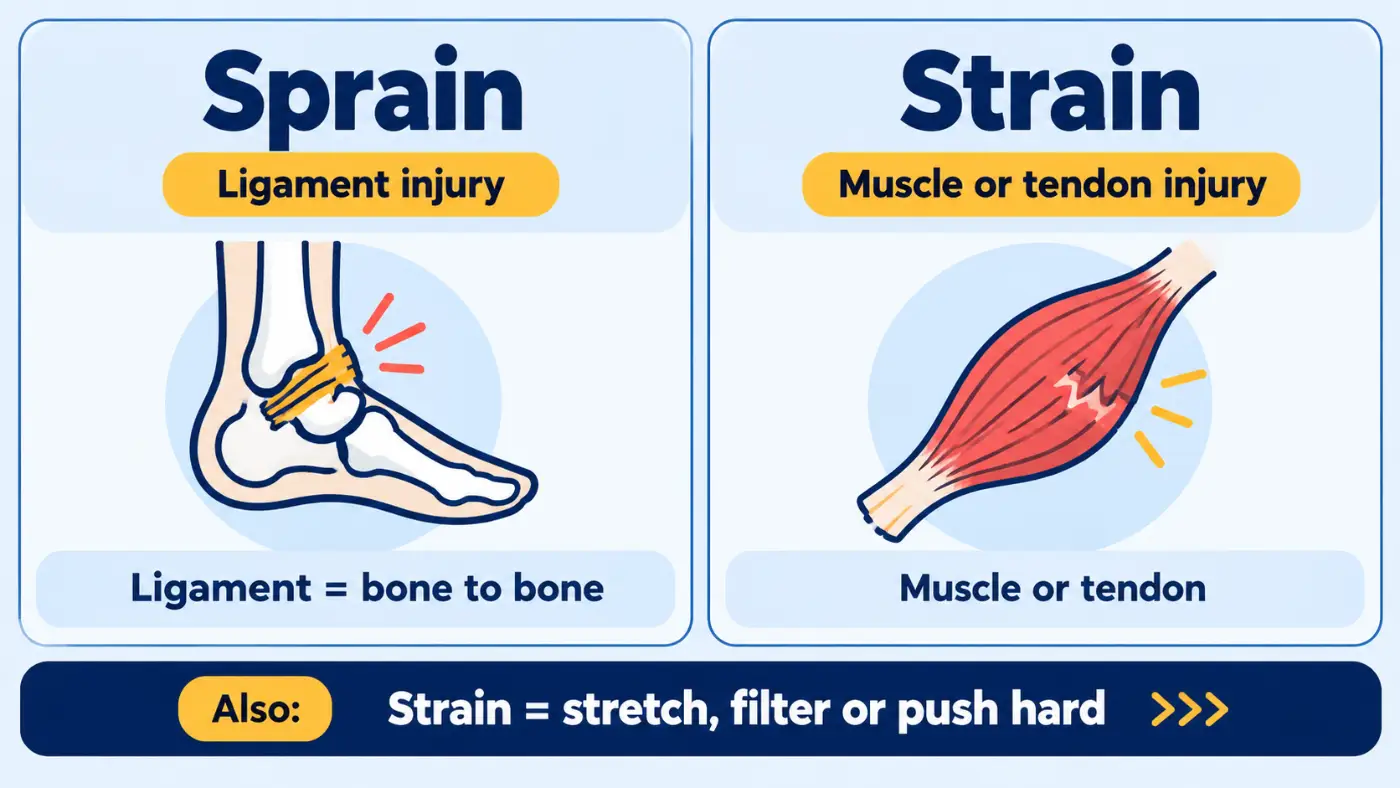
A sprain is an injury to a ligament, the tough band that connects bone to bone at a joint. A strain is an injury to a muscle or a tendon, usually from overstretching or overuse. Strain is also an everyday verb for stretching, filtering, or pushing hard, and sprain never does that job.
The Short Answer at a Glance
Ask what got hurt. If it was the band at a joint, say sprain. If it was a muscle or the cord that attaches it to bone, say strain.
| Word | What it describes | Example |
|---|---|---|
| Sprain | A stretched or torn ligament at a joint. | Lucas sprained his ankle stepping off the curb. |
| Strain | A stretched or torn muscle or tendon, or the act of stretching or forcing something. | Jada strained her hamstring in the final sprint. |
What a Sprain Means and How It Works
A sprain is a noun for a ligament injury, and the same word works as a verb. A ligament is the strong, slightly elastic band that holds two bones together at a joint. When a joint twists, rolls, or bends past its normal range, the ligament can overstretch or tear.
That’s why sprains cluster around joints that take sudden twisting forces. The ankle is the classic case. Wrists, knees, thumbs, and fingers show up often too.
The verb forms are sprain, sprains, sprained, and spraining. People sprain an ankle, sprain a wrist, or end up with a sprained knee. As a noun, it pairs with size words such as mild, bad, and severe, since doctors rank sprains by how much of the ligament is damaged.
Sprain keeps a narrow lane in the language. It almost always refers to a physical joint injury, and everyday English rarely uses it for anything else. That narrowness makes it the easier word of the pair to get right.
What Strain Means and How It Works
Strain is a noun and a verb with a much wider range. In the body, a strain is an injury to a muscle or a tendon. A tendon is the cord that anchors a muscle to a bone. Overstretching or overworking either one can cause a strain.
Strain shows up in common injuries like a hamstring strain, a groin strain, and a lower back strain. In casual speech, a strained muscle is often called a pulled muscle.
As a verb, strain means to stretch or push beyond a comfortable limit. You can strain a muscle, strain your eyes, or strain to hear a quiet voice. It also means to filter. Cooks strain pasta, stock, and yogurt. Figuratively, things strain relationships, budgets, patience, and credulity.
As a noun outside the body, it can mean pressure, as in a bridge under strain. It can also mean a variety of an organism, such as a strain of flu, or a passage of music, as in the strains of a distant violin.
The verb forms are strain, strains, strained, and straining. Strained also works as an adjective, as in a strained smile or a strained conversation.
Sprain vs Strain Key Differences Side by Side
| Feature | Sprain | Strain |
|---|---|---|
| Part of speech | Noun and verb. | Noun, verb, and adjective in the form strained. |
| Body part involved | Ligament, which connects bone to bone. | Muscle or tendon, which connects muscle to bone. |
| Usual cause | A twist, roll, or fall that forces a joint out of position. | Overstretching, overloading, or repeated overuse. |
| Typical spots | Ankle, wrist, knee, thumb. | Hamstring, calf, back, neck. |
| Nonmedical uses | Almost none. | Many, including filtering, exerting effort, and pressure. |
| Register | Neutral at every level. | Neutral at every level. |
| Example | Dana sprained her wrist catching a fall. | Dana strained her back lifting the speaker. |
The table can’t show how often people blur the two in conversation. Someone with a sore ankle might say they strained it, and everyone nods. Medical writers still reserve sprain for the ligament injury. The table also can’t capture severe injuries that damage several tissues at once, where a clinician sorts out the label. Language gives you the vocabulary, but only an exam gives you the diagnosis.
Correct Examples in Real Life Contexts
Sprain in Action
- Everyday speech: Tomas rolled his foot on a loose stair and sprained his ankle before the party even started.
- Workplace writing: The warehouse report logged one sprained wrist and two sore backs from the holiday rush.
- Texting: Can’t make soccer tonight, I think I sprained my thumb on the door.
- School: The coach taught the team how to tape a joint to help prevent a repeat sprain.
- Sports reporting: The point guard will miss two games with a mild ankle sprain.
- Formal writing: Orthopedic clinics see a steady stream of knee sprains each ski season.
Strain in Action
- Everyday speech: Priya strained her calf during the last mile of the 10K.
- Workplace writing: Reading tiny spreadsheets all day can strain your eyes, so adjust the font size.
- Kitchen talk: Strain the tomatoes through a fine mesh sieve to get a smoother sauce.
- Texting: Ugh, I pulled something in my back, probably a strain from moving boxes.
- School: Rising prices began to strain the college’s budget.
- Formal writing: The new tariffs placed serious strain on trade relations between the two countries.
- Listening: Maya had to strain to hear the speaker over the hum of the air conditioner.
Common Mistakes People Make and How to Catch Them
- Calling a muscle injury a sprain. Wrong → I sprained my hamstring. Right → I strained my hamstring. The hamstring is a muscle group, and muscles get strained.
- Calling a ligament injury a strain. Wrong → She strained her ankle on the trail. Right → She sprained her ankle on the trail. The classic ankle roll hurts a ligament, though casual speech often uses strained anyway.
- Using sprain for eyes or ears. Wrong → I sprained my eyes reading in the dark. Right → I strained my eyes reading in the dark. Sprain belongs to joints, and effort belongs to strain.
- Using sprain for relationships. Wrong → The merger sprained their friendship. Right → The merger strained their friendship. Only strain works as a figurative verb.
- Writing the wrong past tense. Wrong → She spranged her wrist. Right → She sprained her wrist. Both verbs take a regular ed ending.
- Mixing up a kitchen verb. Wrong → Sprain the noodles into the colander. Right → Strain the noodles into the colander. Filtering is always strain.
- Treating the two as synonyms in formal writing. Wrong → The report listed sprains and strains interchangeably. Right → The report listed each injury under the correct term. Medical and sports writing usually keeps them apart.
A Fast Trick to Choose the Right One
Use the twist test and the effort test. Ask first whether something twisted or rolled out of position at a joint. If so, write sprain. Then ask whether something was overworked, overstretched, or pushed past its limit. If so, write strain.
For a memory hook, link strain with stretch. Both words share the letters s, t, and r near the start, and a strain is a stretch that went too far. A sprain, by contrast, is about the spot where two bones meet and a joint gave way.
The trick has limits. Some injuries involve both a ligament and a muscle, and a sore joint doesn’t always reveal which tissue was hurt. In everyday conversation, either word may be used loosely, and that’s normal. If you need the precise term, ask the clinician who examined the injury.
How Sprain and Strain Sound in Real Situations
A text exchange
Jordan: How’s the ankle?
Mia: Doctor says it’s a sprain, not a break. I’m in a brace for two weeks.
Jordan: Good news. My back’s still sore from lifting that couch, probably just a strain.
Mia’s word names a joint ligament injury. Jordan’s word names an overworked muscle.
An email snippet
Hi Coach Reyes, Elena won’t be at Thursday’s practice. She sprained her wrist in gym class today, and the nurse wants it checked. Marcus is out too, since his calf strain from last week hasn’t cleared yet.
The wrist injury involves a joint, so sprain fits. The calf is a muscle, so strain fits.
An article excerpt
The veteran forward sat out Sunday’s game with a hamstring strain, and the team’s trainer said he’d return in about a week. A day earlier, the rookie guard left practice with a sprained ankle. The long road schedule has begun to strain the roster’s depth.
Hamstring strain names a muscle injury. Sprained ankle names a ligament injury. The final sentence uses strain as a figurative verb.
Formal Writing vs Casual Writing
Register doesn’t change which word is correct. Sprain and strain keep the same meanings in a text, a news story, and a medical article.
What changes is precision. Medical writing, athletic training manuals, and careful sports reporting keep the two terms apart. Casual speech is looser, and plenty of people say strained ankle without a second thought. Readers rarely stumble on that, but a medical editor would probably adjust it.
Strain has more room to move in formal writing because of its other meanings. Economists write about strain on supply chains, scientists write about strains of bacteria, and novelists write about strained silences. Sprain stays close to the body in all of them.
Most style guides don’t set special rules for either word. The practical rule is to match your term to the tissue involved and keep it consistent in a single document.
Related Mix Ups People Also Search For
Pulled Muscle vs Strain
A pulled muscle is the everyday name for a muscle strain. The two phrases point to the same kind of injury, with pulled sounding casual and strain sounding clinical. Dev pulled a muscle in his shoulder, and the physical therapist called it a mild strain.
Sprain vs Fracture
A fracture is a break in a bone, while a sprain is damage to a ligament. The two can look alike on the surface, since both cause pain and swelling. Only imaging and an exam can tell them apart. Nora feared a fracture, but the scan showed a sprain.
Strain vs Stress
Strain describes the effect of force, and stress describes the force itself. In everyday talk, people use stress for emotional pressure, and strain often means the toll that pressure takes. The deadline added stress to her week, and the late nights began to strain her health.
Exceptions Edge Cases and Tricky Situations
- Strain has several unrelated meanings. A strain of flu, the strains of a song, and the strain on a rope all use the same spelling. Context separates them.
- Tendon injuries count as strains. A tendon links muscle to bone, so injuries there use the strain label even though a tendon isn’t a muscle itself.
- Loose speech blurs the line. People say they strained an ankle when a doctor would say sprained. Neither choice confuses a listener, though the second is the standard medical term.
- Sprain rarely goes figurative. English doesn’t use it for relationships, budgets, or patience. Strain handles all of those.
- Some injuries involve more than one tissue. A serious fall can damage a ligament and a muscle together, so a clinician may use both terms.
- Strained can be an adjective. A strained smile, a strained laugh, and a strained voice all describe forced or tense expression and have nothing to do with muscles.
- Past tense is regular for both. Sprained and strained follow the standard ed pattern, so no irregular forms exist.
Quick Practice Test Yourself
Choose sprain or strain, in the form each sentence needs.
- Lena landed awkwardly on the court and ____ her ankle.
- Please ____ the broth before you add the noodles.
- Reading small print in dim light can ____ your eyes.
- The trainer said his lower back was ____ from too many heavy lifts.
- A long dispute over money began to ____ their partnership.
- Which injury is a ligament problem at a joint, a sprain or a strain?
Answer Key
- Sprained. A rolled ankle injures a ligament.
- Strain. It means to filter liquid.
- Strain. It means to push the eyes too hard.
- Strained. Back muscles are overworked by heavy lifting.
- Strain. It’s the figurative verb for putting pressure on something.
- A sprain. Ligaments connect bone to bone at a joint.
Frequently Asked Questions
What is the main difference between a sprain and a strain?
A sprain injures a ligament, which connects bone to bone. A strain injures a muscle or a tendon.
Is a pulled muscle a sprain or a strain?
It’s a strain. Pulled muscle is the everyday name for a stretched or torn muscle.
Can you sprain a muscle?
No. Muscles get strained, and ligaments get sprained. People sometimes say sprained muscle in casual speech, but it isn’t the standard term.
Is an ankle injury a sprain or a strain?
A rolled ankle most often injures a ligament, so sprain is the usual word. Muscles and tendons around the ankle can also be strained, and a clinician can tell you which applies.
Is strain only a medical word?
No. Strain also means to filter, to exert effort, to put pressure on something, a variety of organism, and a snatch of music.
Are the past tenses sprained and strained?
Yes. Both verbs are regular, so you add ed to form the past tense and the past participle.

Sophia Bennett writes educational content about English vocabulary, grammar, slang, and communication. She is passionate about making complex language topics accessible to students, professionals, and curious readers around the world.