Cringy vs Cringey: Which Spelling Is Correct?
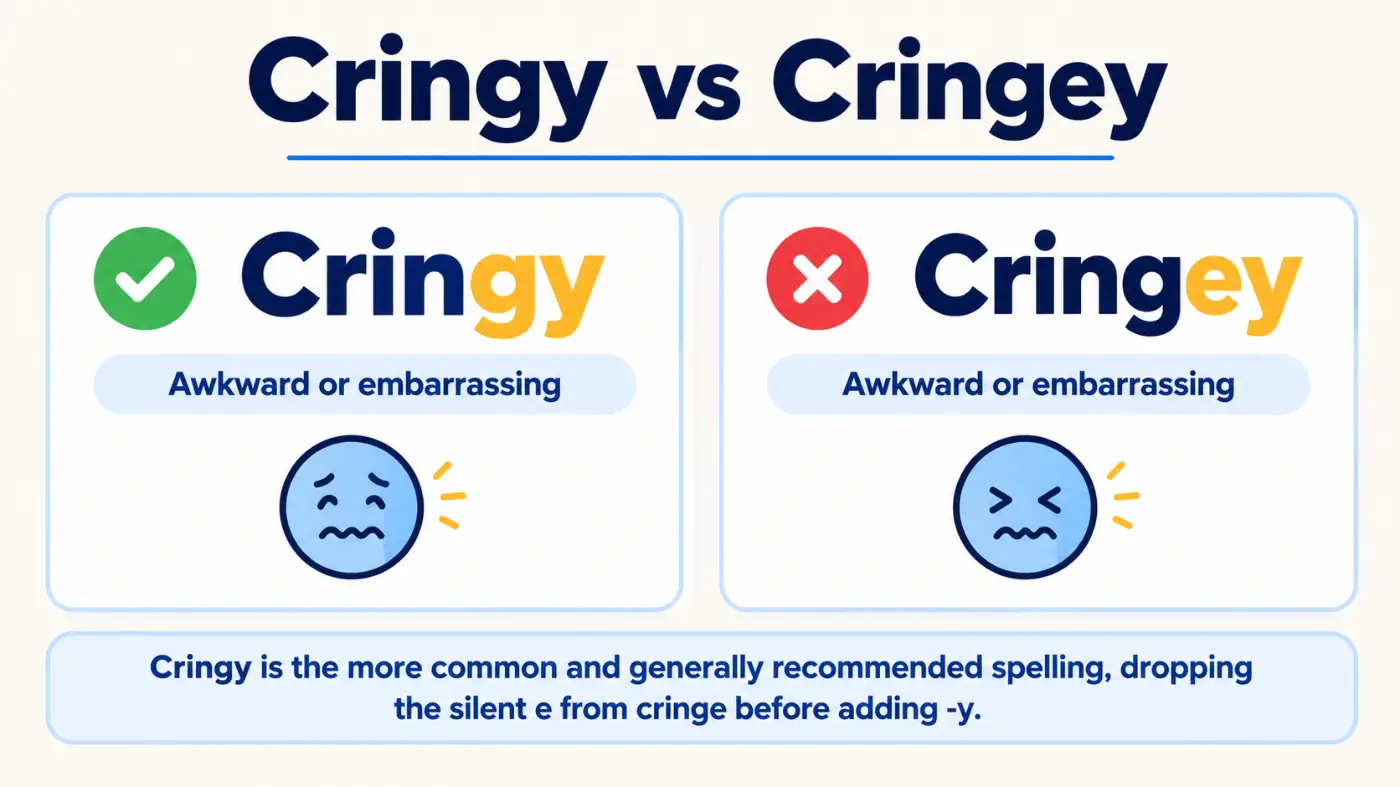
Cringy is the more common and generally recommended spelling, dropping the silent “e” from “cringe” before adding “-y.” Cringey also appears frequently online and isn’t considered wrong, but cringy is the form most style guides and major dictionaries that recognize the word tend to list first.
The Short Answer at a Glance
| Form | Status | What it does | Example |
|---|---|---|---|
| cringy | More common, generally preferred | Adjective describing something that causes secondhand embarrassment | That old yearbook photo is honestly so cringy. |
| cringey | Widely used variant | Identical meaning, keeps the “e” from “cringe” | That old yearbook photo is honestly so cringey. |
Both spellings describe the same feeling of awkward, secondhand embarrassment. Cringy is the more frequently recommended form, but cringey isn’t incorrect, just less common.
What Cringy Means and How It Works
Cringy is an informal adjective describing something that causes a feeling of awkward embarrassment, discomfort, or secondhand humiliation, often on behalf of someone else. It’s used constantly in casual conversation, social media, and online commentary to describe everything from outdated fashion choices to awkward social media posts, overly dramatic speeches, or painfully unfunny jokes.
The word is built from the verb “cringe,” meaning to flinch or recoil, often involuntarily, in response to something embarrassing, disgusting, or uncomfortable. Adding the adjective-forming suffix “-y” turns that verb into a descriptive word, the same basic pattern used to form adjectives like “funny” from “fun” or “messy” from “mess.”
Grammatically, cringy functions as a standard adjective, appearing before a noun (“a cringy moment”) or after a linking verb (“that speech was so cringy”). It follows the regular comparative and superlative pattern for short adjectives ending in “y”: cringy becomes cringier and cringiest.
Cringy is a relatively recent addition to widely recognized English vocabulary, emerging largely through internet culture and casual online commentary before spreading into everyday speech. Because of that origin, it remains firmly informal, showing up constantly in casual writing but rarely in strictly formal or academic contexts.
What Cringey Means and How It Works
Cringey means exactly the same thing as cringy: something that causes awkward, secondhand embarrassment. The definition, grammatical behavior, and typical usage are identical between the two forms.
The difference lies entirely in how the silent “e” from “cringe” is handled when the “-y” suffix is added. Cringy drops that silent “e” before adding “-y,” following the standard English pattern seen in words like “shine” becoming “shiny” or “grime” becoming “grimy.” Cringey instead keeps the “e,” a pattern seen in a smaller but still real group of similarly constructed informal adjectives.
Because cringy and cringey both emerged relatively recently through casual and online usage rather than through centuries of established print tradition, neither spelling has the same deep, settled dictionary history that older adjectives typically have. This is part of why both forms circulate so widely and why neither can be called definitively “wrong,” even though cringy tends to edge out cringey in frequency and in style-guide recommendations where the word is addressed at all.
Grammatically, cringey behaves identically to cringy in every respect, functioning as a standard adjective with the same comparative and superlative possibilities, though “cringier” and “cringiest” remain far more common than any equivalent forms built from cringey.
Cringy vs Cringey: Key Differences Side by Side
| Feature | Cringy | Cringey |
|---|---|---|
| Part of speech | Adjective | Adjective |
| Core meaning | Causing awkward, secondhand embarrassment | Identical meaning |
| Typical use | Casual conversation, social media, informal writing | Casual conversation, social media, informal writing |
| Register | Informal | Informal |
| Frequency | More common overall | Common, but somewhat less frequent |
| Example | His attempt at flirting was painfully cringy. | His attempt at flirting was painfully cringey. |
What the table can’t fully capture is how much this word’s spelling is still settling, precisely because of its relatively recent, internet-driven rise in usage. Unlike older word pairs with centuries of dictionary precedent, cringy and cringey are both still actively competing for dominance, and you’ll see both used credibly across social media, casual writing, and even some published commentary.
Correct Examples in Real-Life Contexts
Everyday speech
- I can’t watch that show, the dialogue is way too cringy for me.
- That video of my middle school talent show is unbearably cringy.
- His dad jokes are cringy, but honestly, everyone secretly loves them.
- The whole interview felt cringy, like nobody knew what to say.
Workplace writing
- Let’s avoid anything too cringy in the company’s social media captions.
- The team agreed the old marketing slogan felt a little cringy by today’s standards.
- Please review the script for any lines that might come across as cringy to a younger audience.
- Feedback suggested the training video’s jokes felt more cringy than funny.
Texting
- omg that tiktok was so cringy I had to look away
- ngl that pickup line was kind of cringey but also kind of funny
School and academic
- The media studies class analyzed why certain viral videos are widely considered cringy.
- Her essay explores how “cringe culture” online shapes what younger audiences find cringy or acceptable.
- Students debated whether older internet memes have aged into being genuinely cringy today.
- The presentation examined cringey marketing campaigns from the early 2000s as case studies.
Formal writing
Note: Neither spelling is typically used in strictly formal writing, since both remain informal terms. In more formal contexts, alternatives like “embarrassing,” “awkward,” or “uncomfortable” are usually preferred.
- The campaign was widely criticized as embarrassing and out of touch. (formal alternative)
- Reviewers described the dialogue as painfully awkward throughout the film. (formal alternative)
Common Mistakes People Make (and How to Catch Them)
Assuming one spelling is definitively wrong
Wrong assumption: Cringey is a misspelling of cringy, or vice versa. Right understanding: Both spellings are widely used and understood, with cringy being somewhat more common and typically recommended where dictionaries or style guides address the word at all.
This isn’t a genuine sentence-level error, but a common misunderstanding, since the word’s relatively recent and informal origins mean it hasn’t settled into one single, universally agreed-upon spelling the way older words have.
Inconsistent spelling within the same piece of writing
Wrong: The article uses cringy in the headline and cringey throughout the body text. Right: The article consistently uses one spelling throughout.
Since both forms are acceptable, the real risk is inconsistency rather than outright error, and switching between them mid-document can look like a proofreading oversight.
Using either spelling in strictly formal writing
Wrong: The clinical report described the patient’s social interactions as cringy. Right: The clinical report described the patient’s social interactions as socially awkward or uncomfortable.
Since both cringy and cringey are informal by nature, using either in medical, legal, or highly formal academic writing can feel out of place compared to more neutral, established vocabulary.
Overcomplicating the comparative and superlative forms
Wrong: That was the most cringy thing I’ve ever seen. Right: That was the cringiest thing I’ve ever seen.
Since cringy follows the regular short-adjective pattern, it typically takes the “-ier” and “-iest” endings directly rather than pairing with “more” and “most,” the same way “funny” becomes “funnier,” not “more funny.”
A Fast Trick to Choose the Right One
Default to cringy unless you have a specific reason to prefer cringey, such as matching an existing document’s established style or personal preference. Since cringy is the more frequently used and typically recommended form where the word appears in dictionaries or style guides, it’s a reasonably safe default choice.
A helpful comparison: think of other informal “-y” adjectives built from a base word ending in a silent “e,” like “shiny” from “shine” or “grimy” from “grime.” Most of these drop the silent “e” before adding “-y,” which is exactly the pattern cringy follows.
This trick works well for choosing a consistent default, but it has a real limit: since this word’s spelling is still actively used both ways across informal writing and social media, neither choice will genuinely confuse a reader, and personal or brand style may reasonably favor cringey instead.
How They Sound in Real Situations
A text exchange
Priya: Did you watch that video I sent?
Sam: Yes, and it was so cringy I had to pause it twice.
Priya: Right?? I couldn’t finish it in one sitting either.
Cringy works naturally here in casual conversation, and cringey would sound equally natural in the same context.
A workplace email
Subject: Feedback on the new ad concept
Hi team,
I think the concept is strong overall, but a couple of the lines feel a little cringey to me, especially the closing tagline. Could we revisit that section before the client review?
Thanks, Marcus
Cringey fits comfortably here in an informal internal workplace email, and cringy would work equally well in the same spot.
An article-style excerpt
Social media users have spent the past week dissecting the brand’s latest campaign, with many calling it painfully cringy for its forced attempt at youth slang. The company has yet to respond publicly to the backlash.
Cringy fits naturally here in casual, commentary-style journalism covering internet culture.
Formal Writing vs Casual Writing
Neither cringy nor cringey is typically appropriate in strictly formal writing, regardless of which spelling is chosen. Both terms are informal by nature, and more neutral words like “embarrassing,” “awkward,” or “uncomfortable” are the standard choice for academic papers, legal writing, and other formal contexts.
In casual writing, both spellings are entirely appropriate, and the choice comes down to personal preference, platform norms, or brand voice rather than formality level. Social media, casual conversation, entertainment commentary, and informal blog writing all comfortably use either cringy or cringey.
Neither AP nor Chicago style has established a definitive ruling on this specific word, since both terms remain relatively informal and haven’t been widely adopted into strictly formal journalistic or academic writing.
Related Mix-Ups People Also Search For
Cringe vs Cringy
Cringe is the base verb (and sometimes noun) describing the act or feeling of flinching in embarrassment, while cringy is the adjective form describing something that causes that feeling. Example: The scene made everyone cringe, and viewers online quickly labeled it one of the most cringy moments of the season.
Cringy vs Awkward
These two overlap closely in meaning, though “awkward” is a more neutral, widely accepted term appropriate across all registers, while “cringy” carries a more casual, often more intense connotation specifically tied to secondhand embarrassment. Example: The silence after his joke was awkward, but the joke itself was just plain cringy.
Cringeworthy vs Cringy
Cringeworthy is a related adjective meaning something is deserving of cringing, functioning very similarly to cringy but built slightly differently, using “worthy” instead of the “-y” suffix. Example: That cringeworthy toast at the wedding will probably be brought up at every family gathering from now on, it was that cringy.
Quick Practice: Test Yourself
Both spellings are correct in each of these sentences; choose whichever fits the described context.
- A casual social media caption describes an old photo as ______. (cringy / cringey)
- A pop culture blog post discusses the ______est moments from reality TV this year. (cringy / cringey)
- A friend’s text message calls a viral video absolutely ______. (cringy / cringey)
- An internal workplace email gently flags a line in an ad script as a little ______. (cringy / cringey)
- An entertainment article describes an award show speech as painfully ______. (cringy / cringey)
- A comment under a video jokes that the acting is almost too ______ to watch. (cringy / cringey)
Answer Key
- cringy: works naturally here, matching the more common casual spelling.
- cringiest: the superlative form of cringy, following the standard “-y” adjective pattern.
- cringy: fits comfortably, though cringey would work equally well.
- cringey: fits naturally in casual workplace communication, though cringy would also work.
- cringy: matches typical entertainment journalism phrasing, though cringey remains acceptable.
- cringy: fits naturally in casual online commentary, with cringey as an equally valid alternative.
Frequently Asked Questions
Is cringy or cringey the correct spelling?
Both are correct and widely used. Cringy, which drops the silent “e” from “cringe,” is somewhat more common and typically listed first where the word appears in dictionaries or style guides, while cringey remains a frequently used, accepted variant.
Do cringy and cringey mean the same thing?
Yes. Both words describe something that causes awkward, secondhand embarrassment, with no difference in meaning between the two spellings.
Is cringy considered a formal word?
No. Cringy, along with cringey, is informal and typically avoided in formal writing, where words like “embarrassing” or “awkward” are more appropriate.
What’s the comparative form of cringy?
The comparative form is cringier, and the superlative form is cringiest, following the standard pattern for short adjectives ending in “y.”
Is cringy a newer word in English?
Yes, relatively speaking. Cringy gained widespread use largely through internet and social media culture, which is part of why its spelling hasn’t settled as firmly as older, more established adjectives.
Should I use cringy or cringey in professional communication?
If your writing calls for a more neutral, professional tone, it’s generally best to avoid both spellings and use alternatives like “awkward” or “uncomfortable” instead, since cringy and cringey are inherently casual terms.

Sophia Bennett writes educational content about English vocabulary, grammar, slang, and communication. She is passionate about making complex language topics accessible to students, professionals, and curious readers around the world.