Counsel vs Council: What’s the Difference?
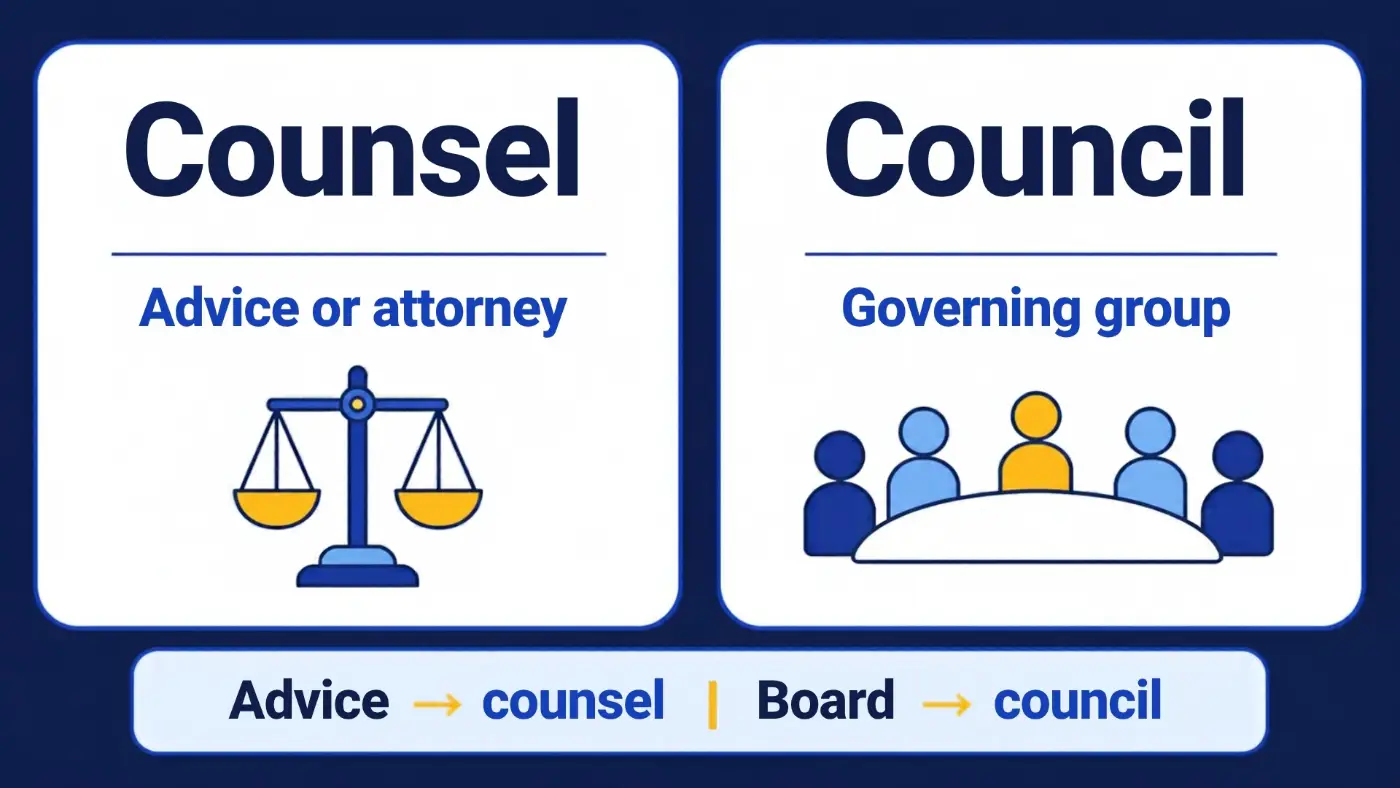
Counsel means advice, a lawyer, or the act of advising someone. Council means a group of people who meet to govern, decide, or advise. If you can swap in “advice,” “attorney,” or “advise,” write counsel; if you can swap in “committee” or “board,” write council.
The Short Answer at a Glance
- Counsel (noun): advice, or a lawyer who represents a client. The senator ignored her chief of staff’s counsel.
- Counsel (verb): to advise or recommend. Dr. Okafor counsels families through grief.
- Council (noun only): an assembly that governs or deliberates. The Tulsa city council voted 6-3.
- Memory hook: council = committee (C for crowd); counsel = suggestion (S for solicitor, suggestion, sage advice).
What Counsel Means and How It Works
Counsel carries three related jobs, and all of them circle around one idea: someone giving guidance to someone else.
Counsel as advice. In its oldest sense, counsel is the guidance one person offers another. It is a slightly formal, slightly weighty word. You would ask a friend for advice over coffee, but you might seek a mentor’s counsel before a career-defining decision. The noun is usually uncountable in this sense: you receive “good counsel,” not “a counsel.”
Counsel as a lawyer. In legal settings, counsel names the attorney or attorneys handling a case. It is unusual because the form never changes for number. “Counsel for the plaintiff” can describe one attorney or a team of five, and a judge can say “both counsel approach the bench” without adding an s. Related legal phrases include general counsel (the top in-house lawyer at a company), outside counsel (a law firm hired from the outside), defense counsel, and of counsel (an attorney affiliated with a firm without being a partner or regular associate).
Counsel as a verb. To counsel is to advise, often with an emphasis on care or caution. Therapists, guidance staff, financial planners, and clergy counsel people. The verb takes a person as its object (“She counseled the new hires”) and often a recommendation (“He counseled patience”). In American spelling the forms are counsel, counsels, counseled, counseling. The person doing the advising is a counselor.
Fixed expressions worth knowing.
- Keep your own counsel means to stay quiet about your plans or opinions.
- A counsel of despair is advice that urges giving up.
- A counsel of perfection is advice that is ideal but impractical to follow.
- Take counsel means to consult someone before deciding.
What Council Means and How It Works
Council is simpler. It is a noun, and only a noun, for a body of people formally brought together to make decisions, give direction, or offer recommendations.
The size and power vary enormously. A city council passes zoning ordinances and approves budgets. A student council plans the spring dance and negotiates with the principal about the dress code. A tribal council governs on behalf of a Native nation. The United Nations Security Council has fifteen members and can authorize sanctions or peacekeeping missions. Companies, charities, and professional groups also use the word, as in a “council of advisors” or the “National Council of Teachers of English.”
Because a council is made up of people, the members are councilors (spelled councilor in US usage).
One historical footnote explains why the pair is so slippery. Both words descend from Latin ancestors that sat close together in meaning and sound: one for advice, one for an assembly gathered to deliberate. Centuries of overlap in French and English left two words that look nearly alike but ended up with separate jobs.
Counsel vs Council: Key Differences Side by Side
| Feature | Counsel | Council |
|---|---|---|
| Part of speech | Noun and verb | Noun only |
| Core meaning | Advice; a lawyer; to advise | A governing or advisory assembly |
| Plural | Counsel (lawyers) or counsels (rare, for pieces of advice) | Councils |
| Person word | Counselor (advisor, lawyer, camp supervisor) | Councilor (member of a council) |
| Typical settings | Courtrooms, therapy, mentoring, formal speech | City halls, schools, boards, governments |
| Substitution test | Replace with advice, attorney, or advise | Replace with committee or board |
| Can it be a verb? | Yes (to counsel) | No |
The most useful row is the verb line. If your sentence needs an action word, council is automatically wrong. If your sentence names a group of decision-makers, counsel is almost always wrong, with the single exception of counsel meaning the lawyers on a case, which is a legal team rather than a governing body.
Correct Examples in Real-Life Contexts
Counsel
- Priya Venkataraman asked her grandfather for counsel before accepting the job in Singapore.
- Defense counsel objected twice before the jury returned to the room.
- The hospital’s general counsel reviewed the merger documents over the weekend.
- Her coach counseled caution after the marathon runner’s second stress fracture.
- Marcus kept his own counsel at the family dinner, even as his cousins argued about the will.
Council
- The Asheville city council approved funding for three new bus routes.
- Naomi ran for student council because the cafeteria menu needed a serious rethink.
- Members of the tribal council met in Window Rock to discuss water rights.
- The village council rejected the developer’s plan to build on the wetland.
- A council of retired teachers advises the district on curriculum changes.
Common Mistakes People Make (and How to Catch Them)
Mistake 1: Using council for advice. Wrong: The retired judge offered the young attorney a word of council. Right: The retired judge offered the young attorney a word of counsel. Catch it: If the word means “advice,” no group of people is involved. Test by swapping in “advice.”
Mistake 2: Using counsel for a governing group. Wrong: The town counsel decided to close the library on Mondays. Right: The town council decided to close the library on Mondays. Catch it: A group that votes is a council. (Be careful: “town counsel” is a real term in some municipalities, meaning the town’s lawyer, so the error is easy to make and easy to miss. If the sentence has the lawyer doing the deciding, something is off.)
Mistake 3: Turning council into a verb. Wrong: Her mentor councils new managers every quarter. Right: Her mentor counsels new managers every quarter. Catch it: Council never acts. If the word does something to a person, it must be counsel.
Mistake 4: Mixing up the person words. Wrong: The councilor at the clinic helped him manage his anxiety. Right: The counselor at the clinic helped him manage his anxiety. Catch it: The person who advises is a counselor. The person who sits on a council is a councilor.
Mistake 5: Adding an s to counsel meaning attorney. Wrong: The counsels for each side met in chambers. Right: The counsel for each side met in chambers. (Or: Counsel for each side met in chambers.) Catch it: In the legal sense, counsel does not take a plural s.
A Fast Trick to Choose the Right One
Run a two-second substitution test:
- Swap in “advice” or “advise.” If the sentence still makes sense, use counsel.
- Swap in “committee” or “board.” If that works, use council.
For a visual cue, look at the letters that differ. Counsel has an s for suggestion (and solicitor, the British cousin of the lawyer sense). Council has a c for committee or crowd. When you are about to type the word, ask which of those two ideas you mean.
Test it on a sentence: “The mayor met with the (counsel/council) to discuss the budget.” Does the mayor meet with advice? No. Does she meet with a committee? Yes. Council.
How They Sound in Real Situations
Passage 1: A courtroom hallway. “I’ve asked opposing counsel for another extension,” Lena said, tightening her grip on the file folder. “But if the judge doesn’t grant it, we’ll need to be ready by Friday. My advice, and I’m giving you my honest counsel here, is to stop emailing the client at midnight.”
Notes: Counsel appears twice: once as the lawyer on the other side, once as honest advice. Neither involves a group.
Passage 2: A city hall meeting. The Duluth city council met until nearly eleven, debating whether to rezone the old shipyard. Councilor Reyes spoke against the plan, while Councilor Whitfield argued it would bring jobs. After three hours, the council voted 5-4 to postpone a decision.
Notes: Every use of council refers to the assembled body, and councilor names a single member.
Passage 3: A kitchen-table conversation. After weeks of worrying about whether to leave the bakery, Tomás finally asked his sister for counsel. She counseled patience and suggested he wait until after the holidays. He kept his own counsel at work and mentioned nothing to his boss.
Notes: Counsel is advice (noun) in the first and third sentences, and counseled is the verb in the second.
Formal Writing vs Casual Writing
In formal and professional writing, both words keep their full weight. Legal documents, contracts, and court filings lean heavily on counsel. Government reports, meeting minutes, and press releases use council constantly. Mixing them up in these settings looks careless, and in legal writing it could muddy meaning.
In casual speech, counsel as “advice” sounds a little old-fashioned. Most people say “advice” or “tips” in conversation. Counsel as a verb, though, is still common in professional settings: therapists counsel, school staff counsel students, and financial professionals counsel clients. You may hear “I’ll counsel you on that” in an office, but “I’ll give you advice” is more relaxed.
US vs UK English Differences
The two words keep the same core meanings on both sides of the Atlantic, but several related forms are spelled differently.
| Form | US | UK |
|---|---|---|
| Past tense of counsel | counseled | counselled |
| Present participle | counseling | counselling |
| Person who advises | counselor | counsellor |
| Member of a council | councilor (sometimes councillor) | councillor |
British English also uses council in everyday phrases that sound unfamiliar to Americans, such as council tax (a local property tax), council house (public housing), and the local council (the municipal government). American English uses city council or town board for similar ideas.
Related Mix-Ups People Also Search For
- Councilor vs counselor. The first sits on a council; the second gives advice. A camp counselor, a school counselor, and a legal counselor all fall under the advising meaning.
- Counsel vs consul. A consul is a government official stationed in a foreign city to help citizens and handle trade matters. The word has nothing to do with advice despite sharing letters.
- Counsel vs advice. Advice is the everyday word; counsel is its more formal, solemn cousin. Advice is a noun, advise is the verb, and counsel does both jobs.
Exceptions, Edge Cases, and Tricky Situations
Counsels is real, but rare. In literary or older usage, you may find “counsels” for pieces of advice: “the counsels of her elders.” This is legitimate, though it sounds antique. Most modern writers use “advice” or “guidance” instead.
“Of counsel” is a job title. In a law firm, an attorney listed as “of counsel” is a senior lawyer who is affiliated with the firm but is not a partner. It has nothing to do with councils.
A council can also give counsel. A “council of advisors” is a group (council) whose job is to offer advice (counsel). Both words can fit in the same sentence, and both would be right: “The council offered counsel to the governor.”
Counselor in the legal sense. Some US courts and law firms use “counselor” as a respectful title for an attorney: “Counselor, you may proceed.” It is a courtesy form, not a spelling error.
Quick Practice: Test Yourself
Choose counsel or council for each blank.
- The mayor appointed a new member to the city ______.
- After the diagnosis, Elena sought ______ from her oncologist.
- Please let ______ for the defense finish the question.
- The coach ______ed the freshman to rest his injured knee.
- The Student ______ organized a food drive for the winter break.
- Jonah kept his own ______ about the job offer until Friday.
Answer key
- council (a governing body)
- counsel (advice)
- counsel (the defense attorney)
- counsel (verb: counseled, meaning advised)
- Council (a student governing group)
- counsel (keeping his own counsel means staying quiet)
Frequently Asked Questions
Is counsel a verb or a noun?
Both. As a noun it means advice or a lawyer. As a verb it means to advise: “She counseled him to wait.”
Can council ever be a verb?
No. Council is a noun only. If you need an action word for giving advice, use counsel.
Do I use counsel or counsels for lawyers?
Counsel is used for both single and multiple lawyers: “defense counsel” could be one person or several. Counsels for lawyers is considered incorrect in standard legal writing.
What is the difference between a counselor and a councilor?
A counselor gives advice or guidance, as in a school counselor or camp counselor. A councilor is a member of a council, as in a city councilor.

Sophia Bennett writes educational content about English vocabulary, grammar, slang, and communication. She is passionate about making complex language topics accessible to students, professionals, and curious readers around the world.