
Advice vs Advise Which Word Do You Need
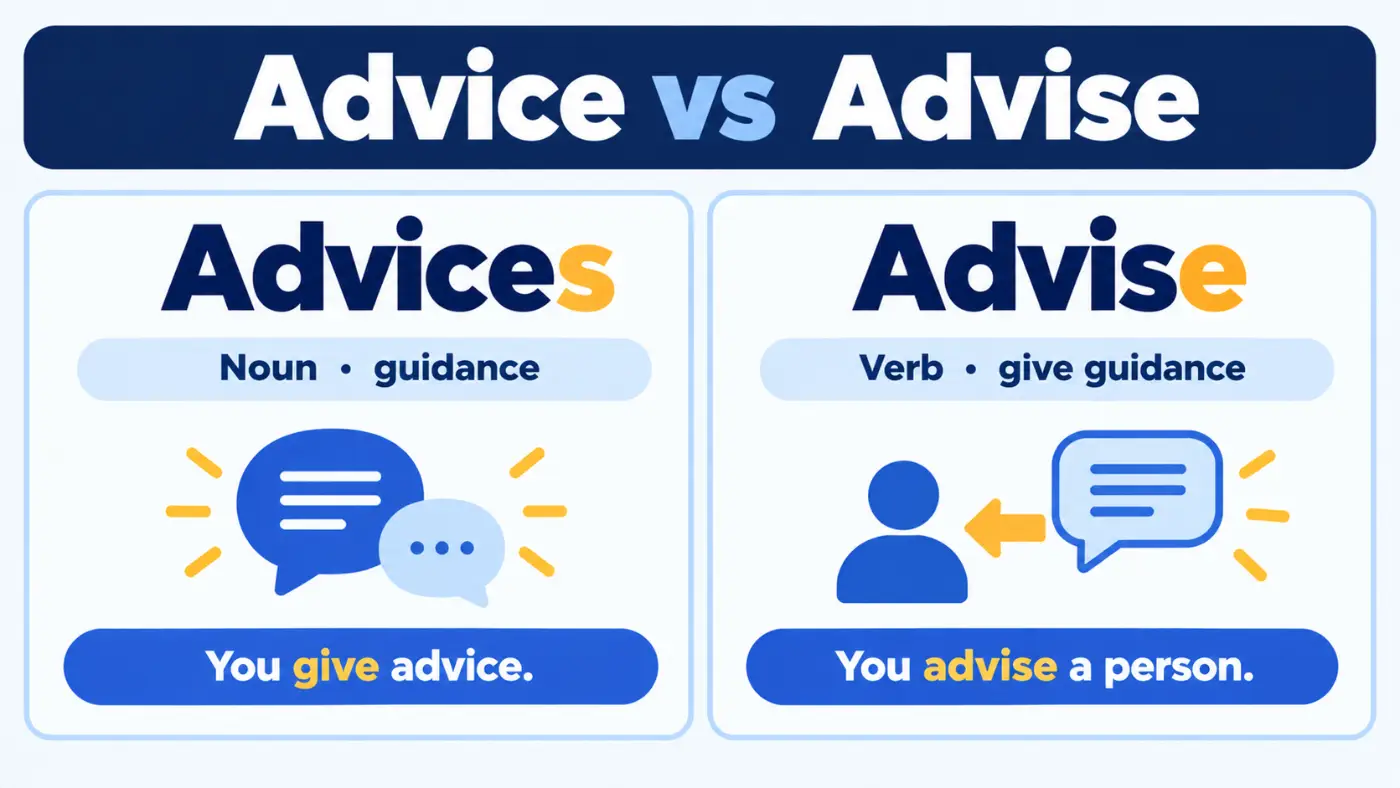
Advice is a noun for the guidance you give or get, and it ends with an s sound. Advise is a verb for the act of giving that guidance, and it ends with a z sound. You give advice, and you advise a person.
Related Post: capital vs capitol
The Short Answer at a Glance
One word is a thing, and the other is an action. Your ear can tell them apart, which is rare for a spelling pair.
| Word | Part of speech | Sound | Example |
|---|---|---|---|
| Advice | Noun. | Ends in an s sound, /ədˈvaɪs/. | Dana took her mentor’s advice and waited a week. |
| Advise | Verb. | Ends in a z sound, /ədˈvaɪz/. | Her mentor advised her to wait a week. |
What Advice Means and How It Works
Advice is a noun that names a recommendation about what someone should do. It’s the suggestion itself, and you can ask for it, give it, take it, ignore it, or follow it. A person can offer good advice, bad advice, legal advice, or a quick bit of advice about parking.
The word is uncountable, which means it doesn’t take a plural s and doesn’t pair with a or an directly. You don’t collect advices or ask for an advice. When you need to count it, borrow a measuring phrase such as a piece of advice, a word of advice, or two pieces of advice.
It usually pairs with a small set of verbs. People seek advice, give advice, take advice, heed advice, and ask for advice. It often connects to a topic with on or about, as in advice on taxes or advice about a career move.
The pronunciation is the quiet giveaway. The final sound is a crisp s, like the end of ice and price. That matches the spelling, since advice ends with the letters ice.
What Advise Means and How It Works
Advise is a verb that means to give someone advice, to recommend an action, or to inform someone formally. Someone has to do the advising, and usually someone else receives it. The forms are advise, advises, advised, and advising.
It follows several common patterns. You can advise a person directly, as in the planner advised the couple. Another option is advising that something happen, as in the doctor advised that he rest. You might also advise someone to do something, as in her lawyer advised her to sign nothing, or advise against a course of action, as in the pilot advised against flying.
Advise has a second, more formal meaning. It can mean to notify, as in the airline advised passengers of a gate change. The phrase please be advised belongs to this use, and it shows up in business and legal notices.
The pronunciation ends with a z sound, like the end of size and wise. That also matches the spelling, since advise ends with the letters ise, which sounds like eyes.
Related words follow the verb. An adviser or advisor is a person who gives advice. The adjective advisable means recommended, and advisory refers to a notice or a role that offers guidance.
Advice vs Advise Key Differences Side by Side
| Feature | Advice | Advise |
|---|---|---|
| Part of speech | Noun. | Verb. |
| Core meaning | A recommendation or guidance. | To recommend, counsel, or formally inform. |
| Final sound | s, as in ice. | z, as in eyes. |
| Countable | No, so use a piece of advice. | Not applicable, since it’s a verb. |
| Plural or past form | None in everyday use. | Advises, advised, advising. |
| Register | Neutral and fits every setting. | Neutral, with a formal edge in the sense of notify. |
| Example | Her advice saved us an hour. | She advised us to leave early. |
The table can’t show how the words team up in real life. People often use both in one sentence, as in I advise you to take her advice. The table also can’t capture how easily spelling errors slip through. Both words are real, so spellcheck rarely objects, and only the sentence structure tells you which one fits.
Correct Examples in Real Life Contexts
Advice in Action
- Everyday speech: My grandmother’s advice about bread dough was simple, never rush the second rise.
- Workplace writing: Please send me your advice on the vendor shortlist before Thursday’s meeting.
- Texting: Need your advice, should I wear the green jacket or the gray one tonight?
- School: Professor Alvarez gave the class one piece of advice about the final paper, start with the sources.
- Formal writing: The board acted on legal advice and postponed the vote until the contract review was done.
Advise in Action
- Everyday speech: The mechanic advised Tomas to replace the brake pads before the road trip.
- Workplace writing: I advise that we confirm the budget before anyone signs the agreement.
- Texting: The airline just advised that our gate moved to B14, so head that way.
- School: The counselor advises students to meet with her before the registration deadline.
- Formal writing: The agency advises residents to boil water until further notice.
- Caution: Experienced hikers advise against starting the trail after two in the afternoon.
Common Mistakes People Make and How to Catch Them
- Using advise as a noun. Wrong → I need some advise on my resume. Right → I need some advice on my resume. The thing you receive is a noun, and the noun ends with ice.
- Using advice as a verb. Wrong → I advice you to read the contract. Right → I advise you to read the contract. A sentence that needs an action needs the verb.
- Pluralizing the noun. Wrong → She gave me several advices. Right → She gave me several pieces of advice. Advice is uncountable in everyday English.
- Adding an article. Wrong → That’s an advice worth hearing. Right → That’s advice worth hearing, or that’s a piece of advice worth hearing. A and an don’t attach directly to uncountable nouns.
- Forming the past tense on the wrong word. Wrong → He adviced me to wait. Right → He advised me to wait. Only the verb has a past tense, and it takes ed.
- Misspelling the verb ending. Wrong → I advize you to call first. Right → I advise you to call first. The z sound is real, but the spelling keeps the ise ending.
- Choosing by ear in fast speech. Wrong → Writing the word that sounds familiar without checking the job it does. Right → Check whether the sentence needs a thing or an action. Speakers blur the final sound in casual speech, so the ear isn’t always reliable.
- Mixing up the person word. Wrong → My financial advicer called back. Right → My financial adviser called back. The person is an adviser or advisor, built from the verb.
A Fast Trick to Choose the Right One
Use the ear test first. Say the word aloud as you would in careful speech. If it ends with an s sound, as in ice, write advice. If it ends with a z sound, as in eyes, write advise.
Then use the swap test. Try replacing the word with suggestion. If it fits, you want advice. Try replacing it with recommend. If it fits, you want advise. In Please give me your suggestion, the swap works, so advice is correct. In Please recommend a plan, the swap works, so the verb advise fits.
A spelling hook helps too. Advice has the word ice inside it, and ice is a noun you can hold. Advise has the letters is and e, and it describes something you do.
The tricks have limits. The sound test relies on careful pronunciation, and people sometimes blur the ending when they talk fast. The swap test works best with simple sentences. In very formal wording, such as please be advised, the meaning shifts toward inform, so try the swap with notify instead.
How They Sound in Real Situations
A text exchange
Maya: Should I take the job in Denver?
Leo: I can’t decide for you, but my advice is to visit the office first.
Maya: Good call. My sister advised me to ask about relocation help too.
Leo’s advice is a noun that names a recommendation. Maya’s advised is a verb that tells what her sister did.
An email snippet
Hi Priya, thanks for your note. Our attorney advised that we hold off on signing until the changes are reviewed. If you have advice on the timeline, I’d love to hear it before Friday.
Advised that is a verb with a clause after it. The second sentence uses advice as a noun, the thing Priya might offer.
An article excerpt
City officials advise residents to charge their phones before the storm arrives. Emergency crews also shared advice for protecting pets, including a short checklist for carrying water and medicine in a go bag.
Advise is the verb that tells readers what officials are doing. Advice is the noun that names the guidance for pets.
Formal Writing vs Casual Writing
Register doesn’t change which word is correct. The noun stays advice, and the verb stays advise in a text, a business email, and a research paper.
What changes is flavor. Advise sits comfortably in formal and professional settings, especially in the sense of notify, as in the committee advised the applicants of the decision. In casual speech, people more often say tell, suggest, or recommend. A friend might say I’d tell you to skip it, while a lawyer would write we advise you to decline.
The phrase please be advised is formal. It works in business and legal notices, though some readers find it stiff, and a plain sentence often does the job better.
Both adviser and advisor are accepted spellings of the person word. Style guides and organizations differ in their preference, so follow your publication’s rule, or use one spelling consistently if you have none.
Related Mix Ups People Also Search For
Adviser vs Advisor
Both spellings are accepted for a person who gives advice. Adviser is the older form, and advisor is very common, especially in business and education titles. Pick one for each document, and keep official titles exactly as the organization writes them.
Device vs Devise
Device is a noun for a tool or gadget, and devise is a verb for planning or inventing. The pattern matches advice and advise. The engineer devised a plan to protect the device.
Practice vs Practise
In British English, practice is the noun and practise is the verb, which mirrors advice and advise. American English uses practice for both. A British writer might say she practises daily and keeps a regular practice.
Advise vs Inform
Both can mean to tell someone something, but advise carries a formal edge and often implies recommendation. Inform simply passes on facts. The clerk informed us that the store closes at six, and the manager advised us to arrive early.
Exceptions Edge Cases and Tricky Situations
- Advice can be a business notice. In trade and finance, a remittance advice or shipping advice is a formal notice. The plural advices appears in those niche settings, though everyday writing sticks with advice.
- Advise can mean to notify. The airline advised passengers of a delay means the passengers were told, and no recommendation is involved.
- Advisement appears in fixed phrases. To take a matter under advisement means to consider it carefully, and it’s common in courtrooms and meetings.
- Ill advised and well advised use the verb form as an adjective. That move was ill advised means it was a poor idea, and you’re well advised to check means it’s wise to check.
- Advice has no verb form to borrow. You can’t advice a person, so if you need a verb, switch to advise.
- Say the difference carefully when clarity matters. Some speakers merge the two sounds in rapid talk, so a quick pause on the final consonant helps in phone calls and presentations.
- Related words follow the verb. Advisable, advisory, and adviser all grow from advise, not advice.
Quick Practice Test Yourself
Choose advice or advise, in the form the sentence needs.
- My accountant gave me solid ____ about quarterly taxes.
- I would ____ you to double check the address before mailing it.
- Maria asked her coach for ____ on pacing the marathon.
- The airline will ____ passengers of any gate changes by text.
- That was a good piece of ____, and I’m glad I listened.
- Which spelling is right for a person, advicer, advisor, or advisor and adviser?
Answer Key
- Advice. It names the guidance she received, so it’s a noun.
- Advise. It’s an action done to a person.
- Advice. It’s the thing Maria asked for.
- Advise. It means notify, and the airline performs the action.
- Advice. It follows piece of, which signals an uncountable noun.
- Advisor and adviser. Both are accepted, and advicer isn’t a word.
Frequently Asked Questions
Is it advice or advise?
Use advice for the noun and advise for the verb. If you can add a piece of in front of the word, it’s advice.
How do you pronounce advice and advise?
Advice ends with an s sound, like ice. Advise ends with a z sound, like eyes. In both words the stress falls on the second syllable.
Is advices ever correct?
Rarely. In everyday English, advice is uncountable, so use pieces of advice. Advices appears only in some specialized business and legal contexts.
What is the past tense of advise?
It’s advised. The word is a regular verb, so the past tense and past participle both take ed.
Is it adviser or advisor?
Both are accepted. Choose one and use it consistently, or follow the spelling an organization uses in an official title.
Can advise mean the same as inform?
Yes, in formal writing. The airline advised passengers of a delay means the airline notified them, without any recommendation attached.

Sophia Bennett writes educational content about English vocabulary, grammar, slang, and communication. She is passionate about making complex language topics accessible to students, professionals, and curious readers around the world.
One Comment