Anyway vs Anyways: Standard Spelling and Spoken Variant
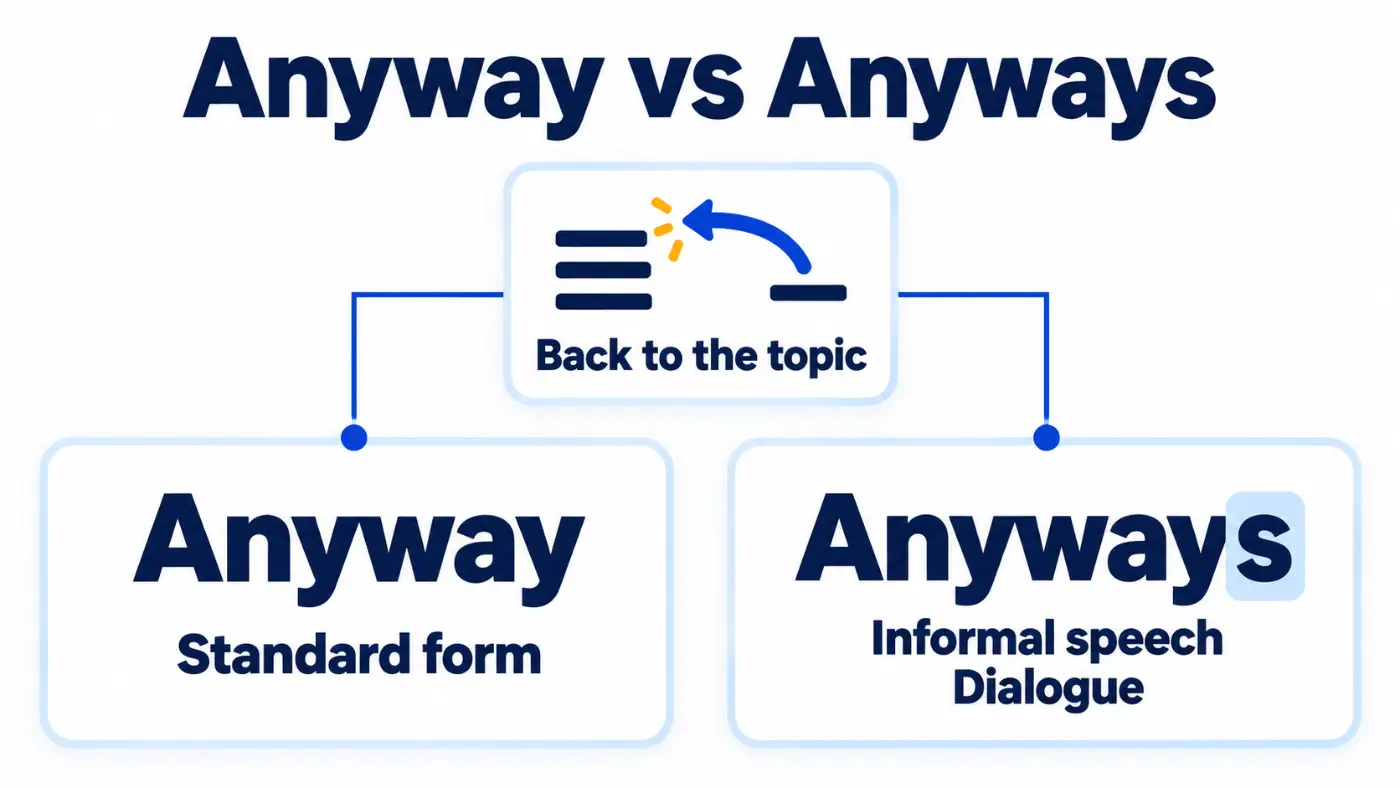
Anyway is the standard spelling for regardless, in any case, or a shift back to the main topic. Anyways is an informal variant heard mostly in speech, and most editors change it in writing. Use anyway everywhere, and keep anyways for dialogue where a character really talks that way.
Related Post: gray vs grey
The Short Answer at a Glance
| Form | Status | Meaning | Example |
|---|---|---|---|
| Anyway | Standard adverb | Regardless; in any case; back to the point | The forecast says rain, but we’re going to the lake anyway. |
| Anyways | Informal, mostly spoken variant | Same meaning as anyway | Anyways, see u at 7. |
| Any way | Two words (determiner plus noun) | Any method or manner | Is there any way to move the demo? |
Anyway and anyways share one meaning. The two word form any way is a different construction.
What Anyway Means and How It Works
Anyway is an adverb with three common jobs. It can mean regardless or despite something, as in the road was closed, but we drove out anyway. It can mean in any case, as in I don’t need the receipt, but I’ll keep it anyway. It can also signal a return to the main topic after a detour.
That last job is the one most speakers use in conversation. Anyway, as I was saying, we have two options works as a verbal bridge. It tells the listener that the side story is over.
Anyway can sit at the start, the middle, or the end of a sentence. It can also end a question, as in why are you here anyway, where it asks for the real reason. The word has no plural and no other forms.
It’s written as one word. The spelling is standard in every kind of writing, from texts to academic papers.
What Anyways Means and How It Works
Anyways carries the same meaning as anyway. It’s an adverb that means regardless, in any case, or back to the point. The only difference is the extra s and the register.
Dictionaries label anyways as informal, dialectal, or nonstandard, and they note that it’s mostly spoken. It’s common in everyday conversation, especially in North America. It also shows up in texts, casual posts, and fictional dialogue.
The extra s isn’t unique to this word. English has a group of adverbs that take a trailing s in casual speech, such as nowheres and somewheres. Some of these forms are older and some are newer, but editors treat most of them as nonstandard in edited prose.
Anyways isn’t a mistake in the sense of a random slip. It’s a real variant, widely understood, and people use it on purpose. It simply isn’t the form that most style guides and editors accept in formal writing.
Anyway vs Anyways: Key Differences Side by Side
| Feature | Anyway | Anyways |
|---|---|---|
| Part of speech | Adverb | Adverb |
| Core meaning | Regardless; in any case; back to the point | Same meaning |
| Typical use | All writing and speech | Informal speech, texts, dialogue |
| Register | Standard in every register | Informal; often edited out |
| Example | We finished the draft anyway. | We finished the draft anyways. |
The meaning is the same in both rows, so the choice rests on tone and audience. A reader will understand either word. A professional reader may react to the extra s.
The table also can’t show how the word sounds in speech. In natural talk, the s sound at the end can slide in or out without notice. That’s why writers sometimes type what they hear.
Correct Examples in Real-Life Contexts
Anyway
- Everyday speech: The forecast says rain, but we’re going to the lake anyway.
- Texting: anyway, back to the group chat, what time are we meeting
- Workplace writing: The deadline moved, but the client approved the budget anyway.
- School or academic: The results looked weak, but the researchers ran the second trial anyway.
- Formal writing: The committee reviewed the appeal anyway, even though the filing deadline had passed.
- Transition: Anyway, as I was saying about the budget, we have two options.
Anyways
These examples show informal, spoken style, where the variant is common.
- Casual speech: Anyways, I told him I’d bring the chairs.
- Texting: anyways, see u at 7
- Fiction dialogue: Anyways, we just kept playing, the coach said.
- Casual blog: Anyways, that’s my weekend in a nutshell.
Common Mistakes People Make (and How to Catch Them)
Mistake 1: Using anyways in formal writing. Wrong: The board approved the plan anyways. → Right: The board approved the plan anyway. The variant sounds like speech. Formal prose keeps the standard form.
Mistake 2: Splitting the adverb into two words. Wrong: The road was closed, but we drove any way. → Right: The road was closed, but we drove anyway. In speech, no space shows, and any way is a real phrase. The adverb that means regardless needs one word.
Mistake 3: Joining a phrase that should stay split. Wrong: Is there anyway to fix this? → Right: Is there any way to fix this? Here the meaning is any method, so the two words stay apart. The one word form would mean regardless.
Mistake 4: Merging in any way. Wrong: She can’t help in anyway. → Right: She can’t help in any way. In any way is a fixed phrase that means in any manner. The two word form is the standard choice.
Mistake 5: Adding an s to other adverbs. Wrong: I looked everywheres for my keys. → Right: I looked everywhere for my keys. The same speech habit that creates anyways creates everywheres and somewheres. Editors treat these forms as nonstandard.
Mistake 6: Editing a quotation. Wrong: A writer silently changes a speaker’s anyways to anyway inside a direct quote. → Right: Keep the speaker’s wording inside quotation marks. Quotes preserve what was said. Change the spelling only in your own prose.
A Fast Trick to Choose Between Anyway and Anyways
Swap in regardless or in any case. If the sentence still works, write anyway, and leave off the s.
Try it on a real sentence. We went to the lake ___. Regardless fits, so the answer is anyway. Now test a second one: Is there ___ to fix this? Regardless doesn’t fit, but any method does, so the answer is any way, as two words.
A short rule helps. Write anyway for every piece of writing, and keep anyways for dialogue where a character talks that way.
For a spelling hook, remember that way is singular in all three forms. The word means one route, one path, or one case, so no plural s is needed.
The trick has limits. It tells you which form is standard, but it can’t tell you how a speaker talks. If you quote someone who says anyways, the quotation should keep it.
How They Sound in Real Situations
A text exchange
Maya: The forecast says rain on Saturday. Dev: We’re going to the lake anyway. Bring a jacket. Maya: Anyways, I’ll pack snacks.
Anyway is the standard form in Dev’s line. Maya’s anyways is a natural informal choice in a text between friends.
An email snippet
Subject: Budget approval
Hi Elena, the deadline moved, but the client approved the budget anyway. Is there any way to confirm the new dates by Friday? I’ll update the schedule once we hear back.
Anyway is the standard adverb. Any way is the two word phrase that means any method.
An article excerpt
The coach said the team trailed by ten points at halftime. We just kept playing anyway, he told reporters. Nobody on the bench thought the game was over.
Anyway is the standard form in a news story. If the coach had said anyways, the writer could keep it inside quotation marks.
Formal Writing vs Casual Writing
Anyway is standard in every register. Academic papers, business emails, journalism, social media, and texts all use it. Anyways is common in casual speech, but most editors treat it as nonstandard in writing.
Dictionaries label anyways informal or dialectal. Style guides generally advise against it in edited prose. In a formal document, it can look careless, even though readers understand it.
In fiction and quoted speech, anyways can be a useful choice. It signals a casual voice, a regional style, or a relaxed character. In that setting, it’s a deliberate decision and not an accident.
US vs UK English Differences
Anyways is mostly heard in North American English. British speakers tend to say anyway in both speech and writing, and they use anyways less often.
A reader in either region will understand both words. A British editor may mark the variant more quickly than an American one, but most editors in both countries prefer anyway in formal prose.
The spelling of the standard form is the same in American and British English. Anyway has no regional variant.
Related Mix-Ups People Also Search For
Any Way vs Anyway
Any way is two words. Any is a determiner, and way is a noun, so the phrase means any method or manner. Anyway is one word, and it means regardless. If you can swap in any method, use two words.
Is there any way to fix this, or should we replace it anyway?
Anyhow vs Anyway
Anyhow is a close synonym of anyway. Both mean in any case, and both can shift the topic back to the main point. Anyhow can sound a little more casual or old fashioned in some settings.
We missed the train, but we got there anyhow.
Regardless vs Irregardless
Regardless means without regard for something. Irregardless is a nonstandard variant, and most editors change it. The pattern is similar to anyways, since both are informal forms of standard adverbs.
The council approved the plan regardless of the objections.
Exceptions, Edge Cases, and Tricky Situations
Anyway as a topic shifter. In Anyway, back to the budget, the word doesn’t mean regardless. It signals a return to the main subject. Both forms can do that in speech, but only anyway is standard in writing.
Anyway at the end of a question. In why are you here anyway, the word asks for the real reason. It adds a sense of what’s behind the situation.
Anyway as at least. In well, I think so, anyway, the word means at least or as far as I know. The use is informal but common.
Any way in fixed phrases. In any way, in no way, and any way you can all use two words. In each case, any is a determiner that describes the noun way.
Dialogue and voice. Writers of fiction and journalism often keep anyways inside quotation marks. That choice preserves the character’s voice and doesn’t change the narrator’s spelling.
Quick Practice: Test Yourself
Choose anyway, anyways, or any way for each sentence.
- The forecast says rain, but we’re going to the lake ___.
- Is there ___ to reschedule the demo?
- Which suits a formal report? A) The board approved the plan anyways. B) The board approved the plan anyway.
- ___, back to the budget.
- The sauce was too salty, but the guests ate it ___.
- She can’t help in ___, so we’ll ask Omar.
Answer key
- Anyway. It means regardless.
- Any way. It means any method, so it needs two words.
- B. A formal report needs the standard form.
- Anyway. It’s the standard word for a topic shift.
- Anyway. It means regardless, with no extra s.
- Any way. In any way is a fixed two word phrase.
Frequently Asked Questions
Is anyways a word?
Yes, it’s a recorded informal variant of anyway. Dictionaries label it dialectal or nonstandard, and editors often change it in writing.
Is anyways correct?
It’s understood and common in speech, but it isn’t the standard form. Use anyway in formal and professional writing.
Is it anyway or any way?
Anyway is one word and means regardless. Any way is two words and means any method.
Can I use anyways in a text?
Yes. Texts are casual, and both forms are common there. Anyway is still the safer choice.
Is anyways British or American?
It’s mostly heard in North American English. British speakers tend to use anyway.
Can I start a sentence with anyway?
Yes. Anyway is a common transition, and it signals a return to the main topic.

Sophia Bennett writes educational content about English vocabulary, grammar, slang, and communication. She is passionate about making complex language topics accessible to students, professionals, and curious readers around the world.