Began vs Begun: Which Form Goes Where?
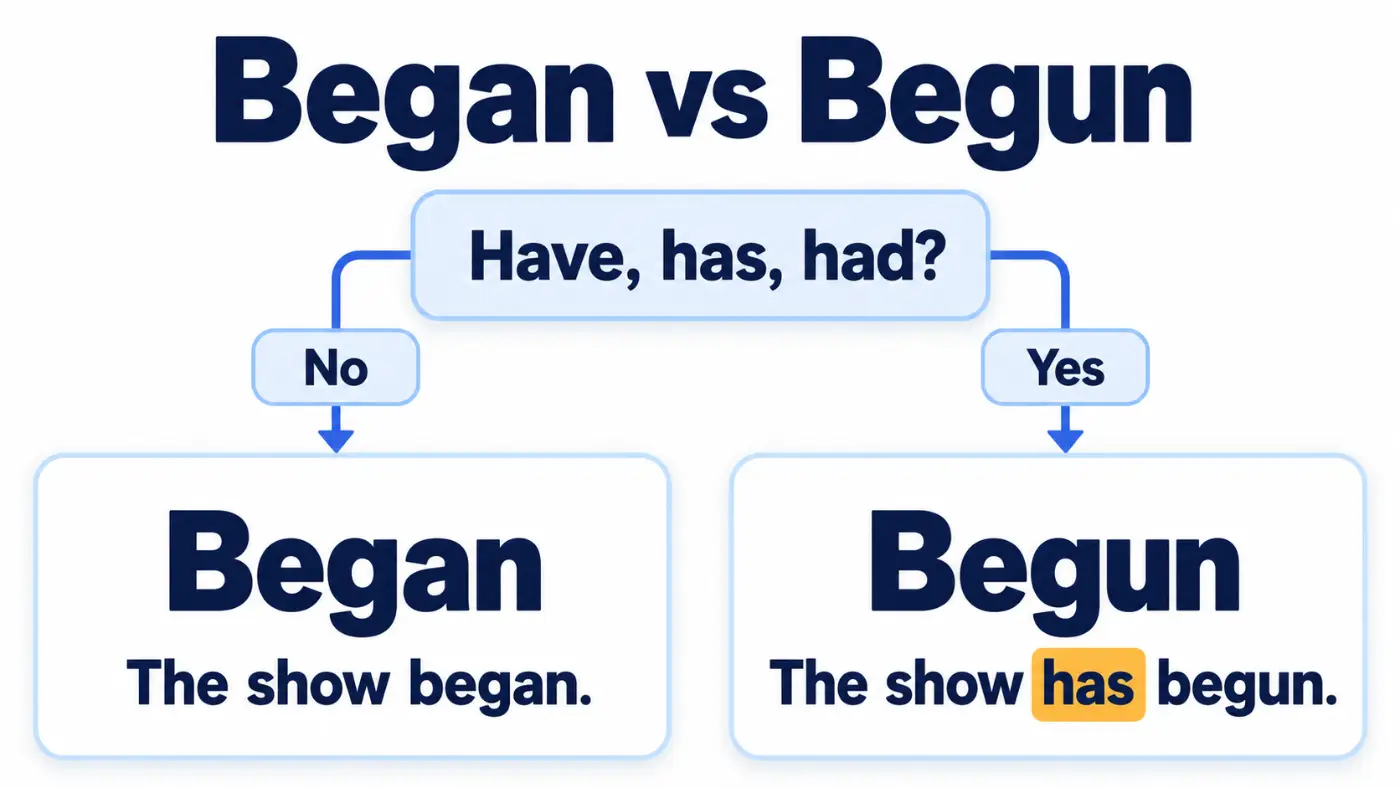
Began is the simple past of begin, and it stands on its own, as in the show began at eight. Begun is the past participle, and it needs a helper such as have, has, had, was, or been, as in the show has begun. If you can put have or had before the word, write begun.
Related Post: capital vs capitol
The Short Answer at a Glance
| Form | Verb Form | Needs a Helper? | Example |
|---|---|---|---|
| Began | Simple past | No | The storm began around midnight. |
| Begun | Past participle | Yes (have, has, had, was, been) | The storm has begun to ease. |
The two forms come from the same verb, and they never trade places in standard writing. A helper word is the quickest clue.
What Began Means and How It Works
Began is the simple past tense of begin. It describes something that started at a specific point in the past and is finished as a starting event. The subject comes first, then began, with no helper in between.
It pairs naturally with time markers that point to a finished moment, such as yesterday, last week, in 2019, or two hours ago. The class began ten minutes ago is a typical sentence. The word marks the moment the action kicked off.
Began never takes a helper in standard English. You write she began, not she had began or she did began. When a helper such as did appears, the main verb returns to its base form, as in did she begin.
The word follows a pattern shared by several irregular verbs. Begin, began, begun matches sing, sang, sung and ring, rang, rung. The vowel shifts from i to a in the simple past.
What Begun Means and How It Works
Begun is the past participle of begin. A past participle is the form that works with a helper verb to build perfect tenses or passive sentences. It never stands alone as the main verb in standard writing.
It follows have, has, or had in perfect tenses. The meeting has begun, the work had begun, and they will have begun by noon all use it. It also follows forms of be in passive sentences, as in the project was begun in 2022.
Begun can act as an adjective in a few formal phrases. Once begun, the audit can’t be paused uses it that way. The proverb well begun is half done does too.
The form matches the pattern of sung, rung, and swum. It shifts the vowel from i to u. A handy hook is that begun rhymes with done, and both are participles that need a helper.
Began vs Begun: Key Differences Side by Side
| Feature | Began | Begun |
|---|---|---|
| Verb form | Simple past | Past participle |
| Helper needed | No | Yes |
| Typical pattern | Subject plus began | Have, has, had, was, or been plus begun |
| Time markers | Yesterday, last week, ago | Already, yet, by noon, since |
| Example | The festival began on Friday. | The festival has begun. |
The table makes the split look clean, and in careful writing it is. The confusion comes from speech, where a perfect tense can blur into a simple past and where some dialects use begun without a helper.
The table also can’t show how the choice changes the meaning. Began names the starting moment. Have begun links the starting moment to the present, as in the work has begun and is still going. That link to now is why the perfect tense exists.
Correct Examples in Real-Life Contexts
Began
- Everyday speech: The storm began around midnight and rattled the shutters until dawn.
- Texting: class began 10 mins ago and i’m still in the parking lot
- Workplace writing: Our new hire began on Monday and already fixed the shared calendar.
- School or academic: The experiment began with a control group of twelve seedlings.
- Formal writing: Construction began in March, shortly after the city approved the permit.
- Narrative use: She began writing her novel the summer she turned nineteen.
Begun
- Everyday speech: We’ve begun to see the first tomatoes on the vines.
- Texting: has the meeting begun or are we still waiting for ravi?
- Workplace writing: Work on the budget had already begun when the new director arrived.
- School or academic: By the third week, the class had begun reading the longer essays.
- Formal writing: Once begun, the audit cannot be paused without written approval.
- Passive use: The renovation was begun in 2022 and finished last spring.
Common Mistakes People Make (and How to Catch Them)
Mistake 1: Using began after a helper. Wrong: We have began the process of moving offices. → Right: We have begun the process of moving offices. Began feels like the natural past tense, so the helper gets ignored. A perfect tense needs the participle.
Mistake 2: Using begun without a helper. Wrong: The show begun at eight. → Right: The show began at eight. Begun sounds familiar in the perfect tense, and some dialects use it as a simple past. Standard writing keeps began for the simple past.
Mistake 3: Writing had began. Wrong: By noon, the crowd had began to leave. → Right: By noon, the crowd had begun to leave. Had signals the past perfect, which takes the participle. The helper and the participle must match.
Mistake 4: Putting began after did. Wrong: When did the meeting began? → Right: When did the meeting begin? Did already marks the past tense, so the main verb takes the base form. The same rule gives didn’t begin, not didn’t began.
Mistake 5: Using began in a passive sentence. Wrong: The project was began in May. → Right: The project was begun in May. Passive sentences use a form of be plus the past participle. Begun is the participle.
Mistake 6: Treating the verb as regular. Wrong: It beginned to rain. → Right: It began to rain. Begin is irregular, so it doesn’t take ed. Forms such as beginned and begined aren’t standard.
Mistake 7: Trusting the spellchecker. Both words are real, so no tool will underline the wrong one. Reread every sentence that contains either.
A Fast Trick to Choose Between Began and Begun
Use the helper test. If you can put have, has, or had in front of the word, write begun. If the word works with yesterday and no helper, write began.
Try it on a real sentence. The concert ___ at 8 p.m. sharp. A helper doesn’t fit, but yesterday does, so the answer is began. By the time we arrived, the game had already ___. A helper is already there, so the answer is begun.
A sound hook helps too. Begun rhymes with done, and both forms need a helper. Began rhymes with ran, and both stand alone as a simple past.
The trick has limits. After did or didn’t, neither form fits, and the base form begin takes over. In some dialects, speakers use begun without a helper, so you may hear it in speech even though standard writing avoids it.
How They Sound in Real Situations
A text exchange
Maya: Has the meeting begun? Dev: It began at ten, but they’ve only begun the budget. Maya: Okay, I’ll join in five.
Begun follows has and have in the perfect tenses. Began stands alone and points to a finished starting moment at ten.
An email snippet
Subject: Installation update
Hi Elena, construction began on Monday, and the crew has already begun the second floor. I’ll send photos on Friday. Let me know if you need the schedule in writing.
Began is the simple past for the start on Monday. Has begun links the second floor work to the present.
An article excerpt
The festival began on a cold Friday morning, and by noon the crowds had begun to fill the riverfront. Organizers said the first day set a record for early arrivals.
Began is a simple past with no helper. Had begun is the past perfect, and it shows that the crowds started before noon.
Formal Writing vs Casual Writing
Both forms are standard in every register. Academic papers, business emails, journalism, social media, and texts all use began as the simple past and begun as the participle. The distinction holds across all of them.
Casual speech blurs the line in some dialects. People may say I begun working there in May, and listeners understand. Standard written English keeps began for that sentence.
Formal writing uses begun in a few set phrases. Once begun, well begun, and the work was begun all sound formal and polished. Casual writing usually replaces them with started.
The same rules hold in American and British English, so no regional split applies to this pair.
Related Mix-Ups People Also Search For
Sang vs Sung
Sang is the simple past of sing, and sung is the past participle. The same helper test works. Use sung after have, has, or had.
The choir sang at noon, and it has sung there every year since.
Drank vs Drunk
Drank is the simple past of drink, and drunk is the past participle. The adjective drunk also describes someone intoxicated, which is a separate use. Use the helper test for the verb forms.
She drank the water and had drunk two glasses before lunch.
Rang vs Rung
Rang is the simple past of ring, and rung is the past participle. The same pattern applies to swim, which gives swam and swum. When a helper is present, use the participle.
The bell rang at nine, and it has rung every morning since.
Exceptions, Edge Cases, and Tricky Situations
Begun as an adjective. In Once begun, the process continues, the word works like an adjective. The use is formal, and it appears in laws and contracts. The proverb well begun is half done uses it too.
Dialect forms. Some speakers use begun for the simple past, as in I begun to worry. That choice appears in spoken dialects and in some dialogue. Standard written English uses began.
Questions and negatives. After did, does, or do, the main verb returns to the base form. You write did it begin, does it begin, and didn’t begin. Neither began nor begun fits after those helpers.
Be forms in the passive. Passive sentences use the participle after is, was, were, or been. The project was begun, and the work has been begun, are standard, though many writers recast them with started.
Began with progressive forms. A phrase such as was beginning describes an ongoing start, as in the sun was beginning to rise. The ing form is a separate tool. It doesn’t replace began or begun.
Quick Practice: Test Yourself
Choose began, begun, or begin for each sentence.
- The concert ___ at 8 p.m. sharp.
- By the time we arrived, the game had already ___.
- Which is correct? A) She has began her training. B) She has begun her training.
- When did the meeting ___?
- The first draft was ___ in January and finished in May.
- Yesterday I ___ reading the new novel.
Answer key
- Began. It’s the simple past, and no helper appears.
- Begun. Had signals the past perfect, which takes the participle.
- B. Has needs the participle.
- Begin. Did takes the base form.
- Begun. Passive sentences use the participle after was.
- Began. Yesterday marks a finished moment, so the simple past fits.
Frequently Asked Questions
Is it began or begun?
Began is the simple past, as in it began. Begun is the past participle, as in it has begun.
Can you say I begun?
Some dialects do, but standard written English uses I began. Begun needs a helper such as have or had.
What is the past participle of begin?
Begun. It goes with have, has, had, and forms of be.
Is it had began or had begun?
Had begun is correct. The past perfect takes the past participle.
Is it when did it began or when did it begin?
When did it begin is correct. After did, the main verb stays in the base form.
What is the past tense of begin?
Began. It stands on its own as the simple past.

Sophia Bennett writes educational content about English vocabulary, grammar, slang, and communication. She is passionate about making complex language topics accessible to students, professionals, and curious readers around the world.