Well-Being vs Wellbeing: Which Spelling Is Correct?
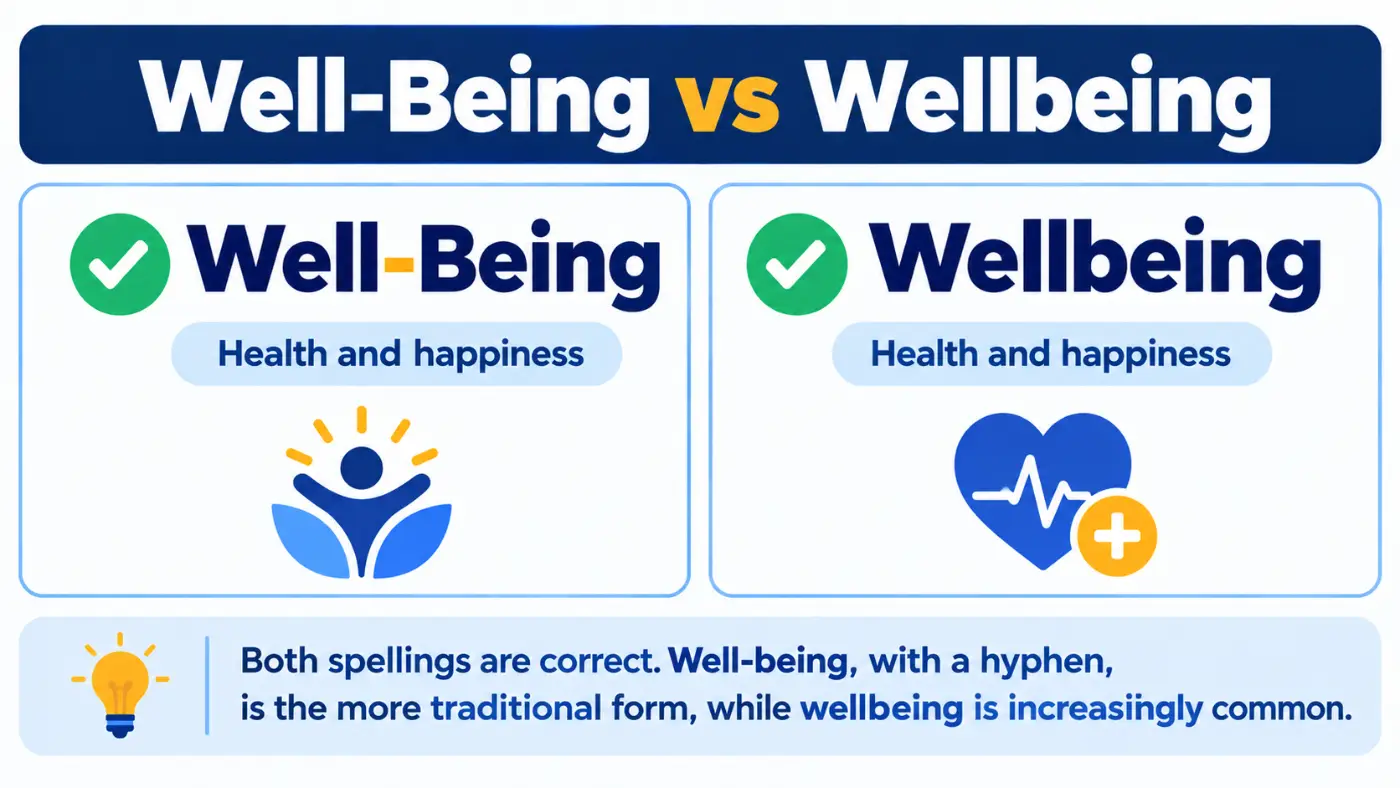
Both spellings are correct. Well-being, with a hyphen, is the more traditional and still widely used form, while wellbeing, written as one word, has become increasingly common, especially in health, wellness, and workplace writing.
The Short Answer at a Glance
| Form | Status | What it does | Example |
|---|---|---|---|
| well-being | Traditional, widely accepted | Noun referring to a state of health, happiness, or comfort | The retreat focuses on mental and physical well-being. |
| wellbeing | Increasingly common, also accepted | Identical meaning, written as a single word | The retreat focuses on mental and physical wellbeing. |
Both forms mean exactly the same thing. The choice generally comes down to house style, industry convention, or personal preference rather than strict correctness.
What Well-Being Means and How It Works
Well-being is a noun referring to a general state of being healthy, happy, comfortable, or satisfied with life. It’s a broad, holistic term, often encompassing physical health, mental health, emotional stability, and overall life satisfaction all at once, rather than referring narrowly to just one of those dimensions.
The hyphenated form has long been the standard in dictionaries and formal writing, reflecting how English often hyphenates compound words built from an adjective or adverb and a noun-like element, at least until that compound becomes common enough to merge into a single word over time. Well-being follows a pattern similar to other hyphenated compounds like “well-known” or “well-mannered,” where “well” combines with another element to form a single descriptive concept.
Grammatically, well-being functions as an uncountable noun in nearly all its uses. You’d say “her well-being improved” rather than “her well-beings improved,” since it describes an overall state rather than a collection of individual, countable things. It frequently appears in phrases like “physical well-being,” “emotional well-being,” and “financial well-being,” each specifying a particular dimension of the broader concept.
The word appears constantly in healthcare, psychology, workplace policy, and public health discussions, often in contexts emphasizing holistic care rather than treating physical and mental health as entirely separate concerns.
What Wellbeing Means and How It Works
Wellbeing means exactly the same thing as well-being: a state of health, happiness, comfort, or overall life satisfaction. The definition, grammatical behavior, and typical usage are identical between the two forms.
The single-word spelling reflects a broader, very common pattern in English where hyphenated compounds gradually lose their hyphen as they become more established and familiar over time. Words like “email” (once “e-mail”) and “online” (once “on-line”) followed this same trajectory, and wellbeing appears to be following a similar path, particularly in health, wellness, and corporate contexts where the term is used so frequently that writers increasingly treat it as a single, unified concept rather than two joined words.
Wellbeing has become especially common in British English and in international health and wellness writing, though it appears in American writing as well, particularly in workplace wellness programs, HR documentation, and psychology-adjacent content. Some major dictionaries now list wellbeing as an accepted variant alongside well-being, reflecting this genuine shift in usage.
Grammatically, wellbeing behaves identically to well-being in every respect, functioning as an uncountable noun and appearing in the same kinds of phrases: “employee wellbeing,” “mental wellbeing,” “financial wellbeing.”
Well-Being vs Wellbeing: Key Differences Side by Side
| Feature | Well-Being | Wellbeing |
|---|---|---|
| Part of speech | Noun | Noun |
| Core meaning | A state of health, happiness, or comfort | Identical meaning |
| Typical use | Traditional formal writing, dictionaries, medical and psychological literature | Health and wellness industries, HR and workplace writing, increasingly common overall |
| Register | Standard in all registers | Standard in all registers, especially common in modern wellness contexts |
| Example | The program supports employees’ overall well-being. | The program supports employees’ overall wellbeing. |
What the table can’t fully capture is the ongoing shift in usage happening in real time. Well-being remains the more traditional, dictionary-standard form, but wellbeing has gained significant ground, particularly in newer industries and publications built around health, mindfulness, and workplace culture, where the single-word form now often appears as the default.
Correct Examples in Real-Life Contexts
Everyday speech
- I’ve really been focusing on my well-being since starting therapy.
- Taking walks every day has done wonders for her wellbeing.
- We just want to make sure you’re okay, your well-being matters to us.
- The whole family’s wellbeing depends on everyone getting enough sleep, honestly.
Workplace writing
- The company launched a new initiative focused on employee well-being.
- Our wellbeing program now includes free access to a meditation app.
- HR is conducting a survey to assess overall staff well-being this quarter.
- Leadership emphasized that financial wellbeing is just as important as physical health.
Texting
- honestly just prioritizing my well-being this year, less stress more sleep
- this app is actually helping my wellbeing more than I expected
School and academic
- The psychology course examines how social connection influences long-term well-being.
- Her thesis explores the relationship between financial stress and mental wellbeing.
- Researchers measured student well-being using a standardized survey tool.
- The university introduced new resources to support student wellbeing during exam season.
Formal writing
- The report highlights significant gaps in public well-being across rural communities.
- The organization’s mission centers on improving community wellbeing through accessible healthcare.
- Policymakers are being urged to prioritize child well-being in the new legislation.
- The study measured wellbeing across several dimensions, including emotional and financial security.
Common Mistakes People Make (and How to Catch Them)
Assuming one spelling is simply wrong
Wrong assumption: Wellbeing is a misspelling of well-being, or vice versa. Right understanding: Both spellings are correct and widely accepted, with the choice largely depending on style preference or industry convention.
This isn’t a genuine sentence-level error, but a common misunderstanding worth clarifying, since some writers assume only one version can be “official.”
Inconsistent spelling within the same document
Wrong: The wellness guide discusses well-being in one section and wellbeing in another. Right: The guide consistently uses one spelling throughout.
Since both forms are correct, the real risk is inconsistency rather than outright error, and switching between them mid-document tends to look like a proofreading oversight.
Hyphenating unnecessarily in adjective phrases where it doesn’t apply
Wrong: We support well being initiatives across the company. (missing the hyphen entirely, without adopting the single-word form either) Right: We support well-being initiatives across the company, or We support wellbeing initiatives across the company.
Writers sometimes drop the hyphen without fully committing to the single-word spelling either, producing an inconsistent middle version, “well being” as two separate words with no hyphen, which isn’t standard in either accepted form.
Ignoring an organization’s established style guide
Wrong: A company’s HR materials use well-being in some documents and wellbeing in others, depending on the author. Right: The company consistently applies one spelling across all materials, matching its house style guide.
This isn’t a language mistake exactly, but it becomes a noticeable inconsistency at scale, particularly in official health, benefits, or policy documentation.
A Fast Trick to Choose the Right One
Check whether your organization, publication, or style guide has already made a choice, and follow that consistently. Many major dictionaries, along with more traditional or formal publications, favor well-being with a hyphen, while health, wellness, and HR-focused writing increasingly favors the single-word wellbeing.
A second approach: think of well-being’s trajectory the same way you might think of “email,” which used to require a hyphen as “e-mail” but has since become standard as one word in virtually all contexts. Wellbeing may be partway through that same kind of transition, which is exactly why you’ll see both forms used credibly and correctly across different sources.
This trick works well for making a consistent choice, but it has one limit: it won’t tell you which form will eventually “win” as the single dominant spelling, since language change of this kind tends to happen gradually and unevenly across different fields and regions.
How They Sound in Real Situations
A text exchange
Priya: You seem way more relaxed lately.
Sam: Yeah, I’ve really been prioritizing my well-being this year.
Priya: Good for you, seriously.
Well-being works naturally here in casual conversation, though wellbeing would sound equally natural in the same context.
A workplace email
Subject: New wellbeing resources available
Hi team,
We’re excited to announce new wellbeing resources, including free counseling sessions and a wellness stipend. These benefits are part of our ongoing commitment to supporting employee wellbeing across the company.
Best, Renata
Wellbeing fits naturally here, reflecting the common HR and workplace wellness convention of using the single-word form.
An article-style excerpt
Public health officials say community well-being has improved modestly over the past year, citing increased access to mental health services and expanded social support programs. Advocates argue that further investment is still urgently needed.
Well-being works well here in a more traditional, policy-focused journalistic context, though wellbeing would also be acceptable.
Formal Writing vs Casual Writing
Both spellings are appropriate across formal and casual writing, so this isn’t fundamentally a matter of register. What tends to vary more is field and context. Traditional academic, medical, and policy writing often defaults to well-being with a hyphen, following long-established dictionary conventions. Modern health, wellness, and corporate HR writing increasingly favors the single-word wellbeing, reflecting current industry trends.
Neither AP nor Chicago style has settled on a single, universally enforced preference the way they have for some other compound words, so writers and publications often make their own consistent choice within this accepted range.
Related Mix-Ups People Also Search For
Well-Being vs Welfare
These two overlap in meaning but aren’t identical. Well-being refers broadly to a state of health, happiness, or comfort, while welfare often carries a more specific connotation related to material or financial support, particularly in the context of government assistance programs. Example: The nonprofit focuses on improving community well-being, separate from any direct welfare payments it distributes.
Well-Being vs Wellness
Wellness often refers more specifically to active efforts toward achieving good health, particularly physical health, through practices like exercise, nutrition, or mindfulness, while well-being is a broader term encompassing overall life satisfaction across multiple dimensions. Example: Her wellness routine, including yoga and healthy meals, has noticeably improved her overall well-being.
Well-Known vs Wellbeing (Hyphenation Patterns)
Well-known remains consistently hyphenated in standard usage, unlike wellbeing, which has increasingly shifted toward the single-word form in many contexts. Example: The well-known researcher has spent decades studying workplace wellbeing.
Quick Practice: Test Yourself
Both spellings are correct in each of these sentences; choose whichever fits the described context.
- A traditional medical journal article discusses patient ______ following surgery. (well-being / wellbeing)
- A company’s HR wellness newsletter promotes employee ______ programs. (well-being / wellbeing)
- A dictionary entry defines the term ______ as a state of comfort and health. (well-being / wellbeing)
- A modern wellness app’s homepage advertises tools to improve daily ______. (well-being / wellbeing)
- A government policy report addresses public ______ across several regions. (well-being / wellbeing)
- A workplace culture blog discusses strategies for supporting team ______. (well-being / wellbeing)
Answer Key
- well-being: matches the more traditional convention common in medical and academic writing.
- wellbeing: matches the common single-word convention in HR and workplace wellness contexts.
- well-being: matches the traditional, dictionary-standard hyphenated form.
- wellbeing: matches the common single-word convention in modern wellness branding.
- well-being: fits comfortably in traditional policy and academic writing, though wellbeing would also work.
- wellbeing: fits comfortably in modern workplace culture writing, though well-being would also work.
Frequently Asked Questions
Is well-being or wellbeing the correct spelling?
Both are correct. Well-being is the more traditional, hyphenated form, while wellbeing, written as one word, has become increasingly common and is now widely accepted as well.
Do well-being and wellbeing mean the same thing?
Yes. Both words describe a state of health, happiness, comfort, or overall life satisfaction, with no difference in meaning.
Which spelling should I use in professional writing?
Either is acceptable, though it’s best to check whether your organization or publication has an established style preference and use that consistently throughout your writing.
Is wellbeing more common in British or American English?
Wellbeing as a single word has gained particular traction in British English and international health and wellness writing, though it also appears frequently in American writing, especially in HR and workplace contexts.
Is “well being,” without a hyphen and as two separate words, ever correct?
This form isn’t standard. The accepted options are the hyphenated well-being or the single-word wellbeing, not two separate words without a hyphen.
Will wellbeing eventually replace well-being entirely?
It’s possible, following a pattern seen in other English compounds that gradually shed their hyphens over time, but both forms currently remain in active, correct use across different fields and publications.

Sophia Bennett writes educational content about English vocabulary, grammar, slang, and communication. She is passionate about making complex language topics accessible to students, professionals, and curious readers around the world.