Suing vs Sueing: Which Spelling Is Correct?
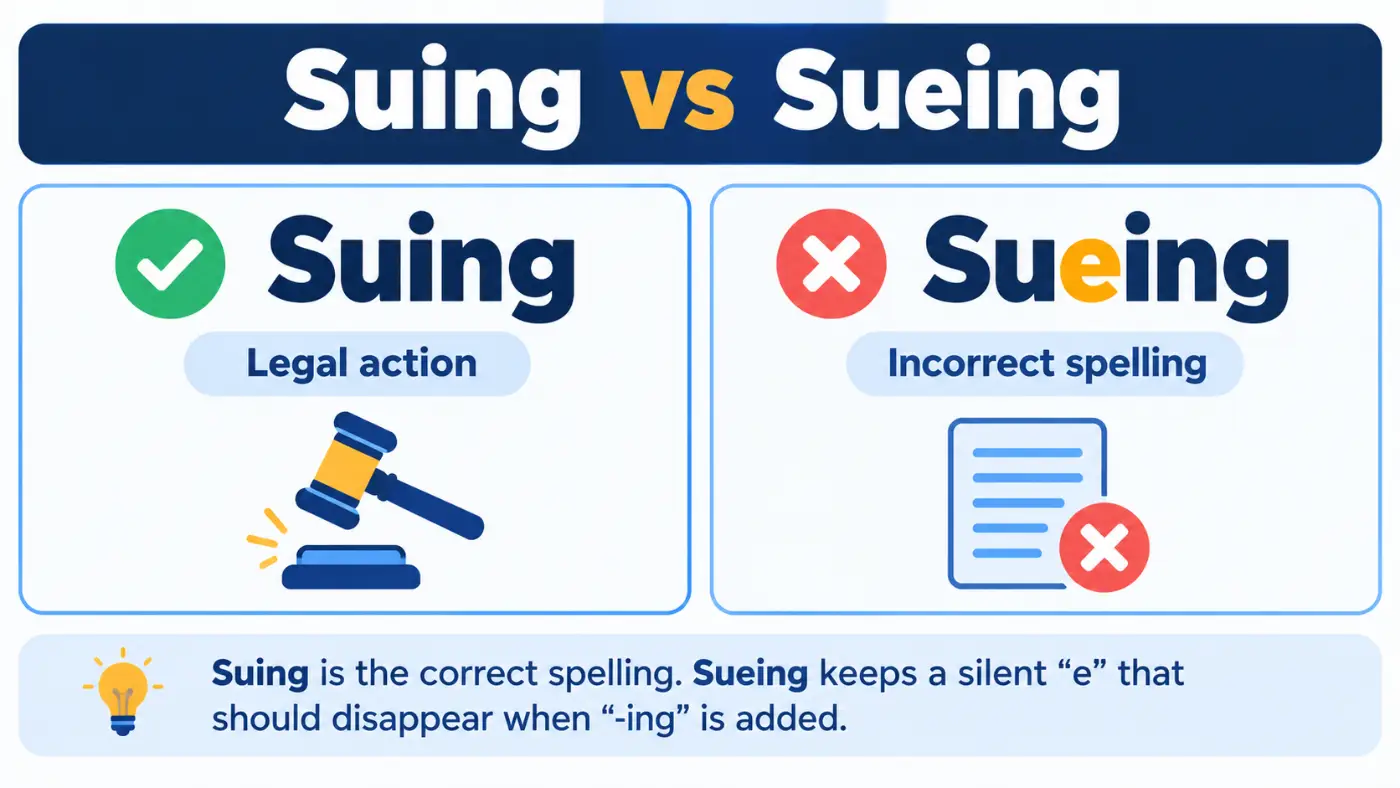
Suing is the correct spelling. Sueing keeps a silent “e” that’s supposed to disappear when “-ing” is added, a mistake that happens because dropping a letter feels less natural than simply adding one.
The Short Answer at a Glance
| Form | Status | What it does | Example |
|---|---|---|---|
| suing | Correct | Present participle of sue, describing the act of taking legal action against someone | She’s suing the contractor for breach of agreement. |
| sueing | Misspelling | Not a word in standard English | Correct it to suing every time. |
There’s only one real spelling here. The silent “e” in sue is supposed to drop before “-ing” is added, and sueing simply fails to make that drop.
What Suing Means and How It Works
Suing is the present participle of the verb sue, meaning to bring a lawsuit against someone, or to take legal action in court to seek compensation, enforce a right, or resolve a dispute. It’s a core term in legal contexts, but it also shows up constantly in everyday conversation about disputes, threats of legal action, and news coverage of court cases.
The verb sue can be used in a general sense, as in “he’s threatening to sue,” or with a specific object naming who is being sued and often why, as in “she’s suing her former employer for wrongful termination.” Suing, as the present participle, typically appears alongside a form of “to be” to build progressive tenses: is suing, was suing, has been suing.
Grammatically, suing functions as part of a verb phrase in most cases, though it can also work as a gerund, acting like a noun, as in “suing someone rarely feels satisfying, even when you win.” This dual role, participle in progressive tenses and gerund as a noun-like form, is typical of “-ing” verb forms throughout English.
The verb sue itself is a regular verb in most respects, following expected patterns for its other forms: sues, sued, and suing. The only slightly unusual step is exactly the one that creates the spelling confusion, dropping the silent “e” before adding “-ing.”
Sue comes from a root related to following or pursuing, which fits naturally with its legal meaning of pursuing a claim or remedy through the courts. That etymological connection isn’t something most speakers think about day to day, but it does explain why the word carries such a strong sense of formally pursuing something.
Is “Sueing” Ever Correct?
No. Sueing isn’t recognized in standard dictionaries, and it isn’t a regional variant, dated form, or accepted alternative spelling. It’s a straightforward error involving a silent “e” that should have been dropped.
English has a well-established pattern for verbs ending in a silent “e”: drop that “e” before adding “-ing.” This is why write becomes writing, not “writeing,” and why hope becomes hoping, not “hopeing.” Sue follows this exact same rule, so it becomes suing, not sueing.
The mistake likely happens because dropping a letter feels like it requires more conscious effort than simply adding letters onto the end of a word. Many writers, especially when typing quickly, default to preserving every letter of the base word and just tacking “-ing” onto the end, without pausing to apply the silent “e” rule.
There’s also a visual factor at play. Because sue is such a short word, removing its final letter can feel like it changes the word too drastically, even though “su” plus “-ing” is exactly how the rule is meant to work. This hesitation may lead some writers to keep the “e” out of an instinct to preserve the word’s recognizable shape, even though doing so produces an incorrect spelling.
Suing vs Sueing: Key Differences Side by Side
| Feature | Suing | Sueing |
|---|---|---|
| Recognized word | Yes | No |
| Part of speech | Present participle / gerund | None |
| Core meaning | Taking legal action against someone | No meaning |
| Typical use | Legal disputes, news coverage, everyday conversation about lawsuits | Appears only as a typo |
| Register | Works in formal and casual writing | Never appropriate |
| Example | The company is suing its former partner over unpaid royalties. | The company is sueing its former partner over unpaid royalties. (wrong) |
The table shows a clear contrast, but what it can’t fully capture is how this particular silent-e rule applies so consistently across English that suing isn’t really an exception at all, it’s simply an application of a very standard pattern that happens to trip people up with this specific short word.
Correct Examples in Real-Life Contexts
Everyday speech
- I heard she’s suing the landlord over the mold issue.
- He keeps threatening to sue, but he’s never actually suing anyone.
- My neighbor is suing the city after that pothole wrecked his car.
- Suing someone you used to be close with is never easy, even when you’re right.
Workplace writing
- Legal confirmed we’re not currently suing the supplier, despite the contract dispute.
- The client is suing a former partner for breach of the licensing agreement.
- HR flagged that the former employee is suing the company for wrongful termination.
- Our insurance policy covers legal costs if we end up suing over the damaged shipment.
Texting
- did you hear she’s suing her old roommate over the security deposit
- lol he’s been “thinking about suing” for like two years now, nothing ever happens
School and academic
- The case study examines a small business owner suing a major supplier over faulty equipment.
- Students debated the ethics of suing for damages in cases involving emotional distress.
- The mock trial exercise involved one team suing the other over a fictional contract breach.
- Her research paper explores patterns in consumers suing companies over data breaches.
Formal writing
- The plaintiff is suing the manufacturer for damages related to a defective product.
- The firm advised against suing until all other resolution options had been exhausted.
- Shareholders are suing the company’s board over alleged mismanagement of funds.
- The city is suing several contractors following the collapse of the parking structure.
Common Mistakes People Make (and How to Catch Them)
Keeping the silent “e” out of habit
Wrong: They’re sueing the airline for the canceled flight compensation. Right: They’re suing the airline for the canceled flight compensation.
This is the core error. Writers often default to preserving every letter of the base word rather than applying the silent-e drop rule.
Typing quickly and skipping the correction
Wrong: My cousin is sueing his old business partner. Right: My cousin is suing his old business partner.
Fast typing tends to favor the most direct, letter-preserving version of a word, especially when a writer isn’t consciously thinking through spelling rules in the moment.
Assuming short words are exceptions to spelling rules
Wrong: I can’t believe she’s actually sueing over something so small. Right: I can’t believe she’s actually suing over something so small.
Some writers assume that because sue is such a short word, it might behave differently from longer words like write or hope. It doesn’t; the silent-e rule applies regardless of word length.
Autocorrect not catching the error consistently
Wrong: The article said the company was sueing multiple vendors. Right: The article said the company was suing multiple vendors.
Not every spellcheck tool reliably flags this specific error, especially in less common phrasing or informal writing platforms.
A Fast Trick to Choose the Right One
Compare sue directly to other short verbs ending in a silent “e” that you likely already spell correctly, like use and cue. Use becomes using, and cue becomes cuing or cueing depending on style, but sue specifically and reliably becomes suing, following the same basic silent-e-drop pattern as using.
A second trick is to say the word slowly: “soo-ing.” There’s no extra syllable or sound hiding in the middle that would suggest an extra “e” belongs there. The silent “e” in sue exists only to shape the pronunciation of the base word, and once “-ing” is added, that job is no longer necessary, so the letter is dropped.
This trick works well for sue specifically, but it won’t cover every silent-e verb in English, since a small number of words, like cue, do sometimes retain variant spellings in certain styles. For sue, though, suing is the standard, expected form.
How They Sound in Real Situations
A text exchange
Jordan: Did you hear about the neighbor drama?
Casey: Yeah, apparently he’s suing over the fence line now.
Jordan: Over a fence? That seems intense.
Suing is correct here, describing an ongoing legal dispute in casual conversation.
A workplace email
Subject: Update on the Hendricks matter
Hi team,
Just a quick note that the client has decided against suing the vendor at this time. We’ll continue negotiating directly and revisit legal action only if talks stall.
Thanks, Priya
Suing is correct because the email discusses the possibility of formal legal action.
An article-style excerpt
Several former employees are suing the company, alleging it failed to pay overtime wages owed under state law. The lawsuit, filed earlier this week, seeks damages covering the past three years.
Suing is correct here, used in standard legal and journalistic reporting.
Formal Writing vs Casual Writing
The correct spelling doesn’t change based on formality. Suing is right in a court filing, a news article, a text message, and a casual conversation. Sueing is wrong everywhere, regardless of tone or setting.
What shifts with register is how directly the word gets used. In formal legal and journalistic writing, suing often appears in precise, factual statements describing active litigation, as in “the plaintiff is suing for damages.” In casual speech, it’s frequently used more loosely or even jokingly, as in someone threatening to sue over a minor inconvenience without any real intention of doing so.
Related Mix-Ups People Also Search For
Suing vs Sewing
These two words sound completely different but are sometimes confused in casual typing due to their visual similarity. Suing relates to legal action, while sewing relates to stitching fabric together. Example: She spent the afternoon sewing curtains, a welcome distraction from the stress of suing her former landlord.
Sue vs Prosecute
Sue and prosecute both relate to legal action, but they apply in different contexts. Suing typically refers to civil lawsuits between private parties, while prosecuting refers to pursuing criminal charges on behalf of the state. Example: The company is suing a competitor in civil court, while prosecutors separately pursue criminal charges related to the same fraud.
Lawsuit vs Suit
A lawsuit is the formal legal action itself, while “suit” alone is often used informally as a shorthand for the same thing, though it also has entirely unrelated meanings, like a matching set of clothing. Example: He filed a lawsuit against his former employer, and everyone at the office just calls it “the suit” now.
Quick Practice: Test Yourself
Choose the correct spelling for each blank.
- She’s ______ the moving company for the damaged furniture. (suing / sueing)
- He threatened to sue, but he’s never actually gone through with ______ anyone. (suing / sueing)
- The board is ______ its former CEO over alleged misconduct. (suing / sueing)
- My sister is ______ her old landlord over the security deposit. (suing / sueing)
- They ended up ______ the contractor after months of failed repairs. (suing / sueing)
- Is it worth ______ over something this small? (suing / sueing)
Answer Key
- suing: the correct spelling always drops the silent “e” from sue before adding “-ing.”
- suing: consistent spelling regardless of sentence structure.
- suing: correct spelling in a formal, corporate context.
- suing: correct spelling in casual conversation.
- suing: correct spelling describing a completed legal action.
- suing: correct spelling used as a gerund.
Frequently Asked Questions
Is “sueing” ever an acceptable spelling?
No. Sueing isn’t recognized in standard dictionaries and isn’t used as an informal or regional variant. The correct spelling in every context is suing.
Why does sue drop its silent “e” before adding “-ing”?
English generally drops a verb’s silent final “e” before adding “-ing,” which is why write becomes writing and hope becomes hoping. Sue follows this identical, very common pattern.
Is suing always related to formal court proceedings?
Not necessarily in casual speech. While suing formally refers to filing a lawsuit, people sometimes use the word loosely or jokingly to describe minor complaints without any real legal intention.
What’s the past tense of sue?
The past tense is sued, which follows the regular pattern for verbs ending in a silent “e,” simply adding “-d” instead of “-ed.”
Can suing be used as a noun?
Yes, in a gerund form. Suing can function like a noun in sentences such as “suing takes time and money,” describing the general act rather than a specific ongoing action.
Is there a difference between suing and filing a lawsuit?
Not really; they refer to the same basic action. “Suing” is the verb form describing the act, while “filing a lawsuit” describes the formal procedural step of starting that legal action.

Sophia Bennett writes educational content about English vocabulary, grammar, slang, and communication. She is passionate about making complex language topics accessible to students, professionals, and curious readers around the world.