Per Se vs Per Say: Which Phrase Is Correct?
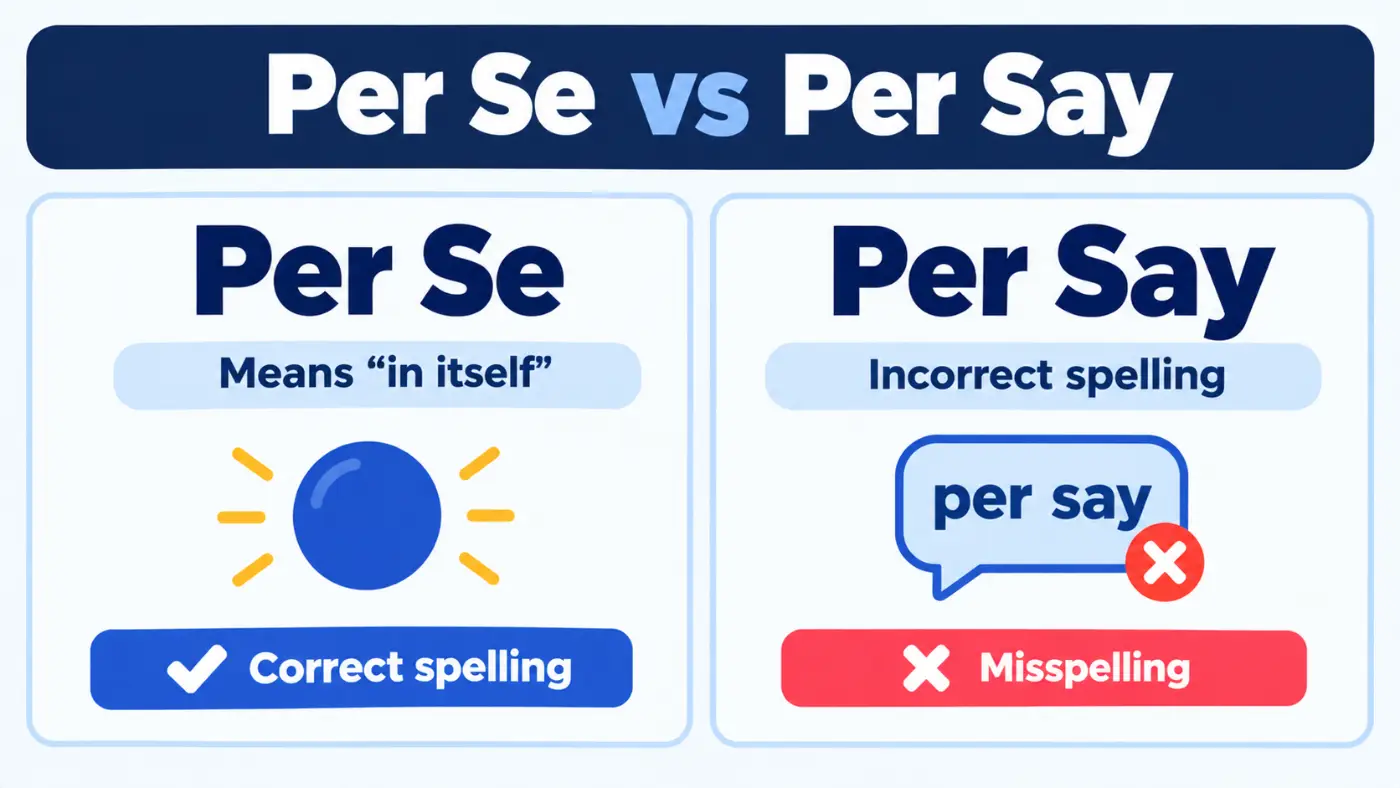
Per se is the correct phrase. Per say is a common misspelling based on how the Latin phrase sounds when spoken, since the word “se” doesn’t visually hint at its actual pronunciation.
The Short Answer at a Glance
| Form | Status | What it does | Example |
|---|---|---|---|
| per se | Correct | Latin phrase meaning “in itself” or “by itself,” used to clarify or qualify a statement | The plan isn’t bad per se, it just needs better timing. |
| per say | Misspelling | Not a standard phrase in English | Correct it to per se every time. |
Only one version is a real, recognized phrase. “Se” is the correct Latin word, and “say” is simply an English word that happens to sound similar when the phrase is spoken aloud.
What Per Se Means and How It Works
Per se is a Latin phrase that has been fully absorbed into English, meaning “in itself,” “by itself,” or “intrinsically.” It’s used to clarify that a particular quality or judgment applies strictly to the thing itself, independent of other factors, context, or related considerations.
The phrase often shows up to soften, qualify, or precisely narrow a statement. Saying “it’s not expensive per se” suggests that while the price might raise some other concern, cost in isolation isn’t the problem. This precise, almost legalistic narrowing is part of what makes per se such a useful phrase in careful argumentation and nuanced explanation.
Grammatically, per se functions as an adverbial phrase, typically placed after the word or concept it modifies, as in “the idea isn’t flawed per se” or “violence per se isn’t the film’s focus.” It doesn’t change form and isn’t conjugated or pluralized, since it functions as a fixed, unchanging expression borrowed directly from Latin.
Per se appears frequently in legal, academic, and analytical writing, where precision about what exactly is or isn’t being claimed matters a great deal. It also shows up comfortably in everyday conversation, often to walk back or refine a stronger statement someone just made.
Is “Per Say” Ever Correct?
No. Per say isn’t a recognized phrase in standard English, and it isn’t a regional variant, informal shortcut, or accepted alternative spelling. It’s an error that comes specifically from how per se sounds when spoken aloud.
The Latin word “se” is pronounced in a way that, to an English speaker’s ear, closely resembles the English word “say.” Because per se is a phrase most people encounter and learn through hearing it spoken rather than through reading it first, it’s especially vulnerable to this kind of sound-based misspelling, sometimes called an eggcorn, where a less familiar phrase gets reshaped into a more familiar-sounding one that seems to make a certain intuitive sense.
In this case, “per say” doesn’t actually carry any coherent meaning in English on its own, but the resemblance to “say” might make it feel plausible to someone encountering the phrase only through speech, without ever having seen it written out correctly.
Because per se is a borrowed Latin phrase rather than a native English expression, it doesn’t follow typical English spelling patterns, which removes one of the usual tools writers rely on to catch a spelling error by instinct.
Per Se vs Per Say: Key Differences Side by Side
| Feature | Per Se | Per Say |
|---|---|---|
| Recognized phrase | Yes | No |
| Origin | Latin, meaning “in itself” or “by itself” | No meaningful origin; a phonetic error |
| Core meaning | Clarifies that something applies strictly in isolation | No meaning |
| Typical use | Legal, academic, and everyday clarifying statements | Appears only as a typo |
| Register | Works in formal and casual writing | Never appropriate |
| Example | The rule isn’t unfair per se, just poorly explained. | The rule isn’t unfair per say, just poorly explained. (wrong) |
The table draws a clear line, but what it can’t fully capture is how genuinely easy this mistake is to make, given that per se is almost always learned by ear long before most people ever see it written down. That gap between hearing and reading is exactly where the confusion with “say” takes root.
Correct Examples in Real-Life Contexts
Everyday speech
- I don’t dislike the restaurant per se, I just think it’s overpriced for what you get.
- The movie isn’t bad per se, it’s just slower than I expected.
- He’s not lazy per se, he just prioritizes things differently than I would.
- It’s not that I’m against the idea per se, I just need more details first.
Workplace writing
- The proposal isn’t flawed per se, but it does need stronger supporting data.
- We’re not opposed to remote work per se, we just need clearer accountability measures.
- The issue isn’t the software per se, it’s how inconsistently the team uses it.
- Her performance hasn’t declined per se, though her availability has become less predictable.
Texting
- not mad at you per se, just a little disappointed lol
- it’s not a bad plan per se, just risky
School and academic
- The essay argues that the policy isn’t discriminatory per se, but its implementation has uneven effects.
- The professor clarified that the theory doesn’t claim human behavior is irrational per se.
- Her thesis distinguishes between harmful intent and harmful outcomes, which aren’t the same thing per se.
- The debate centered on whether the law targets specific behavior per se, or broader social conditions.
Formal writing
- The court ruled that the practice wasn’t illegal per se, though it raised significant ethical concerns.
- The report concludes that automation isn’t inherently harmful to employment per se, but its pace of adoption matters.
- The policy doesn’t restrict free speech per se, but it does impose certain procedural requirements.
- The study found that stress alone doesn’t cause the condition per se, though it may worsen existing symptoms.
Common Mistakes People Make (and How to Catch Them)
Spelling the phrase purely by sound
Wrong: The movie isn’t boring per say, it’s just long. Right: The movie isn’t boring per se, it’s just long.
This is the core error. Since per se is usually learned through hearing it spoken, writers relying entirely on pronunciation often land on “say,” which sounds nearly identical.
Assuming “say” fits because of its common use in English
Wrong: I’m not against the plan per say, I just have some questions. Right: I’m not against the plan per se, I just have some questions.
Because “say” is such a frequent, familiar English word, it can feel like a natural fit, even though it has no actual connection to the Latin phrase’s meaning or origin.
Typing quickly without verifying an unfamiliar phrase
Wrong: The product isn’t defective per say, but customers have reported inconsistent quality. Right: The product isn’t defective per se, but customers have reported inconsistent quality.
Writers who use the phrase occasionally, rather than frequently, are more likely to rely on memory of how it sounds rather than how it’s actually spelled.
Autocorrect not reliably catching the error
Wrong: My phone didn’t flag “per say,” so it made it into my final email. Right: Manually double-checking less common phrases like per se before sending important messages.
Because “per say” doesn’t form an obviously broken word, some spellcheck tools may not flag it as confidently as they would a more clearly garbled term.
A Fast Trick to Choose the Right One
Remember that per se is a two-word Latin phrase, and “se” relates to the reflexive idea of “itself,” similar to how “self” begins with the same “se” sound. Connecting per se to the concept of something being considered “in itself” can help anchor the correct spelling.
A second trick: since per se almost always appears alongside a clarifying or qualifying statement, such as “not bad per se” or “not illegal per se,” try mentally substituting the fuller phrase “in itself” into your sentence. “The plan isn’t bad in itself” confirms that per se, not “per say,” is the phrase you’re reaching for.
This trick works well for remembering the correct spelling, but it won’t help you decide when to use per se stylistically, since that depends more on tone and precision than on any fixed rule.
How They Sound in Real Situations
A text exchange
Priya: Did you like the new café?
Jordan: It’s not bad per se, just really overpriced for a small coffee.
Priya: Yeah, I’ve heard that from a few people.
Per se is correct here, used naturally to qualify a mild criticism in casual conversation.
A workplace email
Subject: Feedback on Q3 proposal
Hi team,
The proposal isn’t weak per se, but I think it would benefit from more concrete data to support the main recommendations. Let’s discuss further before Thursday’s meeting.
Thanks, Renata
Per se is correct because the email uses it to precisely qualify a piece of feedback.
An article-style excerpt
Analysts say the company’s recent struggles aren’t the result of poor leadership per se, but rather a combination of market shifts and outdated infrastructure. The distinction matters for investors weighing whether to stay the course.
Per se is correct here, used to carefully narrow what exactly is and isn’t being blamed for the company’s challenges.
Formal Writing vs Casual Writing
The correct spelling doesn’t change based on formality. Per se is right in a legal brief, a business email, a text message, and a casual conversation. Per say is wrong everywhere, regardless of tone or context.
What shifts with register is frequency and tone. In formal and legal writing, per se often appears in precise, analytical statements, carefully distinguishing what a law, policy, or argument does and doesn’t claim. In casual speech, it’s used more loosely, often to soften a statement or clarify that a criticism is narrower than it might otherwise sound.
AP and Chicago style both treat per se as a standard, italicized-when-appropriate Latin phrase, with no accepted alternate spelling.
Related Mix-Ups People Also Search For
Per Se vs Per Say (Pronunciation Confusion)
This is the core confusion addressed throughout this guide, rooted entirely in how the Latin phrase sounds when spoken aloud. Example: The decision wasn’t controversial per se, though it did spark some quiet disagreement among staff.
Per Se vs As Such
These two phrases overlap in function, both used to clarify or narrow a statement, though “as such” often refers back to something previously mentioned, while per se emphasizes something considered purely in isolation. Example: The rule isn’t harsh per se, but as such, it has created unintended complications for smaller businesses.
Vice Versa vs Per Se
Both are Latin phrases fully absorbed into English, though they serve entirely different functions. Vice versa indicates a reversed relationship between two things, while per se clarifies that something applies strictly in itself. Example: The policy isn’t unfair per se, and the same could be said vice versa for the opposing proposal.
Quick Practice: Test Yourself
Choose the correct phrase for each blank.
- The idea isn’t bad ______, it just needs more development. (per se / per say)
- He’s not unqualified ______, he just lacks experience in this specific field. (per se / per say)
- The policy doesn’t target small businesses ______, but it does affect them disproportionately. (per se / per say)
- I’m not upset ______, just a little confused about the decision. (per se / per say)
- The product isn’t poorly made ______, it’s just not what customers expected. (per se / per say)
- The argument isn’t weak ______, it’s just missing stronger evidence. (per se / per say)
Answer Key
- per se: the correct spelling always uses “se,” never “say.”
- per se: consistent spelling regardless of context.
- per se: correct spelling in a formal, analytical statement.
- per se: correct spelling in casual conversation.
- per se: correct spelling clarifying a nuanced criticism.
- per se: correct spelling in an academic or argumentative context.
Frequently Asked Questions
No. Per say isn’t recognized in standard English and isn’t used as a regional or informal variant. The correct phrase in every context is per se.
The Latin word “se” is pronounced in a way that closely resembles the English word “say,” which is why the misspelling occurs so frequently, especially among people who’ve only heard the phrase spoken aloud.
Per se means “in itself” or “by itself,” used to clarify that a particular quality or judgment applies strictly to the thing itself, separate from other related factors.
It’s originally Latin, but it has been fully absorbed into English and is used constantly without needing translation or special explanation.
Style guides vary, though many treat fully absorbed Latin phrases like per se as standard English at this point, meaning italics are often optional rather than required.
Yes. Per se works comfortably across registers, from legal and academic writing to everyday conversation and casual messages.

Sophia Bennett writes educational content about English vocabulary, grammar, slang, and communication. She is passionate about making complex language topics accessible to students, professionals, and curious readers around the world.