Exceed vs Excede: Which Spelling Is Correct?
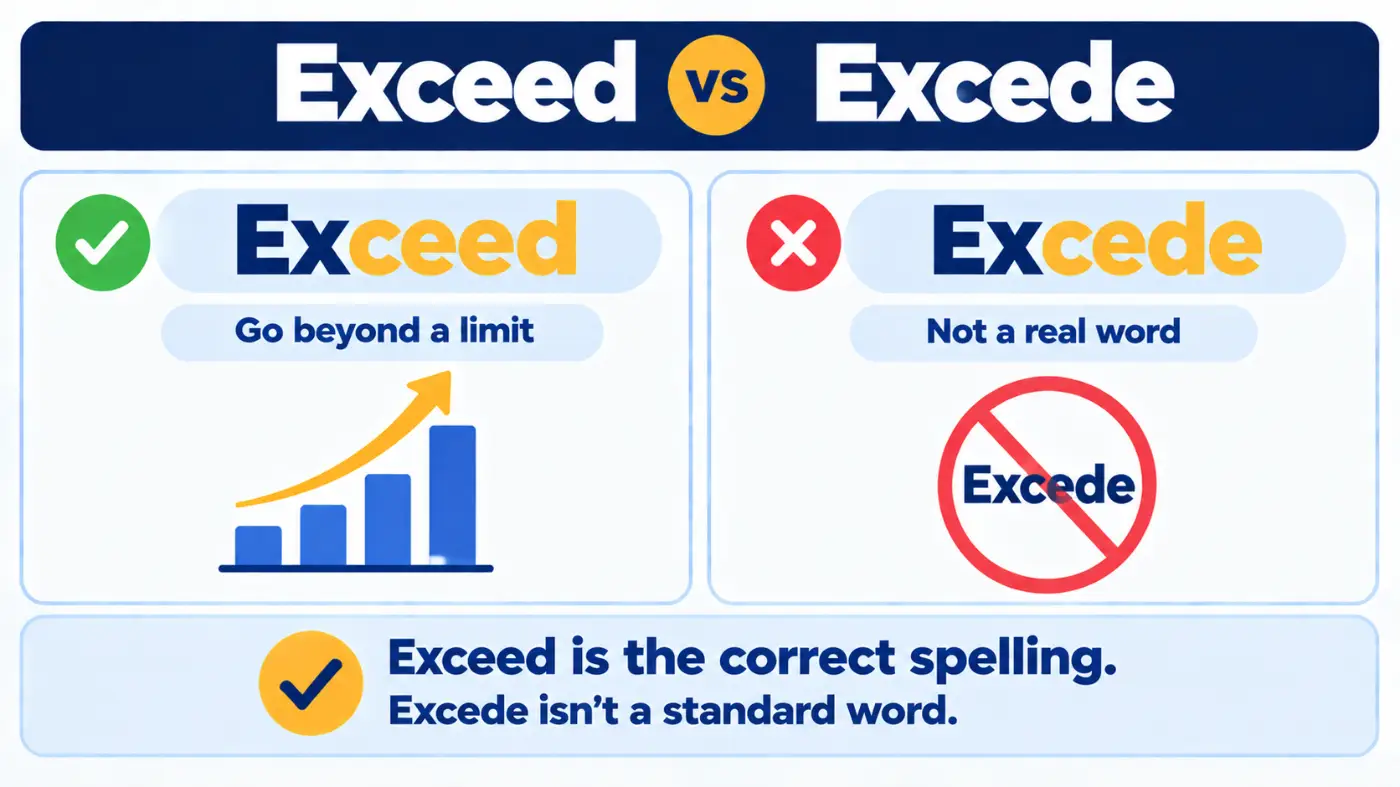
Exceed is the correct spelling. Excede isn’t a standard English word, and it likely comes from confusing exceed’s ending with words like precede and concede, which really do end in “-cede.”
The Short Answer at a Glance
| Form | Status | What it does | Example |
|---|---|---|---|
| exceed | Correct | Verb meaning to go beyond a limit, amount, or expectation | The runners exceeded the race’s previous record time. |
| excede | Misspelling | Not a word in standard English | Correct it to exceed every time. |
Only one spelling exists here. The confusion comes from a family of similar-looking verbs that end differently, not from two competing forms of the same word.
What Exceed Means and How It Works
Exceed is a verb that means to go beyond a boundary, limit, quantity, or standard. You can exceed a speed limit, exceed a budget, exceed someone’s expectations, or exceed a previous record.
The word carries a sense of surpassing something measurable. Whatever gets exceeded usually has a defined edge: a number, a deadline, a rule, a level of quality. That’s part of what separates exceed from vaguer words like “go past” or “beat,” since exceed almost always implies there was a specific threshold to begin with.
Grammatically, exceed is a transitive verb, meaning it needs a direct object. You exceed a limit, a budget, a goal. It doesn’t typically stand alone without naming what’s being surpassed.
The verb follows a regular conjugation pattern:
- exceed (base form)
- exceeds (third-person present)
- exceeded (past tense and past participle)
- exceeding (present participle, often used as an adjective, as in “exceeding demand”)
The related adjective is excessive, which describes something that has gone beyond a reasonable or acceptable amount. The noun form, excess, refers to the surplus amount itself, the part that goes beyond what’s needed or expected.
Exceed comes from a Latin root related to going out or beyond, and that same root shows up in several other English words. What makes exceed spell-worthy of its own guide is the specific ending it uses, which doesn’t match a surprisingly large family of similar verbs.
Is “Excede” Ever Correct?
No. Excede isn’t listed in standard dictionaries, and it isn’t a regional variant, dated form, or accepted alternative. It’s a spelling error, and a particularly understandable one.
English has a cluster of verbs that end in “-cede,” including precede, concede, recede, and secede. All of these are spelled with that exact ending, no exceptions. Because exceed sounds so similar to these words and shares the same root meaning of “going beyond” or “going away from,” writers often assume it must follow the same spelling pattern.
It doesn’t. Exceed breaks from the “-cede” group and uses a double “e” ending instead: “-ceed.” This isn’t a matter of one spelling being more modern or one being more formal. The “-cede” words and the “-ceed” words are simply two different spelling families that happen to sound alike and share related meanings.
Only a small number of English verbs use the “-ceed” ending: exceed, proceed, and succeed. Everything else in this family, including precede, concede, recede, secede, and intercede, uses “-cede.” Knowing that exceed belongs to the shorter, less common group is the key to spelling it correctly every time.
Exceed vs Excede: Key Differences Side by Side
| Feature | Exceed | Excede |
|---|---|---|
| Recognized word | Yes | No |
| Part of speech | Transitive verb | None |
| Core meaning | To go beyond a limit, amount, or expectation | No meaning |
| Typical use | Budgets, limits, expectations, records, performance | Appears only as a typo |
| Register | Works in formal and casual writing | Never appropriate |
| Example | The project exceeded its original budget by ten percent. | The project excedeed its original budget by ten percent. (wrong) |
The table shows a clear right and wrong, but what it can’t fully explain is why this specific mistake is so persistent. Exceed sits in a small minority group of “-ceed” verbs surrounded by a much larger family of “-cede” verbs, so the odds of guessing correctly from sound alone are stacked against most writers.
Correct Examples in Real-Life Contexts
Everyday speech
- I think we’re going to exceed our grocery budget again this month.
- His enthusiasm for the trip exceeded everyone else’s by a mile.
- The line at the coffee shop exceeded twenty people by the time we left.
- She always finds a way to exceed her own expectations at these events.
Workplace writing
- Q3 revenue exceeded projections by nearly fifteen percent.
- Please flag any expenses that exceed the approved travel allowance.
- The new hire has already exceeded performance benchmarks set for her first quarter.
- Our server traffic exceeded capacity during the product launch and caused a brief outage.
Texting
- lol we already exceeded our snack budget for this trip and we’re only on day two
- his test score exceeded what he was expecting, he’s thrilled
School and academic
- The study found that student engagement exceeded initial predictions in the pilot program.
- Her final thesis word count exceeded the department’s stated limit by several pages.
- The lab results exceeded the threshold required for further clinical testing.
- Enrollment numbers this year exceeded the university’s original projections.
Formal writing
- The contractor’s fees may not exceed the amount specified in the original agreement.
- Emissions from the facility exceeded regulatory limits for the third consecutive quarter.
- The court found that the settlement amount exceeded what state law permitted.
- Interest rates on the loan shall not exceed the cap outlined in section twelve.
Common Mistakes People Make (and How to Catch Them)
Following the “-cede” pattern from similar words
Wrong: The final cost excedeed our estimate by a wide margin. Right: The final cost exceeded our estimate by a wide margin.
Writers who know precede, concede, or recede often assume exceed follows the same “-cede” spelling, since the words sound alike and share a related meaning.
Mishearing the word in speech
Wrong: Sales excedeed last year’s numbers across every region. Right: Sales exceeded last year’s numbers across every region.
Spoken English doesn’t clearly distinguish between “-ceed” and “-cede” endings, so writers spelling by ear can easily land on the wrong version.
Typing quickly and defaulting to a more familiar pattern
Wrong: We can’t excede the limit set by the contract. Right: We can’t exceed the limit set by the contract.
Because “-cede” appears in more common words overall, some writers default to it automatically without pausing to check which specific verb they’re using.
Confusing exceed with succeed’s spelling pattern
Wrong: They excedeed at meeting the deadline early. Right: They exceeded at meeting the deadline early. (Note: in standard usage, succeed pairs with “at,” while exceed typically takes a direct object rather than “at.”)
Even when writers correctly recall that some verbs use “-ceed,” they sometimes garble the spelling further while trying to remember which ending applies.
A Fast Trick to Choose the Right One
Memorize the short list first. Only three common English verbs use the “-ceed” ending: exceed, proceed, and succeed. If you can remember that trio, you’ll automatically know that anything else in this word family, like precede or concede, uses “-cede” instead.
A simple way to lock in the three “-ceed” verbs is to notice they all describe forward or upward movement in some sense: exceeding a limit, proceeding forward, succeeding at something. That shared feeling of movement or achievement can help anchor the unusual spelling.
This trick works well because the “-ceed” group is so small. Its only limitation is that it doesn’t explain why English split these words into two spelling families in the first place, so it’s best treated as a memorization shortcut rather than a rule with deeper logic behind it.
How They Sound in Real Situations
A text exchange
Devon: How’d the fundraiser go?
Maya: We exceeded our goal by almost two thousand dollars!
Devon: That’s incredible, congrats.
Exceeded is correct here because the fundraiser surpassed a specific dollar goal.
A workplace email
Subject: Budget update for Q2
Hi team,
I wanted to flag that our marketing spend has exceeded the allocated budget for this quarter. Let’s discuss reallocating funds during Thursday’s meeting so we can course-correct before Q3 begins.
Thanks, Renata
Exceeded is correct because the email describes going past a specific budget limit.
An article-style excerpt
The city’s water usage exceeded conservation targets for the second summer in a row, prompting officials to consider stricter restrictions ahead of next year’s dry season. Residents have been asked to voluntarily cut back in the meantime.
Exceeded fits well here because it describes surpassing a measurable target.
Formal Writing vs Casual Writing
The correct spelling doesn’t change based on formality. Exceed is right in a legal contract, a performance review, a text message, and a casual conversation. Excede is wrong everywhere, regardless of tone.
What shifts with register is how often exceed appears in certain contexts. In formal and business writing, exceed shows up constantly around budgets, limits, regulations, and performance metrics. In casual speech, people are just as likely to say something “went over” or “beat” an expectation, saving exceed for moments that feel a bit more precise or official.
AP and Chicago style both treat exceed as a standard verb with a fixed spelling, and neither offers any accepted shortcut or alternate form.
Related Mix-Ups People Also Search For
Exceed vs Proceed
Both belong to the small “-ceed” family, but they mean different things. Exceed means to go beyond a limit, while proceed means to continue or move forward with an action. Example: Once sales exceeded expectations, the team decided to proceed with the expansion plan.
Exceed vs Succeed
Succeed also uses the “-ceed” ending, but it means to achieve a desired result or outcome, not to surpass a numerical limit. Example: The company hopes to succeed in a market where competitors have already exceeded growth projections.
Exceed vs Precede
Precede belongs to the larger “-cede” family and means to come before something in time or order. Its meaning is unrelated to exceed’s sense of surpassing a limit. Example: A brief safety briefing will precede the tour, which is expected to exceed two hours.
Exceed vs Concede
Concede also uses “-cede” and means to admit something is true or to give up a point in an argument or contest. Example: She had to concede the debate once her opponent’s data clearly exceeded her own in accuracy.
Exceptions, Edge Cases, and Tricky Situations
Exceed in legal and regulatory language
In contracts, statutes, and regulations, exceed often carries precise legal weight, marking a hard boundary that triggers specific consequences, such as penalties or automatic termination clauses. The spelling doesn’t change in this context, but it’s worth noting that exceed here often functions almost as a technical term rather than a casual description.
Exceed versus surpass in tone
Exceed and surpass are close in meaning, but exceed often implies crossing a defined limit, while surpass can describe outperforming a rival or expectation more generally, without necessarily implying a strict numerical boundary. This is a usage nuance rather than a spelling issue.
Quick Practice: Test Yourself
Choose the correct spelling for each blank.
- The company’s profits ______ analyst expectations this quarter. (exceeded / excedeed)
- Please don’t ______ the recommended dosage listed on the label. (exceed / excede)
- Once the paperwork is finalized, we can ______ with the merger. (proceed / precede)
- Ticket sales have already ______ last year’s total. (exceeded / excedeed)
- He hopes to ______ where his predecessor struggled. (succeed / excede)
- The new noise levels ______ the city’s legal limit. (exceed / excede)
Answer Key
- exceeded: the correct spelling always uses the double “e” ending, never “-cede.”
- exceed: base form, correctly spelled with “-ceed.”
- proceed: another member of the small “-ceed” family, referring to moving forward.
- exceeded: consistent with the correct “-ceed” pattern.
- succeed: the third member of the “-ceed” trio, meaning to achieve a goal.
- exceed: correctly spelled, describing going past a legal threshold.
Frequently Asked Questions
Is “excede” ever an acceptable spelling?
No. Excede isn’t recognized in standard dictionaries and isn’t used as a regional or informal variant. The correct spelling in every context is exceed.
Why does exceed end in “-ceed” instead of “-cede” like similar words?
Exceed belongs to a small group of English verbs, along with proceed and succeed, that use the “-ceed” ending, while most other related verbs, like precede and concede, use “-cede” instead. There’s no single rule explaining the split. It’s simply how these specific words settled into English spelling.
What’s the difference between exceed and surpass?
The two are closely related, but exceed often implies going beyond a specific, measurable limit, while surpass can describe outperforming something more generally, without necessarily involving a strict numerical boundary.
Is exceed always followed by a specific number or limit?
Not always, but it typically implies some kind of threshold, whether that’s a number, a standard, or an expectation, even if the exact limit isn’t stated in the sentence.
What is the adjective form related to exceed?
The related adjective is excessive, which describes something that has gone beyond a reasonable or acceptable amount.
Are there other English verbs that use the “-ceed” ending?
Yes, but only two others: proceed and succeed. Every other common verb in this word family uses “-cede” instead.

Sophia Bennett writes educational content about English vocabulary, grammar, slang, and communication. She is passionate about making complex language topics accessible to students, professionals, and curious readers around the world.