
Argument vs Arguement: Which Spelling Is Correct?
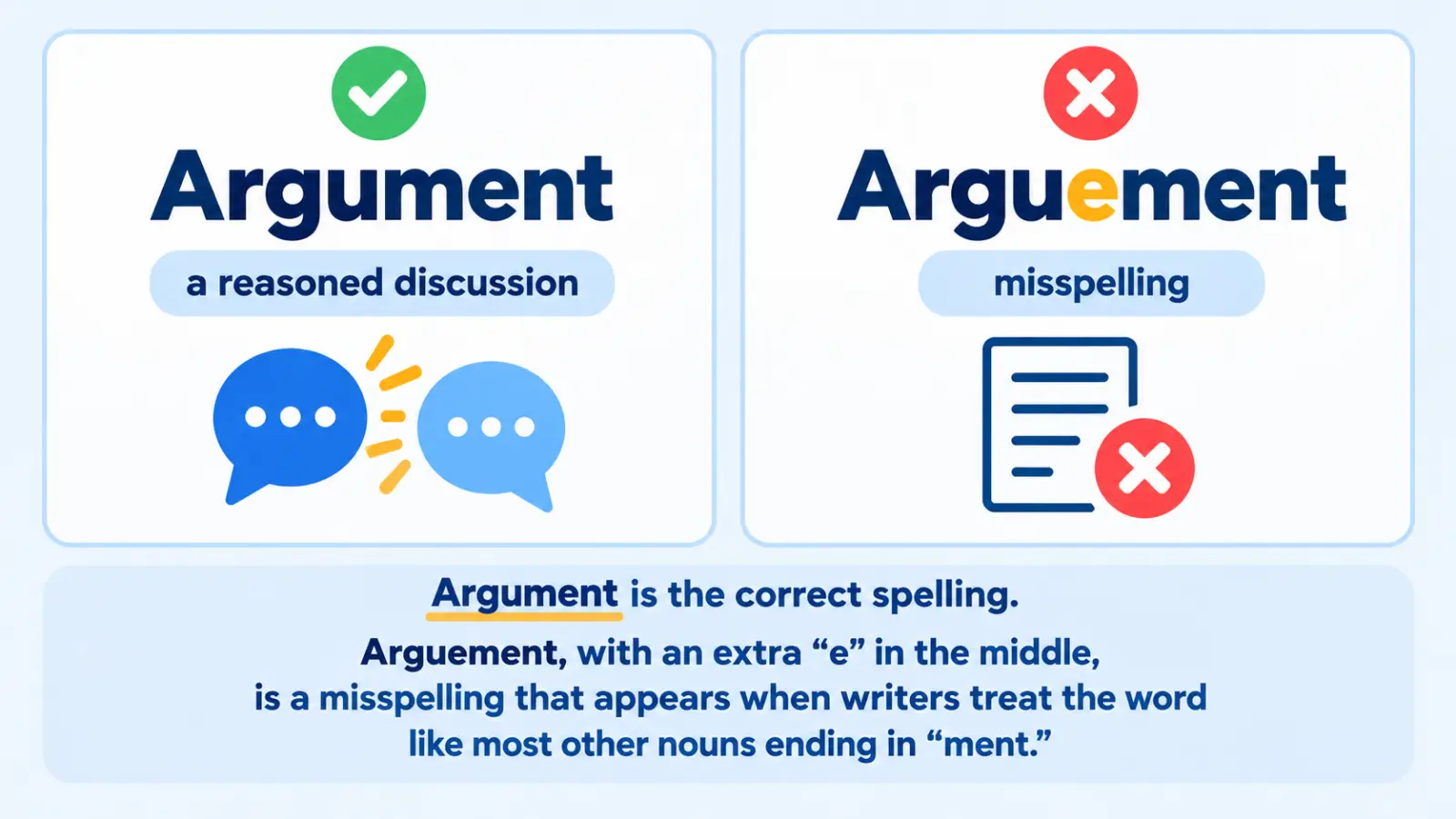
Argument is the correct spelling. Arguement, with an extra “e” in the middle, is a misspelling that appears when writers treat the word like most other nouns ending in “ment.”
The Short Answer at a Glance
| Form | Status | What it does | Example |
|---|---|---|---|
| argument | Correct | Noun meaning a disagreement, or a set of reasons offered to support a claim | Lena’s argument for a four-day workweek won over the board. |
| arguement | Misspelling | Not a word in standard English | Replace it with argument every time. |
There’s only one real word here. The choice comes down to whether the “e” before “ment” stays or goes, and it goes.
What Argument Means and How It Works
Argument is a noun with two main meanings. The first is a heated exchange, a clash between people who disagree. The second is a reasoned case, a chain of points built to convince someone that a claim is true.
Both senses show up constantly. Two neighbors can have an argument about a fence line. A lawyer can present an argument about why a contract is void. A philosophy student can write an argument in defense of free will. The word covers shouting matches and careful logic alike.
In math and computer science, argument has a technical meaning too. It refers to a value passed into a function, as in “the function takes two arguments.” That use has nothing to do with disagreement, though the spelling is identical.
Argument is a countable noun, so it takes articles and can be plural. You can have an argument, several arguments, or no argument at all. It also pairs with a predictable set of verbs: make an argument, win an argument, lose an argument, present an argument, and back up an argument.
The word grows out of the verb argue. That connection explains the spelling. When English builds a noun from a verb by adding “ment,” a verb ending in a silent “e” often loses that “e” first. Argue drops its final “e” and becomes argu-, then picks up “ment” to make argument. The letters “u” and “m” now sit next to each other with nothing between them.
This is the whole reason arguement is wrong. The “e” from argue has nowhere to stay once the suffix arrives.
Is “Arguement” Ever Correct?
No. Arguement is not a word in standard American English, and no major dictionary lists it as an accepted variant. It isn’t a British spelling, a dated form, or an informal shortcut. It’s a spelling error.
The mistake happens because so many similar nouns do keep the “e.” Think of agreement, from agree. Or advertisement, from advertise. Or amusement, statement, and management. In many of these, the “e” before “ment” is either part of the base word or gets retained, so writers develop a feeling that “ment” should be preceded by an “e.”
Argument breaks that pattern, and your eye and your hand expect the pattern to hold. That’s why arguement feels right even though it isn’t.
A few other words drop the final “e” before “ment” in the same way, including judgment in American usage, where judge loses its “e.” The pattern isn’t unique to argument, but it’s inconsistent enough that guessing doesn’t work well. Memorizing the spelling of argument is the safer plan.
Argument vs Arguement: Key Differences Side by Side
| Feature | Argument | Arguement |
|---|---|---|
| Recognized word | Yes | No |
| Part of speech | Noun | None |
| Core meaning | A disagreement, or a reasoned case for a claim | No meaning |
| Typical use | Everyday speech, law, debate, academic writing, programming | Appears only as a typo |
| Register | Works in casual and formal writing | Never appropriate |
| Example | The senator’s argument rested on three years of budget data. | The senator’s arguement rested on three years of budget data. (wrong) |
The table treats these as two entries, but they’re really one word and one mistake. What it can’t capture is how confidently people misspell this word. Because arguement looks so plausible, it slips past a quick proofread more easily than a random typo would. If you write about debates, contracts, essays, or code, it’s worth double-checking every time.
Correct Examples in Real-Life Contexts
These sentences use the correct spelling across a range of situations.
Everyday speech
- My sister and I had a ten-minute argument about whose turn it was to walk the dog, and neither of us remembers who won.
- There’s no argument from me on pizza for dinner.
- Their argument started over a parking spot and ended with two people not speaking at Thanksgiving.
- Whatever the argument was about, it clearly wasn’t worth losing a friendship over.
Workplace writing
- Marcus made a strong argument for moving the launch to March, and leadership agreed.
- Please send me the core argument you plan to make in Thursday’s pitch.
- The vendor’s argument for a higher price didn’t hold up against the competing quotes.
- Our legal team is preparing arguments on the licensing dispute.
Texting
- ok but my argument for getting the dog is that it’ll make us walk more
- lol we literally had an argument about which movie to watch and then watched neither
School and academic
- Your thesis statement should be the central argument of the whole essay.
- Dr. Okafor asked the class to identify the weakest argument in the article.
- In his paper on urban housing, Elijah presents a counterargument before dismantling it.
- The argument in the second paragraph depends on an assumption the author never proves.
Formal writing
- Counsel’s argument on the motion to dismiss lasted forty minutes.
- The court found the appellant’s argument unpersuasive and affirmed the lower ruling.
- The report advances a compelling argument for reforming the state’s pension system.
- Each argument must be supported by evidence drawn from the record.
Programming
- The function accepts two arguments: a file path and a timeout value.
- If you pass the wrong argument type, the script will throw an error.
Common Mistakes People Make (and How to Catch Them)
Each mistake has a cause. Knowing the cause makes it easier to spot in your own writing.
Keeping the “e” from argue
Wrong: She won the arguement by citing the original contract. Right: She won the argument by citing the original contract.
This is the classic error. Writers see argue, add “ment,” and forget that the final “e” has to go.
Copying the pattern from agreement
Wrong: The two sides never reached an arguement on terms. Right: The two sides never reached an agreement on terms.
Here the writer may have meant agreement, and the spelling of argument bled in. Watch for this when writing about disputes and resolutions in the same paragraph.
Trusting autocorrect too much
Wrong: His arguement, though loud, had no evidence behind it. Right: His argument, though loud, had no evidence behind it.
Modern autocorrect catches most arguement typos, but not all. Text fields with spellcheck turned off, code comments, and social media captions often let it through.
Overcorrecting and dropping the “u”
Wrong: Her argment made the whole room go quiet. Right: Her argument made the whole room go quiet.
Once people learn that something is off about the middle of the word, they sometimes remove the wrong letter. The “u” stays. Only the “e” goes.
Spelling it as it sounds
Wrong: The arguemint over the budget dragged on for weeks. Right: The argument over the budget dragged on for weeks.
In fast speech, the last syllable can sound like “mint” or “mnt.” Writers who spell by ear can end up with a vowel that doesn’t belong.
A Fast Trick to Choose the Right One
Start from the verb. If you can spell argue, you can build argument. Take argue, remove the final “e,” and add “ment.” The rule is mechanical: argue minus “e” plus “ment” equals argument.
A second trick is to picture the word as two parts: “argu” and “ment.” There’s no letter between them. If you see one, you’ve added something the word doesn’t have.
You can test yourself by saying the pieces out loud: “ar-gu-ment.” Three syllables, no extra vowel anywhere.
Neither trick is perfect for other words. Some “ment” nouns keep the “e” from their verb, so the shortcut only works because you’re checking one specific word. That’s fine, since argument is the one you need to spell.
How They Sound in Real Situations
A text exchange
Dani: Are you still mad about last night?
Rory: No, but I’m still right. My argument was solid.
Dani: Your argument was that pineapple counts as a vegetable.
Argument works here because Rory is defending a claim, which is the reasoned-case sense of the word.
A workplace email
Subject: Feedback on the Q3 proposal
Hi Priyanka,
I read through the draft. The central argument is clear, but the second section needs stronger data to support it. Can you add the survey numbers from June before we send this to the client?
Thanks, Greg
Argument is correct because Greg is talking about the logical case the proposal makes, not a fight.
An article-style excerpt
The council’s argument for closing the library branch rests on declining foot traffic. Residents at Tuesday’s meeting offered a sharper counterpoint: the branch is the only free internet access on the east side. The debate is expected to continue next month.
Argument fits because the writer is describing a position with reasons behind it, in a formal news context.
Formal Writing vs Casual Writing
The spelling of argument never changes with register. It’s argument in a legal brief, a college essay, a news story, a text message, and a code comment. Arguement is wrong in all of them.
What shifts is how the word gets used. In academic and professional writing, argument often means a structured case, as in “the paper’s central argument.” In casual speech, it more often means a quarrel. Both are correct, and context makes clear which one is meant.
In formal writing, be careful with sentences that could read either way. “They had an argument about the policy” suggests a fight. “They presented an argument about the policy” suggests reasoned advocacy. If your meaning could be misread, choose the verb or add a modifier to make it clear.
AP and Chicago style both treat argument as a standard noun with a fixed spelling, so no style guide offers alternatives.
Related Mix-Ups People Also Search For
Argument vs Agreement
These look alike and both end in “ment,” but they often mean opposite things. An argument is a disagreement or a case made for a claim. An agreement is a shared understanding or a deal. Example: After a long argument, the two partners finally signed an agreement.
Judgment vs Judgement
Both spellings exist, and the split is regional. American English generally prefers judgment, without the middle “e,” while British English commonly uses judgement. Unlike arguement, which has no legitimate side, this is a real spelling variation. Example: The jury’s judgment came back within an hour.
Argument vs Debate
An argument can be a personal clash or a reasoned case. A debate is usually more structured, with two sides presenting positions in turn. Example: The class debate on school start times featured one strong argument from each team.
Argumentative vs Arguementative
The adjective follows the same spelling rule as the noun, so argumentative keeps the “u” and “m” together with no extra “e.” Example: Grandpa gets argumentative whenever someone brings up the score of that 1998 game.
Exceptions, Edge Cases, and Tricky Situations
Argument as a technical term
In programming and mathematics, an argument is a value given to a function. In logic, it’s a set of premises leading to a conclusion. The spelling doesn’t change, but the meaning is narrower and more exact than in casual speech.
Argument in linguistics
In linguistic analysis, arguments are the noun phrases connected to a verb, such as the subject and object of a sentence. This is a specialized use, and again, the spelling holds.
Argument as reasoning, not conflict
Some writers assume argument always means a fight, and hesitate to use it in academic writing. That’s a misconception. In scholarly and legal settings, argument is the standard term for a reasoned case, and it carries no hint of hostility.
Words that keep the “e”
Some nouns built from verbs ending in “e” retain the “e” before “ment,” including engagement and management. Others drop it, including argument. The pattern isn’t fully predictable, which is why it helps to learn argument as a fixed spelling.
Quick Practice: Test Yourself
Choose the correct spelling for each blank.
- Camila’s ______ in favor of remote work was backed by two years of productivity data. (argument / arguement)
- Their ______ about the thermostat has been going on since October. (argument / arguement)
- The function requires one ______ and returns a sorted list. (argument / arguement)
- Before submitting the essay, make sure your central ______ is clear in the first paragraph. (argument / arguement)
- I don’t have an ______ with that plan. (argument / arguement)
- The lawyer’s closing ______ ran nearly an hour. (argument / arguement)
Answer Key
- argument: a reasoned case, spelled with no “e” before “ment.”
- argument: a quarrel, same correct spelling.
- argument: the technical programming sense, still spelled the same way.
- argument: the main claim of an essay, no extra “e.”
- argument: a disagreement, and the only correct form.
- argument: a formal legal presentation, spelled the same as in casual use.
Frequently Asked Questions
Is Arguement Ever a Correct Spelling?
No. Arguement is a misspelling in both American and British English. The correct spelling is argument.
Why Is There No E in Argument?
The noun comes from the verb argue. When ment is added, the final e in argue is dropped, leaving argu plus ment.
How Do You Spell the Plural of Argument?
Add s to make arguments. The spelling of the base word does not change.
Is Argument Spelled Differently in British English?
No. British and American English both spell it argument. The regional difference in this word family involves other words, such as judgment and judgement.
What Is the Difference Between an Argument and a Debate?
An argument can be a quarrel or a reasoned case. A debate is typically a structured discussion in which two sides present opposing positions.
Does Argument Always Mean a Fight?
No. In academic, legal, and technical contexts, an argument can mean a reasoned case for a claim or a value passed into a function. It does not always suggest conflict.

Sophia Bennett writes educational content about English vocabulary, grammar, slang, and communication. She is passionate about making complex language topics accessible to students, professionals, and curious readers around the world.

2 Comments