Barbecue vs Barbeque: Which Spelling Is Correct?
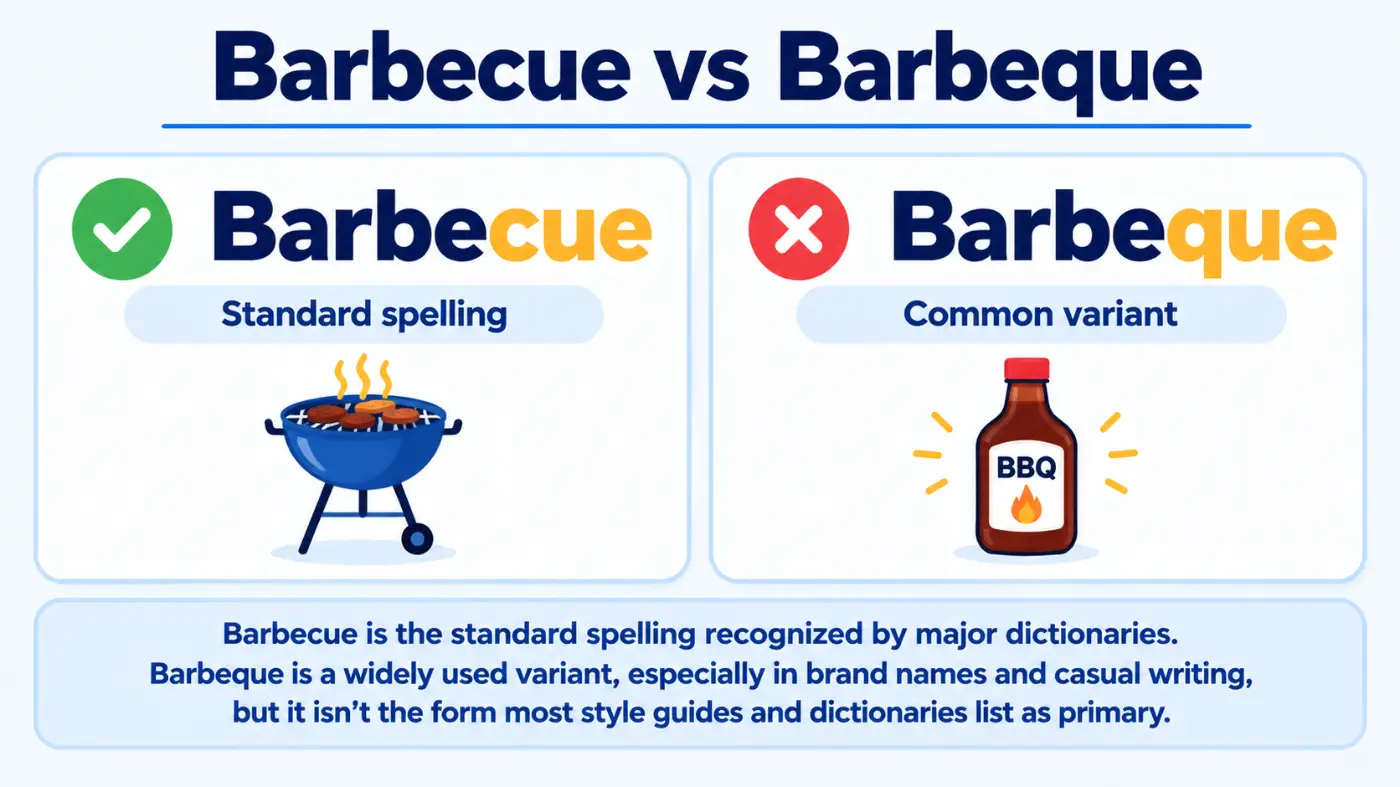
Barbecue is the standard spelling recognized by major dictionaries. Barbeque is a widely used variant, especially common in brand names and casual writing, but it isn’t the form most style guides and dictionaries list as primary.
The Short Answer at a Glance
| Form | Status | What it does | Example |
|---|---|---|---|
| barbecue | Standard spelling | Noun or verb referring to grilling food, or the event itself | We’re hosting a backyard barbecue this Saturday. |
| barbeque | Common variant | Identical meaning, alternate spelling | We’re hosting a backyard barbeque this Saturday. |
Both spellings describe the same food, cooking method, and social gathering. Barbecue is the dictionary-standard form, while barbeque remains common, especially in branding and informal writing.
What Barbecue Means and How It Works
Barbecue functions as both a noun and a verb, and its meaning covers a surprisingly wide range depending on context. As a noun, barbecue can refer to a style of cooking meat slowly over low, indirect heat, often with a distinctive smoky flavor; to the meal or gathering built around that style of cooking; or even to the grill or cooking equipment itself in some regional usage.
As a verb, to barbecue means to cook food using this slow, smoke-based method, as in “we barbecued ribs all afternoon.” In more casual, everyday American English, the word is also used loosely to describe grilling in general, even when the cooking method doesn’t strictly involve the slow, smoky technique associated with traditional barbecue.
Grammatically, barbecue conjugates as a regular verb:
- barbecue (base form)
- barbecues (third-person present)
- barbecued (past tense and past participle)
- barbecuing (present participle)
As a noun, it’s countable in certain uses, as in “we’re hosting a barbecue” or “several barbecues took place that weekend,” referring to specific events or gatherings.
The word traces back through Spanish to an Indigenous Caribbean language, originally referring to a wooden framework used for cooking or drying meat over a fire. That origin explains why the word doesn’t follow typical English spelling patterns, and it’s part of why both barbecue and barbeque have persisted as competing forms over time.
Is “Barbeque” Also Correct?
Yes, in the sense that it’s a widely recognized and commonly used variant, even though barbecue remains the primary form in most major dictionaries. Barbeque isn’t considered an outright error the way a true misspelling would be; it’s simply the less frequently listed alternative.
Part of the reason barbeque persists so strongly is the popularity of the abbreviation “BBQ,” which visually echoes the “que” ending rather than the “cue” ending found in the standard spelling. Because so many signs, menus, and products use “BBQ” as a shorthand, it’s a natural step for some writers to extend that same “que” pattern into the full word itself.
Barbeque also appears frequently in business names, restaurant branding, and regional identity, where the alternate spelling sometimes becomes a stylistic choice tied to a particular establishment’s identity rather than simply a spelling preference. This is especially true in the American South and in regions with strong barbecue traditions, where both spellings circulate heavily in signage and local culture.
Despite its popularity, most style guides and dictionaries that address the word directly continue to list barbecue as the standard, primary spelling, with barbeque treated as a secondary or informal variant.
Barbecue vs Barbeque: Key Differences Side by Side
| Feature | Barbecue | Barbeque |
|---|---|---|
| Part of speech | Noun and verb | Noun and verb |
| Core meaning | Slow cooking over smoke/heat; the food, event, or method | Identical meaning |
| Typical use | Standard writing, dictionaries, formal and informal contexts | Branding, signage, casual writing, regional identity |
| Register | Standard in all registers | Common in casual and branded contexts |
| Example | The restaurant specializes in Texas-style barbecue. | The restaurant specializes in Texas-style barbeque. |
What the table can’t fully capture is how much the choice between these two spellings often comes down to branding and regional tradition rather than a strict rule. A restaurant’s sign might read “Joe’s Barbeque” specifically as a stylistic or traditional choice, even while the surrounding menu and website consistently use the standard “barbecue” spelling elsewhere.
Correct Examples in Real-Life Contexts
Everyday speech
- We’re throwing a barbecue for the Fourth of July this year.
- Nothing beats a good barbecue on a hot summer evening.
- My uncle swears his barbecue sauce recipe is a family secret.
- We barbecued burgers and corn for the whole neighborhood.
Workplace writing
- The office is hosting a company-wide barbecue to celebrate hitting our annual goals.
- Please RSVP for Friday’s team barbecue by Wednesday.
- Catering confirmed the barbecue menu includes both meat and vegetarian options.
- HR is organizing a barbecue fundraiser to support the local food bank.
Texting
- are you coming to the barbecue this weekend or nah
- smells like someone’s already got the barbecue going next door
School and academic
- The culinary program’s final project focused on regional barbecue traditions across the American South.
- Her research paper examines how barbecue culture varies by geographic region.
- The class field trip included a visit to a historic barbecue restaurant for a food history lesson.
- Students compared barbecue techniques used in Texas, Kansas City, and the Carolinas.
Formal writing
- The county fair’s annual barbecue competition draws competitors from across the region.
- The report highlights barbecue tourism as a growing contributor to the local economy.
- Health inspectors reviewed food safety protocols at the outdoor barbecue event.
- The cookbook’s final chapter is dedicated entirely to traditional barbecue methods.
Common Mistakes People Make (and How to Catch Them)
Assuming barbeque is simply wrong
Wrong assumption: Barbeque is a misspelling with no legitimate standing at all. Right understanding: Barbeque is a widely used, commonly accepted variant, even though barbecue remains the primary dictionary form.
This isn’t a genuine sentence-level error, but a common misunderstanding, since many people assume only one spelling can be “official” without realizing both circulate credibly.
Inconsistent spelling within the same document
Wrong: The menu lists barbecue in the title but barbeque throughout the item descriptions. Right: The menu consistently uses one spelling throughout.
Since both forms are widely used, the real risk is inconsistency rather than outright error, and switching between them mid-document can look unpolished.
Overcorrecting a brand name to match standard spelling
Wrong: Changing “Joe’s Barbeque” to “Joe’s Barbecue” in a quote or citation referencing the actual business name. Right: Preserving the business’s chosen spelling exactly as it appears in its official name.
If barbeque is part of a proper noun, like a restaurant’s actual name, that spelling should be preserved exactly, regardless of which form is more common in general usage.
Confusing “BBQ” with a universal justification for “barbeque”
Wrong assumption: Since “BBQ” ends in “que,” the full word must also be spelled “barbeque.” Right understanding: “BBQ” is simply an abbreviation and doesn’t determine which full spelling is more standard.
The abbreviation’s letters don’t map directly onto a specific full spelling; it’s simply a common shorthand that happens to visually echo one of the two accepted forms.
A Fast Trick to Choose the Right One
Default to barbecue unless you’re specifically referencing a brand, business name, or regional tradition that uses the alternate spelling. Since barbecue is the primary form listed in most major dictionaries, it’s the safer, more broadly recognized choice for general writing.
A helpful check: if you’re writing about a specific restaurant, product, or event with an established name, use whichever spelling that name actually uses, even if it doesn’t match the standard dictionary form elsewhere in your writing.
This trick works well for making a consistent default choice, but it has a real limit: regional culture and tradition strongly influence which spelling feels most natural in certain parts of the country, so you’ll often see confident, intentional use of barbeque in contexts where it’s simply the expected local convention.
How They Sound in Real Situations
A text exchange
Jordan: Are we still doing the barbecue Saturday?
Casey: Yes! I already bought the burgers and the corn.
Jordan: Perfect, I’ll bring the sides.
Barbecue works naturally here in casual conversation, and barbeque would sound equally natural in the same context.
A workplace email
Subject: Summer team barbecue details
Hi everyone,
Just a reminder that our team barbecue is this Friday at noon in the courtyard. Please let me know if you have any dietary restrictions so catering can plan accordingly.
Thanks, Devon
Barbecue fits well here, matching the standard spelling typically used in professional workplace communication.
An article-style excerpt
The small Texas town has built its reputation almost entirely around barbecue, with pitmasters competing each year for the title of best brisket in the state. Visitors travel from across the country just to sample the smoky, slow-cooked specialty.
Barbecue is correct here, matching the standard spelling typically used in food journalism and travel writing.
Formal Writing vs Casual Writing
Barbecue is the generally preferred spelling across both formal and casual writing, since it’s the standard form recognized by most dictionaries and style guides. Barbeque appears comfortably in casual writing, branding, and regional contexts, but it’s less commonly seen in formal journalism, academic writing, or official documentation.
In practice, the real-world difference often comes down to branding and regional identity rather than strict formality. A formal food science journal would almost certainly use barbecue, while a family-owned restaurant’s sign might proudly display barbeque as part of its established identity.
AP style and most major American dictionaries list barbecue as the standard spelling, which is why it’s the safer choice for journalism, business writing, and other contexts where consistency with established style conventions matters.
Related Mix-Ups People Also Search For
Barbecue vs BBQ
BBQ is simply an informal abbreviation of barbecue, commonly used in signage, texting, and casual writing, rather than a separate spelling of the full word itself. Example: The sign out front just said “BBQ,” but the full menu clearly read “barbecue” throughout.
Barbecue vs Grill
These two overlap in casual speech but technically describe different cooking methods. Barbecue traditionally refers to slow cooking over low, indirect heat, often with smoke, while grilling typically involves faster cooking over direct, higher heat. Example: We grilled burgers quickly over high heat, but the ribs needed a proper barbecue session over several hours.
Barbeque vs Barbecued
This isn’t really a separate confusion, but writers sometimes incorrectly spell the past tense as “barbequed” when using the alternate spelling, rather than consistently applying either full spelling pattern. Example: We barbecued the chicken for hours, giving it that deep, smoky flavor everyone loved.
Quick Practice: Test Yourself
Both spellings are acceptable in each of these sentences; choose whichever fits the described context.
- A formal food magazine article discusses regional styles of ______ across the South. (barbecue / barbeque)
- A local restaurant’s hand-painted sign reads “Mama’s ______ Shack.” (barbecue / barbeque)
- A company’s internal memo announces a team ______ for Friday afternoon. (barbecue / barbeque)
- A recipe blog post shares tips for the perfect summer ______. (barbecue / barbeque)
- A cookbook chapter title reads “The History of American ______.” (barbecue / barbeque)
- A casual group text asks if everyone’s still coming to the weekend ______. (barbecue / barbeque)
Answer Key
- barbecue: matches the standard spelling expected in formal food journalism.
- barbeque: whichever spelling the actual business name uses should be preserved exactly.
- barbecue: matches the standard spelling typically used in professional workplace writing.
- barbecue: fits naturally in general recipe writing, following standard dictionary spelling.
- barbecue: matches the standard spelling expected in formal published writing.
- barbecue: fits naturally in casual conversation, though barbeque would work equally well.
Frequently Asked Questions
Is barbecue or barbeque the correct spelling?
Barbecue is the standard spelling recognized by most major dictionaries, while barbeque is a widely used, accepted variant, particularly common in branding and casual writing.
Do barbecue and barbeque mean the same thing?
Yes. Both words refer to the same cooking method, food, and type of gathering, with no difference in meaning between the two spellings.
Why does “BBQ” end in “que” if barbecue is the standard spelling?
“BBQ” is simply a common abbreviation, and its letters don’t need to directly match either full spelling. It happens to visually echo the ending of “barbeque,” which may be part of why that variant remains so popular.
Is barbeque ever used in official or formal writing?
It can appear in formal writing when referencing a proper noun, like a specific business or product name that uses that spelling, but barbecue remains the generally preferred form for formal writing overall.
Is one spelling more regionally common than the other?
Barbeque does appear somewhat more frequently in certain regional branding, particularly in parts of the American South, though barbecue remains the dominant spelling in formal and general writing nationwide.
Which spelling should I use for a restaurant or business name?
If you’re creating a new name, either spelling is acceptable, since both are widely recognized; the choice often comes down to personal style or regional tradition rather than strict correctness.

Sophia Bennett writes educational content about English vocabulary, grammar, slang, and communication. She is passionate about making complex language topics accessible to students, professionals, and curious readers around the world.