Imbalance vs Inbalance: Which Spelling Is Correct?
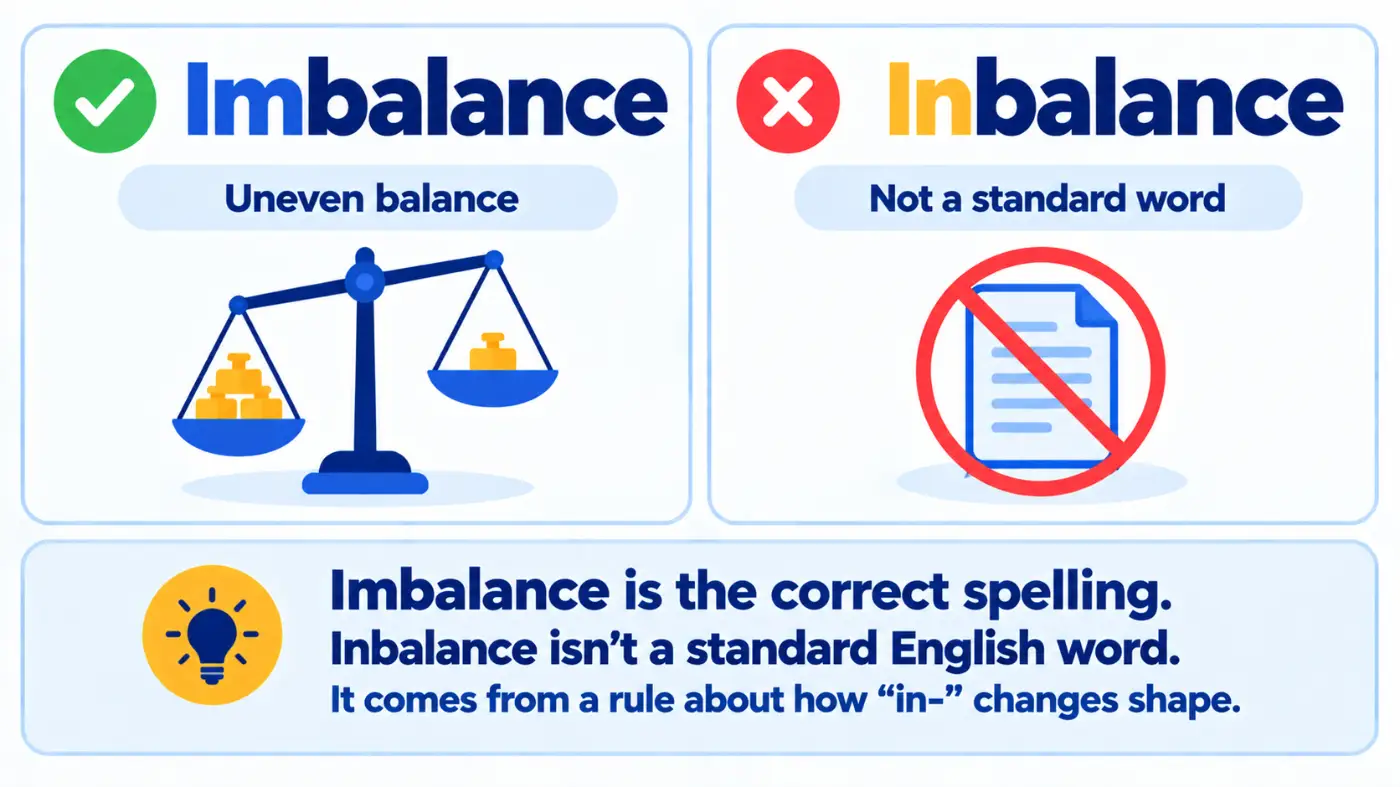
Imbalance is the correct spelling. Inbalance isn’t a standard English word, and it comes from missing a small but consistent rule about how the prefix “in-” changes shape in front of certain letters.
The Short Answer at a Glance
| Form | Status | What it does | Example |
|---|---|---|---|
| imbalance | Correct | Noun describing a lack of balance or proportion | The doctor identified a hormonal imbalance during the checkup. |
| inbalance | Misspelling | Not a word in standard English | Correct it to imbalance every time. |
Only one spelling is real. The prefix simply shifts its final letter before certain sounds, and “balance” happens to start with one of those sounds.
What Imbalance Means and How It Works
Imbalance is a noun that describes a lack of balance, proportion, or equilibrium between two or more things. It can apply to physical states, like a chemical imbalance in the body, or to more abstract situations, like a power imbalance in a relationship or a trade imbalance between countries.
The word is built from the prefix “im-,” meaning “not” or “the absence of,” attached to the noun “balance.” Balance itself refers to a stable, even state where forces, amounts, or influences are properly distributed. Imbalance describes the opposite: something has tipped too far in one direction.
Grammatically, imbalance functions as a standard countable or uncountable noun depending on context. You can refer to “an imbalance” in a specific, isolated case, or to “imbalance” more generally as a broader condition, similar to how you might use “inequality” or “disorder.”
The word appears constantly across medicine, economics, psychology, ecology, and everyday relationships. A nutritional imbalance, an emotional imbalance, an imbalance of trade, and an imbalance of power all describe the same underlying idea: two or more things that should be roughly equal or stable have fallen out of proportion.
There’s also a related adjective, imbalanced, which describes something affected by this lack of proportion, as in “an imbalanced diet” or “an imbalanced ecosystem.” Both the noun and the adjective keep the same “im-” prefix.
Is “Inbalance” Ever Correct?
No. Inbalance isn’t listed in standard dictionaries, and it isn’t a regional variant, dated spelling, or accepted alternative. It’s a spelling error rooted in a genuine, if easy to miss, pattern in English.
The prefix “in-,” meaning “not,” doesn’t always keep that exact spelling. English regularly changes its final letter depending on the sound that follows, purely to make the word easier to pronounce. Before words starting with “b,” “m,” or “p,” the prefix becomes “im-” instead of “in-.” That’s why you see impossible instead of “inpossible,” immature instead of “inmature,” and immobile instead of “inmobile.”
Balance starts with “b,” which places it squarely in that same category. The correct prefix form is therefore “im-,” producing imbalance, not “in-,” which would produce the incorrect inbalance.
This isn’t a rule most people consciously learn; it’s something native speakers usually absorb naturally through repeated exposure to correctly spelled words. Writers who type “inbalance” typically know the word should mean “not balanced” and default to the more common “in-” prefix without realizing that this particular word falls into the smaller “im-” group instead.
Imbalance vs Inbalance: Key Differences Side by Side
| Feature | Imbalance | Inbalance |
|---|---|---|
| Recognized word | Yes | No |
| Part of speech | Noun | None |
| Core meaning | A lack of balance or proportion | No meaning |
| Typical use | Medicine, economics, relationships, ecology | Appears only as a typo |
| Register | Works in formal and casual writing | Never appropriate |
| Example | Doctors are monitoring her thyroid imbalance closely. | Doctors are monitoring her thyroid inbalance closely. (wrong) |
The table shows a clear contrast, but what it can’t fully capture is how logical the mistake actually is. Inbalance looks like a perfectly reasonable combination of “in-” and “balance,” and it would be reasonable if English always kept “in-” unchanged. The exception exists specifically because of how the sounds “b,” “m,” and “p” interact with “n” in spoken language.
Correct Examples in Real-Life Contexts
Everyday speech
- I think there’s a real imbalance in how much each of us contributes to chores around here.
- Her doctor mentioned a possible imbalance in her iron levels.
- There’s an obvious imbalance in that friendship, honestly.
- The seesaw wouldn’t work right because of the weight imbalance between the two kids.
Workplace writing
- The audit revealed a significant imbalance between departmental budgets.
- We need to address the gender imbalance in our leadership team.
- The report highlights a growing trade imbalance between the two regions.
- Employee feedback pointed to an imbalance in workload distribution across teams.
Texting
- ugh definitely feels like there’s an imbalance in how much effort each of us is putting in
- the doctor mentioned some kind of hormone imbalance, gonna get bloodwork done
School and academic
- The economics lecture focused on how trade imbalances affect currency values.
- Her research examines gender imbalance within STEM leadership roles.
- Students studied ecological imbalance caused by the introduction of an invasive species.
- The psychology paper discusses emotional imbalance as a symptom of chronic stress.
Formal writing
- The committee’s findings point to a structural imbalance within the funding allocation process.
- Regulatory bodies are investigating a significant trade imbalance affecting the industry.
- The report recommends corrective measures to address the identified budgetary imbalance.
- Clinical notes indicate a hormonal imbalance requiring further testing.
Common Mistakes People Make (and How to Catch Them)
Defaulting to the more common “in-” prefix
Wrong: There’s a clear inbalance in how the workload is split. Right: There’s a clear imbalance in how the workload is split.
Because “in-” is a far more frequently used prefix overall, writers often apply it automatically without recognizing that balance specifically requires the “im-” form.
Typing quickly without checking the prefix
Wrong: The report noted an inbalance in departmental spending. Right: The report noted an imbalance in departmental spending.
Fast typing tends to favor whichever spelling feels most familiar, and since “in-” appears in so many other common words, it’s an easy default to fall into by mistake.
Confusing it with correctly spelled “in-” words
Wrong: This diet seems really inbalanced. Right: This diet seems really imbalanced.
Writers who correctly use “in-” in words like inconsistent or inaccurate sometimes assume the same prefix applies universally, without noticing that words starting with “b” follow a different pattern.
Overcorrecting into an unrelated spelling
Wrong: The imbalence in her diet was causing fatigue. Right: The imbalance in her diet was causing fatigue.
This variant swaps the internal vowel as well, likely because the middle of the word gets blurred together in fast speech, making the correct spelling harder to reconstruct from sound alone.
A Fast Trick to Choose the Right One
Remember the small group of letters that trigger the “im-” version: “b,” “m,” and “p.” If the root word starts with any of these three letters, the prefix becomes “im-,” not “in-.” Balance starts with “b,” so imbalance is correct.
A helpful comparison is to line balance up with other familiar “im-” words that follow the exact same pattern: impossible, immature, and impatient. If you already spell those correctly, you can apply that same instinct to imbalance, since balance belongs to the identical group.
This trick works reliably for the “b,” “m,” and “p” pattern specifically, but it won’t cover every prefix exception in English, since other prefixes follow their own separate rules depending on the word they’re attached to.
How They Sound in Real Situations
A text exchange
Priya: How’d the doctor’s appointment go?
Sam: They think it might be a thyroid imbalance, so I’m getting more tests done.
Priya: Let me know what they find.
Imbalance is correct here because it’s describing a medical condition involving hormone levels.
A workplace email
Subject: Budget review findings
Hi team,
After reviewing Q2 spending, I noticed a clear imbalance between the marketing and operations budgets. Let’s discuss reallocating funds during Thursday’s meeting.
Thanks, Devon
Imbalance is correct because the email describes uneven budget distribution between departments.
An article-style excerpt
Economists warn that the widening trade imbalance between the two nations could lead to further currency instability in the coming months. Officials on both sides have called for renewed negotiations to address the gap.
Imbalance fits naturally here, describing a significant disparity in international trade figures.
Formal Writing vs Casual Writing
The correct spelling doesn’t change based on formality. Imbalance is right in a medical report, an economic analysis, a text message, and a casual conversation. Inbalance is wrong everywhere, regardless of tone or context.
What shifts with register is the type of imbalance typically discussed. In formal and academic writing, imbalance often appears in precise contexts like chemical imbalance, trade imbalance, or power imbalance, each carrying specific technical weight in its field. In casual speech, people use imbalance more loosely, often describing everyday unfairness or unevenness, like an imbalance in who does the dishes.
AP and Chicago style both treat imbalance as a standard noun with a fixed spelling, and neither offers any accepted alternate form.
Related Mix-Ups People Also Search For
Imbalance vs Unbalanced
Imbalance is a noun describing the lack of balance itself, while unbalanced is an adjective describing something affected by that lack of balance. Example: The imbalance in nutrients left her feeling unbalanced and fatigued throughout the week.
Impossible vs Inpossible
This pair follows the exact same “im-” versus “in-” pattern as imbalance versus inbalance, since possible also begins with the letter “p.” Example: It felt impossible to fix the imbalance in the budget without cutting staff.
Immature vs Inmature
Another word in the same prefix family, immature also uses “im-” because it begins with the letter “m.” Example: His immature response only made the imbalance in the negotiation more obvious.
Imbalance vs Disequilibrium
These two are closely related in meaning, though disequilibrium tends to appear in more technical or scientific writing, particularly in economics and physics, while imbalance is used more broadly across everyday and professional contexts. Example: The physicist described the system’s disequilibrium, while the news report simply called it an imbalance in supply and demand.
Quick Practice: Test Yourself
Choose the correct spelling for each blank.
- The nutritionist identified an ______ in her client’s diet. (imbalance / inbalance)
- There’s a clear power ______ in that business partnership. (imbalance / inbalance)
- The report highlights a growing trade ______ between the two countries. (imbalance / inbalance)
- Doctors are still investigating the hormonal ______ causing her symptoms. (imbalance / inbalance)
- The seesaw tipped sharply due to the weight ______ between the riders. (imbalance / inbalance)
- Her thesis explores gender ______ within corporate leadership. (imbalance / inbalance)
Answer Key
- imbalance: correct spelling using the “im-” prefix before a word starting with “b.”
- imbalance: consistent with the same prefix rule.
- imbalance: correct in an economic context as well.
- imbalance: correct spelling regardless of the specific type of imbalance described.
- imbalance: same rule applies in a physical, everyday context.
- imbalance: correct spelling in an academic context.
Frequently Asked Questions
Is “inbalance” ever an acceptable spelling?
No. Inbalance isn’t recognized in standard dictionaries and isn’t used as a regional or informal variant. The correct spelling in every context is imbalance.
Why does imbalance use “im-” instead of “in-“?
English changes the prefix “in-” to “im-” before words beginning with “b,” “m,” or “p,” purely to make pronunciation smoother. Since balance starts with “b,” it follows that same pattern.
Are there other words that follow this same “im-” pattern?
Yes. Words like impossible, immature, and impatient all follow the identical rule, since they begin with “p,” “m,” and “p” respectively.
What’s the difference between imbalance and unbalanced?
Imbalance is a noun describing the lack of balance itself, while unbalanced is an adjective describing something or someone affected by that lack of balance.
Can imbalance be used in a positive sense?
Not typically. Imbalance almost always carries a neutral-to-negative connotation, describing a state that has moved away from a healthier or more stable equilibrium.
Is imbalance always used in medical or scientific writing?
No. While it appears frequently in medicine, economics, and science, imbalance is also commonly used in everyday language to describe unfairness or uneven distribution in relationships, workloads, and responsibilities.

Sophia Bennett writes educational content about English vocabulary, grammar, slang, and communication. She is passionate about making complex language topics accessible to students, professionals, and curious readers around the world.