Shiny vs Shiney: Which Spelling Is Correct?
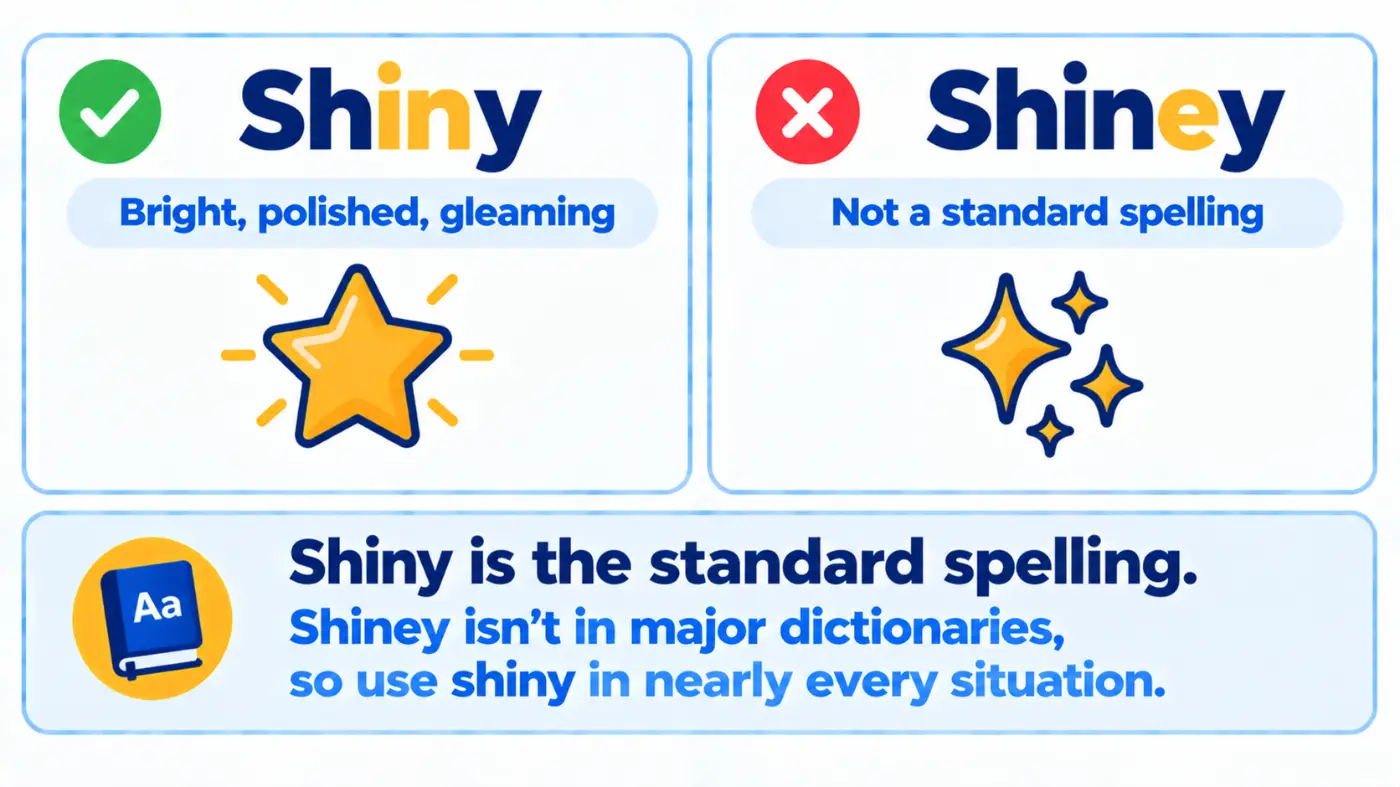
Shiny is the standard, overwhelmingly preferred spelling in modern English. Shiney does occasionally appear as a variant in less formal writing, but it isn’t listed as standard in major dictionaries, and shiny is the spelling you should default to in nearly every situation.
The Short Answer at a Glance
| Form | Status | What it does | Example |
|---|---|---|---|
| shiny | Standard spelling | Adjective describing something that reflects light or has a glossy, bright surface | The car’s paint job looked shiny after the wash. |
| shiney | Nonstandard variant | Same intended meaning, but not recognized in standard dictionaries | Occasionally seen in casual or informal writing. |
Both spellings aim to describe the same quality, but shiny is the correct, dictionary-recognized form, while shiney should generally be avoided.
What Shiny Means and How It Works
Shiny is an adjective describing something that reflects light, has a smooth and glossy surface, or gives off a bright, gleaming appearance. It applies to an enormous range of things: polished metal, wet pavement, new coins, freshly waxed cars, glossy hair, and countless other surfaces that catch and reflect light.
The word also carries a lighter, more playful figurative use, especially in casual speech, where “shiny” can describe something new, exciting, or momentarily captivating, as in “he’s easily distracted by shiny new gadgets.” This figurative sense leans into the idea of something eye-catching or novel, drawing attention the way a literally shiny object would.
Grammatically, shiny functions as a standard adjective, appearing before a noun (“a shiny new bike”) or after a linking verb (“the floor is shiny”). It follows the regular comparative and superlative pattern for short adjectives ending in “y”: shiny becomes shinier and shiniest, the same way happy becomes happier and happiest.
The suffix “-y” attaches to the noun “shine,” which describes the quality of reflecting light, to form the adjective.This is a common and productive pattern in English, seen in similar words like sunny, rainy, and windy, all formed the same way from a noun plus “-y.”
Is “Shiney” Ever Correct?
Not really, at least not as a standard, dictionary-recognized spelling. Shiney does appear from time to time in informal writing, branding, and casual online content, but major dictionaries consistently list shiny as the correct and standard form, without recognizing shiney as an accepted alternate spelling the way some other word pairs allow for regional or historical variants.
The confusion likely stems from the same inconsistency that affects several similar adjectives built from a noun plus “-y.” English doesn’t have one single, universal rule dictating whether an extra “e” gets inserted before that suffix, and a handful of related words, like “flaky” versus the rarer “flakey,” show a similar, if uneven, pattern of variation. Shiny and shiney follow a comparable dynamic, though shiney is generally considered even less standard than some of those other cases.
Shiney isn’t a reliably accepted dictionary variant, so treating it as interchangeable with shiny carries more risk than a genuinely recognized alternate spelling would. In professional, published, or edited writing, shiny is the spelling readers and editors expect. Straying from it is more likely to get flagged as an error than accepted as a stylistic choice.
Shiny vs Shiney: Key Differences Side by Side
| Feature | Shiny | Shiney |
|---|---|---|
| Part of speech | Adjective | Adjective (nonstandard) |
| Core meaning | Reflecting light; glossy or bright in appearance | Same intended meaning |
| Typical use | All contexts: everyday writing, branding, professional content | Occasional informal or casual writing |
| Register | Standard everywhere | Not standard; best avoided in formal or professional writing |
| Frequency | Dominant spelling by a wide margin | Rare and inconsistent |
| Example | Her shoes were polished to a shiny finish. | Her shoes were polished to a shiney finish. |
What the table can’t fully capture is just how lopsided this comparison actually is. Unlike some word pairs where both spellings appear regularly across dictionaries and publishing, shiny stands as the clear, unambiguous standard, while shiney shows up mostly in casual, unedited writing rather than as a recognized parallel form.
Correct Examples in Real-Life Contexts
Everyday speech
- I love how shiny the floor looks after you mop it.
- That’s such a shiny new phone, when did you get it?
- Her hair looked so shiny after using that new conditioner.
- The kids were mesmerized by the shiny ornaments on the tree.
Workplace writing
- The product photography needs to emphasize the phone’s shiny, reflective back panel.
- Please polish the display cases so they look shiny for tomorrow’s showroom event.
- Our new packaging features a shiny, metallic finish to stand out on shelves.
- The vendor delivered shiny, brand-new equipment ahead of schedule.
Texting
- omg look at this shiny new watch i just got
- the car looks so shiny after that detail job, worth every penny
School and academic
- The chemistry lab examined why certain metals appear shiny while others look dull.
- Her art project used shiny materials to reflect light across the room.
- Students studied how polishing affects a surface’s shiny appearance at the molecular level.
- The geology unit compared shiny mineral samples to their duller counterparts.
Formal writing
- Consumer reviews consistently praise the appliance’s shiny, easy-to-clean surface.
- The report notes that shiny packaging increases shelf visibility in retail environments.
- Inspectors confirmed the newly installed fixtures met the required shiny, corrosion-resistant standard.
- The museum’s exhibit features artifacts prized for their shiny, well-preserved surfaces.
Common Mistakes People Make (and How to Catch Them)
Assuming shiney is simply an acceptable alternate spelling
Wrong assumption: Shiney is just as correct as shiny, since both spellings exist. Right understanding: Shiny is the standard, dictionary-recognized spelling, while shiney is a nonstandard variant best avoided, especially in formal or professional writing.
This isn’t a mistake in the traditional sentence-writing sense, but a common misunderstanding worth clarifying, since not every pair of “-y” versus “-ey” spellings carries equal legitimacy.
Inconsistent spelling within the same document
Wrong: The brochure describes the finish as shiny in one section and shiney in another. Right: The brochure consistently uses shiny throughout.
Even setting aside the question of whether shiney is acceptable at all, mixing spellings within a single piece of writing looks like a proofreading oversight.
Applying the same logic from words that do have accepted variants
Wrong: Since flakey is sometimes accepted, shiney should be too.Right: Dictionary acceptance varies across this whole category of words, so writers need to check each word’s variant spellings individually.
Writers sometimes assume that because one related adjective has a recognized alternate spelling, similar words automatically follow the same pattern. That assumption doesn’t hold up reliably across this word family.
Typing quickly and inserting an unnecessary “e”
Wrong: The countertop has a shiney, polished look. Right: The countertop has a shiny, polished look.
Fast typing sometimes inserts extra letters out of habit, especially when other “-ey” spellings a writer has encountered elsewhere shape their instincts, even if those spellings aren’t standard either.
A Fast Trick to Choose the Right One
Default to shiny without exception, unless you’re deliberately quoting or preserving an existing use of shiney from another source. Since shiny is the dictionary-standard spelling with no meaningful competition, there’s little reason to second-guess it in everyday writing.
A helpful comparison: think of other short adjectives built the same way, like “sunny,” “funny,” and “runny.” None of these commonly appear with an inserted “e” before the “y,” and shiny follows that identical, much more common pattern.
This trick works reliably for nearly all writing situations. Its only real limitation is preserving direct quotations or brand names that might intentionally use shiney as a stylistic choice, in which case the original spelling should be kept exactly as written.
How They Sound in Real Situations
A text exchange
Priya: Did you see Marco’s new car?
Sam: Yes! So shiny, he’s clearly obsessed with keeping it clean.
Priya: As he should be, that thing cost a fortune.
Shiny is correct here, describing the car’s polished, reflective appearance in a casual conversation.
A workplace email
Subject: Product photography notes
Hi Elena,
Could we get a few more shots highlighting how shiny the new finish looks under studio lighting? I think that detail will really help with the product listing.
Thanks, Marcus
Shiny is correct because the email describes a product’s reflective surface in a professional context.
An article-style excerpt
The renovated lobby features shiny marble floors that reflect the building’s new chandeliers, a dramatic upgrade from the space’s dated, worn-down appearance. Architects say the redesign was intended to feel bright and modern.
Shiny is the natural choice here, describing the reflective quality of the marble in a polished, professional piece.
Formal Writing vs Casual Writing
Shiny is appropriate and expected across every register, from casual conversation to formal, published writing. There’s no situation where shiny would be considered too informal or too formal; it simply works everywhere.
Shiney, on the other hand, is inconsistent enough that it should generally be avoided regardless of register, though it’s somewhat more likely to slip through unnoticed in very casual, unedited writing like social media captions or quick messages than in anything professionally reviewed or published.
Major style guides don’t specifically address shiney as an accepted variant, and in practice, virtually all professionally edited content defaults to shiny without exception.
Related Mix-Ups People Also Search For
Shiny vs Shine
Shine is the base noun or verb describing the quality of reflecting light or the act of polishing something, while shiny is the adjective form describing something that possesses that quality. Example: After a good shine, the trophy looked incredibly shiny on the shelf.
Shiny vs Glossy
These two overlap closely in meaning, though glossy often specifically implies a smooth, polished finish, particularly on printed materials, paint, or cosmetics, while shiny is a broader term for anything reflecting light. Example: The magazine’s glossy cover made the model’s shiny jewelry practically sparkle off the page.
Sunny vs Sunney
This pair mirrors the shiny versus shiney pattern closely, since sunny is the standard spelling and “sunney” isn’t a recognized variant at all. Example: It was a bright, sunny afternoon, perfect for polishing the car until it looked shiny.
Quick Practice: Test Yourself
Choose the spelling that matches standard modern usage for each blank.
- The freshly waxed floor looked incredibly ______ under the lights. (shiny / shiney)
- Her new necklace was so ______ it caught everyone’s attention. (shiny / shiney)
- The car dealership advertised its inventory as “______ and ready to drive.” (shiny / shiney)
- After polishing the silverware, it looked noticeably ______. (shiny / shiney)
- The children were drawn to the ______ display of holiday decorations. (shiny / shiney)
- Reviewers praised the phone’s sleek, ______ design. (shiny / shiney)
Answer Key
- shiny: the standard spelling, appropriate in any context.
- shiny: correct in casual, descriptive speech.
- shiny: standard spelling, even in advertising copy.
- shiny: standard spelling describing a polished object.
- shiny: standard spelling in a descriptive, everyday sentence.
- shiny: standard spelling in a product review context.
Frequently Asked Questions
Is shiney a real word?
Shiney occasionally appears in informal writing, but it isn’t listed as a standard spelling in major dictionaries. Shiny is the correct, recognized form.
Which spelling should I use in professional writing?
Shiny is the safe, standard choice for professional, published, and formal writing of any kind.
Does shiny always describe something literal, like a surface?
No. Shiny also has a figurative use describing something new, exciting, or attention-grabbing, as in being distracted by “shiny” new ideas or gadgets.
What’s the comparative form of shiny?
The comparative form is shinier, and the superlative form is shiniest, following the standard pattern for short adjectives ending in “y.”
Are there regional differences between shiny and shiney, like US versus UK spelling?
No meaningful regional pattern exists between the two. Shiny is the standard spelling in both American and British English.
Is shiney ever acceptable in creative or stylistic writing?
It can appear in stylized branding, usernames, or intentional creative choices, but it isn’t a standard alternate spelling, so it should be used deliberately rather than by accident.

Sophia Bennett writes educational content about English vocabulary, grammar, slang, and communication. She is passionate about making complex language topics accessible to students, professionals, and curious readers around the world.