Chief vs Cheif: Which Spelling Is Correct?
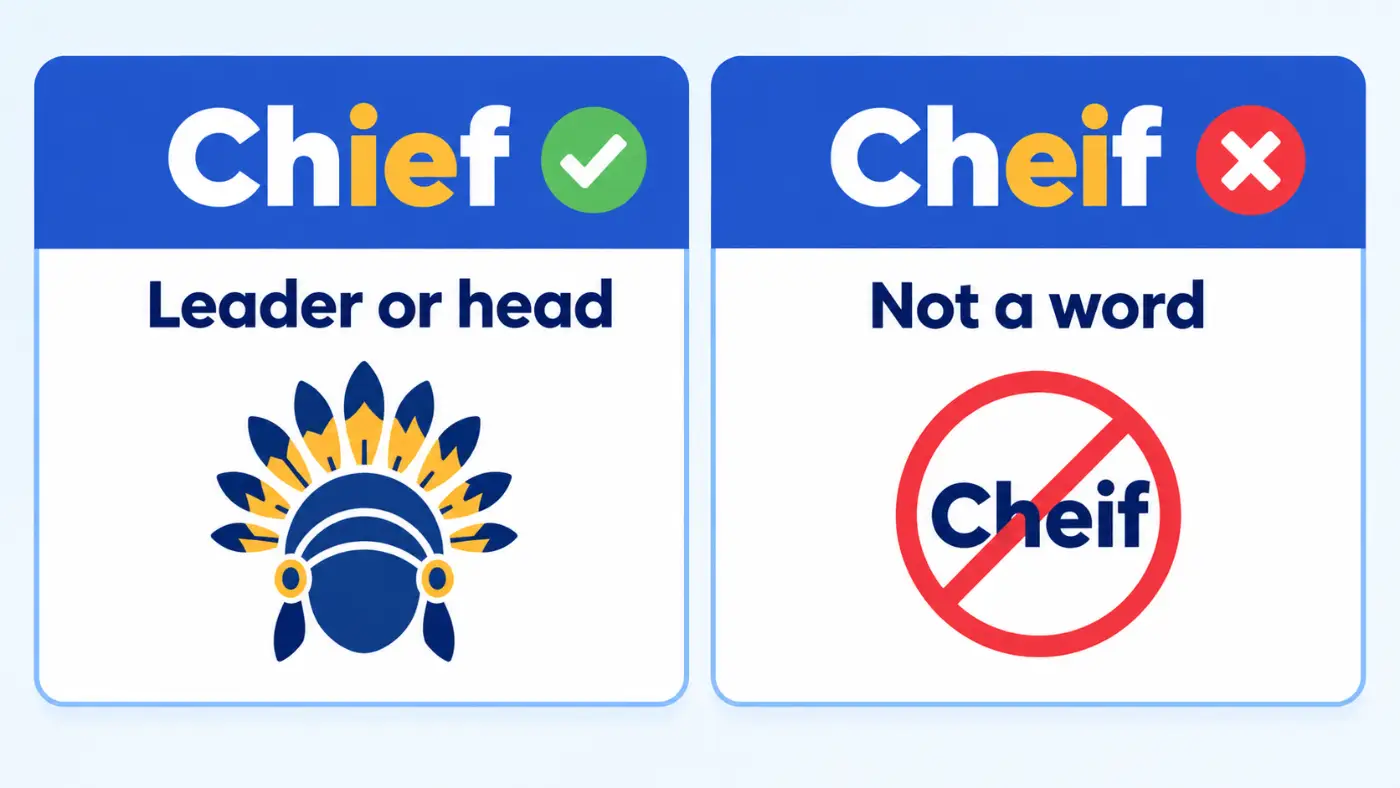
Chief is the correct spelling. Cheif transposes the “i” and “e,” breaking one of English’s most familiar spelling guidelines: “i before e, except after c.”
The Short Answer at a Glance
| Form | Status | What it does | Example |
|---|---|---|---|
| chief | Correct | Noun or adjective referring to a leader, or describing something as primary or most important | The fire chief addressed the community after the storm. |
| cheif | Misspelling | Not a word in standard English | Correct it to chief every time. |
Only one spelling is real. The “i” comes before the “e” here, following the classic rule most English speakers learn early on.
What Chief Means and How It Works
Chief functions as both a noun and an adjective. As a noun, a chief is a person who holds the highest rank or authority within a group, organization, or community, such as a tribal chief, a police chief, or the chief of a fire department. As an adjective, chief describes something as the most important, primary, or principal element of a larger group, as in “the chief concern” or “her chief responsibility.”
The noun sense of chief carries a strong connotation of leadership and authority, often within a formal hierarchy or organizational structure. It appears constantly in titles and official roles: chief executive officer, chief of staff, chief justice, tribal chief. In each case, the word signals the top position within that particular structure.
The adjective sense works differently, modifying a noun to indicate it holds the greatest importance among several related things, as in “his chief complaint was the noise” or “the chief ingredient in the recipe is garlic.” This use doesn’t necessarily involve leadership or hierarchy at all, simply priority or primacy.
Grammatically, chief as a noun is countable: a chief, several chiefs, two tribal chiefs. As an adjective, it functions just like other adjectives, placed directly before the noun it modifies, with no special conjugation or agreement required.
Chief follows a well-known English spelling pattern, “i before e, except after c,” and it demonstrates the rule in its most straightforward form: no “c” precedes the vowel combination, so “i” correctly comes before “e.”
Is “Cheif” Ever Correct?
No. Cheif isn’t recognized in any standard dictionary, and it isn’t a regional variant, dated form, or accepted alternative spelling. It’s a straightforward letter-transposition error, and one of the most common types of spelling mistakes in English overall.
The “i before e, except after c” rule is one of the most widely taught spelling guidelines in English education, and chief is actually a clean, reliable example of it working exactly as expected. Since there’s no “c” immediately before the vowel pair, the rule correctly predicts “i” before “e,” producing “chief.”
Despite how familiar this rule is, transposition errors like cheif remain common, largely because English has plenty of exceptions to the same rule, like “weird,” “seize,” and “their,” which can make writers second-guess themselves even on words where the rule applies perfectly well. That hesitation, combined with the visual similarity between “ie” and “ei,” makes chief an easy word to misspell despite its relatively simple underlying pattern.
Because chief appears so frequently in titles, headlines, and official language, this particular transposition error tends to stand out and get flagged quickly in professional writing, even though it’s an easy slip to make in fast or informal typing.
Chief vs Cheif: Key Differences Side by Side
| Feature | Chief | Cheif |
|---|---|---|
| Recognized word | Yes | No |
| Part of speech | Noun and adjective | None |
| Core meaning | A leader or top authority; or something of primary importance | No meaning |
| Typical use | Job titles, leadership roles, describing primary importance | Appears only as a typo |
| Register | Works in formal and casual writing | Never appropriate |
| Example | The chief financial officer presented the quarterly report. | The cheif financial officer presented the quarterly report. (wrong) |
The table shows a clean contrast, but what it can’t fully capture is how reliably chief actually follows the classic spelling rule most people learn as children. Unlike many words that break the “i before e” guideline, chief is one of the clearer cases where the rule holds up perfectly, which makes the cheif misspelling feel more like a simple slip than a genuine rule confusion.
Correct Examples in Real-Life Contexts
Everyday speech
- My chief complaint about the new apartment is the lack of storage space.
- The tribal chief spoke at the opening ceremony for the new community center.
- Her chief goal this year is to finally finish her degree.
- The fire chief praised the volunteers for their quick response.
Workplace writing
- The company just announced a new chief operating officer.
- Our chief priority this quarter is improving customer retention rates.
- Please loop in the chief of staff before finalizing the schedule.
- The chief engineer signed off on the final safety inspection.
Texting
- omg did you hear the chief of police is retiring next month
- my chief concern rn is whether we have enough snacks for the trip lol
School and academic
- The history lecture covered the role of tribal chiefs in pre-colonial governance.
- Her thesis identifies the chief factors contributing to urban housing shortages.
- Students debated the chief responsibilities of a modern school principal.
- The case study examines decisions made by the company’s former chief executive.
Formal writing
- The report outlines the chief executive’s strategic priorities for the coming year.
- The chief justice delivered the court’s majority opinion.
- Regulatory filings require disclosure of the company’s chief financial officer.
- The committee identified three chief concerns regarding the proposed legislation.
Common Mistakes People Make (and How to Catch Them)
Transposing the “i” and “e”
Wrong: The cheif of police addressed the media this morning. Right: The chief of police addressed the media this morning.
This is the core error. Despite the rule working correctly for this word, writers sometimes reverse the letters out of habit or uncertainty.
Second-guessing the rule due to known exceptions
Wrong: Remembering exceptions like “weird” and “their,” a writer assumes chief must also break the “i before e” rule. Right: Recognizing that chief is actually a reliable example of the rule working as expected, with no “c” preceding the vowel pair.
Because English has so many well-known exceptions to this spelling guideline, some writers lose confidence in applying it even to words where it holds up perfectly.
Typing quickly and reversing adjacent letters
Wrong: She was named cheif marketing officer last year. Right: She was named chief marketing officer last year.
Fast typing can easily transpose two adjacent letters, especially in a word typed frequently in titles and headlines.
Confusing chief with similarly spelled words
Wrong: The theif, I mean cheif, gave a speech at the ceremony. Right: The chief gave a speech at the ceremony.
This kind of mix-up sometimes happens when a writer is thinking of a different “ie/ei” word, like “thief,” and the spelling patterns blend together momentarily.
A Fast Trick to Choose the Right One
Apply the classic rule directly: “i before e, except after c.” Since chief has no “c” immediately before the vowel pair, the rule correctly tells you “i” comes first, producing chief, not cheif.
A second trick: pair chief with other reliable “i before e” words that follow the same clean pattern, like “field,” “yield,” and “piece.” If you already spell those correctly without hesitation, chief follows the identical, non-exceptional pattern.
This trick works well specifically because chief isn’t one of the rule’s many exceptions. Its only limitation is that it won’t help you with words like “weird” or “seize,” which genuinely do break the rule, so it’s worth remembering that chief is one of the reliable cases, not a tricky one.
How They Sound in Real Situations
A text exchange
Priya: Did you hear who the new fire chief is?
Jordan: Yeah, she used to work downtown, people seem excited about it.
Priya: That’s great, hope she brings some good changes.
Chief is correct here, referring to the leadership position in casual conversation.
A workplace email
Subject: Org chart update
Hi team,
Just a heads-up that we’ve promoted Marcus to chief technology officer, effective next month. Please join me in congratulating him on this well-deserved role.
Thanks, Renata
Chief is correct here, used as part of a formal job title in professional communication.
An article-style excerpt
The newly appointed police chief outlined her priorities during Tuesday’s press conference, emphasizing community engagement and transparency. Residents say they’re cautiously optimistic about the direction of the department under her leadership.
Chief is correct here, used in standard journalistic coverage of a leadership appointment.
Formal Writing vs Casual Writing
The correct spelling doesn’t change based on formality. Chief is right in a corporate press release, a news article, a text message, and a casual conversation. Cheif is wrong everywhere, regardless of tone or context.
What shifts with register is how the word tends to appear. In formal and professional writing, chief frequently shows up as part of official titles, like chief executive officer or chief of staff. In casual speech, it’s used more loosely to describe the primary or most important version of something, as in “my chief worry” or “the chief reason I’m tired.”
AP and Chicago style both treat chief as a standard word requiring no special formatting, and neither offers any accepted alternate spelling.
Related Mix-Ups People Also Search For
Chief vs Thief
These two words look somewhat similar and both follow the “i before e” pattern correctly, but they mean completely different things. Chief refers to a leader or something of primary importance, while a thief is someone who steals. Example: The chief of security reviewed footage after a thief broke into the warehouse.
Chief vs Chef
Despite looking and sounding similar, these words are unrelated in origin and meaning. Chief refers to a leader or top priority, while a chef is a professional cook, particularly one in charge of a kitchen. Example: The chief financial officer hired a private chef for the company retreat.
Chief vs Brief
This pair shares the same correctly ordered “ie” spelling pattern, reinforcing how reliably the “i before e” rule applies here. Example: The chief gave a brief statement before taking questions from reporters.
Exceptions, Edge Cases, and Tricky Situations
Chief as part of compound titles
Chief frequently combines with other words to form compound job titles, such as chief executive officer, chief marketing officer, or chief of staff. In all these cases, the spelling of chief itself never changes, regardless of which title it’s part of.
Chief versus “in chief”
The phrase “in chief,” as in “editor in chief” or “commander in chief,” places chief after the main noun rather than before it, but the spelling and meaning remain consistent with its standard use elsewhere.
Quick Practice: Test Yourself
Choose the correct spelling for each blank.
- The new ______ of police promised greater transparency with the community. (chief / cheif)
- Her ______ concern was whether the budget would hold up through the project. (chief / cheif)
- The company just named a new ______ financial officer. (chief / cheif)
- The tribal ______ addressed the gathered crowd before the ceremony began. (chief / cheif)
- His ______ complaint about the apartment was the noise from the street. (chief / cheif)
- The editor in ______ approved the final draft just before deadline. (chief / cheif)
Answer Key
- chief: the correct spelling always places “i” before “e” here.
- chief: consistent spelling regardless of sentence structure.
- chief: correct spelling used in a formal job title.
- chief: correct spelling describing a leadership role.
- chief: correct spelling used adjectivally to describe primary importance.
- chief: correct spelling in the fixed phrase “editor in chief.”
Frequently Asked Questions
Is “cheif” ever an acceptable spelling?
No. Cheif isn’t recognized in standard dictionaries and isn’t used as a regional or informal variant. The correct spelling in every context is chief.
Why does chief follow “i before e, except after c” so reliably?
Chief has no “c” immediately before the vowel pair, which means the classic spelling rule applies cleanly and correctly here, unlike some other English words that break the pattern.
Is chief always related to leadership?
Not necessarily. While it often refers to a leader or top authority, chief can also function as an adjective simply meaning “primary” or “most important,” without any connection to hierarchy or leadership roles.
What’s the plural of chief?
The plural is chiefs, formed by simply adding “s,” following the regular English pattern.
Is chief the same as chef?
No, despite the similar spelling and sound. Chief refers to a leader or something of primary importance, while chef refers specifically to a professional cook.
Does chief ever appear after the noun it modifies?
Yes, in certain fixed phrases like “editor in chief” or “commander in chief,” chief follows the main noun rather than preceding it, though its meaning and spelling remain the same.

Sophia Bennett writes educational content about English vocabulary, grammar, slang, and communication. She is passionate about making complex language topics accessible to students, professionals, and curious readers around the world.