Tomatoes vs Tomatos: Which Plural Is Correct?
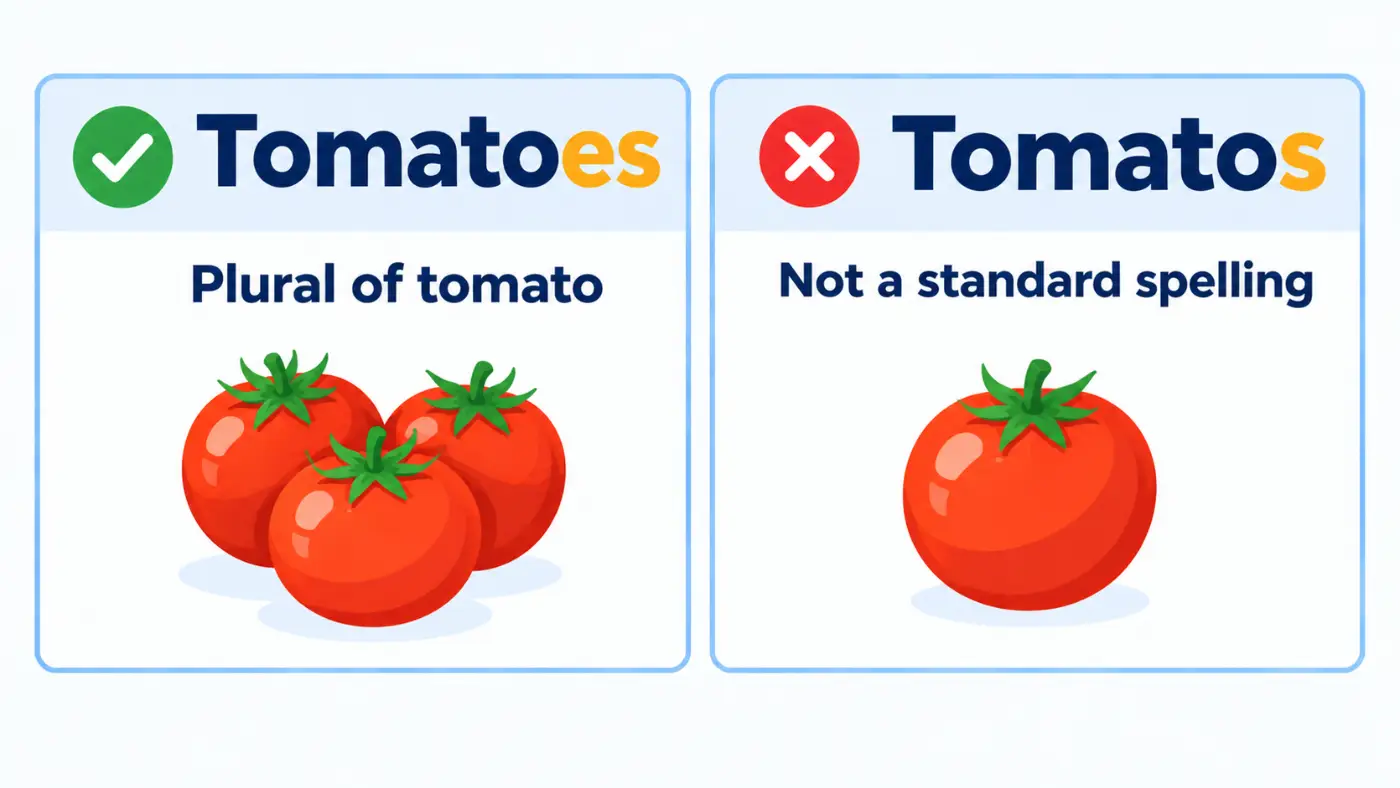
Tomatoes is the correct plural of tomato. Tomatos isn’t a standard spelling, and the mistake usually comes from assuming every word ending in “o” simply adds an “s” for its plural, when tomato actually belongs to a smaller group that adds “es” instead.
The Short Answer at a Glance
| Form | Status | What it does | Example |
|---|---|---|---|
| tomatoes | Correct plural | More than one tomato | We picked a whole basket of tomatoes from the garden. |
| tomatos | Incorrect | Not a standard spelling | Always replace it with tomatoes. |
There’s only one correct plural here. Tomato follows the “add -es” pattern, the same one used by potato, hero, and echo.
What Tomatoes Means and How It Works
Tomatoes is the plural form of the noun tomato, a word referring to the common round, typically red fruit widely used as a vegetable in cooking. The plural follows a spelling pattern used by many, though not all, English nouns ending in “o” preceded by a consonant: add “es” instead of simply “s.”
This pattern applies because tomato ends in “t” plus “o,” a consonant-vowel combination that historically trended toward the “-es” plural in English, following patterns absorbed from the word’s Spanish and Nahuatl origins as it moved through English usage over time. Other everyday words sharing this same structure include potato (potatoes), hero (heroes), and echo (echoes).
Grammatically, tomatoes functions as a standard plural noun: several tomatoes, three ripe tomatoes, a crate of tomatoes. It pairs naturally with plural verbs and determiners, as in “these tomatoes are perfectly ripe” or “many tomatoes went to waste after the frost.”
It’s worth noting that not every “o”-ending noun follows this same pattern. Words like photo, piano, and halo simply add “s” for their plurals (photos, pianos, halos), which is exactly why this particular spelling question comes up so often. English doesn’t apply the “-es” rule universally to every word ending in “o,” which makes memorization, rather than a single clean rule, the most reliable approach for many of these words.
Is “Tomatos” Ever Correct?
No. Tomatos isn’t recognized in any standard English dictionary, and it isn’t a regional variant, informal shortcut, or accepted alternative spelling. It’s a straightforward pluralization error.
The mistake typically happens because English has two competing patterns for pluralizing nouns ending in “o,” and neither pattern applies with full consistency across every word. Some words simply add “s” (photos, logos, kilos), while others add “es” (tomatoes, potatoes, heroes). Because there’s no single rule that reliably predicts which pattern a given word follows, writers often default to the simpler “add just an s” pattern, producing “tomatos” instead of the correct “tomatoes.”
This confusion isn’t unique to tomato. In fact, potato, tomato’s close cousin in both meaning and spelling pattern, is one of the most famously misspelled plurals in English for the exact same reason, to the point that a well-known political gaffe decades ago centered on exactly this mistake.
Because tomatoes and potatoes follow identical spelling logic, learning one correctly often reinforces the other, which is part of why these two words are so frequently discussed together in spelling guides.
Tomatoes vs Tomatos: Key Differences Side by Side
| Feature | Tomatoes | Tomatos |
|---|---|---|
| Recognized word | Yes | No |
| Part of speech | Plural noun | None |
| Core meaning | More than one tomato | No meaning |
| Typical use | Cooking, gardening, grocery lists, recipes | Appears only as a typo |
| Register | Works in all writing | Never appropriate |
| Example | The recipe calls for four large tomatoes. | The recipe calls for four large tomatos. (wrong) |
The table draws a clear line, but what it can’t fully capture is how reasonable this mistake actually feels, given how inconsistently English handles “o”-ending plurals overall. Since plenty of similar-looking words really do just add “s,” defaulting to that simpler pattern for tomato is an understandable, if incorrect, guess.
Correct Examples in Real-Life Contexts
Everyday speech
- These tomatoes are so sweet, they’re perfect for salads this time of year.
- I always grow way too many tomatoes every summer.
- Can you grab some tomatoes from the fridge for the sauce?
- Half these tomatoes went bad before we could use them, unfortunately.
Workplace writing
- The restaurant’s supplier delivers fresh tomatoes three times a week.
- Please update the inventory list to reflect the new shipment of canned tomatoes.
- Our seasonal menu features heirloom tomatoes sourced from a local farm.
- The grocery chain reported a shortage of tomatoes due to recent weather disruptions.
Texting
- can you grab tomatoes on your way home, we’re almost out
- just picked like twenty tomatoes from the garden, come get some
School and academic
- The biology class studied how different soil conditions affect tomato yield.
- Her agricultural research focuses on disease-resistant tomato varieties.
- Students compared the nutritional content of fresh versus canned tomatoes.
- The culinary program’s garden produces several varieties of heirloom tomatoes each season.
Formal writing
- The agricultural report highlights a significant increase in regional tomato production this year.
- Food safety inspectors flagged several shipments of imported tomatoes for further testing.
- The study examines consumer preferences across different tomato varieties.
- Supply chain disruptions have affected the availability of fresh tomatoes nationwide.
Common Mistakes People Make (and How to Catch Them)
Applying the simpler “just add s” pattern
Wrong: We bought six tomatos at the farmers market. Right: We bought six tomatoes at the farmers market.
This is the core mistake. Writers default to the more common, simpler plural pattern used by many other “o”-ending words, without realizing tomato specifically requires “es.”
Confusing tomato’s plural with words that only add “s”
Wrong: The recipe needs three tomatos, similar to how you’d only add an “s” to “photo.” Right: The recipe needs three tomatoes, since tomato follows a different pattern than photo.
Because some “o”-ending words genuinely do just add “s,” writers sometimes apply that same logic across the board, not realizing tomato belongs to the other group.
Typing quickly and dropping the extra letter
Wrong: I need more tomatos for the sauce. Right: I need more tomatoes for the sauce.
Fast typing often favors the shorter, simpler-looking plural, especially since the difference between the two spellings is just one letter.
Overcorrecting other words after learning about tomatoes
Wrong: Assuming every “o”-ending word, like “photo” or “piano,” also needs “es” after learning the tomato rule. Right: Recognizing that tomato and potato follow this pattern, while words like photo and piano don’t, since English doesn’t apply the rule universally.
Once writers learn that tomato needs “es,” some mistakenly assume this rule applies to every similar word, when in fact each “o”-ending noun needs to be learned somewhat individually.
A Fast Trick to Choose the Right One
Pair tomato with its closest relative in both meaning and spelling behavior: potato. Both words end in a consonant plus “o,” and both correctly take the “-es” plural: tomatoes and potatoes. If you remember one, you’re far less likely to misspell the other.
A second trick is to say the plural slowly and notice the extra syllable. “Tomato-ez” has a distinct additional sound compared to simply adding an “s,” which can serve as an audible cue that an extra letter belongs in the written form as well.
This trick works well for tomato and potato specifically, but it won’t reliably predict every other “o”-ending plural in English, since words like photo and piano don’t follow the same extra-syllable pattern, and memorization remains the most dependable approach for this category of words overall.
How They Sound in Real Situations
A text exchange
Priya: Can you grab tomatoes from the store?
Sam: Yep, how many do you need?
Priya: Maybe six, I’m making sauce tonight.
Tomatoes is correct here, used naturally in casual conversation about grocery shopping.
A workplace email
Subject: Produce order update
Hi team,
Our supplier confirmed that fresh tomatoes will arrive a day later than scheduled this week due to transportation delays. Please adjust the weekend prep schedule accordingly.
Thanks, Marcus
Tomatoes is correct here, referring to a shipment of produce in a professional context.
An article-style excerpt
Local farmers say this summer’s unusually warm weather has produced an especially abundant harvest of tomatoes, with many reporting their best yields in years. Farmers markets across the region are seeing record turnout as shoppers stock up before the season ends.
Tomatoes is correct here, used in standard agricultural and local news reporting.
Formal Writing vs Casual Writing
The correct spelling doesn’t shift based on formality. Tomatoes is right in a scientific report, a grocery list, a text message, and a casual conversation. Tomatos is wrong everywhere, regardless of tone or context.
What changes with register is simply the context in which tomatoes typically appears. In formal or academic writing, tomatoes often shows up in agricultural, nutritional, or economic discussions. In casual speech, it’s used constantly in everyday conversations about cooking, gardening, and grocery shopping.
AP and Chicago style both follow standard English pluralization rules here, with no special guidance needed beyond recognizing that tomato takes the “-es” plural ending.
Related Mix-Ups People Also Search For
Potatoes vs Potatos
This pair follows the exact same spelling pattern as tomatoes, since potato also ends in a consonant plus “o” and takes the “-es” plural. Example: We roasted potatoes and tomatoes together for the perfect side dish.
Heroes vs Heros
Another word following the identical “-es” pattern, since hero also ends in a consonant plus “o.” Example: The documentary profiles several local heroes who stepped up during the flood.
Photos vs Photoes
This word demonstrates the opposite pattern, since photo simply adds “s” rather than “es,” making it a useful contrast to remember alongside tomatoes. Example: She took dozens of photos of the tomatoes growing in her garden.
Echoes vs Echos
Echo follows the same “-es” pattern as tomato and hero, reinforcing that this group, while not universal, does include several common words. Example: The canyon’s echoes seemed to multiply every sound we made.
Quick Practice: Test Yourself
Choose the correct plural for each blank.
- We grew so many ______ this summer that we started giving them away. (tomatoes / tomatos)
- The recipe calls for two cups of chopped ______. (tomatoes / tomatos)
- My grandmother always grows the best ______ in her backyard garden. (tomatoes / tomatos)
- The grocery store was completely out of fresh ______ this week. (tomatoes / tomatos)
- We added diced ______ and basil to the pasta sauce. (tomatoes / tomatos)
- Those heirloom ______ are perfect for a summer salad. (tomatoes / tomatos)
Answer Key
- tomatoes: the correct plural always adds “es,” following the same pattern as potatoes.
- tomatoes: consistent spelling regardless of sentence context.
- tomatoes: correct plural used in a gardening context.
- tomatoes: correct plural describing grocery store inventory.
- tomatoes: correct plural used in a recipe context.
- tomatoes: correct plural describing a specific variety.
Frequently Asked Questions
No. Tomatos isn’t recognized in standard dictionaries and isn’t used as a regional or informal variant. The correct plural in every context is tomatoes.
Tomato ends in a consonant followed by “o,” a pattern that a number of English nouns, including potato and hero, pluralize by adding “es” rather than simply “s.”
No. Words like photo, piano, and halo simply add “s” for their plurals, which is exactly why there’s no single universal rule and why memorization matters for this category of words.
Yes. Both British and American English use the identical plural spelling, tomatoes, with no regional variation.
Potato, hero, and echo all follow the same “-es” pattern, becoming potatoes, heroes, and echoes respectively.
Not a universal one, but pairing tomato with potato, since both are extremely common and follow the identical pattern, can help reinforce the correct spelling for both words at once.

Sophia Bennett writes educational content about English vocabulary, grammar, slang, and communication. She is passionate about making complex language topics accessible to students, professionals, and curious readers around the world.