
Echoes vs Echos: Which Plural Is Correct?
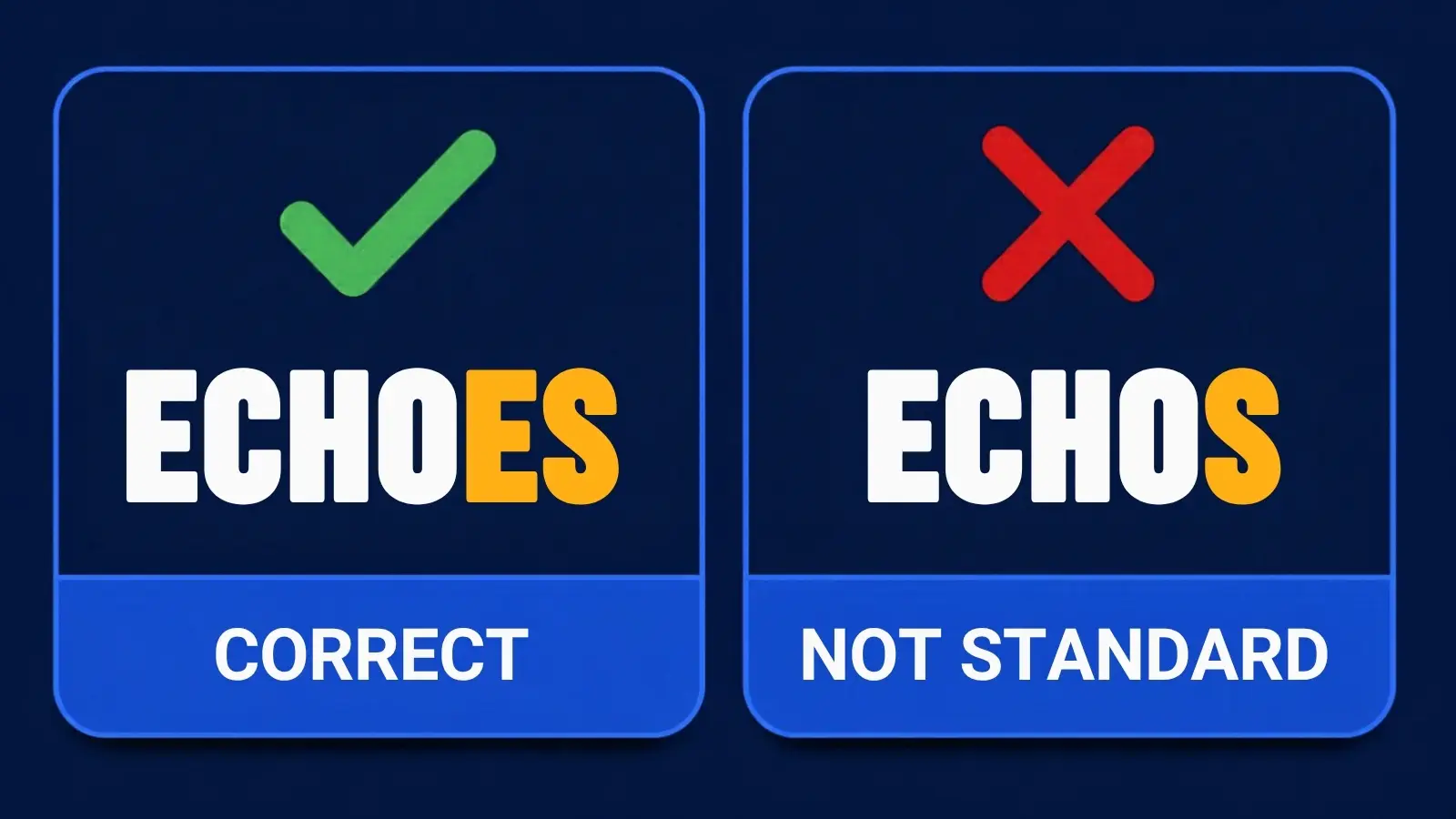
Echoes is the correct plural of echo. Echos isn’t a standard spelling, and the mistake usually comes from assuming every word ending in “o” simply adds an “s” for its plural, when echo actually belongs to a smaller group of words that add “es” instead.
The Short Answer at a Glance
| Form | Status | What it does | Example |
|---|---|---|---|
| echoes | Correct plural | More than one echo, or the verb form describing repeated sounds | The canyon produced several distinct echoes as we called out. |
| echos | Incorrect | Not a standard spelling | Always replace it with echoes. |
There’s only one correct plural here. Echo follows the “add -es” pattern, the same one used by hero, tomato, and potato.
What Echoes Means and How It Works
Echoes functions as both the plural of the noun echo and as the third-person singular present tense of the verb echo. As a noun, an echo refers to a sound that reflects off a surface and is heard again, often repeated multiple times as it bounces between surfaces, as in a canyon, cave, or empty room. Echoes, the plural, refers to more than one such repeated sound.
The word also carries a widely used figurative meaning, describing something that repeats, reflects, or reminds one of something earlier, as in “echoes of her mother’s voice in the way she laughed” or “the policy echoes similar measures from a decade ago.” This figurative sense shows up constantly in writing about history, culture, politics, and personal reflection.
Grammatically, echoes as a noun follows the regular English pattern for pluralizing nouns ending in “o” preceded by a consonant, adding “es” rather than simply “s.” This same pattern applies to several other common nouns, including hero, tomato, and potato, which is why remembering one of these words can often help with spelling the others correctly.
As a verb, echo conjugates following this pattern:
- echo (base form)
- echoes (third-person singular present)
- echoed (past tense and past participle)
- echoing (present participle)
So “echoes” does double duty, correctly functioning as both the plural noun and the present-tense verb form, depending on how it’s used in a sentence.
Is “Echos” Ever Correct?
No. Echos isn’t recognized in any standard English dictionary, and it isn’t a regional variant, informal shortcut, or accepted alternative spelling. It’s a pluralization error.
The mistake happens because English has two competing patterns for pluralizing nouns ending in “o,” and neither pattern applies universally. Some words, like photo, piano, and halo, simply add “s” to form their plurals (photos, pianos, halos). Other words, like echo, hero, and tomato, add “es” instead (echoes, heroes, tomatoes). Since there’s no single, predictable rule that tells you which pattern a given word follows, writers often default to the simpler “just add s” pattern, producing the incorrect “echos.”
This confusion isn’t unique to echo. It’s part of a broader, well-documented inconsistency in English spelling involving “o”-ending nouns, one that affects several other common words in exactly the same way. Because echo doesn’t offer any obvious visual or phonetic clue pointing toward the “-es” ending, the error can feel like a reasonable guess even for otherwise careful writers.
Worth noting: you may occasionally see “Echos” used as a stylized brand or product name, where a company has deliberately chosen that spelling for trademark or branding purposes. That kind of intentional, proper-noun usage is different from using “echos” as the standard plural of the common noun, which remains incorrect in everyday writing.
Echoes vs Echos: Key Differences Side by Side
| Feature | Echoes | Echos |
|---|---|---|
| Recognized word | Yes | No (except as a stylized proper noun/brand name) |
| Part of speech | Plural noun; also present-tense verb | None in standard usage |
| Core meaning | More than one echo; to repeat or reflect sound | No meaning |
| Typical use | Acoustics, figurative writing, everyday speech | Appears only as a typo, outside of branding |
| Register | Works in all writing | Never appropriate outside of a proper noun |
| Example | The mountains created layered echoes across the valley. | The mountains created layered echos across the valley. (wrong) |
The table draws a clear line, but what it can’t fully capture is how this mistake fits into a larger, genuinely inconsistent pattern in English. Echo isn’t an isolated case; it’s part of a small but common group of “o”-ending words that simply don’t follow the more familiar “just add s” rule most English speakers default to.
Correct Examples in Real-Life Contexts
Everyday speech
- We stood in the cave and listened to our voices echo back at us.
- The canyon’s echoes were so loud they startled the kids.
- Her advice still echoes in my head whenever I face a tough decision.
- I love how sound echoes off the walls in that old gymnasium.
Workplace writing
- The feedback from this quarter echoes concerns raised in last year’s survey.
- Our marketing message should echo the brand’s core values consistently across platforms.
- The acoustics in the new conference room create noticeable echoes during calls.
- Several client comments echoed the same frustration about response times.
Texting
- Oh my goodness, the tunnel had wild echoes, we were yelling for like ten minutes.
- this song’s chorus echoes in my head all day, send help
School and academic
- The physics lab examined how sound waves produce echoes in enclosed spaces.
- Her essay traces how the author’s themes echo earlier works in the genre.
- Students measured the time delay between a sound and its returning echoes.
- The historical analysis explores how past policies echo through modern legislation.
Formal writing
- The report’s findings echo earlier studies on workplace productivity trends.
- Acoustic engineers adjusted the auditorium’s design to minimize unwanted echoes.
- The committee’s recommendations echo concerns previously raised by stakeholders.
- Researchers measured sound reflection patterns and the resulting echoes in the test chamber.
Common Mistakes People Make (and How to Catch Them)
Applying the simpler “just add s” pattern
Wrong: The cave produced several loud echos. Right: The cave produced several loud echoes.
This is the core mistake. Writers default to the more common, simpler plural pattern used by many other “o”-ending words, without realizing echo specifically requires “es.”
Confusing echo’s plural with words that only add “s”
Wrong: The concert hall’s echos were noticeably different from the smaller venue. Right: The concert hall’s echoes were noticeably different from the smaller venue.
Because some “o”-ending words genuinely do just add “s,” like photo and piano, writers sometimes apply that same logic across the board, not realizing echo belongs to the other group.
Typing quickly and dropping the extra letter
Wrong: You could hear faint echos bouncing off the canyon walls. Right: You could hear faint echoes bouncing off the canyon walls.
Fast typing often favors the shorter, simpler-looking plural, especially since the difference between the two spellings is just one letter.
Confusing the brand name with the standard spelling
Wrong: Using a product’s stylized “Echos” branding as justification for spelling the common noun the same way. Right: Recognizing that a brand’s proper noun spelling doesn’t change the correct spelling of the everyday word echoes.
A company’s trademarked spelling choice is a separate matter from standard English usage, and it shouldn’t be treated as evidence that “echos” is an acceptable general spelling.
A Fast Trick to Choose the Right One
Pair echo with hero, another extremely common word that ends in a consonant plus “o” and also takes the “-es” plural: heroes. If you remember that heroes needs “es,” you’re more likely to remember that echoes does too, since both words follow the identical pattern.
A second trick is to say the plural slowly and notice the extra syllable. “Echo-ez” has a distinct additional sound compared to simply adding an “s,” which can serve as a helpful audible cue that an extra letter belongs in the written form as well.
This trick works well for echo and hero specifically, but it won’t reliably predict every other “o”-ending plural in English, since words like photo and piano don’t follow the same extra-syllable pattern. Memorization remains the most dependable approach for this particular category of words.
How They Sound in Real Situations
A text exchange
Priya: How was the cave tour?
Jordan: Incredible, the echoes in there were unreal, kept going for seconds.
Priya: I need to go, that sounds amazing.
Echoes is correct here, used naturally in casual conversation about an acoustic experience.
A workplace email
Subject: Client feedback summary
Hi team,
I’ve reviewed this quarter’s feedback, and several comments echo concerns we heard last year about onboarding speed. Let’s prioritize addressing this before the next product update.
Thanks, Marcus
Echo, used here as a verb, is correct because the sentence describes feedback repeating or reflecting earlier concerns.
An article-style excerpt
Acoustic engineers redesigned the concert hall’s interior after visitors complained about jarring echoes disrupting performances. The updated layout has significantly reduced unwanted sound reflection throughout the venue.
Echoes is correct here, used in a technical, acoustics-focused context.
Formal Writing vs Casual Writing
The correct spelling doesn’t shift based on formality. Echoes is right in a scientific report, a business email, a text message, and a casual conversation. Echos is wrong everywhere in standard writing, regardless of tone or context, apart from its occasional appearance as a stylized brand name.
What changes with register is simply how the word gets used. In formal and academic writing, echoes often appears in acoustics, literary analysis, or figurative discussions of recurring themes and ideas. In casual speech, it’s used constantly to describe literal sound reflections, like shouting in a canyon or an empty hallway.
AP and Chicago style both follow standard English pluralization rules here, with no special guidance needed beyond recognizing that echo takes the “-es” plural ending.
Related Mix-Ups People Also Search For
Heroes vs Heros
This pair follows the exact same spelling pattern as echoes, since hero also ends in a consonant plus “o” and takes the “-es” plural. Example: The documentary honors several local heroes who responded during the flood.
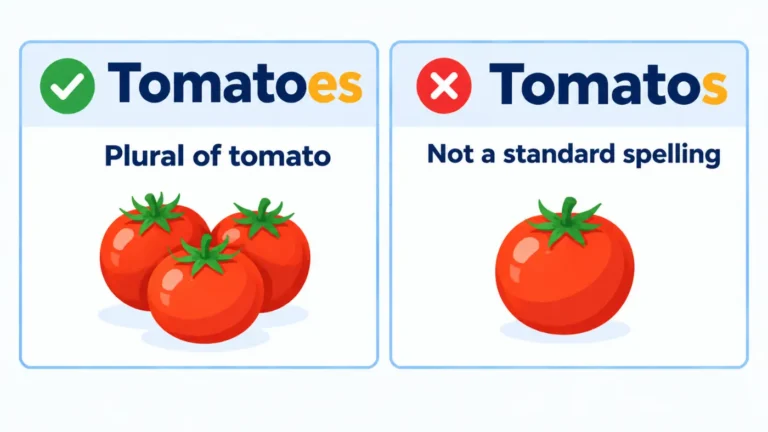
Tomatoes vs Tomatos
Another word following the identical “-es” pattern, reinforcing that this spelling behavior, while not universal, applies to a recognizable group of common nouns. Example: We added fresh tomatoes to the sauce after letting it simmer with the herbs.
Photos vs Photoes
This word demonstrates the opposite pattern, since photo simply adds “s” rather than “es,” making it a useful contrast to remember alongside echoes. Example: She took dozens of photos while hiking through the canyon that produced such striking echoes.
Echo vs Echoed vs Echoing
These verb forms all stem from the same base word and follow regular conjugation patterns, unrelated to the plural noun spelling question but useful to recognize as part of the same word family. Example: His warning echoed through the empty hallway long after he’d walked away.
Quick Practice: Test Yourself
Choose the correct plural or verb form for each blank.
- The empty gymnasium created loud ______ every time someone shouted. (echoes / echos)
- Her speech ______ themes she’d mentioned in previous interviews. (echoes / echos)
- We could hear faint ______ coming from deep within the cave. (echoes / echos)
- The canyon’s ______ made it feel like the mountains were talking back. (echoes / echos)
- His criticism ______ concerns that several other reviewers had already raised. (echoes / echos)
- The old stone hallway amplified every footstep into dramatic ______. (echoes / echos)
Answer Key
- echoes: the correct plural always adds “es,” following the same pattern as heroes.
- echoes: the verb form, correctly matching third-person singular present tense.
- echoes: consistent spelling regardless of sentence context.
- echoes: correct plural describing repeated sounds in a specific setting.
- echoes: the verb form, used here to describe repeating a sentiment.
- echoes: correct plural describing amplified sound.
Frequently Asked Questions
Is “echos” ever an acceptable spelling?
No, not as a standard English word. Echos isn’t recognized in dictionaries as the plural of echo, and the correct spelling in everyday writing is always echoes. It may occasionally appear as a stylized brand name, but that’s a separate, proper-noun use.
Why does echo take “es” instead of just “s” in its plural?
Echo ends in a consonant followed by “o,” a pattern that several English nouns, including hero and tomato, pluralize by adding “es” rather than simply “s.”
Does every word ending in “o” follow this same “es” rule?
No. Words like photo, piano, and halo simply add “s” for their plurals, which is exactly why there’s no single universal rule, and memorization matters for this category of words.
Is echoes also a verb, or only a noun?
Both. Echoes functions as the plural noun describing repeated sounds, and it also serves as the third-person singular present tense of the verb echo, as in “the hallway echoes every footstep.”
What other common words follow the same plural pattern as echoes?
Hero, tomato, and potato all follow the same “-es” pattern, becoming heroes, tomatoes, and potatoes respectively.
Is echoes spelled the same way in British and American English?
Yes. Both British and American English use the identical plural spelling, echoes, with no regional variation.

Sophia Bennett writes educational content about English vocabulary, grammar, slang, and communication. She is passionate about making complex language topics accessible to students, professionals, and curious readers around the world.

One Comment