
Awhile vs A While Which One Is Correct
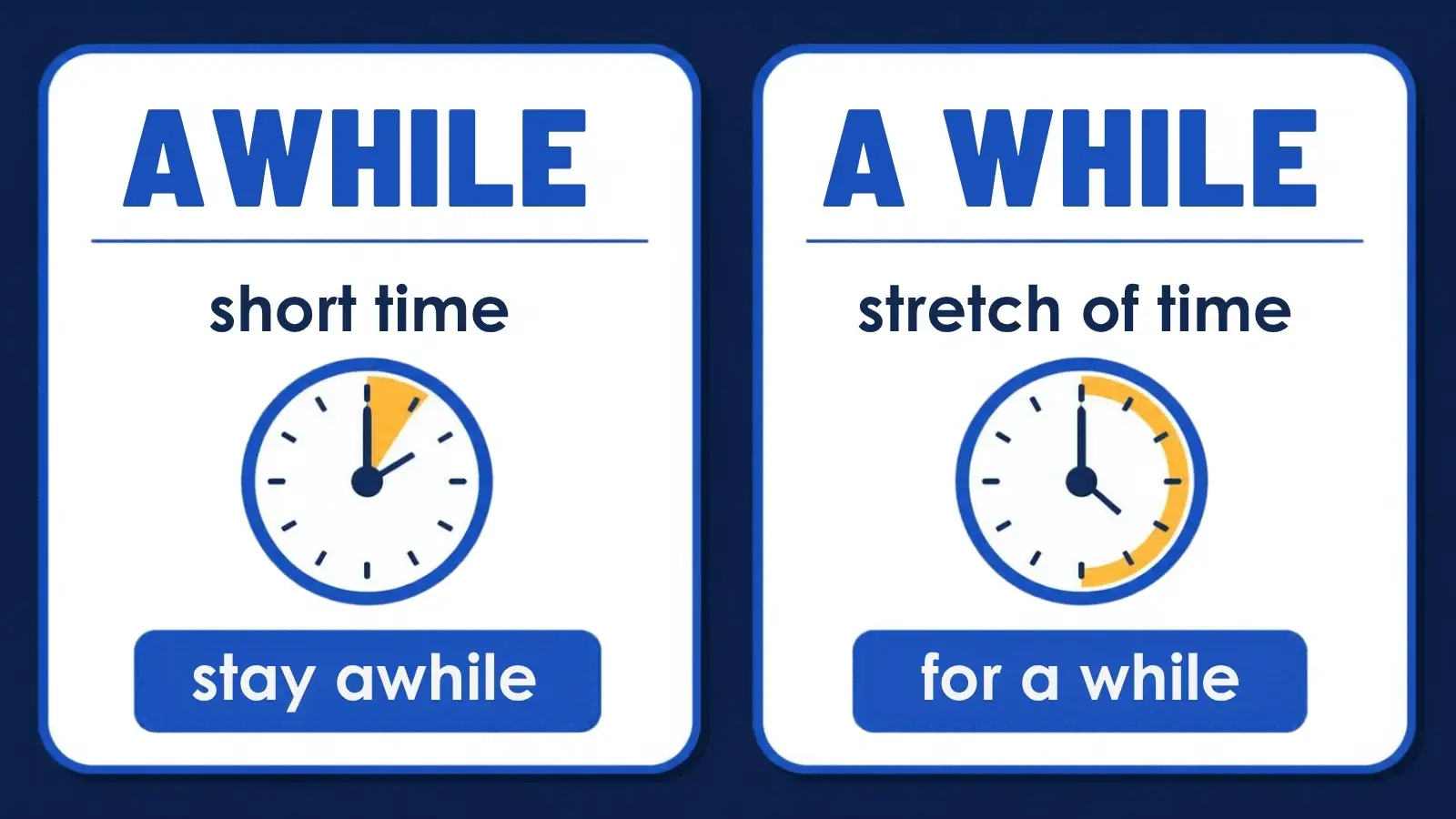
Awhile is one word, an adverb that means for a short time, as in stay awhile. A while is two words, an article plus a noun that names a stretch of time, as in stay for a while. If the word for sits right in front of it, write two words.
The Short Answer at a Glance
Both forms are correct. The difference is part of speech, and a preposition decides the rest.
| Form | What it is | Example |
|---|---|---|
| Awhile | Adverb meaning for a short time. | Let the dough rest awhile. |
| A while | Noun phrase meaning a period of time. | Let the dough rest for a while. |
What Awhile Means and How It Works
Awhile is an adverb, which is a word that describes how, when, or how long an action happens. It means for a short time, and it usually sits right after a verb. You stay awhile, rest awhile, wait awhile, think awhile, or linger awhile.
The word already carries the idea of for inside it. That’s why it can’t follow a preposition. Awhile means for a while, so writing for awhile says for twice.
It also works alone, with nothing attached. You can’t put little, long, or good in front of it, because it’s a single adverb and not a phrase with a noun inside. Compare it with words like briefly and soon, which also stand on their own.
Awhile started as the phrase itself and fused into one word over time. The fusion explains the whole rule. When the phrase is doing the job of an adverb, it can be one word. When it’s still acting like a noun, it stays in two pieces.
What A While Means and How It Works
A while is a noun phrase. The article a introduces the noun while, which in this sense means a stretch of time. It behaves like any other noun phrase, so it can follow a preposition, take adjectives, or sit in the subject or complement position.
After a preposition, it’s always two words. You wait for a while, rest in a while, or look up after a while. The same goes for other connectors such as in, after, and since, as in it’s been a while since lunch.
It can also take modifiers. A long while, a little while, a good while, quite a while, and a short while are all natural. Awhile can’t accept any of them, which gives you a quick check.
It can even work without a preposition. Wait a while is correct, because a while acts like an adverb phrase after the verb. In that spot, awhile is also fine, which is why people argue about the pair.
Fixed expressions use the two word form too. Once in a while, a while ago, and a while back are standard. One related phrase drops the article entirely. Something worth your while is time well spent, and the noun while stands alone there.
Awhile vs A While Key Differences Side by Side
| Feature | Awhile | A while |
|---|---|---|
| Part of speech | Adverb. | Noun phrase with an article. |
| Core meaning | For a short time. | A period of time. |
| After a preposition | Never. | Always. |
| Accepts modifiers | No. | Yes, as in a long while. |
| Typical position | Right after a verb. | After a preposition, or as subject or complement. |
| Register | Fits every setting. | Fits every setting. |
| Example | Priya waited awhile. | Priya waited for a while. |
The table can’t show the one place where the two forms overlap. After a verb with no preposition in between, both are accepted. Wait awhile and wait a while mean the same thing, and neither is a mistake. It also can’t show how spellcheck behaves. Both forms are real, so your software will accept either one even when your sentence needs the other.
Correct Examples in Real Life Contexts
Awhile in Action
- Everyday speech: Let the soup simmer awhile before you stir in the cream.
- Workplace writing: The design team debated awhile, then agreed to table the vote until Monday.
- Texting: Grab a chair and stay awhile, I’m still finishing the dishes.
- School: In the final scene, the narrator stands at the window awhile before opening the letter.
- Formal writing: The panel deliberated awhile and then released its findings to the press.
A While in Action
- Everyday speech: It’s been a while since Marcus visited the old lake house.
- Workplace writing: Our supplier says the replacement part will take a while to ship.
- Texting: Sorry I went quiet for a while, my phone died on the train.
- School: After a while, the students noticed the pattern hiding in the data.
- Formal writing: The agency has operated in the region for quite a while.
- Idiom: Once in a while, Tomas bakes a full tray of cinnamon rolls on a Tuesday night.
Common Mistakes People Make and How to Catch Them
- Writing for awhile. Wrong → We lived in Tucson for awhile. Right → We lived in Tucson for a while. Awhile already means for a short time, so the preposition doubles up. This is the most common slip, and many editors correct it, though it appears often in real life.
- Writing after awhile. Wrong → After awhile, the rain stopped. Right → After a while, the rain stopped. After needs a noun phrase, and awhile is an adverb.
- Writing awhile ago. Wrong → I saw her awhile ago. Right → I saw her a while ago. Ago follows a noun phrase that names a time period.
- Using awhile after been. Wrong → It’s been awhile since we talked. Right → It’s been a while since we talked. The sentence needs a noun phrase to describe the time that has passed.
- Adding a modifier to the one word form. Wrong → She stayed a long awhile. Right → She stayed a long while. Awhile can’t take adjectives, but the noun while can.
- Dropping the article in a fixed phrase. Wrong → Once in awhile, he calls. Right → Once in a while, he calls. The phrase is built on the noun phrase.
- Mangling the idiom. Wrong → It’s worth your awhile. Right → It’s worth your while. Here while stands alone, with no article and no a.
- Trusting spellcheck. Both forms are real words, so no red line appears. Only the sentence structure tells you which one fits.
A Fast Trick to Choose the Right One
Use the for test. Look at the word right before the phrase. If it’s a preposition such as for, in, after, or since, write two words. If the phrase comes straight after a verb with nothing in between, you can write awhile, though a while also works.
A second check is the modifier test. Try adding long, little, or good. If the sentence still works, you need the two word form, because only the noun can take a modifier. She stayed a little while makes sense, and she stayed a little awhile doesn’t.
The tests have limits. They tell you when two words are required, but they can’t tell you which form to prefer when both are allowed. For wait a while versus wait awhile, either choice is fine. Pick one and stay consistent.
How They Sound in Real Situations
A text exchange
Jess: Are you at the restaurant yet?
Omar: Just got here. They said it’ll be a while for a table.
Jess: Okay, sit awhile at the bar and I’ll be there in ten.
Omar’s a while follows will be and describes a stretch of time. Jess’s awhile follows the verb sit and answers how long.
An email snippet
Hi Dana, thanks for your patience. Our print vendor is backed up, so your order will take a while to arrive. If you’d like, we can hold the invoice awhile until the shipment clears and you’ve had a chance to check the totals.
A while is the noun phrase after take. Awhile follows the verb hold and says how long.
An article excerpt
For a while, the neighborhood bakery was the only place open after the storm. Customers lingered awhile over coffee, trading stories about fallen trees and flooded basements.
For a while uses a preposition, so it needs two words. Lingered awhile is a verb followed by an adverb.
Formal Writing vs Casual Writing
Register doesn’t change which form is correct. A text, a business email, and a research paper all follow the same rule. The difference is how strictly readers enforce it.
Most American dictionaries and style guides draw the same line this guide does. Awhile is the adverb, and a while is the noun phrase after a preposition. Editors in newsrooms, publishing houses, and corporate communications usually correct for awhile to for a while.
In casual writing, the two word form after a preposition is far less likely to be flagged by anyone. The one word form after a preposition shows up regularly in speech and informal posts, and readers rarely stumble over it. In anything an editor will see, follow the rule.
Related Mix Ups People Also Search For
Sometime vs Some Time
Sometime means at an unspecified point, and some time means an amount of time. We should meet sometime next week, and I need some time to think.
Anytime vs Any Time
Anytime works as an adverb meaning whenever. Any time is a noun phrase that follows a preposition or acts as the object. Call me anytime, and you can reply at any time.
Everyday vs Every Day
Everyday is an adjective that means ordinary. Every day means each day. Her everyday routine starts with a walk, and she walks every day before work.
Maybe vs May Be
Maybe is an adverb meaning perhaps. May be is a verb phrase. Maybe the shipment will arrive today, and the delay may be caused by weather.
Exceptions Edge Cases and Tricky Situations
- Wait a while and wait awhile are both correct. After a verb with no preposition, either form works, and neither one is a mistake.
- A while ago and a while back are the standard forms. You may see awhile back in informal writing, but the two word version is the safe choice.
- Modifiers force two words. A long while, a little while, and a good while all need the noun. Awhile can’t carry an adjective.
- Worth your while has no article. The phrase uses the noun while on its own and means worth the effort.
- A while later is the standard form. Awhile later appears in casual writing, but editors prefer two words.
- Sentence openers use two words. A while passed before anyone spoke is correct, because a while is the subject.
- Do not confuse these forms with while as a conjunction. While you wait, I’ll refill the printer uses a different part of speech altogether.
- Pick one form and stay consistent. In a sentence where both are acceptable, switching back and forth in a single document looks sloppy.
Quick Practice Test Yourself
Choose awhile or a while for each sentence.
- Let the paint dry ____ before you add the second coat.
- We haven’t seen the Hendersons in quite ____.
- After ____, the printer finally woke up.
- Come in and sit ____.
- It’s been ____ since the last team lunch.
- Choose the correct phrase: for awhile or for a while.
Answer Key
- Awhile. It follows the verb dry with no preposition and tells how long.
- A while. Quite is a modifier, so the noun is required.
- A while. After is a preposition, so a noun phrase must follow.
- Awhile. It’s an adverb after the verb sit.
- A while. Been needs a noun phrase to name the stretch of time.
- For a while. The word for already supplies the preposition.
Frequently Asked Questions
Is it awhile or a while?
Both are correct, but they do different jobs. Use awhile as an adverb right after a verb, and use a while after a preposition or as a noun phrase.
Is for awhile correct?
Most style guides and editors say no, because awhile already means for a short time. Write for a while instead. The one word form after for is common in everyday writing, but it’s the version people tend to correct.
Is it been awhile or been a while?
It’s been a while. The sentence needs a noun phrase, and a while is one.
Can I say stay a while instead of stay awhile?
Yes. After a verb with no preposition, both forms are accepted and mean the same thing.
Is a while ago correct?
Yes. Ago follows a noun phrase that names a stretch of time, so two words is the standard form.
Why do people mix up awhile and a while so often?
They sound identical, and spellcheck accepts both. The only clue is grammar, and most people never learn that the preposition decides the choice.

Sophia Bennett writes educational content about English vocabulary, grammar, slang, and communication. She is passionate about making complex language topics accessible to students, professionals, and curious readers around the world.
One Comment