Laid vs Layed Which Spelling Is Correct
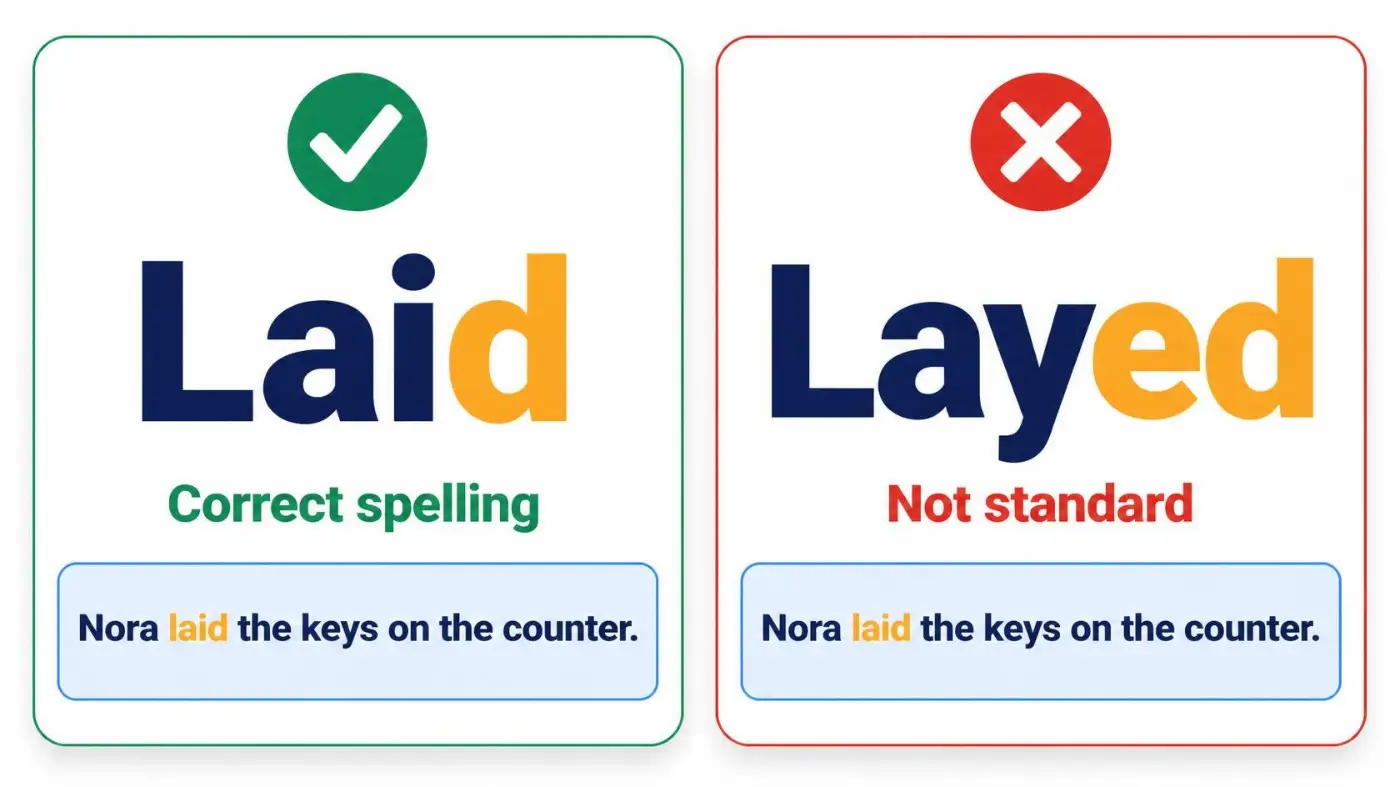
Laid is the correct past tense and past participle of lay, as in Nora laid the keys on the counter. Layed isn’t a standard spelling, so if you typed it, change it to laid.
The Short Answer at a Glance
The laid vs layed question has a one line answer. Lay turns into laid, with the y becoming an i, and nothing else is accepted.
| Spelling | Status | Example |
|---|---|---|
| Laid | Correct past tense and past participle of lay. | Nora laid the blueprints across the workbench. |
| Layed | Not standard. It sounds right but isn’t a real spelling. | Write laid instead. |
What Laid Means and How It Works
Laid is the past tense and the past participle of the verb lay. Lay means to put or place something down, and it always takes an object, the thing someone places. A sentence with laid in it therefore names someone or something that set an object down.
As a simple past tense, it stands on its own. Hector laid the tile in a single afternoon. As a past participle, it follows a helper such as has, had, was, or been. The cable has been laid, and the foundation was laid before the rains arrived.
Laid also covers things you can’t pick up. People lay traps, lay blame, lay claim, lay plans, and lay groundwork. Hens lay eggs. Companies lay off workers. In every case the past form is laid.
The pronunciation rhymes with made and played, and that sound is the root of the spelling trouble. Your ear hears nothing that separates laid from the way layed would be spoken.
What Layed Is and Why People Write It
Layed is a misspelling, not a variant. It’s what you get when you apply the usual past tense rule, which is to add ed, to the word lay. The result looks logical and sounds identical to the correct form, so nothing warns you off.
Two habits produce it most often.
- The regular ed pattern. Verbs such as play, stay, and pray keep their y and take ed, giving played, stayed, and prayed. Lay looks like those verbs, but it belongs to a small irregular group that turns y into i and adds d.
- The lay and lie tangle. The past tense of lie, as in recline, is lay, and its participle is lain. Writers sense that lay already looks like a past form, then wonder where the ending goes. They patch the word with ed and land on layed.
Fast typing helps the error slip through too, especially when spellcheck is off or ignored. Edited writing doesn’t use layed, and laid is the only past form for this verb.
Laid vs Layed Key Differences Side by Side
| Feature | Laid | Layed |
|---|---|---|
| Status | Standard English. | Nonstandard misspelling. |
| Part of speech | Verb form, the past tense and past participle of lay. | None, because it isn’t a word. |
| Intended meaning | Put or placed something down. | The same, but spelled wrongly. |
| Register | Fits every setting. | Fits none. |
| Example | Mira laid the quilt over the sofa. | Mira layed the quilt over the sofa. This is incorrect. |
This isn’t a regional split like color and colour. American and British English both use laid, so there’s no setting where layed becomes acceptable. The table also can’t show how invisible the slip is on the page. Both spellings look plausible at a glance, which is why proofreading has to be deliberate.
Correct Examples in Real Life Contexts
Layed has no correct examples, because it has no correct use. These sentences show laid doing its real jobs.
- Everyday speech: Dev laid his jacket over the chair and kept talking.
- Workplace writing: The facilities team laid new cabling across the third floor during the weekend shutdown.
- Texting: I laid your charger on the dresser, so don’t panic.
- School: The author laid out her argument in the first three paragraphs.
- Formal writing: The committee laid the groundwork for the merger long before the public announcement.
- Farm life: Her hens laid fewer eggs once the days grew short.
- Past participle: By the time the storm arrived, the last row of shingles had been laid.
Common Mistakes People Make and How to Catch Them
- Adding ed to lay. Wrong → She layed the cards on the table. Right → She laid the cards on the table. The regular ed rule feels natural, but lay doesn’t follow it.
- Using layed in the passive. Wrong → Someone layed the carpet last week. Right → Someone laid the carpet last week. The past participle is spelled the same way as the past tense.
- Writing layed off. Wrong → The company layed off forty workers. Right → The company laid off forty workers. A phrasal verb keeps the spelling of its main verb.
- Spelling compounds by ear. Wrong → Traffic waylayed us. Right → Traffic waylaid us. Waylay is built on lay, so it inherits laid.
- Using laid for resting. Wrong → I laid in bed all morning. Right → I lay in bed all morning. Nothing was placed anywhere, so the verb is lie, and its past tense is lay.
- Stacking two errors. Wrong → The files have layed there for years. Right → The files have lain there for years. Resting verbs use lain as the participle, and layed isn’t a word anyway.
- Trusting the software. Wrong → Assuming a blank screen means the spelling is fine. Right → Reread the word yourself. Spellcheck can miss it when a tool is switched off or when a tired proofreader trusts it too much.
A Fast Trick to Choose the Right One
Start with the trio. Lay, laid, laid. Say it as a rhythm, and the middle word locks into memory. Then notice the family resemblance. Pay becomes paid, and say becomes said. If sayed looks absurd to you, layed deserves exactly the same reaction.
A second check is the object test. Ask what got put down. If someone placed something, the past form is laid. If no one placed anything and someone or something simply rested, you need lay or lain from the verb lie.
The tricks have limits. The trio fixes the spelling, but it can’t tell you which verb you need. The object test handles that part, and neither one sorts out look alikes such as relaid and relayed, which the edge cases section explains.
How They Sound in Real Situations
A text exchange
Rosa: Where’s the spare key?
Kai: I laid it on the shelf above the dryer.
Rosa: Found it. Somebody had laid a towel over it.
Both uses involve something being placed. The first is a simple past tense, and the second is a past participle after had.
An email snippet
Hi Dana, the crew laid the final row of tile on Thursday. The new baseboards were laid out for painting on Friday, and the inspector is scheduled for Monday morning.
Laid is a simple past in the first sentence. In the second, laid out is a passive phrase, and the spelling stays the same.
An article excerpt
The company laid off two hundred workers in March, yet it also laid the groundwork for a rehiring program in the fall. Officials said the plan had been laid out months earlier.
Each use comes from the same verb. The three forms show how often laid appears in phrasal verbs and fixed expressions.
Laid vs Layed in Formal and Casual Writing
Register doesn’t change the answer. Laid is right in a text, a business report, and a thesis. Layed is wrong in all of them, including casual ones.
No major style guide treats layed as acceptable, and editors correct it on sight. In a quick message to a friend, the slip may pass without comment, but readers still notice it. Because this verb appears in everything from recipes to legal documents, the safe habit is to remember one spelling and use it everywhere.
Related Mix Ups People Also Search For
Laid vs Lain
Laid belongs to lay, and lain belongs to lie. Lain is the participle of the resting verb, as in the files had lain untouched for a decade. Laid needs something being placed, as in the movers laid fresh boxes beside them.
Paid vs Payed
Paid is the standard past tense of pay. Payed exists only in narrow nautical senses, such as letting out a rope. For money, attention, or visits, write paid. They paid the invoice on Friday.
Waylaid vs Waylayed
Waylaid is correct. The verb means to stop someone unexpectedly, and it follows the same pattern as lay. A chatty neighbor waylaid Ravi on his way to the mailbox.
Lay vs Lie
Lay needs an object, and lie doesn’t. You lay a book on a shelf, and you lie down on a couch. The past tense of the first is laid, and the past tense of the second is lay.
Exceptions Edge Cases and Tricky Situations
- Belayed is correct. Belay is a different verb from climbing and sailing, meaning to secure a rope, and its past tense is regular. The guide belayed her partner up the final pitch.
- Relaid and relayed are different words. Relaid means put down again, as in the crew relaid the sidewalk. Relayed means passed along, as in Mia relayed the message to her manager.
- Many y verbs are regular. Delayed, played, stayed, prayed, and allayed all keep the y and add ed. Lay, pay, and say are the notable exceptions.
- Compound verbs follow lay. Mislaid, overlaid, and inlaid all end in laid, and none of them takes ed.
- British speakers say laid the table. Americans usually say set the table. Both are correct, and the spelling is the same.
- Fixed phrases keep laid. Laid to rest, laid bare, laid waste, and laid claim all use the same form.
- The past of lie is lay. In the sentence he lay awake all night, lay is correct and laid isn’t.
Quick Practice Test Yourself
Choose the correct word for each sentence.
- The crew ____ the new sod before the first frost. Choose laid or layed.
- Last night I ____ awake until two. Choose lay or laid.
- The company ____ off its seasonal staff in January. Choose laid or layed.
- Which spelling is correct, waylaid or waylayed?
- The files had ____ in the basement for years. Choose lain or laid.
- Priya ____ the message to her manager. Choose relayed or relaid.
Answer Key
- Laid. It’s the past tense of lay, and the sod is the object.
- Lay. Nobody placed anything, so this is the past tense of lie.
- Laid. The phrasal verb laid off uses the standard spelling.
- Waylaid. The compound inherits laid from lay.
- Lain. It’s the participle of lie, with nothing being placed.
- Relayed. The message was passed along, which comes from relay.
Frequently Asked Questions
Is layed ever correct?
No. Layed isn’t a standard spelling in any sense. The look alike belayed is correct, but it comes from a different verb.
What is the past tense of lay?
It’s laid. The past participle is laid as well.
Why isn’t it layed like played?
Play keeps its y and adds ed, but lay belongs to a small irregular group. Lay, pay, and say all turn the y into i and add d.
Is it laid or lain?
It depends on the verb. Laid belongs to lay, which means to place something down. Lain belongs to lie, which means to rest in a flat position.
Is it laid off or layed off?
It’s laid off. A phrasal verb keeps the spelling of its main verb.
Is it waylaid or waylayed?
It’s waylaid. The word is built on lay, so it ends in laid.

Sophia Bennett writes educational content about English vocabulary, grammar, slang, and communication. She is passionate about making complex language topics accessible to students, professionals, and curious readers around the world.