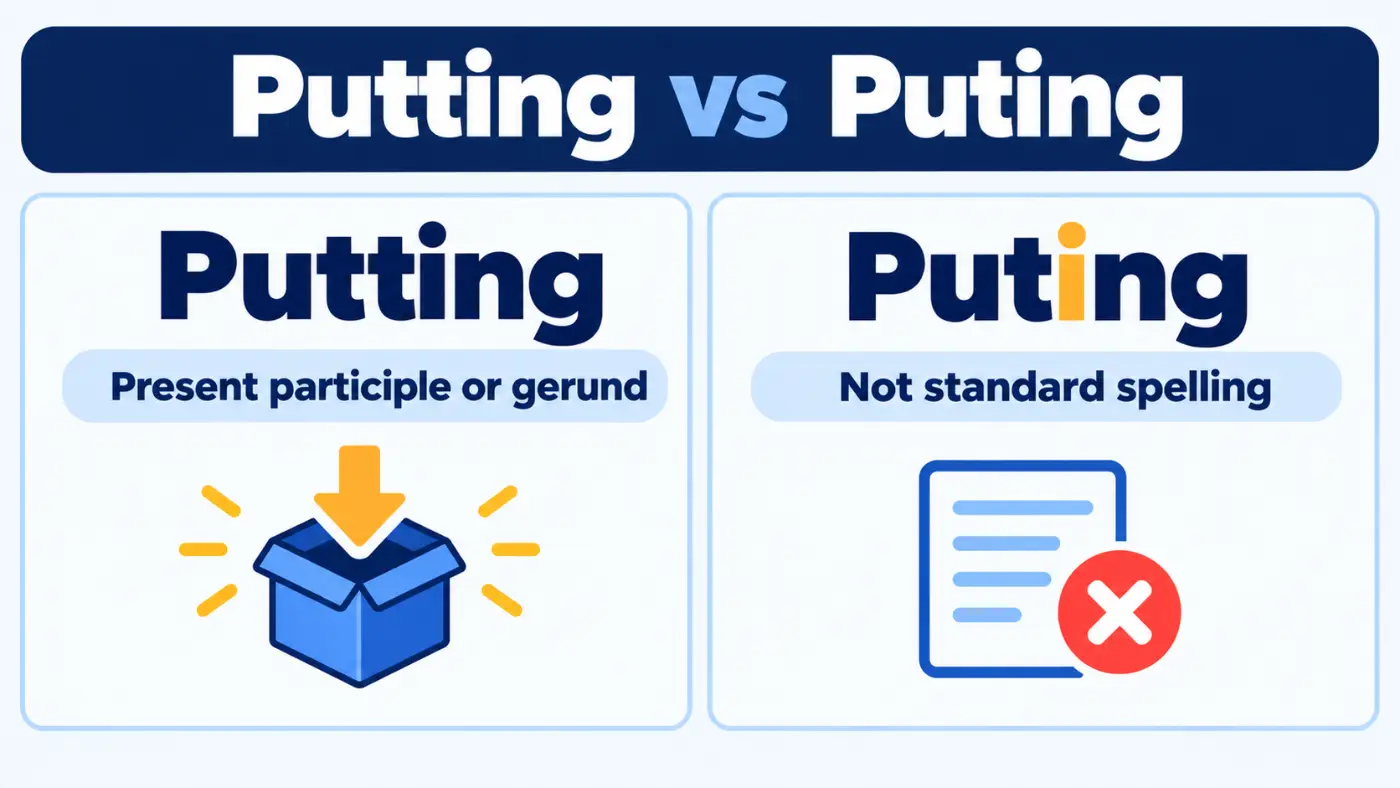
Putting vs Puting: Which Spelling Is Correct?
Putting is the correct form when you mean the present participle or gerund of put. If you mean the verb phrase meaning “place inside,” “add,” “submit,” “install,” or “devote,” use put in as two words; putin is not the standard spelling of that phrase.
The Short Answer at a Glance
| Form | Meaning / function | Example |
|---|---|---|
| putting | The -ing form of put | “Lena is putting the groceries away.” |
| put in | A two-word verb phrase with several meanings | “Lena is putting in a new shelf.” |
| putin | Not the standard spelling of the verb phrase | “Please put in your request before Friday.” |
The distinction is grammatical as well as visual. Putting is one word because it is a form of the verb put, while put in contains the verb put and a separate word, in.
If you see Putin with a capital P, that is a different matter: it is a proper name, not a spelling of put in.
What Putting Means and How It Works
Putting is the -ing form of the verb put. It can function as a present participle in a verb phrase or as a gerund when the activity itself acts like a noun.
As a present participle, putting commonly follows a form of be:
- “Carlos is putting the chairs outside.”
- “We were putting together the display when the lights went out.”
- “Mia has been putting extra money into her savings account.”
The word describes an action involving put. The object being put somewhere can appear directly after it, or the verb can be part of a larger phrase.
As a gerund, putting can name the activity:
- “Putting labels on every box saved us time later.”
- “She enjoys putting together miniature models.”
- “Careful putting of the files prevented them from getting mixed up.”
The spelling putting deserves attention because put has a very short base form. When -ing is added, the final t is doubled. The standard form is therefore putting, not puting.
This pattern is not a special meaning of putting. It is simply the normal spelling of the verb’s -ing form.
What Put In Means and How It Works
Put in is a two-word verb phrase whose meaning changes with context. It can describe physically placing something inside, adding something, submitting information, installing something, or contributing time and effort.
Place something inside
The most literal use is to move or place something into a location:
- “Please put in the clean dishes.”
- “Nora put in the batteries before testing the device.”
- “I put in the spare key and turned the lock.”
Here, put expresses the action and in indicates the destination or position.
Add something
Put in can also mean add an ingredient, component, feature, or other item:
- “The recipe says to put in two teaspoons of cinnamon.”
- “The developer put in a search filter after users requested one.”
Submit or enter something
In forms, applications, systems, and requests, put in can mean enter or submit information:
- “You can put in your availability through the scheduling app.”
- “I put in a request for Friday off.”
Spend effort or time
Put in can describe time, labor, practice, or effort:
- “Jamal put in three hours of practice before the audition.”
- “The team put in a lot of work before launch.”
Install or introduce something
The phrase can also refer to installing equipment or adding a feature to a place:
- “They are putting in new windows this month.”
- “The school put in a wheelchair ramp last summer.”
These uses show why put in cannot be reduced to a simple spelling issue. The words remain separate because put and in contribute separately to the construction, even though together they can form a familiar phrasal-verb pattern.
Putting vs Put In: Key Differences Side by Side
| Feature | putting | put in |
|---|---|---|
| Form | One word; -ing form of put | Two-word verb phrase |
| Core function | Describes or names the action of put | Expresses placing, adding, submitting, installing, or contributing effort |
| Typical grammar | Often follows is, are, was, or were, or acts as a gerund | Usually functions as a verb phrase |
| Register | Neutral and standard | Neutral and standard |
| Example | “She is putting the books away.” | “She will put in the books before lunch.” |
The table does not capture every meaning of put in. The phrase can mean more than physical placement, while putting simply identifies the -ing form of put and can appear with many different complements.
There is also a useful tense clue. You can write puts in, put in, or putting in, depending on the sentence: “She puts in the order,” “She put in the order,” and “She is putting in the order.” The word in remains separate.
Correct Examples in Real-Life Contexts
Everyday speech
- “I’m putting the leftovers in the fridge before they get forgotten.”
- “Could you put in the blue folder with the rest of the paperwork?”
- “Dad was putting the patio cushions away when the rain started.”
- “We need to put in another chair because Priya is joining us.”
Workplace writing
- “The design team is putting the final labels on the product mockups.”
- “Please put in your expense request before the monthly deadline.”
- “Our contractor is putting in a second outlet near the conference table.”
- “The interns have been putting the archived files into clearly marked boxes.”
Texting and casual messages
- “I’m putting my shoes on now—give me five minutes.”
- “Can you put in a good word for me with the hiring manager?”
- “I keep putting off cleaning my desk.”
- “Just put in the address and the map should take you there.”
School and academic contexts
- “Students were putting their completed worksheets into separate folders.”
- “Before submitting the application, make sure you put in your current contact information.”
- “The researchers are putting the observations into a shared spreadsheet.”
- “Maya put in extra study time before the chemistry exam.”
Formal or edited writing
- “The restoration team is putting the original documents into protective sleeves.”
- “Applicants must put in a formal request before receiving access to the archive.”
- “The committee is putting considerable effort into revising the policy.”
- “The museum plans to put in a new climate-control system next year.”
In every example, putting is the -ing form of put, while put in keeps put and in separate because they perform separate grammatical roles.
Common Mistakes People Make (and How to Catch Them)
1. Writing puting instead of putting
Wrong → Right: “She is puting the files away.” → “She is putting the files away.”
The error happens because writers may remember the -ing ending but forget that the final consonant is doubled in the standard spelling.
2. Joining put in into one word
Wrong → Right: “Please putin your application today.” → “Please put in your application today.”
The mistake often comes from typing quickly or treating a familiar verb phrase as though it were a single word.
3. Confusing putting with put in
Wrong → Right: “She is put in the books on the shelf.” → “She is putting the books on the shelf.”
The auxiliary is signals an ongoing action, so the main verb needs its -ing form: is putting.
4. Adding in unnecessarily
Wrong → Right: “He is putting in the keys on the desk.” → “He is putting the keys on the desk.”
The word in changes the construction. If the keys are being placed on the desk, in is not needed.
5. Removing in when the phrase requires it
Wrong → Right: “I need to put a request for a schedule change.” → “I need to put in a request for a schedule change.”
In this expression, put in means submit or make a request. Leaving out in changes the construction.
6. Treating Putin as the spelling of put in
Wrong → Right: “Please Putin your information.” → “Please put in your information.”
Capitalized Putin is a proper name, most commonly referring to Vladimir Putin. It is not the standard written form of the English verb phrase put in.
7. Trusting speech alone
Wrong → Right: “I heard ‘putin,’ so I typed it as one word.” → “I wrote put in because the phrase contains the verb put and the separate word in.”
Connected speech can make word boundaries difficult to hear. Pronunciation is therefore not a reliable way to decide whether a phrase should be written as one word or two.
A Fast Trick to Choose the Right One
Use the tense-change test.
If the construction can become puts in, put in, or putting in, you are dealing with the two-word phrase put in:
- “She puts in the order.”
- “She put in the order.”
- “She is putting in the order.”
The word in stays separate.
For putting, remove the -ing ending. The base verb is put, so the standard spelling is putting, not puting.
This test has one limitation: putting and putting in can both be correct. The sentence’s meaning determines whether in belongs. For example, “She is putting the books away” does not need in, while “She is putting in new shelves” does.
How They Sound in Real Situations
Text exchange
“Are you still putting the shelves together?”
“Yep. I’m putting in the last bracket now.”
The first putting describes an ongoing assembly activity. The second putting in means installing or placing the final bracket.
Workplace message
“I’m putting the revised figures into the report. Please put in any comments before 3 p.m.”
The first phrase describes an action happening now. The second asks colleagues to enter or submit their comments.
Article-style passage
The renovation crew spent the morning putting new panels around the entrance. By noon, they had put in enough work to finish the most visible section.
The two constructions serve different purposes. Putting describes the ongoing placement of panels, while put in refers to effort contributed over a period of time.
Formal Writing vs Casual Writing
The choice between putting and put in does not normally depend on formality. Both are standard constructions in US English.
In academic writing, you can use putting naturally when describing an action: “The researchers are putting the samples into separate containers.” Put in is also standard when the intended meaning is submit, add, install, or contribute effort.
Business writing uses both forms regularly. “Please put in your request” and “We are putting the materials together” are ordinary constructions.
Texting and social media do not change the grammatical distinction. A casual writer may shorten words or omit punctuation, but putting remains one word and put in remains two.
Journalism and formal publications follow the same basic distinction. The spelling becomes different only when you are dealing with a proper name such as Putin, which is capitalized and has an entirely different function.
US vs UK English Differences
There is no meaningful US-versus-UK spelling difference between putting and put in. Both forms are standard in American and British English.
The same distinction applies in both varieties: putting is the -ing form of put, while put in is a two-word verb phrase. Differences in surrounding vocabulary or style do not turn put in into putin.
Related Mix-Ups People Also Search For
Put in vs put into
Put in and put into can overlap when something is being placed inside something else. Movement toward an interior location sounds more explicit with into, while in is often shorter when the destination is already clear.
Example: “She put the receipt in the folder” and “She put the receipt into the folder” can both be grammatical.
Putting vs put
Put is the base form and also serves as the simple past and past participle, while putting is the -ing form.
Example: “I put the package outside yesterday” but “I am putting another package outside now.”
Putting vs puting
Putting is the standard spelling. Puting is a spelling error.
Example: “They are putting the signs up before the event,” not “They are puting the signs up.”
Put in vs put on
The phrases put in and put on are not interchangeable. Context decides the meaning of put on, which can describe placing clothing on your body, activating something, or pretending.
Example: “Put on your jacket before you leave” uses put on, not put in.
Exceptions, Edge Cases, and Tricky Situations
The most important edge case is the word Putin. If you encounter it with a capital letter, it is normally a proper name rather than a grammatical form of put. Context usually makes the distinction clear.
Another tricky situation occurs when put in is followed by a noun that can appear on either side of in:
- “She put in the request.”
- “She put the request in.”
Both can be grammatical when in has the meaning of submitting or entering something. The word in does not become attached to put merely because the two words are closely connected.
The same kind of variation appears with some physical-placement uses:
- “They put in the new windows.”
- “They put the new windows in.”
Again, the second version moves in after the object; it does not create a one-word form.
A final edge case is putting in, where both forms appear together. In “He is putting in extra hours,” putting is the -ing form of put, and in contributes the established meaning of devoting time or effort. Writing puttingin would therefore be incorrect.
Quick Practice: Test Yourself
Choose the correct form or phrase for each sentence.
- Ava is ______ the clean towels in the linen closet.
- Please ______ your vacation request before Friday.
- The mechanic is ______ a new battery this afternoon.
- Noah has been ______ extra hours to finish the project.
- Which spelling is correct: puting or putting?
- “______ your name in the form” should use which construction?
Answer key
- putting — “Is putting” uses the -ing form of put for an action in progress.
- put in — Here the phrase means submit or enter a request.
- putting in — The sentence describes an ongoing installation, so putting is followed by the separate word in.
- putting in — Put in can mean devote time or effort.
- putting — The final consonant is doubled before the -ing ending.
- put in — The phrase means enter or provide the name in the form.
Frequently Asked Questions
Is putting one word or two?
Putting is one word. It is the -ing form of the verb put and is spelled with a doubled t.
Is putin a word?
Putin is not the standard spelling of the English verb phrase put in. When capitalized as Putin, it is a proper name, not the verb phrase.
Is it putting or puting?
The correct spelling is putting. The spelling puting is not standard.
Should I write put in or putin?
Write put in as two words when you mean the verb phrase. For example, “Please put in your information” and “They put in a new window” both require the space.
What is the difference between putting and putting in?
Putting is the -ing form of put, while putting in combines that form with the separate word in. Adding in changes the construction’s meaning or specifies a destination, addition, installation, submission, or contribution of effort.
Is putting in grammatically correct?
Yes. Putting in is a standard construction. Its meaning depends on context, as in “putting in the drawer,” “putting in a request,” or “putting in extra hours.”

Sophia Bennett writes educational content about English vocabulary, grammar, slang, and communication. She is passionate about making complex language topics accessible to students, professionals, and curious readers around the world.