Coming vs Comming: Which Spelling Is Correct?
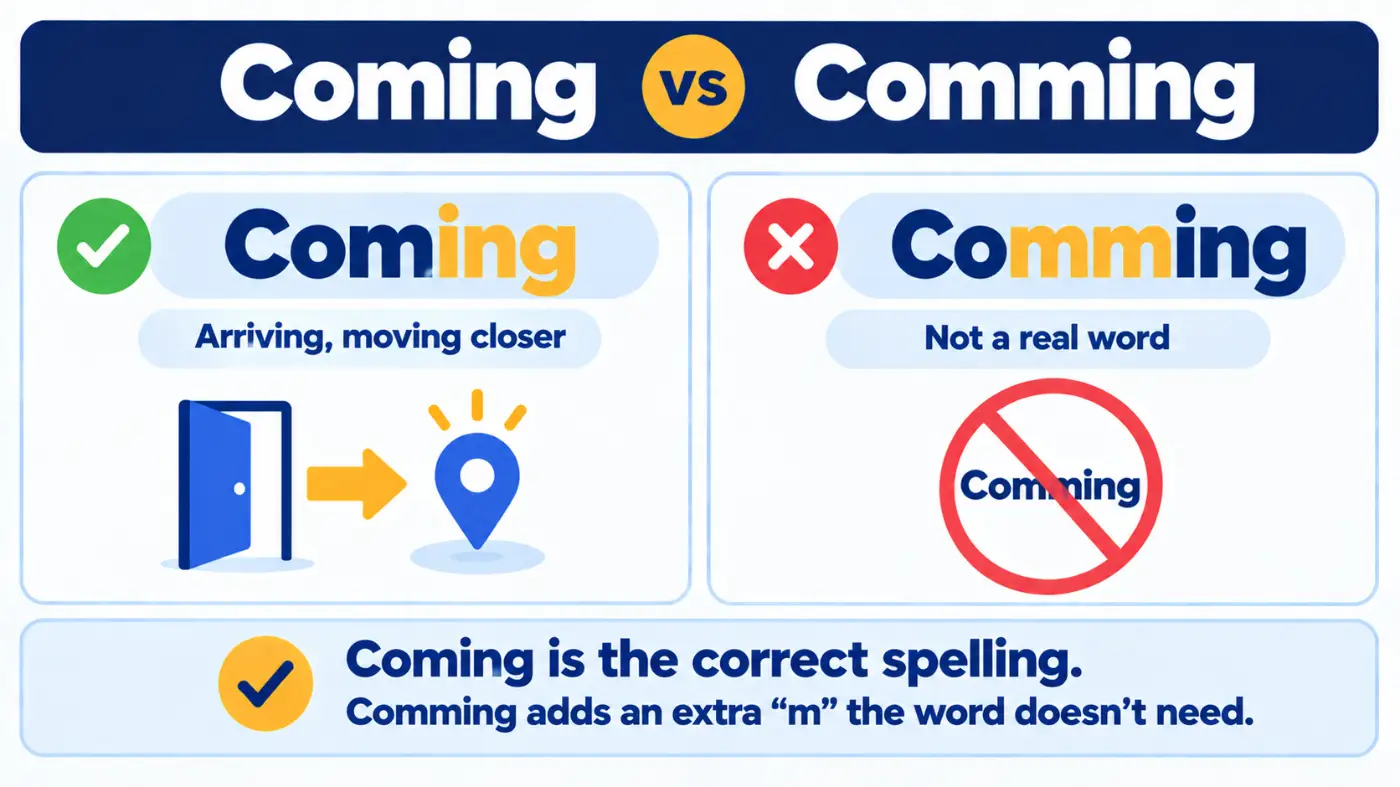
Coming is the correct spelling. Comming is a misspelling that adds an extra “m” the word doesn’t need, likely because writers assume every “-ing” word must double its final consonant.
The Short Answer at a Glance
| Form | Status | What it does | Example |
|---|---|---|---|
| coming | Correct | Present participle of come, describing movement toward something or an approaching event | She’s coming to the reunion this year. |
| comming | Misspelling | Not a word in standard English | Correct it to coming every time. |
There’s only one real spelling here. The extra “m” in comming doesn’t belong, no matter how natural it might look.
What Coming Means and How It Works
Coming is the present participle of the verb come, one of the most frequently used verbs in English. It describes movement toward a place, the approach of an event, or a state of arriving or happening soon.
You’ll see coming used in a few overlapping ways. In progressive verb forms, it shows up as in “he is coming home.” As an adjective, it describes something upcoming, as in “the coming weeks” or “the coming election.” And in a handful of fixed phrases and idioms, it appears the same way, as in “coming of age” or “have it coming.”
Grammatically, coming pairs with a form of “to be” to build the present or past progressive tense: I am coming, they were coming, she has been coming. Without that helping verb, coming can’t stand alone as a main verb the way “comes” or “came” can.
The verb come follows an irregular pattern in its past tense, becoming came rather than “comed,” but the present participle stays regular in shape: come drops its silent “e” and adds “-ing,” producing coming. That’s the whole rule, and it’s simpler than it might seem given how often the spelling goes wrong.
Is “Comming” Ever Correct?
No. Comming isn’t a recognized word in any standard dictionary, and it isn’t a regional variant, informal shortcut, or accepted alternate spelling. It’s a straightforward error rooted in a misapplied spelling rule.
English does have a real rule about doubling a final consonant before adding “-ing,” but it only applies under specific conditions: a short word ending in a single vowel followed by a single consonant, where that final syllable is stressed. That’s why running doubles its “n” (run has a short vowel and ends in one consonant) and why stopping doubles its “p” for the same reason.
Come doesn’t fit that pattern. It ends in a silent “e,” not directly in a consonant, so the rule for doubling consonants doesn’t apply at all. Instead, the correct process is simpler: drop the silent “e,” then add “-ing.” Come becomes coming, the same way write becomes writing and hope becomes hoping.
Writers who type comming are likely applying the doubling rule from memory without checking whether it actually fits this word. Since so many common “-ing” words do double their final letter, it’s an easy rule to overextend.
Coming vs Comming: Key Differences Side by Side
| Feature | Coming | Comming |
|---|---|---|
| Recognized word | Yes | No |
| Part of speech | Present participle / verbal adjective | None |
| Core meaning | Approaching, arriving, or upcoming | No meaning |
| Typical use | Everyday speech, scheduling, announcements, idioms | Appears only as a typo |
| Register | Works in all writing | Never appropriate |
| Example | The storm is coming in fast tonight. | The storm is comming in fast tonight. (wrong) |
The table shows a clean contrast, but the real story is a spelling rule applied where it doesn’t belong. What the table can’t fully explain is why this particular mistake is so common: come is one of the most frequently used verbs in English, so even a small, consistent spelling slip shows up constantly across everyday writing.
Correct Examples in Real-Life Contexts
Everyday speech
- Is your sister coming to the barbecue this weekend?
- I can hear someone coming up the stairs.
- Winter’s coming early this year, judging by the wind already.
- He’s been coming to this same diner every Sunday for a decade.
Workplace writing
- The updated software rollout is coming next Tuesday, according to IT.
- We’re coming up on the end of the fiscal quarter, so please submit expenses soon.
- Leadership announced a coming reorganization affecting two departments.
- The client mentioned they’re coming into town for the product demo.
Texting
- omw, coming down the block now
- are you still coming tonight or did plans change
School and academic
- The professor outlined the coming semester’s reading list during orientation.
- Researchers are still coming to terms with the study’s unexpected results.
- Students discussed the historical events leading up to the coming of the industrial age.
- She’s been coming to office hours every week to review her thesis draft.
Formal writing
- The committee will address the coming budget shortfall in its next session.
- Analysts predict a coming shift in consumer spending habits over the next fiscal year.
- The report outlines risks associated with the coming regulatory changes.
- Residents were notified about the coming road closures near the construction site.
Common Mistakes People Make (and How to Catch Them)
Doubling the “m” out of habit
Wrong: We’re comming over around six tonight. Right: We’re coming over around six tonight.
This is the core mistake. Writers apply the consonant-doubling rule from words like running or shopping without checking whether come actually follows that pattern.
Typing quickly and adding an extra letter
Wrong: Let me know when you’re comming, so I can start dinner. Right: Let me know when you’re coming, so I can start dinner.
Fast typing sometimes results in an accidental repeated letter, especially since the “m” key gets pressed for the base word and muscle memory adds another one out of habit.
Overcorrecting after learning about doubling rules
Wrong: She kept comming back to the same question during the interview. Right: She kept coming back to the same question during the interview.
Writers who’ve recently learned the doubling rule for words like planning or stopping sometimes apply it too broadly, assuming every “-ing” verb needs a doubled consonant.
Confusing it with similar-looking words
Wrong: The comming weeks will be busy for the whole team. Right: The coming weeks will be busy for the whole team.
This error often appears in more formal writing, where a writer reaches for the adjective form of coming and second-guesses the spelling under pressure to sound polished.
A Fast Trick to Choose the Right One
Start from the base verb and picture the silent “e” quietly stepping aside. Come has a silent “e” at the end, and that “e” simply drops when “-ing” is added. There’s no consonant left exposed that needs doubling, since the “m” was never alone at the end of the word to begin with.
A second trick is comparing come to a word you already spell correctly without hesitation, like hope. Hope drops its “e” to become hoping, not “hopping,” which is a completely different word with a doubled “p.” Come works the same way: drop the “e,” add “-ing,” and you get coming.
This trick holds up well for come specifically, but it won’t tell you which other verbs double their final consonant and which don’t, since that depends on vowel length and stress patterns that vary from word to word.
How They Sound in Real Situations
A text exchange
Jordan: You still coming to the game tonight?
Alex: Yeah, just finishing up work. Coming around 7.
Jordan: Perfect, see you there.
Coming is correct in both messages because it’s describing planned arrival at an event.
A workplace email
Subject: Heads up on the coming schedule change
Hi team,
Just a quick note that a new shift schedule is coming into effect starting next Monday. Please review the attached document and reach out with any questions before then.
Thanks, Marisol
Coming is correct here because it describes an upcoming change taking effect soon.
An article-style excerpt
Forecasters say a major storm system is coming up the coast, with heavy rain expected by Thursday evening. Local officials are urging residents to prepare for possible flooding in low-lying areas.
Coming fits naturally because the sentence describes something approaching in the near future.
Formal Writing vs Casual Writing
The correct spelling never changes based on formality. Coming is right in a weather report, a business memo, a text message, and a casual conversation. Comming is wrong in every one of those contexts, with no exceptions.
What does shift with register is how often coming appears in certain grammatical roles. In casual speech, coming shows up constantly in progressive tense sentences about plans and arrivals, like “I’m coming” or “she’s coming too.” In more formal or journalistic writing, coming often functions as an adjective describing something on the horizon, as in “the coming months” or “the coming policy shift,” which carries a slightly more analytical tone.
AP and Chicago style both treat coming as a standard word with no special formatting rules, and neither offers any accepted alternate spelling.
Related Mix-Ups People Also Search For
Coming vs Comeing
Comeing is another misspelling of the same word, made by adding “-ing” to come without dropping the silent “e” first. Either way, the correct spelling stays coming. Example: She kept coming back to visit, never comeing across as anything but genuinely happy to be there.
Coming vs Becoming
These two share a root but serve different purposes. Arrival or approach is what coming describes, while becoming points to a process of transformation or, in another sense, to something flattering or appropriate. Example: Her calm response to the crisis was quite becoming, even as the storm kept coming closer.
Running vs Comming (Doubling Rule Confusion)
Running correctly doubles its final consonant because run is a short word ending in a single stressed vowel and consonant. That pattern doesn’t carry over to come, since it ends in a silent “e” rather than a bare consonant. Example: She was running late, but at least she was finally coming.
Quick Practice: Test Yourself
Choose the correct spelling for each blank.
- My parents are ______ to visit next month. (coming / comming)
- The team announced a ______ product launch during the meeting. (coming / comming)
- I could hear footsteps ______ down the hallway late at night. (coming / comming)
- We’re all still getting used to the ______ changes at work. (coming / comming)
- He’s been ______ to this gym every morning for years. (coming / comming)
- The forecast says a cold front is ______ in by Friday. (coming / comming)
Answer Key
- coming: the correct spelling always drops the silent “e” from come and adds “-ing.”
- coming: same rule applies whether coming functions as a verb or an adjective.
- coming: consistent spelling regardless of sentence structure.
- coming: no doubled consonant is ever needed here.
- coming: correct spelling in a habitual, repeated action context.
- coming: correct spelling describing an approaching weather event.
Frequently Asked Questions
Is “comming” ever an acceptable spelling?
No. Comming isn’t recognized in standard dictionaries and isn’t used as an informal or regional variant. The correct spelling in every context is coming.
Why doesn’t come double its final consonant like run does?
Come ends in a silent “e” rather than a bare consonant, so the doubling rule that applies to short words like run and stop doesn’t apply here. Instead, the silent “e” simply drops before adding “-ing.”
Is coming always used as part of a verb phrase?
No. Coming can also function as an adjective describing something upcoming, as in “the coming year,” without needing a helping verb like “is” or “are.”
What’s the past tense of come?
The past tense is came, which is irregular and doesn’t follow the same pattern as the present participle coming.
Can coming be used without a helping verb?
Not as a main verb on its own. Coming typically needs a form of “to be” to function as a verb, though it can stand alone as an adjective before a noun.
Is there ever a context where an extra “m” is correct in a related word?
No standard English word related to come uses a doubled “m.” Words like commit or comment do have a doubled letter, but that’s part of an entirely different word, not a form of come.

Sophia Bennett writes educational content about English vocabulary, grammar, slang, and communication. She is passionate about making complex language topics accessible to students, professionals, and curious readers around the world.