Babies vs Babys: Which Spelling Is Correct?
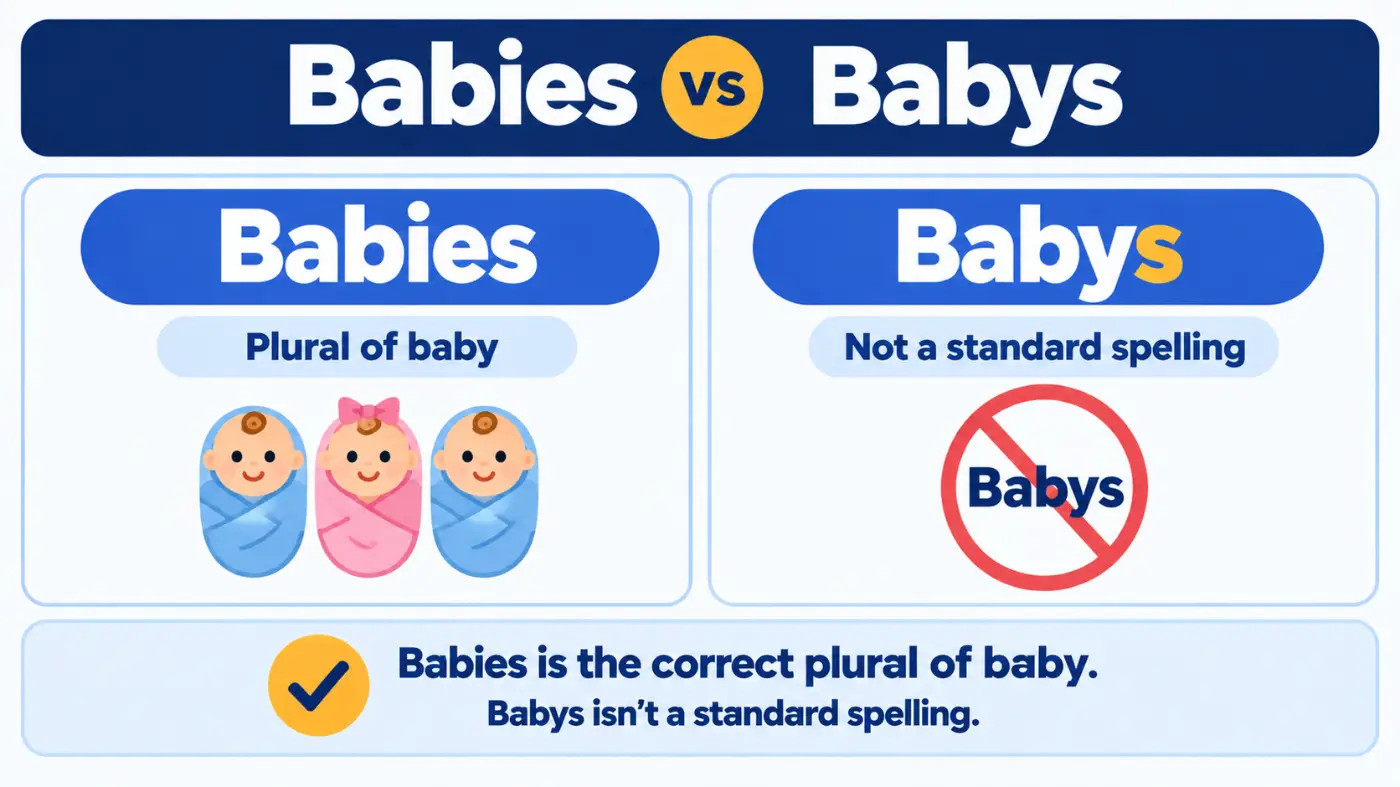
Babies is the correct plural of baby. Babys is not a standard spelling, and the confusion usually comes from mixing up the plural babies with the possessive baby’s, which does use a “y” before the ending.
The Short Answer at a Glance
| Form | Status | What it does | Example |
|---|---|---|---|
| babies | Correct plural | More than one baby | The nursery had four babies napping at once. |
| baby’s | Correct possessive | Shows something belongs to one baby | The baby’s blanket fell off the stroller. |
| babys | Incorrect | Not a standard spelling of any form | Always replace it with babies or baby’s. |
There’s no legitimate use for babys on its own. If you mean more than one baby, use babies. If you mean something belonging to a baby, use baby’s with an apostrophe.
What Babies Means and How It Works
Babies is the plural form of the noun baby. It follows a spelling pattern that applies to many English nouns ending in a consonant plus “y.” Words like city, party, and story all change that final “y” to “ies” in the plural: cities, parties, stories, babies.
The rule kicks in specifically because “y” sits right after a consonant. Baby ends in “b” plus “y,” so the plural drops the “y,” adds “ie,” and then adds “s.” That gives you babies, not babys.
Grammatically, babies functions like any regular plural noun. It takes a plural verb, so you’d write “the babies are sleeping,” not “the babies is sleeping.” It also pairs naturally with plural determiners like these, those, many, and several: these babies, those babies, several babies.
Babies can act as the subject or object of a sentence. As a subject: “Babies cry for many reasons.” As an object: “The clinic vaccinates babies starting at two months.”
The same “y to ies” rule explains why you’ll never see “babys” as a correct plural anywhere in standard English, no matter how casual or formal the writing is.
What Baby’s Means and How It Works
Baby’s is the possessive form of baby, and it shows ownership or a close relationship between the baby and something else. It answers the question “whose?” The baby’s toy means the toy belonging to that baby.
This is where the confusion with babies usually starts. Baby’s does contain a “y” right before the apostrophe, and at a glance, it can look similar to a plural that someone might misspell as babys. But the apostrophe changes everything. Baby’s is singular possessive, referring to one baby’s belongings, features, or associations.
Grammatically, baby’s functions as a modifier before a noun. You’ll see it directly in front of the thing being possessed: the baby’s crib, the baby’s name, the baby’s first steps. It never stands alone as a subject or object the way babies does.
The possessive form follows the standard rule for singular nouns: add an apostrophe and an “s.” Baby becomes baby’s the same way cat becomes cat’s or dog becomes dog’s. The only twist is that people sometimes forget the apostrophe entirely and write “babys,” which isn’t correct in either the plural or possessive sense.
There’s also a plural possessive form, babies’, used when something belongs to more than one baby. The nursery workers labeled the babies’ bottles, for example, refers to bottles belonging to multiple babies. That form takes the plural babies and adds only an apostrophe after the “s.”
Babies vs Babys: Key Differences Side by Side
| Feature | Babies | Babys |
|---|---|---|
| Recognized word | Yes | No |
| Part of speech | Plural noun | None |
| Core meaning | More than one baby | No meaning |
| Typical use | Talking about multiple babies | Appears only as a typo |
| Register | Works in all writing | Never appropriate |
| Example | The daycare cares for twelve babies. | The daycare cares for twelve babys. (wrong) |
The table can’t fully capture why this mistake happens so often. Because baby’s possessive form does include a “y” right before the ending, writers sometimes assume the plural must follow a similar-looking pattern. It doesn’t. The plural changes the “y” to “ies,” while the possessive keeps the “y” and adds an apostrophe plus “s.”
Correct Examples in Real-Life Contexts
Everyday speech
- My sister has twin babies now, and she barely sleeps.
- Both babies started crying the second the fireworks went off.
- We brought snacks for the moms, not realizing half the babies would need bottles too.
- Some babies sleep through anything, and others wake up if a door creaks.
Workplace writing
- The pediatric ward currently has eight babies in the neonatal unit.
- Our new product line is designed specifically for babies under six months old.
- The daycare center is licensed to care for up to fifteen babies at a time.
- Marketing wants testimonials from parents of babies who used the sleep training program.
Texting
- omg the twins are the cutest babies i’ve ever seen
- can’t believe how fast babies grow, she looks nothing like her newborn photos
School and academic
- The study tracked language development in babies from six to eighteen months old.
- Researchers observed how babies respond to unfamiliar faces during the first year.
- The pediatrics course covers common health concerns in newborn babies.
- Her thesis examines sleep patterns among babies raised in different caregiving environments.
Formal writing
- The hospital reported a record number of babies born on the same day last spring.
- Public health officials recommend that babies receive their first vaccinations by two months.
- The policy extends parental leave for employees welcoming babies through birth or adoption.
- Statistics show a decline in the number of babies born in the region over the past decade.
Common Mistakes People Make (and How to Catch Them)
Applying the wrong plural pattern
Wrong: The shelter took in three babys who needed foster placement. Right: The shelter took in three babies who needed foster placement.
Writers sometimes treat baby like a word that just adds “s” for the plural, the way most English nouns do. Baby follows the “consonant plus y” rule instead, so the “y” changes to “ies.”
Confusing the plural with the possessive
Wrong: All the babys toys were scattered across the floor. Right: All the babies’ toys were scattered across the floor.
When more than one baby owns something, the correct form is babies’ with an apostrophe after the “s,” not babys without one.
Dropping the apostrophe in the singular possessive
Wrong: The babys first birthday party is next weekend. Right: The baby’s first birthday party is next weekend.
This happens when a writer means one baby’s belongings or milestones but forgets the apostrophe that marks possession.
Autocorrect and quick typing errors
Wrong: We need more diapers for the babys in room 12. Right: We need more diapers for the babies in room 12.
Fast typing sometimes skips the vowel change entirely, especially on a phone keyboard where autocorrect doesn’t always catch the error.
Overcorrecting into an unnecessary apostrophe
Wrong: The nursery has ten babie’s in the morning session. Right: The nursery has ten babies in the morning session.
Some writers, aware that something is off, add an apostrophe to the plural by mistake. Babies as a plural never takes an apostrophe.
A Fast Trick to Choose the Right One
Ask whether you’re counting babies or describing something that belongs to a baby. If you’re counting, more than one becomes babies, following the same pattern as cities and stories. If you’re showing ownership, add an apostrophe: baby’s for one baby, babies’ for more than one.
A quick test: try substituting a word that doesn’t end in “y,” like child. “Two children” becomes “two babies,” not “two babys.” “The child’s toy” becomes “the baby’s toy,” with the apostrophe in the same spot.
This trick works reliably for regular nouns like baby, but it won’t help with irregular plurals like child to children, since that pattern is different. For baby specifically, though, the “y to ies” swap always applies to the plural.
How They Sound in Real Situations
A text exchange
Priya: How’s the mommy group going?
Sam: So good! Six babies in one room and somehow it’s calm right now.
Priya: Enjoy that calm while it lasts.
Babies is correct here because Sam is counting more than one baby in the room.
A workplace email
Subject: Nursery staffing update
Hi team,
We’re currently caring for eleven babies across both nursery rooms, which is close to our capacity. Please let me know if any families are on the waitlist so we can plan for next month’s enrollment.
Thanks, Diane
Babies is correct because the email is referring to a total count of children.
An article-style excerpt
The hospital’s new maternity wing has already welcomed its first babies, with three born within hours of the ribbon-cutting ceremony. Staff say the added space has made a noticeable difference for families adjusting to a baby’s first days.
Both forms appear correctly here: babies for the plural count, and baby’s for the singular possessive describing one child’s early days.
Formal Writing vs Casual Writing
The spelling rules don’t shift based on formality. Babies is correct in a pediatric journal, a parenting blog, a text message, and a hospital press release. Babys is never correct in any of them.
What changes with register is tone, not spelling. In casual writing, people might use babies loosely, as in “these babies are wild” to describe unrelated objects informally. In formal and medical writing, babies almost always refers literally to infants, and the possessive forms baby’s and babies’ are used carefully to indicate ownership or association, such as a baby’s weight or babies’ immunization records.
AP and Chicago style both follow standard English pluralization and possession rules here, with no special guidance needed for baby specifically.
Babies vs Baby’s
Babies is the plural noun for more than one baby, while baby’s is the singular possessive, showing something belongs to one baby. Example: The babies in the nursery each had their own baby’s chart taped to the crib.
Babies vs Babies’
The plain plural is babies. Add an apostrophe after the “s” to get babies’, the plural possessive used when something belongs to more than one baby. Example: The babies’ feeding schedules were posted on the wall.
City’s vs Cities vs Cities’
This trio follows the exact same pattern as baby, since city also ends in a consonant plus “y.” Example: The city’s budget covers three cities’ worth of infrastructure repairs this year.
Party’s vs Parties vs Parties’
Another word with the identical pattern: party’s is singular possessive, parties is the plain plural, and parties’ is plural possessive. Example: Each party’s theme was different, but all three parties’ decorations came from the same supplier.
Exceptions, Edge Cases, and Tricky Situations
When “baby” describes something other than an infant
Baby can describe a youngest family member, a term of affection, or even a small version of something, as in baby carrots or a baby grand piano. The plural still follows the same rule: baby carrots stays as is since “baby” functions as an adjective there, but multiple infants remain babies regardless of context.
Compound and hyphenated forms
Terms like baby shower or baby name don’t pluralize the word “baby” directly, since “baby” functions as a modifier. You’d say baby showers or baby names, keeping “baby” singular because it’s describing the noun that follows rather than being counted itself.
Quick Practice: Test Yourself
Choose the correct form for each blank.
- The daycare currently watches six ______ under the age of one. (babies / babys)
- Whose stroller is this? It’s the ______ stroller by the door. (baby’s / babys)
- All the ______ toys got mixed up during cleanup. (babies’ / babys)
- My cousin just had twin ______ last month. (babies / babys)
- The ______ first word was “dog.” (baby’s / babys)
- The nursery ordered new cribs for the incoming ______. (babies / babys)
Answer Key
- babies: a plain plural counting more than one infant.
- baby’s: singular possessive showing the stroller belongs to one baby.
- babies’: plural possessive, since the toys belong to more than one baby.
- babies: another plain plural, no apostrophe needed.
- baby’s: singular possessive describing one baby’s milestone.
- babies: plain plural again, referring to newborns generally.
Frequently Asked Questions
Is “babys” ever a correct spelling?
No. Babys isn’t a recognized plural or possessive form in standard English. The plural is babies, and the singular possessive is baby’s.
Why does baby become babies instead of babys?
Baby ends in a consonant followed by “y,” and English typically changes that “y” to “ies” when forming the plural, the same pattern used in words like city and party.
What’s the difference between baby’s and babies’?
Baby’s is singular possessive, showing something belongs to one baby. Babies’ is plural possessive, showing something belongs to more than one baby.
Do you ever write “baby’s” without an apostrophe?
No. The apostrophe is what marks possession. Without it, “babys” isn’t a standard word in any context.
Is babies always the correct plural, even in casual writing?
Yes. Babies is the correct plural regardless of how formal or casual the writing is. There’s no accepted casual spelling that drops the “ies” ending.
How do you know whether to use babies or baby’s in a sentence?
Check whether you’re counting more than one baby or showing that something belongs to a baby. Counting calls for babies. Ownership calls for baby’s or babies’, depending on how many babies are involved.
Sophia Bennett writes educational content about English vocabulary, grammar, slang, and communication. She is passionate about making complex language topics accessible to students, professionals, and curious readers around the world.