Programs vs Programmes: Which Spelling Is Correct?
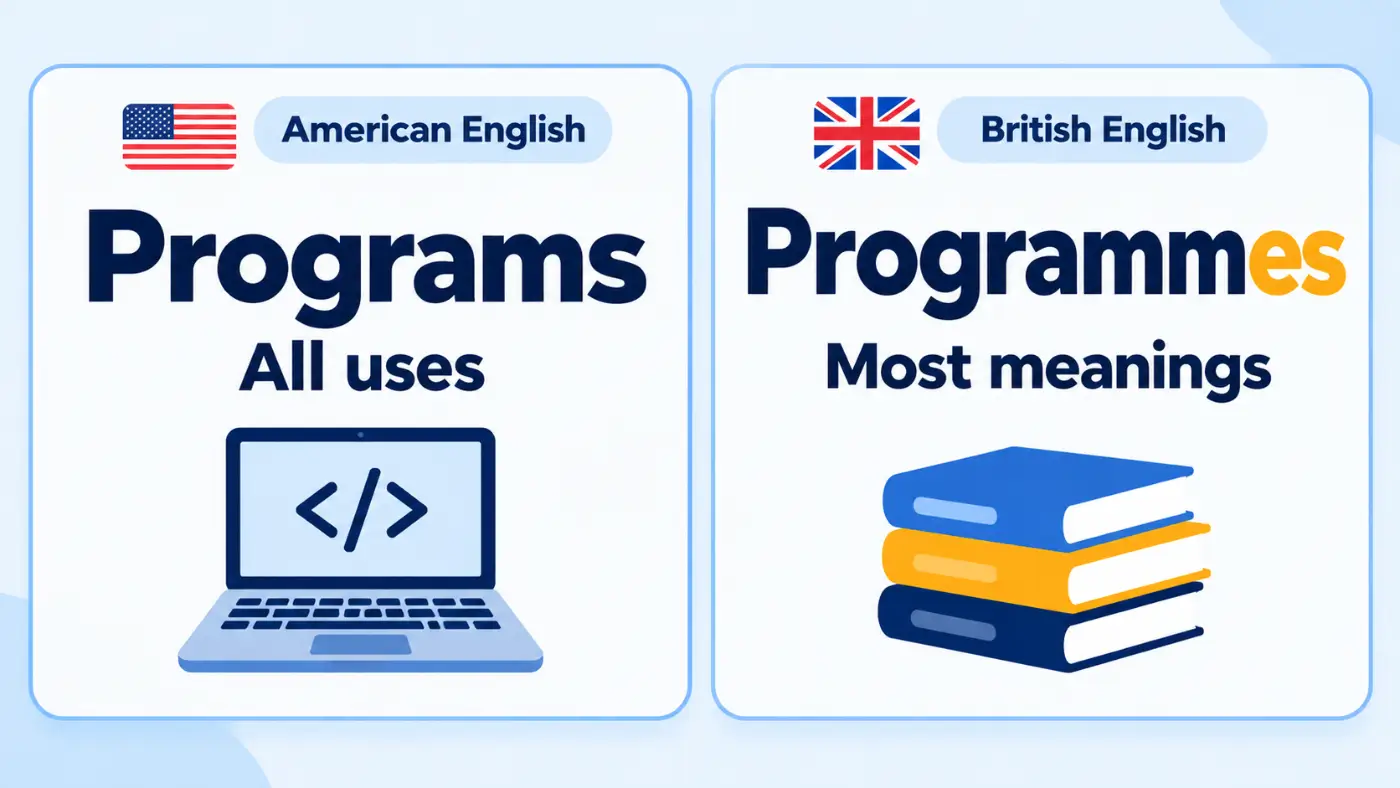
Both spellings are correct, but which one to use depends on region and context. Programs is standard American English for all uses, while British English generally uses programmes for most meanings but switches to programs specifically when referring to computer software.
The Short Answer at a Glance
| Form | Region | What it covers | Example |
|---|---|---|---|
| programs | American English (all uses); British English (computing only) | TV shows, schedules, events, computer software | The university offers several graduate programs in engineering. |
| programmes | British English (general use) | TV shows, schedules, events, but not computer software | The BBC airs several documentary programmes each week. |
American English uses programs for everything. British English splits the word: programmes for most meanings, but programs specifically for computer software, following the American spelling in that one technical context.
What Programs Means and How It Works
Programs is the plural of program, a noun with a wide range of meanings depending on context. It can refer to a planned series of events or activities, as in a conference program or a fitness program; a course of study, as in a degree program; a scheduled broadcast, as in a television program; or, in computing, a set of coded instructions that a computer executes.
In American English, programs covers every one of these meanings without exception, since American spelling conventions never switch to the alternate “-mme” ending regardless of context.
Grammatically, programs functions as a standard plural noun: several programs, two graduate programs, multiple software programs running simultaneously. The singular form, program, pairs naturally with articles and determiners: a program, the program, this program.
Program also functions as a verb in the context of computing and automation, meaning to write code or set instructions for a device to follow, as in “she programs in Python” or “he’s learning to program robotics systems.” This verb use follows the same spelling in both American and British English, which is part of a broader pattern worth understanding.
What Programmes Means and How It Works
Programmes means exactly the same thing as programs in most contexts: a planned series of events, a course of study, a broadcast schedule, or an organized initiative. The core meaning doesn’t change between the two spellings; only the letters used to spell the word differ.
British English traditionally uses programmes for the vast majority of these meanings, following a spelling pattern rooted in how English absorbed the word from French, which used a similar “-mme” ending. This is part of a broader historical pattern where British English sometimes retained spellings closer to a word’s French or Latin origin, while American English simplified many of these same words over time.
However, there’s a genuinely important exception. In British English, when the word specifically refers to a computer program, the spelling switches to program, matching the American form, rather than programme. This exception exists because computing terminology largely developed and spread internationally through American technology and software documentation, and British English adopted that American spelling specifically for the computing sense rather than applying its usual “-mme” pattern.
Grammatically, programmes behaves identically to programs in every other respect, functioning as a standard plural noun in all the same contexts: training programmes, television programmes, educational programmes.
Programs vs Programmes: Key Differences Side by Side
| Feature | Programs | Programmes |
|---|---|---|
| Part of speech | Plural noun | Plural noun |
| Core meaning | A planned series of events, broadcasts, courses, or computer software | Identical meaning, except computer software |
| Typical use | All contexts in American English; computing only in British English | General use in British English, excluding computing |
| Register | Standard in all registers | Standard in all registers within British English |
| Example | The nonprofit runs several community outreach programs. | The nonprofit runs several community outreach programmes. |
What the table can’t fully capture is how specific and consistent the computing exception is within British English. Unlike many US versus UK spelling differences, this isn’t simply a matter of regional preference across the board; it’s a deliberate, narrow carve-out that applies specifically and only to computer software, regardless of how British the rest of the surrounding text might be.
Correct Examples in Real-Life Contexts
Everyday speech (American)
- My favorite shows are all reality TV programs, no shame.
- She’s enrolled in three different after-school programs this semester.
- We’re looking into fitness programs that focus more on strength than cardio.
Everyday speech (British)
- My favourite programmes are mostly documentaries and cooking shows.
- She’s enrolled in three different after-school programmes this term.
Workplace writing (American)
- HR is rolling out new onboarding programs for remote employees.
- The IT department is updating several internal software programs this quarter.
- Our mentorship programs have shown strong results in employee retention.
- Please confirm which training programs new hires need to complete first.
Workplace writing (British)
- HR is rolling out new onboarding programmes for remote employees.
- The IT department is updating several internal software programs this quarter.
Texting (American)
- did you sign up for any of those summer programs yet
- my laptop has like ten programs running and it’s so slow
School and academic (American)
- The university offers several accelerated degree programs for working adults.
- Her research focuses on evaluating the effectiveness of early literacy programs.
- Students in the exchange programs spend a full semester abroad.
- The computer science department teaches students to write programs in multiple languages.
School and academic (British)
- The university offers several accelerated degree programmes for working adults.
- Students in the exchange programmes spend a full term abroad.
- The computer science department teaches students to write programs in multiple languages.
Formal writing (American)
- The agency’s public health programs reach communities across the state.
- The report evaluates the long-term outcomes of several federal assistance programs.
- Software programs used by the department must meet current security standards.
Formal writing (British)
- The agency’s public health programmes reach communities across the country.
- Software programs used by the department must meet current security standards.
Common Mistakes People Make (and How to Catch Them)
Applying “programmes” to computer software in British English
Wrong: I need to update this computer programme before the meeting. Right: I need to update this computer program before the meeting.
This is the most consequential mistake specific to British English, since it reverses the one established exception to the otherwise consistent “-mme” spelling pattern.
Mixing spellings within one document
Wrong: The British report refers to training programmes in one section and training programs in another, without the computing exception applying. Right: The report consistently uses programmes throughout, except specifically when referring to computer software.
Switching between spellings without a clear reason looks inconsistent and often happens when writers combine text from sources using different regional conventions.
Assuming American English ever uses “programmes”
Wrong assumption: Programmes is simply the more formal or correct spelling, and American writers should use it too. Right understanding: American English uses programs exclusively, across every context, with no equivalent exception or alternate spelling.
This misunderstanding sometimes arises from exposure to British media or writing, leading American writers to assume “programmes” carries more formal weight, when it’s simply a different regional convention.
Autocorrect flipping the spelling unexpectedly
Wrong: A British writer types programme correctly, but a British-English spellcheck setting doesn’t flag it when it should actually be program for computing content. Right: Checking computing-specific terminology manually, since general spellcheck settings may not apply the narrow technical exception correctly.
Because this exception is narrow and context-specific, spellcheck tools don’t always catch it reliably, making manual review especially important in technical British English writing.
A Fast Trick to Choose the Right One
For American English, there’s no decision to make: programs covers every single meaning, with no exceptions whatsoever. This is the simplest version of the rule and requires no further thought.
For British English, ask one specific question: am I talking about computer software? If yes, use program, matching the American spelling. If you’re talking about anything else, a TV show, a course of study, an event schedule, use programme instead.
This trick works reliably because the computing exception in British English is narrow, well-established, and doesn’t shift based on formality or audience. Its only limitation is that it requires recognizing when a sentence is specifically about computing versus a loosely related but different meaning, like a training initiative that happens to involve technology.
How They Sound in Real Situations
A text exchange (American)
Priya: Are you still doing that coding bootcamp?
Jordan: Yep, almost done with the second program module.
Priya: That’s awesome, you’ll be writing full programs in no time.
Programs is correct throughout, reflecting standard American spelling regardless of whether the context is education or computing.
A workplace email (British)
Subject: Training programme update
Hi Tom,
Just a note that the new leadership programme starts next Monday. Separately, IT mentioned the scheduling program needs an update before then, so please flag that to your team.
Regards, Priya
Programme and program both appear correctly here, since the email distinguishes between a general training initiative and a specific piece of computer software.
An article-style excerpt (American)
The nonprofit’s after-school programs have expanded to twelve new locations this year, offering tutoring, arts instruction, and mentorship to thousands of students. Officials say demand continues to outpace available funding.
Programs fits naturally here, consistent with standard American spelling throughout.
Formal Writing vs Casual Writing
The spelling choice doesn’t shift based on formality within either regional standard. American English uses programs consistently across casual conversation, business writing, academic papers, and government documents. British English applies the same consistency, using programmes generally and switching specifically to program only for computing, regardless of how formal or casual the writing is.
AP style, which is American, uses programs exclusively. British style guides generally favor programmes, while explicitly carving out the computing exception, meaning British technical writing and general writing may use different spellings within the very same document, which is expected and correct rather than inconsistent.
US vs UK English Differences
This is a genuine US versus UK spelling difference, but with an important technical carve-out that makes it more nuanced than many other American-British spelling pairs. American English uses programs across every context without exception. British English uses programmes for most meanings, following a spelling pattern closer to the word’s French-influenced origin, but switches specifically to program when referring to computer software, aligning with the globally dominant American spelling in that particular technical field.
This computing exception sets programs and programmes apart from simpler US-UK pairs like color versus colour, where no such context-based exception exists. Understanding this narrow, specific rule is essential for anyone writing British English content that touches on both general topics and technology.
Related Mix-Ups People Also Search For
Program vs Programme (Singular Form)
This pair follows the identical pattern as the plural forms, including the same computing exception in British English. Example: The British university’s new degree programme includes a required module on writing computer programs.
Catalog vs Catalogue
This is a similar US-UK spelling pair, though without the specific technical exception found in programs versus programmes, since catalog and catalogue follow a more straightforward regional split. Example: The American retailer’s catalog listed items that the British distributor’s catalogue described slightly differently.
Dialog vs Dialogue
Another related American-British pair, with American English generally preferring the shorter “dialog” particularly in computing and interface design, while British English consistently uses “dialogue.” Example: The software’s dialog box prompted for confirmation, a detail British reviewers described using the fuller spelling, dialogue.
Quick Practice: Test Yourself
Choose the spelling that fits each context, keeping regional conventions and the computing exception in mind.
- A US university’s website describes its new online degree ______. (programs / programmes)
- A British broadcaster’s schedule lists upcoming evening ______. (programs / programmes)
- A British tech company’s documentation explains how to install the ______. (program / programme)
- An American nonprofit’s annual report highlights its community outreach ______. (programs / programmes)
- A British university’s computer science course teaches students to write ______. (programs / programmes)
- A British government department describes its new public health ______. (programs / programmes)
Answer Key
- programs: American context calls for the American spelling across all uses.
- programmes: British broadcasting context calls for the standard British spelling.
- program: even in British English, computing content uses the American spelling.
- programs: American context calls for the American spelling.
- programs: the computing exception applies here, even within a British university.
- programmes: a general public health initiative, not computing, follows standard British spelling.
Frequently Asked Questions
Both are correct, depending on region and context. American English uses programs for everything, while British English uses programmes generally but switches to program specifically for computer software.
Computing terminology largely developed and spread internationally through American technology and documentation, leading British English to adopt the American spelling specifically for that technical context.
Yes. Both words describe the same range of meanings, including scheduled broadcasts, courses of study, organized initiatives, and computer software, with no difference in meaning between the two spellings.
Use programs for American audiences, since American English applies that spelling consistently across every context, with no exceptions.
Yes, this exception is consistently applied in standard British English, meaning a British document can correctly use both programmes and program within the same piece of writing, depending on which meaning is intended.
No, not for general meanings. British English expects programmes for most uses and reserves program specifically for computer software, so using them interchangeably outside that distinction isn’t considered standard.

Sophia Bennett writes educational content about English vocabulary, grammar, slang, and communication. She is passionate about making complex language topics accessible to students, professionals, and curious readers around the world.