Memento vs Momento: Which Spelling Is Correct?
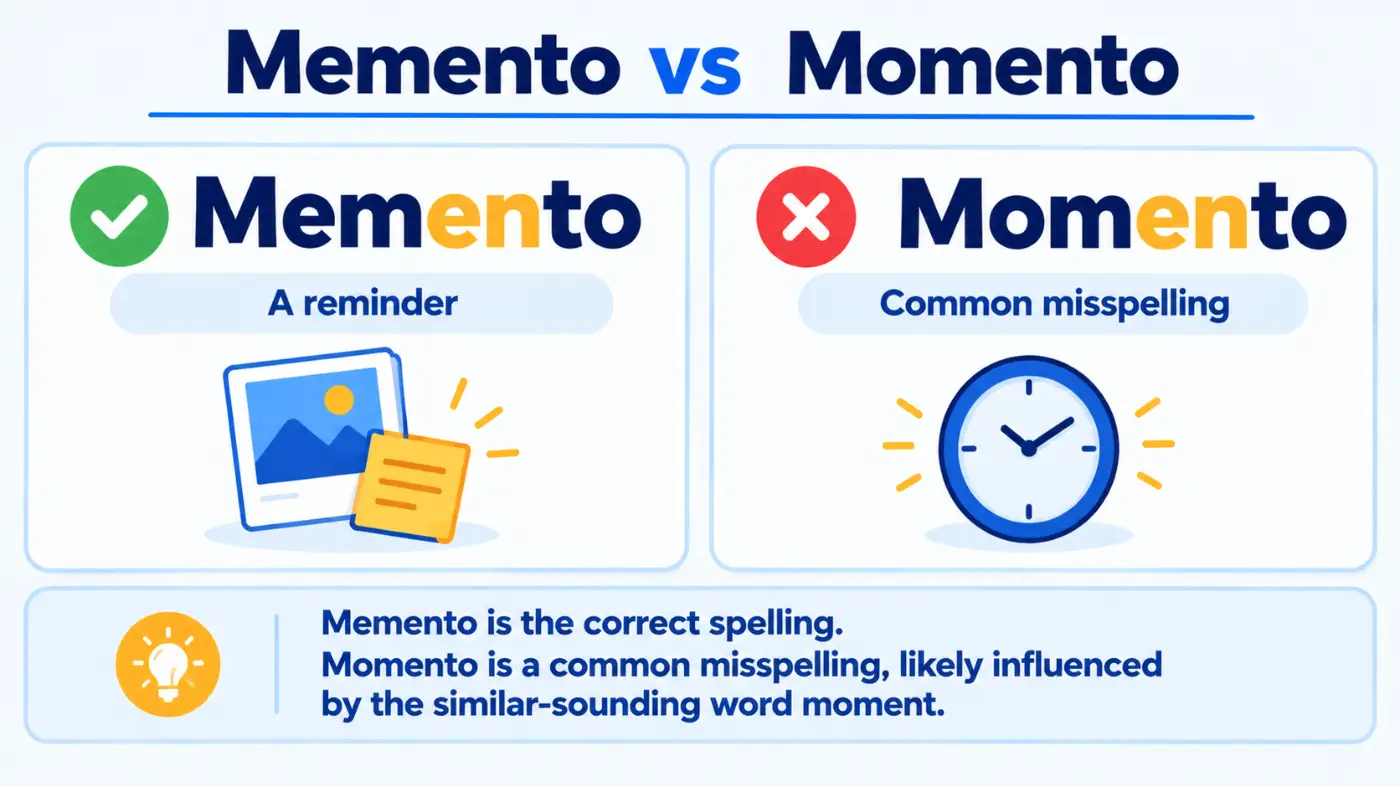
Memento is the correct spelling. Momento is a common misspelling, likely influenced by the similar-sounding word “moment,” since the two words share a related meaning and an almost identical sound.
The Short Answer at a Glance
| Form | Status | What it does | Example |
|---|---|---|---|
| memento | Correct | Noun referring to an object kept as a reminder of a person, place, or event | She kept the ticket stub as a memento from their first concert together. |
| momento | Misspelling | Not a word in standard English | Correct it to memento every time. |
Only one spelling is real. The first vowel is an “e,” not an “o,” despite how naturally “momento” seems to flow off the tongue.
What Memento Means and How It Works
Memento is a noun referring to an object kept specifically because it serves as a reminder of a person, place, experience, or event, often one with emotional or sentimental significance. Mementos can be almost anything: a ticket stub, a piece of jewelry, a photograph, a seashell from a memorable trip, or an item inherited from a loved one.
The word carries a distinctly personal, sentimental tone. Unlike a plain “souvenir,” which can sometimes refer to something mass-produced and purchased specifically to commemorate a trip or event, a memento often implies something more individually meaningful, tied to a specific memory rather than simply marking that a place was visited.
Grammatically, memento functions as a standard countable noun: a memento, several mementos, a cherished memento. It frequently pairs with verbs like “keep,” “treasure,” “hold onto,” and “save,” reflecting the emotional weight the word typically carries.
Memento comes from a Latin word meaning “remember,” which directly explains its core function and meaning: a memento exists specifically to help someone remember something important. That Latin root also explains the word’s spelling, since English preserved the original “e” rather than shifting it to match the more familiar, similarly pronounced word “moment.”
The plural of memento can be spelled either “mementos” or “mementoes,” both of which appear in major dictionaries, with “mementos” being the more commonly used form in modern writing.
Is “Momento” Ever Correct?
No. Momento isn’t recognized in standard English dictionaries, and it isn’t a regional variant, dated form, or accepted alternative spelling. It’s a spelling error, though an understandable one given how closely the word resembles “moment” both in sound and in underlying meaning.
The confusion almost certainly stems from the word “moment,” which shares a similar sound and a conceptually related meaning, since a memento often represents or commemorates a specific moment in time. Because “moment” is a far more common, everyday word, it’s easy for the “o” sound from “moment” to bleed into the spelling of the less frequently written word “memento.”
It’s worth noting that “momento” is actually a real word in Spanish and Italian, where it correctly means “moment.” This cross-language overlap likely reinforces the misspelling for some English writers, particularly those with exposure to Romance languages, where the “o” spelling is entirely correct, just not for this particular English word.
Because memento appears less frequently in everyday writing than many other commonly misspelled words, writers often don’t have as much repeated exposure to its correct spelling, which makes it easier for the more familiar “moment” pattern to take over by default.
Memento vs Momento: Key Differences Side by Side
| Feature | Memento | Momento |
|---|---|---|
| Recognized word in English | Yes | No |
| Recognized word in Spanish/Italian | No | Yes (meaning “moment”) |
| Part of speech | Noun | Not applicable in English |
| Core meaning | An object kept as a sentimental reminder | No meaning in English |
| Typical use | Sentimental keepsakes, travel, personal history | Appears only as a typo in English contexts |
| Register | Works in formal and casual writing | Never appropriate in English |
| Example | He kept the hotel keycard as a silly memento of their honeymoon. | He kept the hotel keycard as a silly momento of their honeymoon. (wrong in English) |
The table draws a clear contrast, but what it can’t fully capture is how reasonable this particular mistake feels. Because “moment” and “memento” are so closely related in both sound and meaning, and because “momento” is genuinely correct in other languages, this error carries less of a random, arbitrary quality than many other common misspellings.
Correct Examples in Real-Life Contexts
Everyday speech
- I kept a little memento from every trip we took together.
- That bracelet is a memento from my grandmother, so I never take it off.
- We grabbed a magnet as a cheap memento from the gift shop.
- He still has the napkin from their first date tucked away as a memento.
Workplace writing
- The retiring employee received a framed memento commemorating her twenty years with the company.
- Each attendee took home a small memento from the conference’s opening reception.
- The office gave out branded mementos to celebrate the company’s tenth anniversary.
- Please include a personalized memento in each client’s welcome package.
Texting
- found an old memento from our trip while cleaning out my closet lol
- keeping this ticket stub as a memento, best concert ever
School and academic
- The museum exhibit features personal mementos donated by survivors of the historical event.
- Her essay reflects on a single memento that connects her to her grandmother’s childhood.
- Students were asked to bring in a memento representing an important family memory.
- The archive includes dozens of wartime mementos preserved by returning soldiers.
Formal writing
- The foundation presented each honoree with a commemorative memento of the occasion.
- The exhibit catalog describes each memento’s historical and personal significance in detail.
- Attendees received a small memento as a token of appreciation for their attendance.
- The estate included several sentimental mementos passed down through three generations.
Common Mistakes People Make (and How to Catch Them)
Swapping the “e” for an “o” due to “moment”
Wrong: I kept this as a momento of our trip to the coast. Right: I kept this as a memento of our trip to the coast.
This is the core error, driven by the word’s strong sonic and conceptual overlap with “moment,” a much more commonly used word.
Typing quickly and defaulting to the more familiar pattern
Wrong: She gave everyone a small momento at the end of the ceremony. Right: She gave everyone a small memento at the end of the ceremony.
Fast typing often favors the more frequently typed, more familiar word pattern, especially when the correct spelling is less commonly encountered in everyday writing.
Relying on pronunciation alone
Wrong: He bought a momento shaped like the Eiffel Tower. Right: He bought a memento shaped like the Eiffel Tower.
Since many speakers pronounce the first syllable of memento in a way that sounds close to “mo,” spelling purely by ear can easily produce the incorrect version.
Cross-language interference for bilingual writers
Wrong: A Spanish-English bilingual writer, familiar with “momento” meaning “moment” in Spanish, carries that spelling into English. Right: Recognizing that English requires memento, spelled with an “e,” even though “momento” is correct in Spanish for an entirely different meaning.
This is a particularly understandable version of the mistake, since “momento” is a completely legitimate word, just in a different language and with a different meaning than the English word being intended.
A Fast Trick to Choose the Right One
Anchor memento to the word “memory.” Both words begin with “mem-,” and since memento exists specifically to preserve a memory, that shared beginning makes logical and visual sense. If you can spell “memory” correctly, you already have the correct first syllable of memento locked in.
A second trick: remember that memento comes from a root meaning “to remember,” which starts with “re-mem-ber,” again sharing that same “mem” syllable. Connecting memento to this family of “remember”-related words helps separate it clearly from “moment,” which has an entirely different root.
This trick works well for anchoring the correct first syllable, but it won’t help with spelling other less common Latin-derived English words, since each one carries its own distinct root and pattern.
How They Sound in Real Situations
A text exchange
Priya: Did you keep anything from the trip?
Jordan: Just this little seashell, it’s basically my memento from that whole summer.
Priya: That’s honestly so sweet.
Memento is correct here, used in its standard sense describing a sentimental keepsake.
A workplace email
Subject: Retirement gift planning
Hi team,
We’d like to put together a meaningful memento for Linda’s retirement next month, something that reflects her twenty years with the company. Let me know if anyone has ideas before we finalize the order.
Thanks, Renata
Memento is correct because the email describes a sentimental object meant to commemorate someone’s long career.
An article-style excerpt
Visitors to the exhibit are invited to view personal mementos donated by families affected by the historic flood, each item accompanied by a brief written reflection. Curators say the collection offers an intimate, deeply human counterpoint to the exhibit’s broader historical timeline.
Mementos is correct here, used in a formal museum and journalistic context describing meaningful personal objects.
Formal Writing vs Casual Writing
The correct spelling doesn’t change based on formality. Memento is right in a museum catalog, a business memo, a text message, and a casual conversation. Momento is wrong everywhere in English, regardless of tone or context.
What shifts with register is the kind of memento typically being described. In formal and museum-related writing, memento often appears in more reflective, historically significant contexts, describing objects with deep personal or cultural meaning. In casual speech, it’s used more loosely to describe anything from a cherished family heirloom to a silly souvenir magnet from a weekend trip.
AP and Chicago style both treat memento as a standard word with a fixed spelling, and neither recognizes momento as an accepted alternate form in English.
Related Mix-Ups People Also Search For
Memento vs Souvenir
These two overlap closely, though souvenir often implies something purchased specifically to commemorate a trip or event, while memento can be any object, purchased or not, that carries personal sentimental meaning. Example: We bought a cheap souvenir from the gift shop, but the real memento of that trip was the handwritten note from the innkeeper.
Memento vs Moment
These words are related in meaning but entirely distinct, since a memento represents or commemorates a specific moment, but the two words aren’t interchangeable. Example: That photograph captures the exact moment we got engaged, and it remains our most treasured memento from that day.
Memento vs Keepsake
Keepsake is a close synonym for memento, both describing objects kept specifically for sentimental reasons, though keepsake sometimes carries a slightly more domestic or old-fashioned connotation. Example: The quilt has become a treasured family keepsake, passed down as a memento of her grandmother’s craftsmanship.
Quick Practice: Test Yourself
Choose the correct spelling for each blank.
- She kept the pressed flower as a ______ from their wedding day. (memento / momento)
- The museum’s new exhibit features personal ______ from Civil War soldiers. (mementos / momentos)
- He still has the old concert ticket as a ______ of his favorite show. (memento / momento)
- Each graduate received a small ______ to commemorate the ceremony. (memento / momento)
- The box in the attic was full of sentimental ______ from her childhood. (mementos / momentos)
- That necklace is more than jewelry, it’s a ______ of her late mother. (memento / momento)
Answer Key
- memento: the correct spelling always uses “e” in the first syllable, not “o.”
- mementos: the plural form, consistent with the correct base spelling.
- memento: correct spelling describing a sentimental keepsake.
- memento: correct spelling in a formal, ceremonial context.
- mementos: correct plural form, matching the standard spelling.
- memento: correct spelling describing an object with deep personal meaning.
Frequently Asked Questions
Is “momento” ever an acceptable spelling in English?
No. Momento isn’t recognized in standard English dictionaries and isn’t used as a regional or informal variant. The correct spelling in every context is memento.
Is “momento” a real word at all?
Yes, but not in English. Momento is a correctly spelled word in Spanish and Italian, where it means “moment,” which likely contributes to the confusion for English writers familiar with those languages.
Why do people spell memento with an “o” by mistake?
The error likely comes from the word’s close similarity in sound and meaning to “moment,” which is a far more commonly used English word.
What’s the plural of memento?
Both “mementos” and “mementoes” are accepted plural forms in English, though “mementos” is more commonly used in modern writing.
Is memento the same as a souvenir?
They’re closely related, but souvenir often implies something purchased specifically to commemorate a trip or event, while memento can refer to any object, purchased or otherwise, kept for personal sentimental reasons.
What language does memento come from?
Memento comes from Latin, derived from a word meaning “to remember,” which directly reflects its function as an object meant to preserve a memory.

Sophia Bennett writes educational content about English vocabulary, grammar, slang, and communication. She is passionate about making complex language topics accessible to students, professionals, and curious readers around the world.