Genius vs Genious: Which Spelling Is Correct?
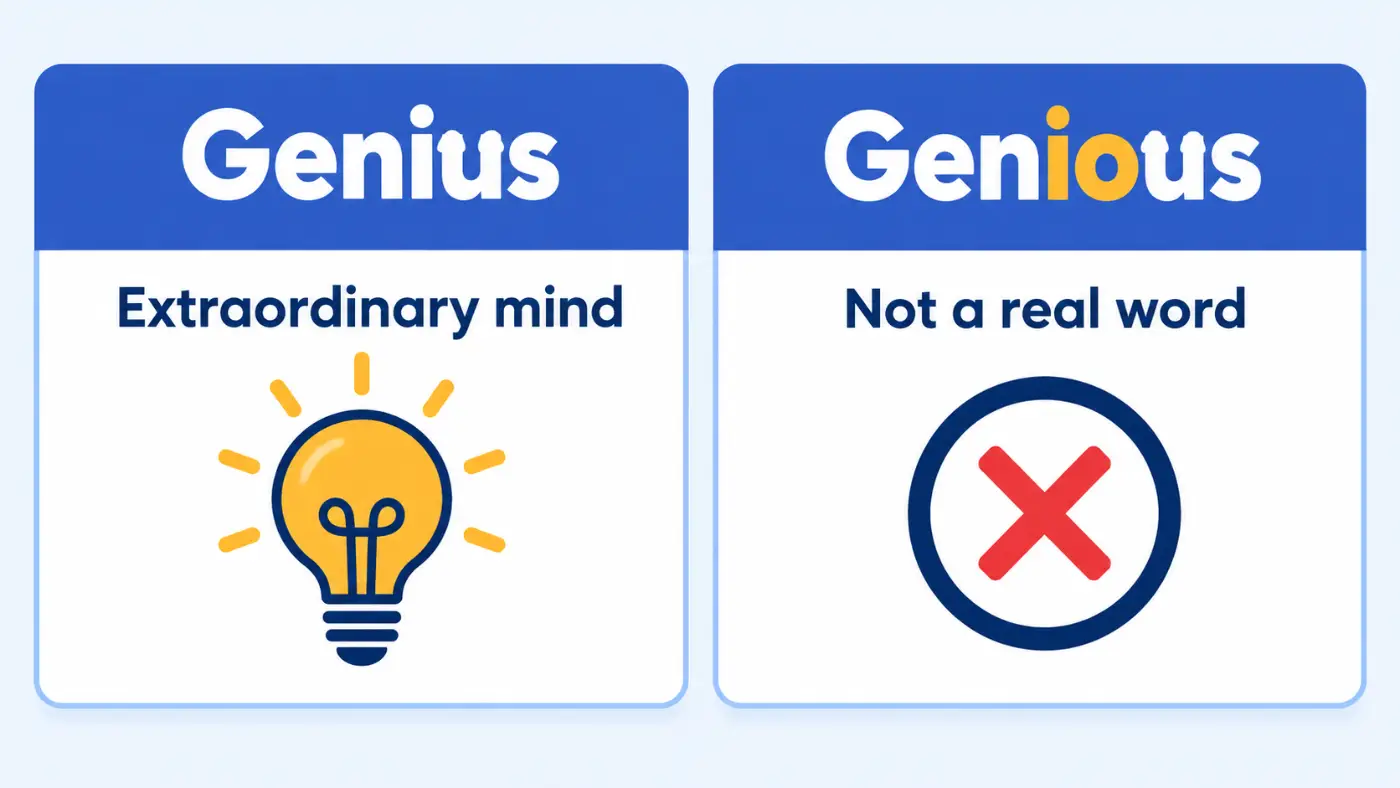
Genius is the correct spelling. Genious isn’t a standard English word, and it comes from applying the familiar “-ious” adjective ending to a word that actually ends in a much simpler “-ius.”
The Short Answer at a Glance
| Form | Status | What it does | Example |
|---|---|---|---|
| genius | Correct | Noun describing exceptional intellectual or creative ability, or a person who has it | Her solution to the problem was pure genius. |
| genious | Misspelling | Not a word in standard English | Correct it to genius every time. |
Only one spelling is real. The ending is “-ius,” not “-ious,” despite how naturally the longer ending seems to fit.
What Genius Means and How It Works
Genius is a noun referring to exceptional natural ability, especially in intellectual, creative, or artistic pursuits. It can describe an abstract quality, as in “a stroke of genius,” or a specific person recognized for extraordinary talent, as in “she’s considered a genius in her field.”
The word also carries a more playful, exaggerated use in everyday speech, often applied humorously or ironically to describe something clever or, occasionally, something absurdly not clever at all, as in “oh sure, genius move, leaving the keys inside the car.”
Grammatically, genius functions as a standard noun, countable when referring to specific individuals (a genius, several geniuses) and uncountable when referring to the abstract quality itself (sheer genius, creative genius). The plural form, geniuses, follows the regular English pattern of simply adding “es,” without any unusual spelling twist.
Genius comes from a Latin root originally associated with a guiding spirit or innate talent, which explains both its meaning and its somewhat unusual “-ius” ending, a pattern English absorbed directly from Latin rather than reshaping into a more typical English adjective or noun ending.
There’s also a related adjective, “ingenious,” which shares a conceptual connection to clever or inventive thinking, though it’s a separate word with its own distinct spelling and shouldn’t be confused with genius itself.
Is “Genious” Ever Correct?
No. Genious isn’t recognized in any standard dictionary, and it isn’t a regional variant, dated form, or accepted alternative spelling. It’s a spelling error rooted in a very natural, understandable assumption about English word endings.
English has a large and extremely common family of adjectives ending in “-ious,” including curious, serious, mysterious, and delicious. Because that ending shows up so frequently, and because genius sounds like it could plausibly belong to that same family, many writers unconsciously apply the familiar “-ious” pattern to a word that actually doesn’t follow it.
Genius, however, ends simply in “-ius,” a much less common pattern in English, shared by only a small number of words. This ending reflects the word’s direct, largely unaltered borrowing from Latin, where English preserved the original spelling rather than reshaping it to match more typical adjective endings.
Because genius functions primarily as a noun rather than an adjective, it’s also slightly unusual that its ending resembles so many English adjectives in the first place, which may contribute further to the confusion, since writers associate that “-ious” pattern specifically with descriptive words.
Genius vs Genious: Key Differences Side by Side
| Feature | Genius | Genious |
|---|---|---|
| Recognized word | Yes | No |
| Part of speech | Noun | None |
| Core meaning | Exceptional intellectual or creative ability; a person with that ability | No meaning |
| Typical use | Describing talent, cleverness, or brilliant ideas | Appears only as a typo |
| Register | Works in formal and casual writing | Never appropriate |
| Example | Einstein’s genius reshaped how we understand the universe. | Einstein’s genious reshaped how we understand the universe. (wrong) |
The table shows a clear contrast, but what it can’t fully capture is how reasonable this particular mistake feels. Because so many extremely common English adjectives end in “-ious,” genius looks like it should follow the same pattern, even though it belongs to a much smaller, Latin-derived group of words that doesn’t.
Correct Examples in Real-Life Contexts
Everyday speech
- Whoever came up with this recipe hack is an absolute genius.
- I don’t know how she keeps coming up with such genius ideas on the spot.
- Forgetting your umbrella on the one day it actually rains, real genius move.
- He’s a genius when it comes to fixing anything mechanical.
Workplace writing
- The marketing team’s campaign concept was nothing short of genius.
- We need a genius-level solution to fix this budget shortfall by Friday.
- Her ability to simplify complex data into clear visuals is pure genius.
- The engineering team credited one genius insight for solving the entire bottleneck.
Texting
- ok that’s actually genius, why didn’t I think of that
- lowkey a genius plan ngl, let’s do it
School and academic
- The professor described the mathematician’s proof as a work of genius.
- Her thesis explores how societal context shapes our definition of genius.
- Students debated whether genius is primarily innate or developed through effort.
- The lecture compared different historical figures widely regarded as geniuses in their fields.
Formal writing
- Critics praised the architect’s design as a genuine display of creative genius.
- The biography examines the scientist’s genius alongside his personal struggles.
- The committee recognized her contributions as a rare example of practical genius.
- Historians continue to debate what separates genius from simple expertise.
Common Mistakes People Make (and How to Catch Them)
Applying the familiar “-ious” ending
Wrong: That’s such a genious idea, honestly. Right: That’s such a genius idea, honestly.
This is the core mistake. Because so many common adjectives end in “-ious,” writers naturally assume genius follows the same pattern, even though it doesn’t.
Typing quickly and defaulting to a more familiar spelling
Wrong: She’s a total genious when it comes to coding. Right: She’s a total genius when it comes to coding.
Fast typing often favors whichever spelling feels most instinctively familiar, and since “-ious” is far more common across English vocabulary, it can slip in unintentionally.
Confusing genius with similarly spelled words
Wrong: His genious approach to the problem impressed everyone. Right: His genius approach to the problem impressed everyone.
This variation often stems from blending genius with other, unrelated “-ious” words encountered frequently in everyday reading and writing.
Autocorrect not catching the error consistently
Wrong: My phone didn’t flag “genious,” so it made it into my final draft. Right: Manually reviewing less common spelling patterns before finalizing important documents.
Some spellcheck tools catch this error reliably, but not all, especially in less formal writing platforms or quick messaging apps.
A Fast Trick to Choose the Right One
Anchor genius to its close relative, “genie,” both of which share that same unusual “-i” sound before the ending, and neither of which follows the common “-ious” pattern. If you can spell “genie” correctly, that same instinct can help remind you that genius similarly skips the extra “o.”
A second trick: remember that genius is fundamentally a noun, not an adjective, unlike the vast majority of English words ending in “-ious,” which are almost always adjectives, like curious, serious, and mysterious. Recognizing that genius breaks that pattern grammatically can help reinforce that it also breaks it in spelling.
This trick works well for genius specifically, but it won’t help with other unusual Latin-derived spellings in English, since each one tends to carry its own unique quirk rather than following one single predictable rule.
How They Sound in Real Situations
A text exchange
Priya: I just realized we can split the bill by Venmo request instead of doing math
Jordan: Genius. Why have we never done this before
Priya: No idea, pure genius moment though
Genius is correct here, used casually to describe a clever, simple idea in everyday conversation.
A workplace email
Subject: Great idea from today’s meeting
Hi team,
I just wanted to say that Maria’s suggestion to automate the weekly report was genius. It’s already saving us hours each week, and I really appreciate the initiative.
Thanks, Renata
Genius is correct because the email describes a particularly clever and effective idea in a professional context.
An article-style excerpt
Historians continue to study the inventor’s genius, pointing to his ability to combine seemingly unrelated fields into groundbreaking innovations. Decades later, his influence remains evident across multiple industries.
Genius is correct here, used in a formal, historical context describing exceptional ability.
Formal Writing vs Casual Writing
The correct spelling doesn’t change based on formality. Genius is right in a biography, a business email, a text message, and a casual conversation. Genious is wrong everywhere, regardless of tone or context.
What shifts with register is tone and intensity. In formal writing, genius often appears in careful, measured discussions of talent, achievement, or historical significance. In casual speech, it’s used more loosely and often humorously, sometimes genuinely praising cleverness and other times playfully pointing out an obvious mistake.
AP and Chicago style both treat genius as a standard word requiring no special formatting, and neither offers any accepted alternate spelling.
Related Mix-Ups People Also Search For
Genius vs Ingenious
These two look and sound related, and they share a conceptual connection to cleverness, but they’re separate words with distinct spellings and grammatical roles. Genius is primarily a noun, while ingenious is an adjective describing something clever or inventive. Example: Her ingenious workaround solved the problem, proving once again that she’s a genius at thinking outside the box.
Genius vs Genie
These words share a similar beginning sound and both avoid the common “-ious” ending, making them a useful memory pair despite having completely unrelated meanings. Example: The story’s genie granted three wishes, though some might call that kind of magical problem-solving its own form of genius.
Curious vs Genious (Ending Pattern Confusion)
Curious correctly follows the common “-ious” pattern shared by many English adjectives, which is exactly the pattern mistakenly applied to genius. Example: Her curious nature led her to study the kind of genius-level thinking behind major scientific breakthroughs.
Quick Practice: Test Yourself
Choose the correct spelling for each blank.
- Whoever designed this app’s interface is clearly a ______. (genius / genious)
- That was such a ______ way to solve the scheduling conflict. (genius / genious)
- Historians still study the inventor’s ______ decades later. (genius / genious)
- I don’t know how she keeps having such ______ ideas under pressure. (genius / genious)
- The whole plan was honestly pure ______. (genius / genious)
- He’s considered one of the great ______ of his generation. (geniuses / geniouses)
Answer Key
- genius: the correct spelling always ends in “-ius,” never “-ious.”
- genius: consistent spelling regardless of sentence structure.
- genius: correct spelling describing exceptional ability.
- genius: correct spelling used as a modifier before a noun.
- genius: correct spelling describing an abstract quality.
- geniuses: the plural form, following the regular English pattern of adding “es.”
Frequently Asked Questions
Is “genious” ever an acceptable spelling?
No. Genious isn’t recognized in standard dictionaries and isn’t used as a regional or informal variant. The correct spelling in every context is genius.
Why doesn’t genius follow the common “-ious” pattern like other English adjectives?
Genius comes directly from Latin, where it ends in “-ius,” and English preserved that original spelling rather than reshaping it to match the more common “-ious” ending found in adjectives like curious or serious.
What’s the plural of genius?
The plural is geniuses, formed by simply adding “es,” following the regular English pattern for most nouns.
Is genius always used to describe a person?
No. Genius can also describe an abstract quality or a specific clever idea, as in “a stroke of genius,” without referring to a particular person at all.
What’s the difference between genius and ingenious?
Genius is primarily a noun describing exceptional ability or a person who has it, while ingenious is an adjective describing something clever, inventive, or resourceful.
Is genius ever used sarcastically?
Yes. In casual speech, genius is often used playfully or sarcastically to point out an ironic or obviously poor decision, as in “oh, genius move,” despite the word’s primary meaning being genuinely complimentary.

Sophia Bennett writes educational content about English vocabulary, grammar, slang, and communication. She is passionate about making complex language topics accessible to students, professionals, and curious readers around the world.