Treat vs Treet: Which Spelling Is Correct?
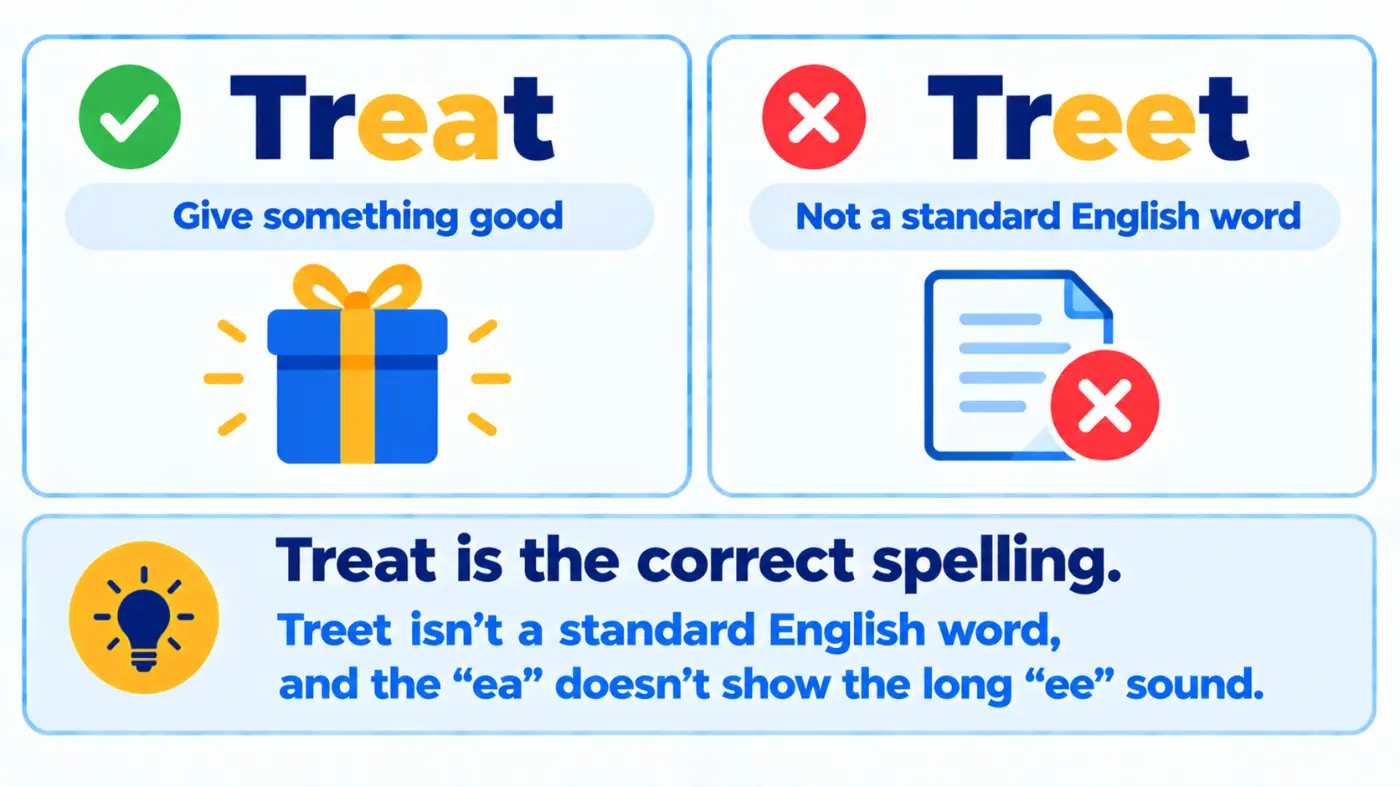
Treat is the correct spelling. Treet isn’t a standard English word, and it shows up mainly because the “ea” in treat doesn’t offer any obvious clue about which letters actually produce that long “ee” sound.
The Short Answer at a Glance
| Form | Status | What it does | Example |
|---|---|---|---|
| treat | Correct | Noun or verb referring to something special given as a reward, or the act of handling/dealing with something | She bought the dog a treat for learning the new trick. |
| treet | Misspelling | Not a word in standard English | Correct it to treat every time. |
Only one spelling is real. The “ea” combination in treat produces the long “ee” sound, and treet is simply a phonetic guess that doesn’t match the actual spelling.
What Treat Means and How It Works
Treat is a versatile word functioning as both a noun and a verb, and its meaning shifts depending on which role it plays in a sentence. As a noun, a treat is something special or pleasurable given as a reward, indulgence, or small gift, like a piece of candy, a favorite snack, or an unexpected outing. As a verb, to treat means to handle, deal with, or behave toward someone or something in a particular way, as in “treat others with respect,” or to provide medical care, as in “the doctor treated the infection.”
The verb also carries a specific, common meaning related to paying for someone else’s meal or experience, as in “let me treat you to dinner.” This sense of generosity and hospitality is deeply embedded in everyday English and shows up constantly in social situations.
Grammatically, treat as a noun is countable: a treat, several treats, my favorite treat. As a verb, it conjugates regularly:
- treat (base form)
- treats (third-person present)
- treated (past tense and past participle)
- treating (present participle)
The related adjective “treatable” describes something, often a medical condition, that can be successfully addressed or cured. The noun “treatment” refers to the specific method or process used to address a condition, situation, or problem, as in “cancer treatment” or “water treatment.”
Treat’s spelling reflects a common English pattern where “ea” produces a long “ee” sound in many words, including read, beach, and clean. This pattern isn’t universal across all “ea” words, which is part of why English spelling in general can feel inconsistent, but it does hold true for treat specifically.
Is “Treet” Ever Correct?
No. Treet isn’t recognized in any standard dictionary, and it isn’t a regional variant, informal shortcut, or accepted alternate spelling. It’s a straightforward phonetic misspelling.
English uses several different letter combinations to represent the long “ee” sound, including “ee” itself (as in “feet”), “ea” (as in “treat” and “beach”), and occasionally other patterns depending on the specific word. Because there’s no single, universal rule dictating which combination applies to any given word, writers spelling purely by sound have roughly equal odds of guessing wrong.
Treat happens to fall into the “ea” category, alongside words like heat, seat, and meat. Treet would only make sense if the word followed the “ee” pattern instead, the way “feet” or “sweet” do. Since treat doesn’t follow that pattern, the “eet” spelling produces an incorrect result, even though it would technically create the same sound if it were a real word.
This kind of error is especially common among early readers and writers still internalizing English spelling patterns, as well as in fast, informal typing where a writer trusts their ear over their memory of the specific word’s correct form.
Treat vs Treet: Key Differences Side by Side
| Feature | Treat | Treet |
|---|---|---|
| Recognized word | Yes | No |
| Part of speech | Noun and verb | None |
| Core meaning | Something given as a reward or indulgence; to handle or care for something | No meaning |
| Typical use | Everyday speech, food, medicine, hospitality, behavior | Appears only as a typo |
| Register | Works in formal and casual writing | Never appropriate |
| Example | The vet recommended a specific treat for dogs with sensitive stomachs. | The vet recommended a specific treet for dogs with sensitive stomachs. (wrong) |
The table draws a clean line between correct and incorrect, but what it can’t fully capture is how reasonable the error actually is from a purely phonetic standpoint. Since English offers multiple valid spellings for the same long “ee” sound, treet isn’t an unreasonable guess, just an incorrect one for this particular word.
Correct Examples in Real-Life Contexts
Everyday speech
- I got myself a little treat after finishing that huge project.
- The dog sat perfectly still, clearly expecting a treat.
- Let’s treat ourselves to takeout tonight, we’ve earned it.
- My grandmother always kept a jar of treats for visiting kids.
Workplace writing
- The office is ordering treats for everyone to celebrate hitting the quarterly goal.
- Please treat this information as confidential until the announcement goes out.
- The clinic offers same-day appointments to treat minor injuries.
- We’re treating our top clients to a dinner at the end of the conference.
Texting
- omw to grab us a treat before the movie starts
- can we just treat ourselves to sushi tonight, I don’t want to cook
School and academic
- The biology unit covered how antibiotics treat bacterial infections.
- Teachers often use small treats as classroom incentives for younger students.
- The paper examines how different cultures treat aging and elder care.
- Her research explores how early exposure to sugar-based treats affects childhood eating habits.
Formal writing
- The hospital’s protocol outlines how staff should treat patients experiencing severe allergic reactions.
- The policy requires that all customer complaints be treated with equal priority.
- Regulatory guidelines specify how manufacturers must treat contaminated water before release.
- Employees are expected to treat confidential client data according to strict security standards.
Common Mistakes People Make (and How to Catch Them)
Spelling purely by sound
Wrong: I bought the kids a special treet for finishing their homework. Right: I bought the kids a special treat for finishing their homework.
This is the core error. Since “ea” and “ee” can both produce the same long “ee” sound, writers relying entirely on pronunciation have no reliable way to know which pattern the specific word actually uses.
Confusing it with genuinely “ee”-spelled words
Wrong: She gave the dog a treet after it sat on command, just like it would meet its owner at the door. Right: She gave the dog a treat after it sat on command, just like it would meet its owner at the door.
Writers sometimes unconsciously borrow the spelling pattern from a nearby “ee” word in the same sentence or paragraph, blending the two patterns together.
Typing quickly without double-checking
Wrong: Let’s treet ourselves to something nice this weekend. Right: Let’s treat ourselves to something nice this weekend.
Fast, informal typing, especially in texting or social media, often skips the moment of hesitation that would normally prompt a writer to double-check an unfamiliar-looking word.
Early literacy spelling patterns carrying into adult writing
Wrong: The teacher explained that healthy treets are better than candy. Right: The teacher explained that healthy treats are better than candy.
Because young children often learn to spell by sound before memorizing exact letter patterns, this kind of phonetic guess can persist as a habit if it isn’t corrected early and reinforced through reading.
A Fast Trick to Choose the Right One
Group treat with its close relatives that share the same “ea” pattern: heat, seat, meat, and beat. If you already spell those correctly without hesitation, treat follows the identical structure, and remembering that shared family can anchor the correct spelling in your memory.
A second trick is to think about the word’s related forms, like treatment and treatable. Since these longer words are less likely to be misspelled phonetically, recalling their correct “ea” spelling can help confirm the base word treat follows the same pattern.
This trick works well for treat specifically, but it won’t help with every English word that makes the long “ee” sound, since spelling patterns vary depending on each word’s individual history and origin.
How They Sound in Real Situations
A text exchange
Priya: Rough day?
Jordan: The worst. I think I deserve a treat tonight.
Priya: Agreed, let’s get ice cream.
Treat is correct here, used in its common sense of something special or indulgent after a hard day.
A workplace email
Subject: Team celebration Friday
Hi everyone,
To celebrate finishing the project ahead of schedule, we’re bringing in treats for the whole team Friday afternoon. Let me know if anyone has dietary restrictions so I can plan accordingly.
Thanks, Devon
Treats is correct because the email refers to food items given as a reward or celebration.
An article-style excerpt
Doctors say early detection significantly improves the odds of successfully treating the condition, particularly when symptoms are caught before they progress. Patients who begin treatment within the first few weeks tend to see the best outcomes.
Treating and treatment are correct here, both following the standard “ea” spelling pattern in a medical context.
Formal Writing vs Casual Writing
The correct spelling doesn’t shift based on formality. Treat is right in a medical journal, a business memo, a text message, and a casual conversation. Treet is wrong everywhere, regardless of tone or context.
What changes with register is which sense of the word tends to appear more often. In casual speech, treat frequently refers to food, small indulgences, or acts of generosity, as in “my treat” when picking up a check. In formal and medical writing, treat and its related forms, like treatment and treatable, often appear in more clinical or procedural contexts, describing how conditions, situations, or substances are managed.
AP and Chicago style both treat “treat” as a standard word requiring no special formatting, and neither offers any accepted alternate spelling.
Related Mix-Ups People Also Search For
Treat vs Treet (the “ea” vs “ee” Pattern)
This is the core confusion behind the entire topic, since treat uses “ea” while many similar-sounding words use “ee” instead. Example: The dog eagerly waited for its treat, then ran to greet its owner at the door.
Treat vs Trick
These two are closely associated, especially around Halloween, but they mean very different things. Treat refers to something pleasant or rewarding, while trick refers to a deceptive or mischievous act. Example: The kids shouted “trick or treat” at every door on the block.
Meat vs Meet vs Mete
This trio shares the exact same “ea” versus “ee” confusion as treat, since meat uses “ea” while meet uses “ee,” and mete (a less common word meaning to distribute) uses yet another pattern. Example: We plan to meet for dinner and grab some meat from the new butcher shop.
Quick Practice: Test Yourself
Choose the correct spelling for each blank.
- The kids were promised a ______ if they finished their chores. (treat / treet)
- Doctors continue to research new ways to ______ chronic pain. (treat / treet)
- My aunt always brings a special ______ when she visits. (treat / treet)
- It’s my turn to ______ everyone to lunch today. (treat / treet)
- The clinic specializes in ways to ______ sports injuries. (treat / treet)
- She saved the best ______ for last. (treat / treet)
Answer Key
- treat: the correct spelling always uses “ea,” never “ee.”
- treat: consistent spelling regardless of grammatical role, verb or noun.
- treat: correct spelling describing something special given as a gift.
- treat: correct spelling in its verb form, meaning to pay for someone.
- treat: correct spelling in a medical context.
- treat: correct spelling in its noun form.
Frequently Asked Questions
Is “treet” ever an acceptable spelling?
No. Treet isn’t recognized in standard dictionaries and isn’t used as a regional or informal variant. The correct spelling in every context is treat.
Why is treat spelled with “ea” instead of “ee”?
Treat follows a common English spelling pattern where “ea” produces a long “ee” sound, the same pattern used in words like heat, seat, and meat.
Can treat be both a noun and a verb?
Yes. As a noun, a treat is something special given as a reward. As a verb, to treat means to handle, care for, or provide something for someone, including paying for their meal or providing medical care.
What’s the difference between treat and treatment?
Treat is the base verb or noun, while treatment is the noun form referring to the specific method, process, or care used to address a condition or situation.
Is “my treat” a common expression?
Yes. “My treat” is a common phrase meaning the speaker will pay for something, typically a meal or outing, on someone else’s behalf.
Are there other common words that follow the same “ea” pattern as treat?
Yes. Words like heat, seat, meat, beat, and wheat all follow the identical “ea” spelling pattern for the long “ee” sound.

Sophia Bennett writes educational content about English vocabulary, grammar, slang, and communication. She is passionate about making complex language topics accessible to students, professionals, and curious readers around the world.