Theater vs Theatre Which Spelling Is Correct
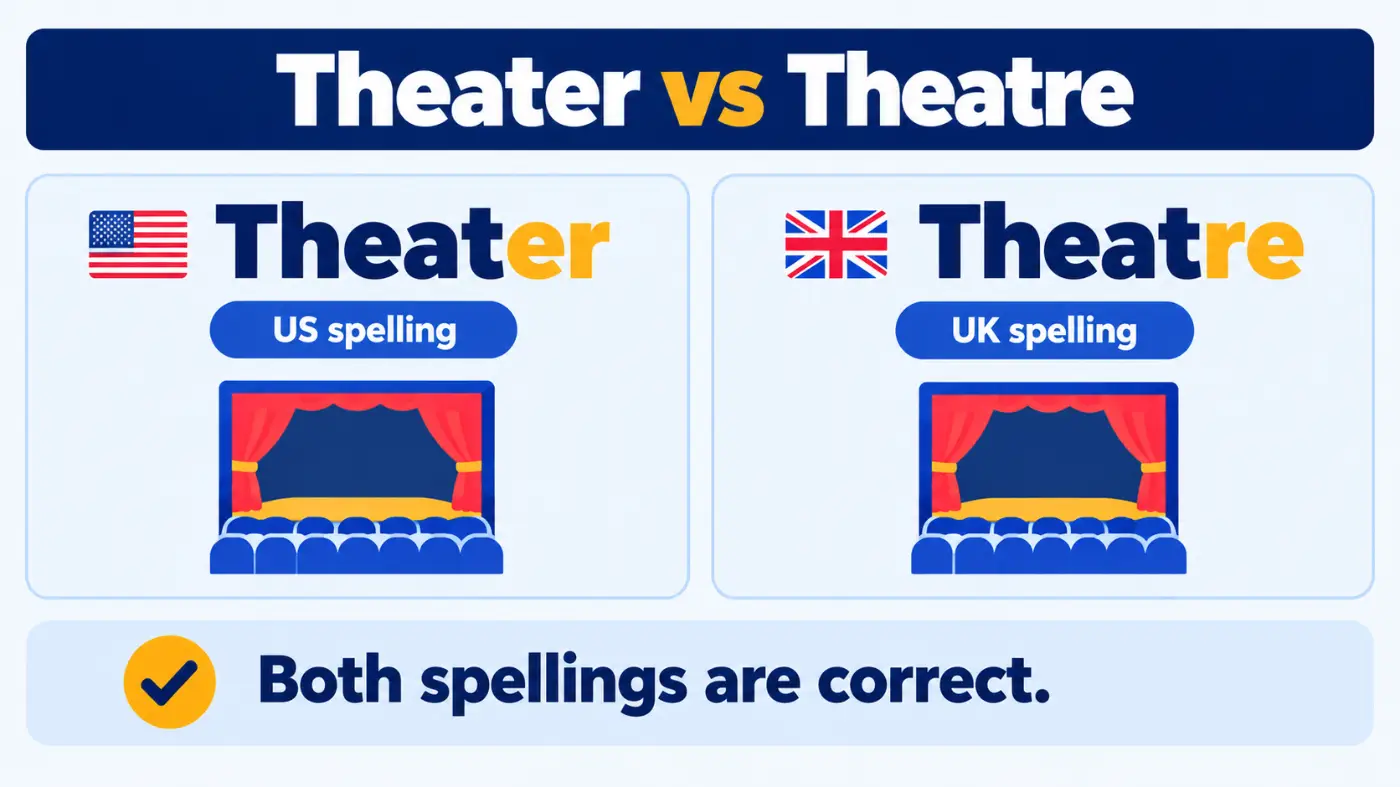
Both spellings are correct. Theater is the standard in American English, and theatre is the standard in British, Canadian, and Australian English. If you’re writing for a US audience, use theater unless you’re naming a venue, company, or department that spells itself with the re ending.
The Short Answer at a Glance
The word is the same and the meaning is the same. Only the spelling shifts with your audience and with the name of the place you’re writing about.
| Form | Where it’s standard | Example |
|---|---|---|
| Theater | United States, for general use. | Mateo bought two tickets at the theater on Cedar Avenue. |
| Theatre | UK, Canada, Australia, and many US proper names. | The Marlow Street Theatre announced its spring lineup. |
What Theater Means and How It Works
Theater is a noun, and it covers four everyday meanings. It can be a building or room where live performances happen, a building where films are shown, the art and profession of staged drama, or a broad area of military action, as in theater of operations.
It also lives inside compound words and set phrases. Think movie theater, home theater, theater kid, and theatergoer. The adjective theatrical and the noun theatrics drop the ending entirely, so the spelling question only affects the base word.
The er ending is the American habit. Noah Webster’s dictionaries helped push American spellings like center and theater away from the French style ending, and those forms became the default in the US. That’s why Americans also write center where British writers write centre.
What Theatre Means and How It Works
Theatre is the same noun with the older, French style ending. It carries every meaning listed above, from the stage to the surgical suite. In the UK, Canada, and Australia, it’s the default spelling in all of them.
The UK adds a small twist. A British speaker usually says cinema for a place that shows films and reserves theatre for live performance. An American says movie theater for the first and just theater for the second.
Some American writers use theatre for the art form and theater for the building. That’s a personal or professional habit, not a rule, and neither major American dictionary treats it as required.
Theater vs Theatre Key Differences Side by Side
| Feature | Theater | Theatre |
|---|---|---|
| Part of speech | Noun. | Noun. |
| Core meaning | Performance venue, movie venue, dramatic art, military area. | Exactly the same meanings. |
| Typical use | General American writing. | UK, Canadian, and Australian writing, plus US proper names. |
| Register | Works at every level of formality. | Works at every level of formality. |
| Example | The school theater holds 400 people. | The Royal Hartley Theatre holds 400 people. |
The table can’t show how much weight a proper name carries. A venue’s own spelling beats any style rule, so a US newspaper that normally writes theater will still print Ford’s Theatre with the re ending. The table also doesn’t capture that these aren’t two words. Nobody who reads theatre in an American blog post will misunderstand it. They’ll just notice the spelling.
Correct Examples in Real Life Contexts
Theater in Action
- Everyday speech: Rosalind drove forty minutes to the only theater in the county that still plays classic films on real reels.
- Workplace writing: Facilities booked the campus theater for Thursday’s all hands meeting.
- Texting: Meet me outside the theater at 6:45 because the trailers run long.
- School: Our professor assigned a paper on how immersive theater changes the way audiences behave.
- Formal writing: The city council approved funding to restore the historic theater downtown and reopen it by next spring.
Theatre in Action
- Proper name: Tickets for Friday’s show at the Marlow Street Theatre sell out within an hour.
- Academic setting: Imani is finishing her bachelor’s degree in theatre and minoring in lighting design.
- UK journalism: The West End revival moved to a larger theatre after a sold out run.
- Canadian workplace email: Please send the program notes to the theatre manager by Friday.
- Formal writing: The Department of Theatre and Dance will hold auditions in the black box studio on Saturday.
Common Mistakes People Make and How to Catch Them
- Mixing spellings for the same general idea. Wrong → Our theater group rehearses at the community theatre. Right → Our theater group rehearses at the community theater. Both words are generic, so they should match unless the building’s official name says otherwise.
- Rewriting a proper name to fit your house style. Wrong → Ford’s Theater. Right → Ford’s Theatre. The venue’s spelling is part of its name, and editors preserve it.
- Misspelling the adjective. Wrong → theaterical. Right → theatrical. The ending drops away when the adjective forms, and typing the base word first causes the slip.
- Spelling by ear. Wrong → theator. Right → theater. The unstressed ending blurs when spoken, so the vowel feels optional.
- Leaving a UK or Canadian language setting on. Wrong → The kids loved the new movie theatre. Right → The kids loved the new movie theater. Autocorrect follows your device’s language, not your audience.
- Switching spellings midway through a long document. Wrong → theater on page one and theatre on page nine for the same building. Right → one spelling throughout. Readers notice inconsistency faster than they notice regional spelling.
A Fast Trick to Choose the Right One
Start with the reader. If your audience is American, write theater. If it’s British, Canadian, or Australian, write theatre. That single check settles most sentences.
Then do a name check. If you’re naming a specific venue, company, or department, copy the spelling from its own sign or website, since that spelling wins.
For a quick memory aid, picture the American version as the one that ends the way it sounds. You hear er at the end, and you type er. The British version keeps the French style flip.
The trick has one limit. It can’t tell you what to do if you’re an American artist who prefers theatre for the craft. That’s a style choice, and you’re free to make it as long as you stay consistent.
How They Sound in Real Situations
A text exchange
Dana: Where are we meeting?
Luis: Outside the theater on Elm. The 7:10 showing is almost full, so grab seats now.
Both uses are generic and American, so theater is correct.
A workplace email
Hi team, the holiday party moves to the Lakeshore Theatre this year. The theater seats 300, so everyone can bring a guest. Parking is behind the building.
The first mention is a proper name and keeps its re ending. The second is a generic reference and takes the American spelling.
An article excerpt
Critics praised the new staging at the Royal Hartley Theatre, where the audience sits on three sides of the stage. Local theatre has rarely felt this alive.
This is British style for both the name and the general noun, so theatre fits.
Formal Writing vs Casual Writing
Register doesn’t change the spelling. Region does. A text message, a term paper, and a news story all follow the same rule for the same audience.
AP style favors theater in general American copy and keeps theatre in proper names. Chicago style generally follows Merriam-Webster, which lists theater first. MLA doesn’t set its own spelling, so follow your instructor or institution and preserve the spelling in titles and sources you cite.
In casual writing, people mostly copy whatever the venue prints on its marquee. That habit is reasonable, and it matches what formal editors do.
US vs UK English Differences
The difference is real and consistent. American English spells it theater, while British, Canadian, and Australian English spell it theatre.
It’s part of a wider pattern of words that end in re in British English and er in American English.
| American | British |
|---|---|
| Theater | Theatre |
| Center | Centre |
| Fiber | Fibre |
| Liter | Litre |
| Somber | Sombre |
Vocabulary shifts alongside spelling. Americans say movie theater where Britons say cinema, and American hospitals have an operating room where British ones have an operating theatre.
Plenty of American venues, companies, and degree programs use theatre in their names. Their choice stays as written, even in American prose.
Related Mix Ups People Also Search For
Theater vs Cinema
Cinema is the usual British word for a movie house, while Americans typically say movie theater. In the US, cinema often appears in business names or when people discuss film as an art form. We’re going to the movies is the casual American phrase.
Theatrical vs Theatrics
Theatrical is an adjective meaning relating to theater or exaggerated in manner. Theatrics is usually a plural noun for over the top behavior. Skip the theatrics and just tell us what happened.
Theatergoer vs Theater Goer
American dictionaries generally treat theatergoer as one word. British writers form theatregoer the same way. Every theatergoer in the front row stood up at the curtain call.
Theater of Operations vs Operating Theater
Theater of operations is a military term for a broad area of action. Operating theater describes a surgical room and is more common in British English. Americans usually say operating room.
Exceptions Edge Cases and Tricky Situations
- Proper names stay as written. Ford’s Theatre and the Shubert Theatre keep the re ending, while Lincoln Center Theater uses er. Match the organization’s own spelling every time.
- A single sentence can legitimately use both spellings. The Lakeshore Theatre is the best theater in town is correct in American English, because one is a name and the other is a general noun.
- Quotations keep the original spelling. If a British source writes theatre, quote it exactly, even in an American essay.
- The craft versus building distinction is optional. Some writers reserve theatre for the art form and theater for the venue. Neither dictionary requires it, so only use it if you apply it consistently.
- Global audiences call for a decision. If your website serves American and British readers, pick one standard and state it in your style guide so every writer follows it.
Quick Practice Test Yourself
Choose the spelling a US editor would use, unless the sentence says otherwise.
- The kids spent Saturday afternoon at the movie ____ downtown.
- In the high school newsletter, the ____ club meets Tuesdays.
- Tickets for the Alder Row ____ go on sale Monday. The venue’s own sign spells it with the re ending.
- A London reviewer wrote about a play at a small ____ in Soho.
- Hendricks State’s official department name is the Department of ____.
- Leo’s cousin in Toronto is studying ____ at a conservatory.
Answer Key
- Theater. It’s a generic American reference to a movie venue.
- Theater. It’s a generic noun in US writing.
- Theatre. The venue’s own sign decides.
- Theatre. It’s a British setting and a British writer.
- Theatre. The official department name uses that spelling.
- Theatre. Canadian English uses the re ending.
Frequently Asked Questions
Is theatre wrong in American English?
No. It’s common in proper names and in some arts and academic settings, though theater is the standard general spelling in the US.
Which spelling should I use in a US business email?
Use theater for general references. Switch to theatre only when you’re naming a venue or company that spells itself that way.
Do theater and theatre mean different things?
No. They’re two spellings of the same word with the same meanings. Any difference in feeling comes from personal habit, not from the dictionary.
Why do some American venues use theatre?
Owners choose how to spell their own names, so the re ending persists on signs and websites. Editors keep that spelling when naming the place.
Is it movie theater or movie theatre?
In American English, it’s movie theater. In British English, people usually say cinema instead.
Does Canada use theatre?
Yes. Canadian English typically uses theatre and centre, though the rest of Canadian spelling can mix American and British habits.

Sophia Bennett writes educational content about English vocabulary, grammar, slang, and communication. She is passionate about making complex language topics accessible to students, professionals, and curious readers around the world.