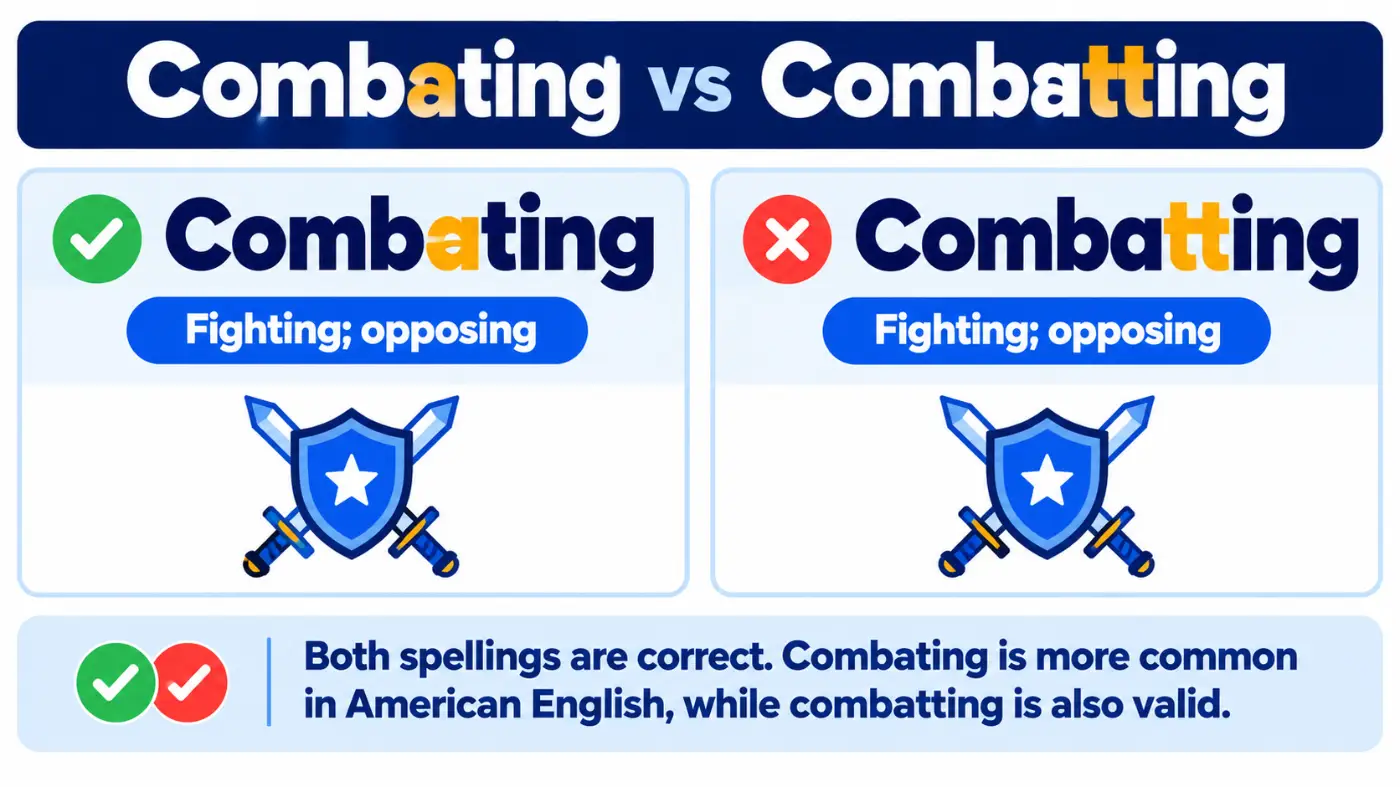
Combating vs Combatting: Which Spelling Is Correct?
Both spellings are correct. Combating, with a single “t,” is the more common form in American English and is generally preferred by US style guides, while combatting, with a doubled “t,” also appears in major dictionaries as an accepted variant.
The Short Answer at a Glance
| Form | Status | What it does | Example |
|---|---|---|---|
| combating | More common, generally preferred in US style | Present participle of combat, describing the act of fighting against something | The city launched a new initiative combating homelessness. |
| combatting | Accepted variant | Identical meaning, doubled “t” | The city launched a new initiative combatting homelessness. |
Both spellings mean exactly the same thing. Combating is the more frequently used and generally recommended form, but combatting isn’t an error.
What Combating Means and How It Works
Combating is the present participle of the verb combat, meaning to fight against, oppose, or actively work to reduce or eliminate something harmful or undesirable. While “combat” as a noun typically refers to literal armed fighting, the verb form extends far beyond warfare, showing up constantly in discussions of public health, crime, climate change, misinformation, and countless other challenges society actively works against.
As a verb, combat is transitive, meaning it takes a direct object: you combat a disease, combat inflation, combat prejudice, or combat climate change. Combating, as the present participle, typically pairs with a form of “to be” to build progressive tenses, as in “the organization is combating food insecurity,” or functions as a gerund, as in “combating misinformation requires a coordinated effort.”
The verb follows this pattern in most American style guides and dictionaries:
- combat (base form)
- combats (third-person present)
- combated (past tense and past participle)
- combating (present participle)
This single-“t” pattern reflects how the word is typically stressed in American English, with emphasis often falling on the first syllable, “COM-bat,” which influences how style guides recommend handling the added suffix.
What Combatting Means and How It Works
Combatting means exactly the same thing as combating: fighting against or actively working to reduce or eliminate something. The definition, grammatical behavior, and typical usage are identical between the two forms.
The doubled “t” spelling reflects a different, also legitimate way of applying English’s consonant-doubling conventions to this particular word. Because “combat” can be pronounced with stress on either the first or second syllable depending on the speaker and context, some style guides and dictionaries treat it similarly to words like “permit” or “refer,” where a final stressed syllable ending in a single vowel and consonant doubles that consonant before “-ing.”
Combatting appears as an accepted variant in several major dictionaries, and it shows up somewhat more frequently in British and international English than in American writing, though it isn’t strictly a US versus UK split the way color versus colour is. Both forms circulate within American English as well, with combating simply being the more statistically common and typically recommended choice.
Grammatically, combatting behaves identically to combating in every respect, functioning as a present participle in progressive tenses and as a gerund in noun-like roles.
Combating vs Combatting: Key Differences Side by Side
| Feature | Combating | Combatting |
|---|---|---|
| Part of speech | Present participle / gerund | Present participle / gerund |
| Core meaning | Fighting against or working to reduce something harmful | Identical meaning |
| Typical use | More common overall, preferred in most US style guides | Accepted variant, somewhat more common internationally |
| Register | Standard in all registers | Standard in all registers |
| Example | The nonprofit focuses on combating illiteracy in rural areas. | The nonprofit focuses on combatting illiteracy in rural areas. |
What the table can’t fully capture is that this isn’t a strict regional split like many other doubled-consonant debates. Both forms appear across American, British, and international English, with combating simply holding a clear edge in frequency and style-guide recommendation, particularly in the United States.
Correct Examples in Real-Life Contexts
Everyday speech
- She’s been combating a nasty cold all week and still made it to work.
- The whole neighborhood got involved in combating the litter problem near the park.
- He’s constantly combating the urge to check his phone during dinner.
- We’re combating the heat with as many fans as we can find.
Workplace writing
- The company launched a new training program combating workplace harassment.
- Our marketing team is combating declining engagement with a revised content strategy.
- HR introduced new policies aimed at combatting burnout across departments.
- The department is combating rising costs by renegotiating supplier contracts.
Texting
- combating this headache with coffee and ibuprofen, wish me luck
- we’re all combatting this group project chaos together lol
School and academic
- The public health course examines strategies for combating the spread of infectious diseases.
- Her thesis explores community-based approaches to combating food insecurity.
- Students debated the effectiveness of various methods for combatting climate change.
- The workshop focused on practical techniques for combating procrastination among college students.
Formal writing
- The agency’s mission centers on combating fraud within the financial sector.
- New legislation aims at combating discrimination in housing and employment.
- The report outlines a comprehensive strategy for combatting cybersecurity threats.
- Public health officials remain focused on combating vaccine misinformation.
Common Mistakes People Make (and How to Catch Them)
Assuming one spelling is simply incorrect
Wrong assumption: Combatting is a misspelling of combating, or vice versa. Right understanding: Both spellings are recognized and correct, with combating being more common and generally preferred, especially in American style guides.
This isn’t a true sentence-level error, but a common misunderstanding, since many similar-looking word pairs do have one clearly wrong form, which leads some writers to assume the same must be true here.
Inconsistent spelling within the same document
Wrong: The report discusses combating inflation in one section and combatting inflation in another. Right: The report consistently uses one spelling throughout.
Since both forms are correct, the real risk is inconsistency rather than outright error, and switching between them mid-document can look like a proofreading oversight.
Ignoring an established style guide’s preference
Wrong: A US-based publication uses combatting throughout, despite its style guide explicitly recommending combating. Right: The publication follows its own style guide consistently, using combating as recommended.
This isn’t a language mistake exactly, but a missed opportunity for consistency, particularly relevant for organizations or publications with formal editorial standards.
Overcorrecting based on a doubling rule that doesn’t universally apply
Wrong assumption: Since occur doubles its final consonant, combat must always do the same. Right understanding: Combat’s stress pattern is less consistent than occur’s, which is exactly why both single and doubled forms have become accepted, unlike occur, which has one clearly correct doubled form.
Writers familiar with reliable doubling rules for words like occur or begin sometimes assume the same strict logic applies universally, but combat’s variable stress pattern is precisely why this word allows more flexibility.
A Fast Trick to Choose the Right One
Default to combating unless you have a specific reason to use combatting, such as matching an existing document’s established style or following a particular publication’s preference. Since combating is the more frequently used and generally recommended form in American English, it’s a safe default in most writing situations.
A helpful check: if your document already follows a specific style guide, such as AP or a company’s internal editorial standards, verify which spelling that guide recommends and apply it consistently throughout your writing.
This trick works well for making a confident, consistent choice, but it has one limit: it won’t tell you which spelling a specific international publication or dictionary might prefer, since acceptance of combatting does vary somewhat by source and region.
How They Sound in Real Situations
A text exchange
Priya: You good? You seem exhausted.
Sam: Yeah, been combating this cold for like a week now.
Priya: Ugh, feel better soon.
Combating works naturally here in casual conversation, and combatting would sound equally natural in the same spot.
A workplace email
Subject: New initiative update
Hi team,
I’m excited to share that our new program combating employee burnout officially launches next month. We’ll be rolling out flexible scheduling options and additional mental health resources as part of this effort.
Best, Renata
Combating fits well here, reflecting the more commonly preferred spelling in professional American business writing.
An article-style excerpt
Public health officials say their latest campaign combating vaccine hesitancy has shown promising early results, with participation rates climbing in several key communities. Experts caution that sustained outreach will be necessary to maintain that progress.
Combating works naturally here in a journalistic context, matching the more common American spelling convention.
Formal Writing vs Casual Writing
Both spellings are acceptable across formal and casual writing, so this isn’t fundamentally a matter of register. What matters more is consistency and, where applicable, adherence to a specific style guide.
In formal writing, particularly in American journalism, government documents, and academic publishing, combating is the more commonly recommended and encountered form. In casual writing and conversation, either form typically passes without any real notice, since most readers process both spellings as correct without hesitation.
AP style generally favors combating, and most major American dictionaries list it as the primary form while still recognizing combatting as an acceptable variant.
Related Mix-Ups People Also Search For
Combat vs Combative
Combat is the base verb or noun referring to fighting or actively opposing something, while combative is an adjective describing someone or something prone to conflict or argument. Example: His combative attitude made it harder for the team to focus on actually combating the real problem.
Combating vs Fighting
These two overlap closely in meaning, though “combating” often carries a slightly more formal or structured tone, frequently used in institutional or policy contexts, while “fighting” feels more general and everyday. Example: The city is combating rising crime rates through a mix of community policing and fighting root causes like poverty.
Occur vs Combat (Doubling Rule Comparison)
Occur reliably doubles its final consonant before “-ing” because of its consistent stress pattern, while combat’s more variable stress pattern is exactly why both combating and combatting are considered acceptable. Example: Officials are combating the issue as new incidents keep occurring across the region.
Quick Practice: Test Yourself
Both spellings are correct in each of these sentences; choose whichever fits the described context.
- A US government press release describes new funding for ______ opioid addiction. (combating / combatting)
- A British news article discusses the country’s strategy for ______ inflation. (combating / combatting)
- An American style guide’s recommended spelling appears in a sentence about ______ misinformation. (combating / combatting)
- An international health organization’s report focuses on ______ malnutrition. (combating / combatting)
- A US-based nonprofit’s mission statement mentions ______ homelessness. (combating / combatting)
- A casual blog post talks about ______ everyday stress. (combating / combatting)
Answer Key
- combating: matches the more common American spelling convention.
- combatting: fits comfortably in British or international writing, though combating would also work.
- combating: matches the form most US style guides recommend.
- combatting: acceptable in international contexts, though combating remains more common overall.
- combating: matches typical American nonprofit and institutional writing.
- combating: works naturally in casual writing, though combatting is equally acceptable.
Frequently Asked Questions
Is combating or combatting the correct spelling?
Both are correct. Combating, with a single “t,” is more common and generally preferred in American English, while combatting, with a doubled “t,” is also recognized as an accepted variant.
Do combating and combatting mean the same thing?
Yes. Both words describe the act of fighting against or working to reduce or eliminate something harmful or undesirable, with no difference in meaning.
Why does combat have two accepted spellings for its “-ing” form?
Combat can be stressed on either syllable depending on the speaker and context, and this variable stress pattern is why English allows both the single and doubled consonant forms, unlike words with a more consistent stress pattern.
Which spelling should I use in American writing?
Combating is generally the safer, more commonly recommended choice for American writing, particularly in journalism and formal documents following AP style.
Is one spelling more correct than the other?
No. Neither spelling is more accurate or more official than the other. Combating is simply more frequent and more often recommended, while combatting remains a legitimate, dictionary-recognized alternative.
Can I use combating and combatting interchangeably in the same document?
It’s best to choose one and use it consistently throughout a single document, since mixing the two can look inconsistent even though both are individually correct.

Sophia Bennett writes educational content about English vocabulary, grammar, slang, and communication. She is passionate about making complex language topics accessible to students, professionals, and curious readers around the world.