Flaky vs Flakey: Which Spelling Is Correct?
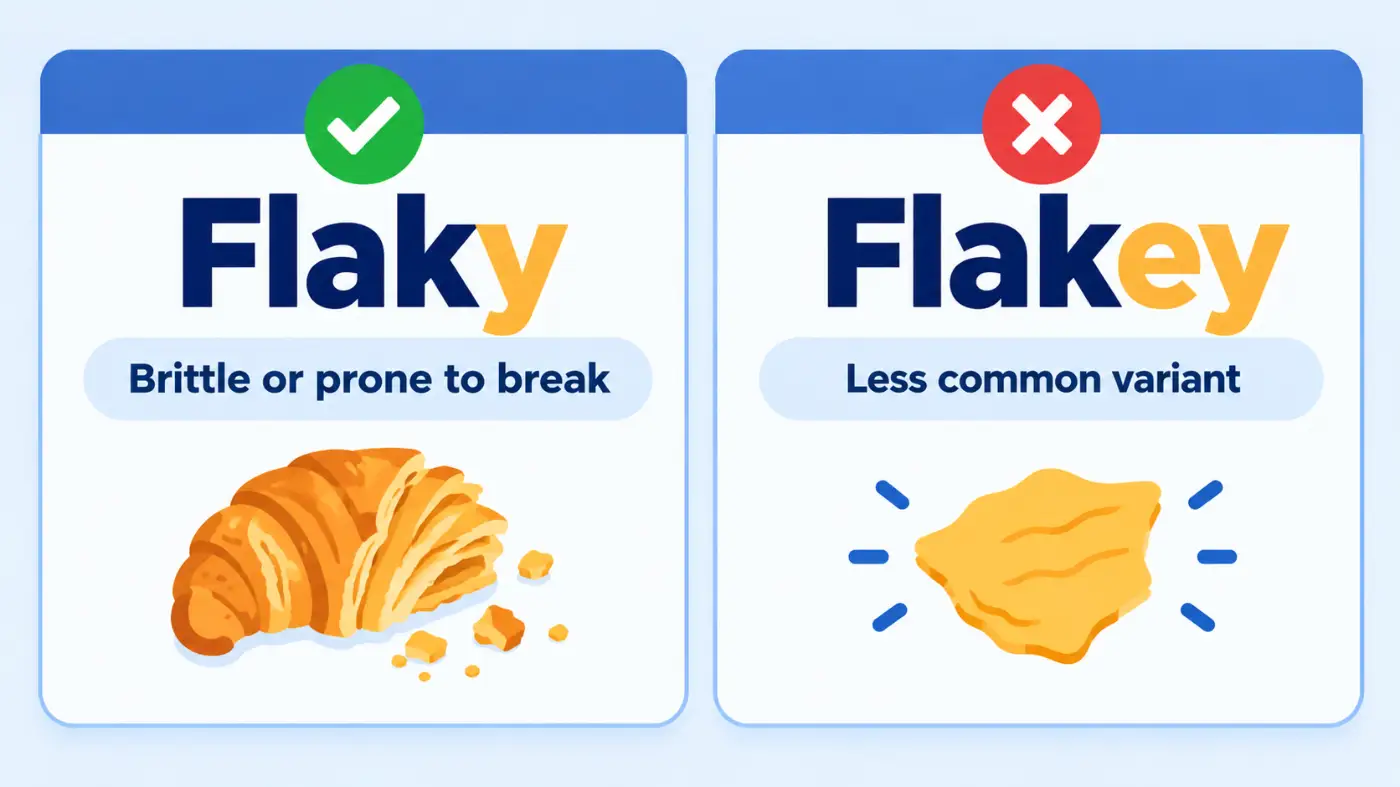
Flaky is the standard, more widely accepted spelling in modern English. Flakey does appear as a secondary variant in some dictionaries, but it’s far less common, and flaky is the safer choice in almost every situation.
The Short Answer at a Glance
| Form | Status | What it does | Example |
|---|---|---|---|
| flaky | Standard spelling | Describes something that breaks into flakes, or informally describes unreliable behavior | The pie crust turned out perfectly flaky this time. |
| flakey | Less common variant | Same meaning, occasionally listed as an accepted alternate spelling | Some older cookbooks describe pastry as flakey instead. |
Both spellings share the same meaning. Flaky is overwhelmingly more common in print, branding, and everyday writing, so it’s the better default choice.
What Flaky Means and How It Works
Flaky is an adjective with two main uses. The first, more literal sense describes something that separates into thin layers or flakes, like a buttery pastry, dry skin, or old peeling paint. The second, more figurative and informal sense describes a person who is unreliable, prone to canceling plans, or difficult to depend on.
In cooking and baking, flaky is a prized quality. A flaky biscuit or a flaky pie crust has thin, distinct layers that separate easily when broken apart, usually the result of cold fat being worked into dough in a particular way. This use is entirely positive and descriptive, with no negative connotation at all.
The informal sense of flaky, describing a person’s behavior, carries a mildly critical tone. Calling someone flaky suggests they frequently back out of commitments, show up late, or can’t be counted on to follow through. This usage is casual and conversational, showing up far more in speech and informal writing than in formal documents.
Grammatically, flaky functions as a standard adjective, appearing before a noun (“a flaky crust”) or after a linking verb (“the crust is flaky”). It also has comparative and superlative forms: flakier and flakiest, following the regular pattern for short adjectives ending in “y.”
The word is built from “flake,” the noun describing a small, thin piece that separates from a larger surface, plus the adjective-forming suffix “-y.” That suffix is exactly where the spelling question comes from, since English sometimes adds “-y” directly and sometimes inserts an extra “e” first, depending on the specific word.
Is “Flakey” Ever Correct?
Yes, though it’s the less common of the two spellings. Flakey appears in some dictionaries as a secondary or variant spelling of flaky, rather than as an outright error. That puts it in a different category from a true misspelling like “recieve” for “receive,” which has no legitimate standing at all.
The reason flakey exists as a variant likely comes from an inconsistency in how English handles adjectives formed from words ending in a silent “e” combined with the “-y” suffix, or from words that already end in similar sounds. English doesn’t have one single rule that predicts whether an extra “e” gets inserted before “-y,” so occasional double spellings like this persist for certain words.
Despite being a recognized variant, flakey is used far less often in professional writing, product descriptions, recipes, and everyday communication. Most major style guides, cookbooks, and publications default to flaky, and readers are far more accustomed to seeing that version.
Because flakey isn’t wrong exactly, but is genuinely uncommon, it occupies a middle ground: not an error to be corrected the way a true misspelling would be, but also not the spelling most writers should reach for by default.
Flaky vs Flakey: Key Differences Side by Side
| Feature | Flaky | Flakey |
|---|---|---|
| Part of speech | Adjective | Adjective |
| Core meaning | Breaking into flakes; informally, unreliable | Identical meaning |
| Typical use | Cooking, skincare, everyday conversation, branding | Occasional appearance in older or informal writing |
| Register | Standard in all registers | Acceptable but uncommon |
| Frequency | Dominant spelling in modern usage | Rare by comparison |
| Example | The croissant had a wonderfully flaky texture. | The croissant had a wonderfully flakey texture. |
What the table can’t fully capture is just how lopsided the usage actually is. This isn’t a fifty-fifty regional split like color versus colour. Flaky is the spelling you’ll see in the vast majority of recipes, product labels, and everyday writing, with flakey showing up only occasionally, often in older texts or more casual, informal contexts.
Correct Examples in Real-Life Contexts
Everyday speech
- My skin gets really flaky in the winter if I don’t moisturize.
- He’s kind of flaky about weekend plans, so don’t count on him showing up.
- This croissant is so flaky it practically falls apart when you pick it up.
- The paint on that old fence has gone completely flaky and needs to be redone.
Workplace writing
- The vendor has been flaky about delivery timelines, which is delaying the project.
- Our new pastry line features an extra flaky, buttery crust.
- Please avoid scheduling calls with contractors who’ve been flaky in the past.
- The product description highlights the cracker’s light, flaky texture.
Texting
- ugh he’s being so flaky about tonight, might just cancel on us
- this fish flakes apart so easily, super flaky and moist
School and academic
- The chemistry lab described the mineral sample as having a flaky, layered structure.
- Her essay on unreliable friendships humorously described one roommate as endlessly flaky.
- The culinary school’s baking unit focuses heavily on achieving a flaky pastry texture.
- Geology students examined how certain rock types naturally form flaky layers over time.
Formal writing
- The dermatology report noted flaky, irritated skin as a common symptom of the condition.
- Consumer reviews frequently praise the product’s flaky, tender texture.
- The contractor’s flaky performance history was cited as grounds for terminating the agreement.
- Inspectors noted flaky paint as a safety concern in the building’s exterior assessment.
Common Mistakes People Make (and How to Catch Them)
Assuming flakey is simply wrong
Wrong assumption: Flakey is a misspelling with no legitimate use at all. Right understanding: Flakey is a recognized but uncommon variant spelling, not a true error like a typo.
This isn’t really a mistake in the sentence-writing sense, but a misunderstanding worth clearing up, since some writers over-correct flakey as if it were as wrong as a completely nonstandard spelling.
Inconsistent spelling within the same document
Wrong: The recipe describes the crust as flaky in one paragraph and flakey in another. Right: The recipe consistently uses flaky throughout.
Since both spellings are technically valid, the real risk is inconsistency rather than outright error. Switching between them mid-document looks like a proofreading oversight.
Overusing the informal sense in professional writing
Wrong: The client has been extremely flaky, so we’re pausing the project. (in a formal legal or contractual document) Right: The client has failed to meet agreed-upon deadlines on multiple occasions, so we’re pausing the project.
This isn’t a spelling issue, but a register mismatch. The informal, personality-describing sense of flaky can feel too casual for strictly formal or legal writing, where more neutral phrasing often fits better.
Confusing the adjective with the unrelated noun “flake”
Wrong: He’s such a flakey, always flaking on plans. (redundant or awkward phrasing) Right: He’s such a flake, always canceling on plans.
Writers sometimes double up on related word forms unnecessarily. “Flake” as a noun already describes an unreliable person informally, so pairing it with “flakey” in the same sentence can feel repetitive.
A Fast Trick to Choose the Right One
Default to flaky unless you have a specific reason to do otherwise. Since flaky is overwhelmingly the more common and expected spelling, choosing it by default will be correct in the vast majority of writing situations, professional or casual.
A helpful comparison: think of other short adjectives built the same way, like “shaky” and “leaky.” Both are spelled without an extra “e,” following the same pattern as flaky. If you already spell those correctly without hesitation, applying that same pattern to flaky will serve you well.
This trick works reliably for everyday writing, but it has one limit: if you’re editing an older text, a direct quote, or a specific brand name that intentionally uses flakey, you should preserve that original spelling rather than changing it to match the more common form.
How They Sound in Real Situations
A text exchange
Priya: Are we still doing brunch Sunday?
Jordan: Yeah, though Marco’s being flaky again, so who knows if he’ll show.
Priya: Typical Marco.
Flaky is correct here, used in its informal sense describing unreliable behavior.
A workplace email
Subject: Vendor concerns for Q3 launch
Hi team,
I wanted to flag that our packaging supplier has been fairly flaky with delivery updates lately. We may want to explore a backup option before the launch date gets closer.
Best, Renata
Flaky fits naturally here, describing inconsistent, unreliable vendor communication in a business context.
An article-style excerpt
The bakery’s signature croissant has developed a cult following for its impossibly flaky layers, achieved through a labor-intensive lamination process repeated dozens of times. Customers routinely line up before opening just to get one fresh from the oven.
Flaky is the natural choice here, describing the literal texture of the pastry.
Formal Writing vs Casual Writing
Both spellings are technically acceptable across registers, but flaky is strongly preferred in formal, professional, and published writing of every kind, from cookbooks to business reports. Flakey shows up occasionally in more casual or older writing, but it’s rarely the expected choice in anything meant for a wide audience.
The literal sense of flaky, describing texture or physical layering, appears comfortably in both formal and casual contexts, from dermatology reports to grandma’s pie recipe. The informal sense, describing an unreliable person, tends to stay firmly in casual speech, texting, and conversational writing, and it’s generally avoided in formal or legal documents in favor of more precise, neutral language.
Major style guides don’t specifically call out flakey as incorrect, but in practice, published style consistently favors flaky as the standard form.
Related Mix-Ups People Also Search For
Flaky vs Flake (Noun vs Adjective)
Flake is the noun describing a small, thin piece separated from a larger surface, or informally, an unreliable person. Flaky is the adjective form describing something that has that quality. Example: One flake of pastry fell onto the plate, a fitting preview of just how flaky the whole croissant turned out to be.
Shaky vs Shakey
This pair mirrors the flaky versus flakey situation closely. Shaky is the standard spelling describing something unsteady or trembling, while “shakey” is a much rarer, generally discouraged variant. Example: Her hands were a little shaky after the flaky pastry crumbled all over the counter.
Leaky vs Leakey
Leaky, describing something that allows liquid or gas to escape, follows the identical spelling pattern as flaky, without an inserted “e.” “Leakey” isn’t a standard variant the way flakey sometimes is, making leaky the clearly preferred and expected spelling. Example: The old faucet was leaky, and the pie crust was flaky, making for an oddly fitting kitchen disaster of a morning.
Exceptions, Edge Cases, and Tricky Situations
Brand names and proper nouns
Some product names or brand identities may intentionally use “flakey” as a stylistic choice, and in those cases, the brand’s chosen spelling should be preserved exactly as presented, regardless of which spelling is more common in general usage.
Direct quotations and historical texts
If you’re quoting an older text, a historical document, or a direct quote that uses flakey, it should be preserved exactly as written, since changing a direct quotation’s spelling would misrepresent the original source.
Quick Practice: Test Yourself
Choose the spelling that best fits standard modern usage for each blank.
- The pastry chef achieved an incredibly ______ texture using cold butter. (flaky / flakey)
- He’s been so ______ about our plans lately that I stopped making them with him. (flaky / flakey)
- The old paint on the porch railing had turned ______ and needed sanding. (flaky / flakey)
- My skin gets noticeably ______ during the colder months. (flaky / flakey)
- The recipe promises a light, ______ biscuit if the dough is handled gently. (flaky / flakey)
- Reviewers consistently describe the fish as tender and ______ once cooked. (flaky / flakey)
Answer Key
- flaky: the standard spelling, appropriate in a professional culinary context.
- flaky: correct in the informal sense describing unreliable behavior.
- flaky: standard spelling describing physical texture.
- flaky: standard spelling in a skincare context.
- flaky: the expected spelling in recipe and cooking writing.
- flaky: standard spelling, matching typical usage in product or food reviews.
Frequently Asked Questions
Is flakey a misspelling of flaky?
Not exactly. Flakey is a recognized but uncommon variant spelling in some dictionaries, rather than an outright error, though flaky is by far the more widely used and expected form.
Which spelling should I use in professional writing?
Flaky is the safer, more standard choice in professional, published, and formal writing, since it’s the spelling readers expect to see.
Does flaky always describe food?
No. Flaky can describe any material that separates into thin layers, such as skin, paint, or minerals, and it also has an informal meaning describing an unreliable person.
Is calling someone “flaky” rude?
It can carry a mildly critical or teasing tone, since it implies unreliability, but it’s generally used casually among friends rather than as a harsh insult.
Are there regional differences between flaky and flakey, like US versus UK spelling?
No consistent regional pattern exists between the two spellings the way it does for words like color and colour. Flaky is generally preferred in both American and British English.
What’s the comparative form of flaky?
The comparative form is flakier, and the superlative form is flakiest, following the standard pattern for short adjectives ending in “y.”

Sophia Bennett writes educational content about English vocabulary, grammar, slang, and communication. She is passionate about making complex language topics accessible to students, professionals, and curious readers around the world.