Themself vs Theirself: Which One Is Correct?
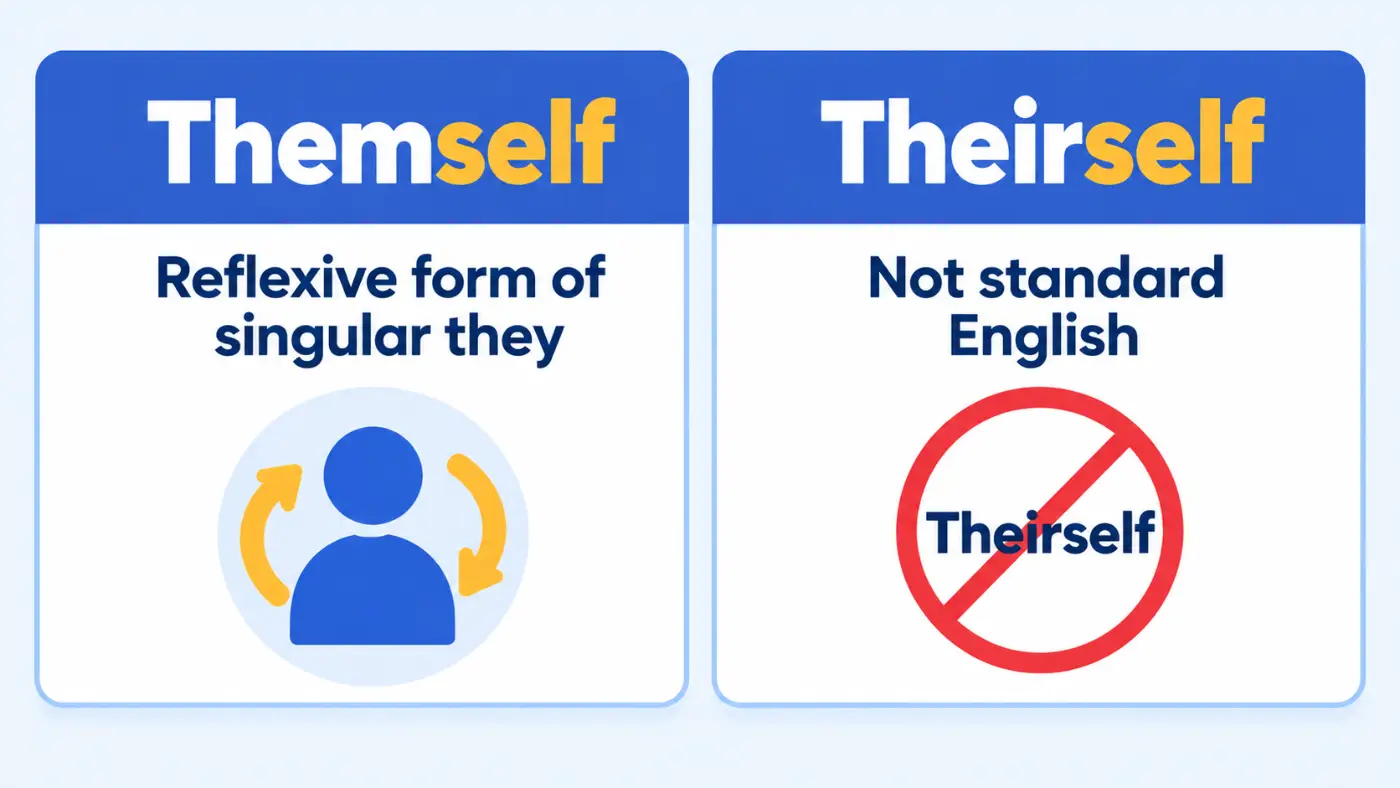
Themself is increasingly accepted as the reflexive form of singular “they,” especially when referring to one specific person whose gender isn’t specified or who uses they/them pronouns. Theirself isn’t standard English in any context and is generally considered incorrect.
The Short Answer at a Glance
| Form | Status | What it does | Example |
|---|---|---|---|
| themself | Increasingly accepted | Reflexive pronoun for singular “they,” referring to one person | The new hire introduced themself at the team meeting. |
| theirself | Nonstandard | Not accepted in any standard English context | Avoid it; use themself or themselves instead. |
If you’re using singular “they” to refer to one specific person, themself is the emerging standard reflexive form. Theirself isn’t used by careful writers in any register.
What Themself Means and How It Works
Themself is a reflexive pronoun, used when the subject and object of a sentence refer to the same person, in cases where that person is referred to with singular “they.” It functions the same way “himself” and “herself” do, but for situations where the speaker doesn’t know, doesn’t specify, or doesn’t want to specify the person’s gender, or when the person uses they/them pronouns themselves.
Singular “they” itself has a long history in English, used for centuries when someone’s gender is unknown or irrelevant, as in “somebody left their umbrella here.” Themself extends that same logic into the reflexive case, matching the singular meaning of “they” in that specific sentence with a singular-feeling reflexive form, rather than the plural-sounding “themselves.”
Grammatically, themself fills a real gap in English. Until relatively recently, writers using singular “they” had only “themselves” available as a reflexive option, which can feel grammatically mismatched when referring to just one person, since “selves” is plural in form. Themself resolves that mismatch, aligning the reflexive pronoun’s singular appearance with its singular meaning.
Usage has shifted substantially in recent years, with themself appearing more frequently in style guides, published writing, and everyday communication, particularly as awareness and usage of singular “they” as a personal pronoun has grown. Major dictionaries have increasingly recognized themself as a standard entry, reflecting this real and ongoing shift in accepted usage.
Is “Theirself” Ever Correct?
No. Theirself isn’t considered standard English in any recognized context, register, or dialect represented in mainstream usage guides. It differs meaningfully from themself, which has a clear, functional grammatical role and growing acceptance.
The confusion between the two likely arises because both words attempt to solve the same underlying problem: finding a singular-feeling reflexive form to pair with singular “they.” But English reflexive pronouns are built from possessive or objective pronoun forms plus “-self” or “-selves,” and that pattern points toward themself, not theirself, as the form that fits.
Compare the pattern across existing reflexive pronouns: he becomes himself (not hisself), she becomes herself, and they becomes themself, following the objective pronoun “them” rather than the possessive form “their.” Theirself breaks this established pattern by attaching “-self” to the possessive “their” instead of the objective “them,” which is exactly why it doesn’t align with how English reflexive pronouns are actually built.
While theirself does occasionally appear in some regional or dialectal speech, it isn’t recognized as standard English by major dictionaries or style guides, and careful writers avoid it in formal and most informal writing alike.
Themself vs Theirself: Key Differences Side by Side
| Feature | Themself | Theirself |
|---|---|---|
| Recognized word | Yes, increasingly | No, not in standard English |
| Part of speech | Reflexive pronoun | Not applicable in standard usage |
| Core meaning | Reflexive form of singular “they” | No standard meaning |
| Typical use | Referring to one person whose gender is unspecified or who uses they/them | Appears only in nonstandard speech or as an error |
| Register | Increasingly accepted in both formal and informal writing | Never standard, in any register |
| Example | Everyone should bring themself a water bottle for the hike. | Everyone should bring theirself a water bottle for the hike. (nonstandard) |
The table makes the distinction look simple, but what it can’t fully capture is how differently these two words are actually treated. Themself is a word genuinely in the process of gaining broader acceptance, appearing increasingly in dictionaries and style guides, while theirself has no comparable momentum or recognition behind it at all.
Correct Examples in Real-Life Contexts
Everyday speech
- Whoever finishes first can reward themself with the last slice of pizza.
- My coworker prefers to introduce themself using they/them pronouns.
- If anyone wants extra credit, they’ll need to challenge themself with the harder assignment.
- The new volunteer seemed a little nervous introducing themself to the group.
Workplace writing
- Each team member should set themself a realistic deadline for the project phase.
- The employee requested that we refer to them and themself using gender-neutral language throughout the review.
- Anyone submitting a proposal should familiarize themself with the updated formatting guidelines.
- The new manager introduced themself during Monday’s all-hands meeting.
Texting
- lol they really outdid themself with that last meme
- tell your friend to treat themself to something nice after finals
School and academic
- Each student should challenge themself to try a new research method this semester.
- The professor asked that anyone presenting introduce themself briefly beforehand.
- A strong writer often pushes themself to revise beyond the first draft.
- The study examines how individuals describe themself when gender identity isn’t specified.
Formal writing
- Any applicant who believes they qualify for an exemption should identify themself in writing.
- The policy requires that each participant register themself individually before the event.
- A whistleblower may choose not to identify themself during the initial report.
- The organization encourages every member to hold themself accountable to the shared code of conduct.
Common Mistakes People Make (and How to Catch Them)
Using “theirself” instead of “themself”
Wrong: Anyone who wants to volunteer should sign theirself up by Friday. Right: Anyone who wants to volunteer should sign themself up by Friday.
This is the core error. Writers reach for “their” because it feels like the natural possessive match for singular “they,” without realizing reflexive pronouns are built from objective forms, not possessive ones.
Defaulting to “themselves” even when referring to one specific person
Not necessarily wrong, but worth distinguishing: Whoever left this bag should come collect themselves. Often preferred when referring to one individual: Whoever left this bag should come collect themself.
“Themselves” remains widely used and accepted, especially in more general or hypothetical statements, but many writers now prefer “themself” specifically when referring to one known, specific individual, particularly someone who uses they/them pronouns personally.
Applying “hisself” logic to “theirself”
Wrong: She told hisself and theirself to wait outside. Right: She told himself and themself to wait outside.
“Hisself” is itself a widely recognized nonstandard form, and “theirself” follows that same flawed pattern, attaching “-self” to a possessive pronoun rather than the correct objective form.
Assuming themself is always interchangeable with themselves
Wrong assumption: Themself and themselves mean exactly the same thing in every context, so either works anywhere. Right understanding: Themself specifically pairs with singular “they” referring to one person, while themselves pairs with plural “they” referring to multiple people, or is used more generally.
Context determines which form fits: “The students should challenge themselves” refers to multiple people, while “The student should challenge themself” refers to one.
A Fast Trick to Choose the Right One
Look at the pattern used by other reflexive pronouns you already know are correct: himself, herself, itself. Each one is built from the objective pronoun (him, her, it) plus “-self,” not from the possessive form (his, her, its). Themself follows that exact same pattern, built from “them,” the objective form of “they.”
A second trick: ask whether you’re referring to one specific person or multiple people. If it’s one person, and you’re using singular “they,” themself is the increasingly standard choice. If you’re referring to more than one person, themselves remains the correct and only option.
This trick reliably rules out theirself, since it never fits the established reflexive pronoun pattern. Its only limitation is that some writers and style guides still prefer themselves even for singular “they,” so themself, while increasingly accepted, isn’t yet universally required.
How They Sound in Real Situations
A text exchange
Priya: Did the new intern introduce themself yet?
Jordan: Yeah, super friendly, seems great so far.
Priya: Nice, I’ll stop by and say hi later.
Themself is correct here, referring to one specific person using singular “they.”
A workplace email
Subject: New team member starting Monday
Hi everyone,
Please join me in welcoming our newest team member, who will introduce themself during Monday’s stand-up. Feel free to reach out directly with any questions beforehand.
Thanks, Renata
Themself is correct because the email refers to one individual whose pronouns are being respected through singular “they.”
An article-style excerpt
The author explained that they wanted readers to see themself reflected in the story’s main character, regardless of gender identity. Critics have praised the novel’s inclusive approach to representation.
Themself is correct here, used in a formal, published context referring to an individual reader in a general, singular sense.
Formal Writing vs Casual Writing
Themself has moved steadily from informal, conversational use into more formal and published writing, reflecting its growing dictionary recognition. Many major style guides, including those used in journalism and academic publishing, now accept themself as appropriate when referring to one specific person using singular “they,” particularly in contexts involving gender-neutral language or respecting an individual’s stated pronouns.
Theirself, by contrast, doesn’t appear as an accepted option in any formal or informal style guide, and its use in writing of any kind is generally considered a straightforward error rather than a stylistic or register-based choice.
Some conservative formal writing contexts may still prefer “themselves” even when referring to one person, particularly in older institutional style guides that haven’t yet updated to reflect themself’s growing acceptance, so checking a specific publication’s current guidance remains worthwhile.
Related Mix-Ups People Also Search For
Himself vs Hisself
This pair offers a useful parallel to themself versus theirself, since hisself follows the same flawed possessive-based pattern as theirself and is similarly considered nonstandard. Example: He reminded himself, not hisself, to double-check the numbers before submitting the report.
Themselves vs Themself
These two aren’t simply interchangeable, since themselves pairs with plural “they” or general statements, while themself increasingly pairs specifically with singular “they” referring to one person. Example: The committee members introduced themselves individually, and the newest member introduced themself last.
Singular They vs Plural They
Understanding this broader distinction helps clarify when themself fits best, since themself specifically supports the singular use of “they” referring to one person. Example: Someone left their jacket here, and they’ll probably want it back for themself before the weekend.
Exceptions, Edge Cases, and Tricky Situations
Older style guides and institutional preferences
Some long-established style guides and institutions have not yet updated their guidance to reflect themself’s growing acceptance, and may still specify “themselves” even for singular “they.” This reflects institutional lag rather than themself being incorrect.
Regional and dialectal use of theirself
In certain regional or dialectal speech patterns, theirself does appear, though it remains outside standard English as recognized by major dictionaries and style guides, and it isn’t recommended for formal, academic, or professional writing.
Quick Practice: Test Yourself
Choose the correct word for each blank.
- Whoever finishes the race first should treat ______ to a nice dinner. (themself / theirself)
- The new employee introduced ______ during the team meeting. (themself / theirself)
- The students were asked to introduce ______ one by one. (themselves / theirself)
- Anyone who needs accommodations should identify ______ to HR directly. (themself / theirself)
- He reminded ______ to double-check the figures before sending the report. (himself / hisself)
- The committee members each presented ______ individually. (themselves / theirself)
Answer Key
- themself: refers to one specific person using singular “they.”
- themself: refers to one individual introducing themselves to the group.
- themselves: refers to multiple students, so the plural reflexive form applies.
- themself: refers to one unspecified individual in a formal context.
- himself: the correct reflexive form, following the objective pronoun pattern.
- themselves: refers to multiple committee members collectively.
Frequently Asked Questions
Is themself a real, accepted word?
Yes, increasingly so. Themself is now recognized by many major dictionaries and style guides as the reflexive form of singular “they,” particularly when referring to one specific person.
Is theirself ever correct?
No. Theirself isn’t accepted as standard English in any recognized context, register, or major style guide.
What’s the difference between themself and themselves?
Themself is increasingly used specifically for singular “they,” referring to one person, while themselves is used for plural “they,” referring to multiple people, or in more general statements.
Why does theirself seem like it should be correct?
Theirself seems intuitive because “their” is the possessive form of “they,” but English reflexive pronouns are built from objective pronoun forms, like “them,” not possessive ones, which is why themself fits the pattern and theirself doesn’t.
Should I use themself in formal writing?
In most modern style guides, yes, particularly when referring to a specific individual using singular “they.” Some older or more conservative institutional guides may still prefer “themselves,” so checking specific guidance is worthwhile.
Is “hisself” similar to “theirself”?
Yes. Both follow the same nonstandard pattern of attaching “-self” to a possessive pronoun rather than the correct objective form, which is why neither is considered standard English.

Sophia Bennett writes educational content about English vocabulary, grammar, slang, and communication. She is passionate about making complex language topics accessible to students, professionals, and curious readers around the world.