Dwarfs vs Dwarves: Which Plural Is Correct?
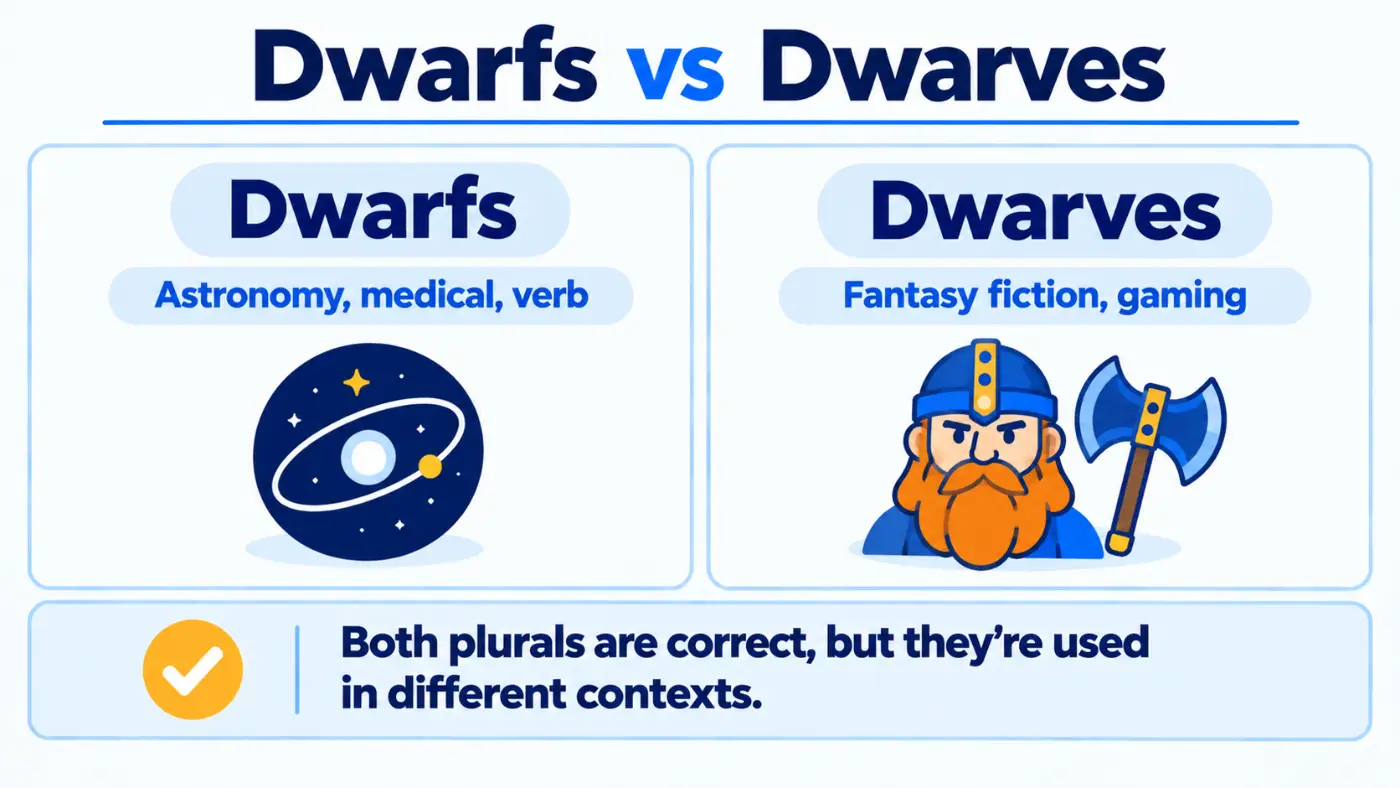
Both plurals are correct, but they tend to show up in different contexts. Dwarfs is the more traditional, general-purpose plural, commonly used for astronomy, medical contexts, and the verb form, while dwarves has become strongly associated with fantasy fiction and gaming, where it’s now the dominant spelling.
The Short Answer at a Glance
| Form | Typical use | Core meaning | Example |
|---|---|---|---|
| dwarfs | General use, astronomy, verb form | Plural of dwarf; also the verb meaning to make seem small | The night sky revealed several white dwarfs through the telescope. |
| dwarves | Fantasy fiction, gaming | Plural of dwarf, specifically in a fantasy context | The dwarves in the story guarded an ancient mountain fortress. |
Both plurals describe more than one dwarf, but which one fits best often depends on whether you’re writing about fantasy creatures or using the word in a general, scientific, or everyday sense.
What Dwarfs Means and How It Works
Dwarfs is the traditional plural of the noun dwarf, following the regular English pattern of simply adding “s” to form a plural. It’s also, importantly, the correct form of dwarf used as a verb, as in “the skyscraper dwarfs every other building downtown.”
As a noun, dwarf has historically referred to a person of unusually short stature, often due to a medical or genetic condition, and this remains a standard general-use meaning. In astronomy, dwarf refers to smaller-than-typical celestial bodies, as in white dwarfs, red dwarfs, or dwarf planets, and dwarfs is the standard plural used consistently across scientific writing.
Grammatically, dwarfs functions as a standard plural noun in these general and scientific contexts: several dwarfs, two red dwarfs, the dwarfs in the study. As a verb, dwarf conjugates regularly:
- dwarf (base form)
- dwarfs (third-person present)
- dwarfed (past tense and past participle)
- dwarfing (present participle)
This verb form, describing the act of making something seem small by comparison, always uses “dwarfs,” never “dwarves,” regardless of context, since the verb and the alternate plural noun spelling never overlap.
What Dwarves Means and How It Works
Dwarves means exactly the same thing as dwarfs when referring to more than one dwarf, but it has become strongly associated with a specific context: fantasy fiction, folklore-inspired storytelling, and gaming, where dwarves are typically portrayed as a distinct, often stocky and skilled race of beings, frequently connected to mining, craftsmanship, or warfare.
This particular spelling gained significant popularity through influential fantasy literature in the twentieth century, and it has since become the standard, expected plural within fantasy genres specifically. Many popular fantasy novels, tabletop games, and video games now use dwarves consistently when referring to this type of fictional race, reinforcing the spelling as the genre’s conventional choice.
Grammatically, dwarves behaves exactly like dwarfs in every respect when used as a noun: several dwarves, an army of dwarves, the dwarves’ ancient stronghold. The key distinction isn’t grammatical at all, but contextual, since dwarves has effectively carved out its own specialized niche within a particular genre of writing.
It’s worth noting that dwarves is not used as a verb form. Only “dwarfs” functions that way, meaning even within fantasy writing, a sentence like “the mountain dwarfs the nearby hills” would still use “dwarfs,” not “dwarves,” since that’s a completely separate grammatical function.
Dwarfs vs Dwarves: Key Differences Side by Side
| Feature | Dwarfs | Dwarves |
|---|---|---|
| Part of speech | Plural noun; also present-tense verb | Plural noun only |
| Core meaning | More than one dwarf (general/scientific); to make seem small (verb) | More than one dwarf, specifically in fantasy contexts |
| Typical use | Astronomy, medical contexts, general writing, the verb form | Fantasy fiction, tabletop games, video games |
| Register | Standard in scientific and general writing | Standard within fantasy and gaming genres |
| Example | Scientists discovered three new dwarf planets, now officially classified as dwarfs. | The dwarves spent generations building their underground city. |
What the table can’t fully capture is how clearly genre-driven this distinction has become. Outside of fantasy contexts, dwarfs remains the default, general-purpose plural, but within fantasy writing specifically, dwarves has become so thoroughly standard that using “dwarfs” there can actually read as unusual or even incorrect to genre readers, despite both spellings being accepted by major dictionaries.
Correct Examples in Real-Life Contexts
Everyday speech
- The skyscraper absolutely dwarfs every building around it downtown.
- My little garden gnomes look like tiny dwarfs next to the real plants now.
- Compared to the mountain range, these hills seem small, almost dwarfed by comparison.
- There are a few dwarf fruit tree varieties that work great for small yards.
Workplace writing
- Our new office tower dwarfs the previous headquarters in both size and scale.
- The research team published findings on binary star systems involving red dwarfs.
- Market analysts noted that the company’s growth dwarfs that of its competitors.
- The horticulture team specializes in dwarf varieties suited for container gardening.
Texting
- lol this new phone case makes my old one look so tiny, totally dwarfs it
- just watched a documentary about white dwarfs, space is wild
School and academic
- The astronomy course covers the life cycle of stars, including red giants and white dwarfs.
- Her thesis examines genetic conditions historically associated with dwarfism and related terminology.
- Students compared how different fantasy authors portray dwarves across various novels.
- The literature seminar discussed how dwarves evolved as a distinct archetype in fantasy storytelling.
Formal writing
- The medical journal’s article addresses outdated and harmful language historically used to describe dwarfs.
- Astronomers confirmed the discovery of several previously unidentified dwarf stars.
- The fantasy anthology features multiple stories centered on warring clans of dwarves.
- The game’s official rulebook describes the dwarves’ unique cultural and combat traits in detail.
Common Mistakes People Make (and How to Catch Them)
Using “dwarves” as a verb
Wrong: The new building dwarves everything else on the block. Right: The new building dwarfs everything else on the block.
This is a genuine grammatical error, since only “dwarfs” functions as the verb form, regardless of whether the surrounding content is fantasy-related or not.
Using “dwarfs” in fantasy writing where “dwarves” is the genre standard
Less typical in fantasy contexts: The dwarfs marched toward the mountain stronghold. More typical in fantasy contexts: The dwarves marched toward the mountain stronghold.
While not a strict grammatical error, using “dwarfs” within fantasy fiction can feel inconsistent with genre convention, where “dwarves” has become the expected standard.
Assuming one spelling is universally correct and the other is wrong
Wrong assumption: Dwarves is simply a misspelling of dwarfs, or vice versa. Right understanding: Both are recognized plurals, with usage differing by context rather than one being universally incorrect.
This misunderstanding is common, since many people assume English words have only one “correct” plural, when context-driven variation like this does occur, particularly for words with strong genre or technical associations.
Mixing both spellings inconsistently within fantasy writing
Wrong: The story refers to dwarves in chapter one but dwarfs in chapter five. Right: The story consistently uses dwarves throughout.
Since genre convention strongly favors consistency, switching between the two spellings within the same fantasy work tends to look like an editing oversight.
A Fast Trick to Choose the Right One
Ask whether you’re writing about fantasy dwarves, the kind found in fiction, games, or folklore-inspired stories. If yes, dwarves is almost certainly the expected, genre-standard spelling. If you’re writing about anything else, astronomy, medical contexts, everyday comparisons, or using the word as a verb, dwarfs is the correct and consistent choice.
A second trick: remember that “dwarfs” is the only correct form when the word functions as a verb, no matter the context. “The mountain dwarfs the town” always uses “dwarfs,” even in a fantasy story, since that’s a completely separate grammatical role from the plural noun.
This trick works well for most situations, but it has one limit: in borderline cases, such as a scientific-sounding fantasy setting or a story that blends genres, the choice may come down to the author’s or publication’s own established style preference.
How They Sound in Real Situations
A text exchange
Priya: Finally finished that fantasy series you recommended
Jordan: The dwarves’ storyline was my favorite part honestly
Priya: Same, their whole underground city was so well written
Dwarves is correct here, reflecting standard usage within fantasy fiction discussion.
A workplace email
Subject: Q3 growth comparison
Hi team,
Our Q3 numbers genuinely dwarf last year’s results, with revenue up significantly across every region. Great work, everyone.
Best, Renata
Dwarf, used here as a verb, is correct regardless of context, since only this spelling functions grammatically as a verb.
An article-style excerpt
Astronomers announced the discovery of several new red dwarfs within a nearby star cluster, offering fresh insight into the formation of smaller stellar bodies. Researchers say the findings could help refine existing models of stellar evolution.
Dwarfs is correct here, used in its standard scientific and general sense.
Formal Writing vs Casual Writing
The choice between dwarfs and dwarves doesn’t shift primarily based on formality, but rather based on context and genre. In scientific, medical, and general everyday writing, formal or casual, dwarfs remains the standard, expected plural. In fantasy fiction, gaming, and related creative writing, dwarves has become the genre’s standard, regardless of whether the writing itself is casual or polished and literary.
Neither AP nor Chicago style specifically addresses this particular word pair, since the distinction has emerged more from genre convention and popular usage than from any formal style rule.
Related Mix-Ups People Also Search For
Dwarf vs Dwarfism
Dwarf is the noun or adjective describing a person, object, or celestial body of unusually small size, while dwarfism is the specific medical term referring to a group of conditions characterized by short stature. Example: Modern medical writing prefers specific, respectful terminology over outdated uses of “dwarf,” and discusses dwarfism using precise clinical language.
Hoofs vs Hooves
This pair follows a similar pattern of two accepted plurals, where hoofs is more traditional and hooves has become the more commonly used form in general modern writing. Example: The horse’s hooves clattered loudly against the cobblestone street.
Elf vs Elves
Elves is the standard, essentially universal plural of elf, without the same kind of competing alternate spelling seen in dwarfs versus dwarves, making it a useful point of comparison. Example: The dwarves and elves in the story formed an uneasy alliance against a common enemy.
Exceptions, Edge Cases, and Tricky Situations
The verb form never changes
Regardless of genre or context, only “dwarfs” functions as the verb meaning to make something seem small by comparison. Even in fantasy writing, where “dwarves” dominates as the plural noun, a sentence using the verb form still requires “dwarfs.”
Older texts and dictionaries
Older or more traditional reference materials may list dwarfs as the primary or only plural form, since the fantasy-specific popularity of “dwarves” is a relatively more recent development in the word’s overall usage history. This doesn’t make dwarves incorrect, simply reflective of how usage has evolved over time within a specific genre.
Quick Practice: Test Yourself
Choose the form that best fits each context.
- The fantasy novel’s final battle features an army of ______ defending their homeland. (dwarfs / dwarves)
- The new stadium completely ______ the old one in terms of seating capacity. (dwarfs / dwarves)
- Astronomers are studying a newly discovered cluster of red ______. (dwarfs / dwarves)
- The tabletop game’s rulebook describes the ______ as skilled blacksmiths and miners. (dwarfs / dwarves)
- Compared to the redwoods, these young trees are completely ______ in size. (dwarfed / dwarved)
- The medical textbook uses outdated terminology when referring to ______, which modern sources now avoid. (dwarfs / dwarves)
Answer Key
- dwarves: fits standard fantasy genre convention for this plural noun.
- dwarfs: the verb form, which never changes regardless of context.
- dwarfs: the standard, correct plural in an astronomy context.
- dwarves: fits standard gaming and fantasy genre convention.
- dwarfed: the past tense of the verb, always based on “dwarf,” never “dwarve.”
- dwarfs: the traditional, general-use plural appropriate in a medical or historical context.
Frequently Asked Questions
Both are correct. Dwarfs is the more traditional, general-purpose plural, commonly used in science, medicine, and everyday writing, while dwarves has become the standard plural specifically within fantasy fiction and gaming.
Dwarves is the genre-standard choice in most modern fantasy writing and gaming, reflecting long-established convention within that specific type of storytelling.
Yes, and importantly, “dwarfs” is the only correct form when used as a verb, as in “the tower dwarfs the surrounding buildings,” regardless of context or genre.
The spelling became closely associated with fantasy fiction through influential twentieth-century fantasy literature, and it has since become the genre’s widely accepted standard plural.
Not strictly. Both spellings appear in major dictionaries, with usage differing primarily by context and genre rather than one being universally more correct than the other.
While dwarfs remains the more conventional choice in general, scientific, and medical contexts, dwarves isn’t considered outright incorrect outside fantasy writing, though it may read as less expected or less standard in those settings.

Sophia Bennett writes educational content about English vocabulary, grammar, slang, and communication. She is passionate about making complex language topics accessible to students, professionals, and curious readers around the world.