Endure vs Indure: Which Spelling Is Correct?
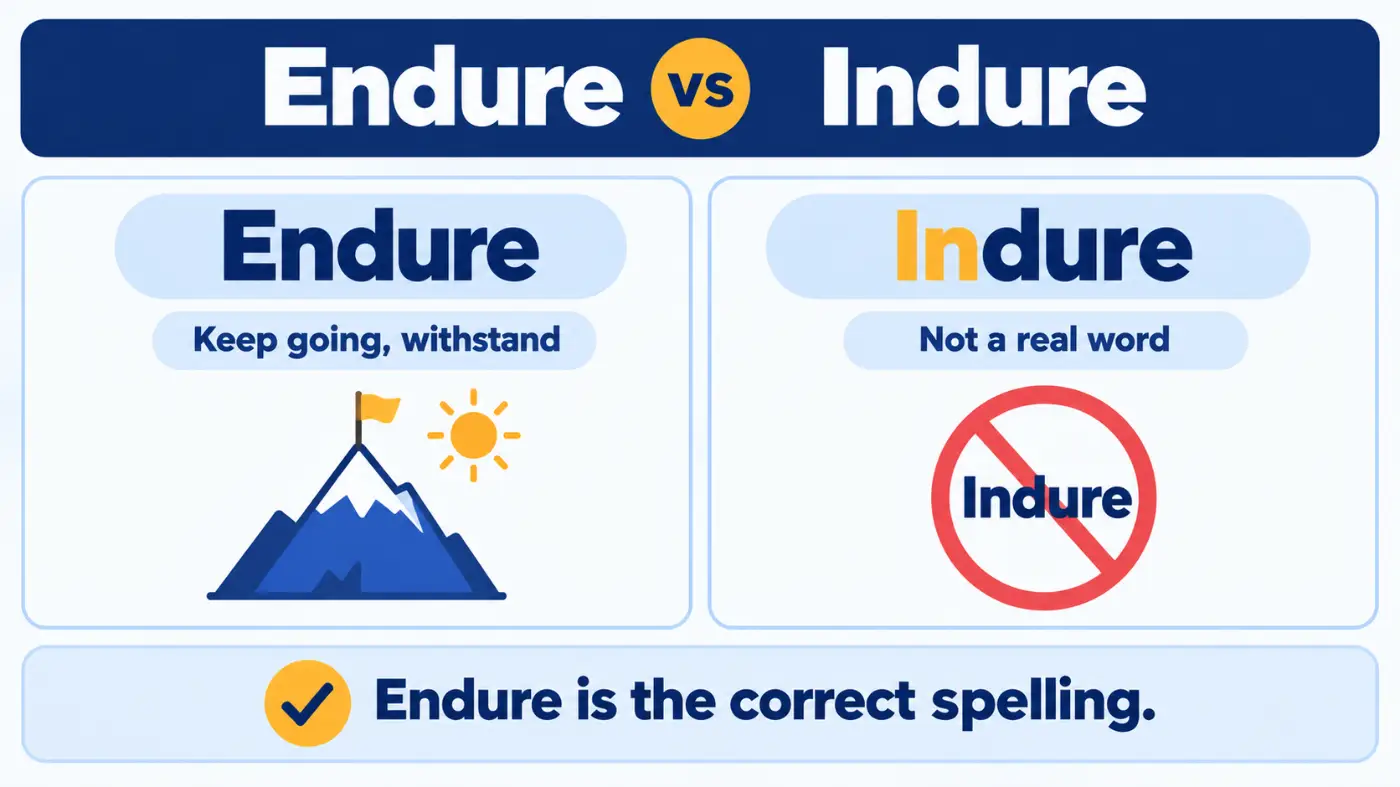
Endure is the correct spelling. Indure isn’t a recognized word in standard English, and it likely comes from confusing the prefix “en-” with the similar-looking “in-.”
The Short Answer at a Glance
| Form | Status | What it does | Example |
|---|---|---|---|
| endure | Correct | Verb meaning to withstand hardship or to last over time | The bridge was built to endure decades of harsh winters. |
| indure | Misspelling | Not a word in standard English | Correct it to endure every time. |
There’s one real word in this pair. The mix-up comes from a prefix swap, not from two words competing for the same meaning.
What Endure Means and How It Works
Endure is a verb with two related but distinct senses. The first is to bear something difficult without giving up: pain, hardship, a long wait, a bad situation. The second is to last or continue over time, especially in the face of pressure or wear.
You can say a person endures a hard winter, and you can also say a friendship endures for decades. The first use is about tolerating something hard. The second is about persistence and survival over a stretch of time.
Grammatically, endure works two ways. It’s often transitive, taking a direct object: you endure the cold, endure criticism, endure a delay. It can also be intransitive, standing alone without an object, especially in the “last over time” sense: their bond endured, the tradition endures.
The verb follows a regular pattern:
- endure (base form)
- endures (third-person present)
- endured (past tense and past participle)
- enduring (present participle, also used as an adjective, as in “an enduring friendship”)
The related noun is endurance, which shows up constantly in sports and fitness writing, as in endurance training or an endurance race. The adjective enduring describes something that lasts, like an enduring memory or an enduring rivalry.
Endure carries a certain weight. It’s stronger than words like “deal with” or “put up with,” and it usually signals real difficulty or real staying power. Saying someone endured a rough meeting suggests more strain than saying they sat through a rough meeting.
Is “Indure” Ever Correct?
No. Indure doesn’t appear in standard dictionaries, and it isn’t a recognized variant, regional form, or older spelling. It’s simply an error.
The likely source of the mistake is the prefix. English has two prefixes that look and sound almost identical: “en-” and “in-.” Both can attach to a root and shift its meaning, and both get pronounced the same way in casual speech, often as a quick, unstressed “uhn” or “in” sound at the start of a word.
Endure comes from a root related to hardness or lastingness, joined with the “en-” prefix, which often means “to make” or “to cause to be.” Words like enrich, enlarge, and enable follow the same pattern. Because “in-” also shows up constantly in English, as in insert, involve, and inquire, writers sometimes default to it out of habit rather than checking which prefix the specific word actually uses.
There’s no meaningful pattern that would make indure a legitimate alternative. It isn’t dialectal, it isn’t archaic, and it isn’t used in any specialized field. If you see it in writing, it’s a typo or a spelling slip, not a stylistic choice.
Endure vs Indure: Key Differences Side by Side
| Feature | Endure | Indure |
|---|---|---|
| Recognized word | Yes | No |
| Part of speech | Verb (transitive and intransitive) | None |
| Core meaning | To bear hardship, or to last over time | No meaning |
| Typical use | Personal hardship, relationships, materials, history | Appears only as a typo |
| Register | Works in formal and casual writing | Never appropriate |
| Example | Her patience endured through the entire delay. | Her patience indured through the entire delay. (wrong) |
The table shows a contrast, but really it shows a word and a spelling slip that happens to look like a word. What it doesn’t capture is how easy the mistake is to make when you’re typing quickly and your fingers reach for the more familiar “in-” prefix instead of pausing on “en-.”
Correct Examples in Real-Life Contexts
Everyday speech
- I don’t know how she endures that commute every single day.
- The old dog endured the fireworks better than the puppy did.
- We endured three hours in that waiting room before anyone called our name.
- Some friendships endure no matter how far apart people move.
Workplace writing
- The team endured a rocky product launch but came out with a stronger process.
- Our supplier’s materials are designed to endure extreme temperature swings.
- Leadership acknowledged that staff had endured a difficult quarter and adjusted the timeline.
- The brand has endured for over sixty years despite major shifts in the market.
Texting
- can’t believe we endured that entire meeting for one decision
- this heat is unreal, not sure how anyone endures a whole summer here
School and academic
- The novel’s protagonist endures a series of personal losses before finding stability.
- Historians debate why some empires endured for centuries while others collapsed quickly.
- Students were asked to write about a hardship a historical figure endured.
- The bridge’s design had to endure loads far beyond normal traffic conditions.
Formal writing
- The community endured significant economic hardship following the plant’s closure.
- The treaty was intended to endure well beyond the lifetimes of those who signed it.
- Employees who endured the transition period were offered additional compensation.
- The structure was engineered to endure seismic activity common to the region.
Common Mistakes People Make (and How to Catch Them)
Swapping “en-” for “in-” out of habit
Wrong: He had to indure a long recovery after the surgery. Right: He had to endure a long recovery after the surgery.
Because “in-” appears at the start of so many common English words, writers sometimes default to it without checking whether the specific word actually starts that way.
Mishearing the word in speech
Wrong: They indured months of construction noise next door. Right: They endured months of construction noise next door.
In fast speech, the difference between “en” and “in” at the start of a word can be almost inaudible, so writers who spell by ear sometimes guess wrong.
Confusing endure with a similar-sounding word
Wrong: The material is designed to indure heavy wear. Right: The material is designed to endure heavy wear.
Writers occasionally blend endure with words like “induce” or “insure,” which do start with “in-,” and the prefix bleeds over into the wrong word.
Typing quickly and transposing the vowel
Wrong: She indured the criticism gracefully. Right: She endured the criticism gracefully.
A quick typing error can swap the first vowel without the writer noticing, especially since both “en” and “in” are short and easy to type without looking.
A Fast Trick to Choose the Right One
Anchor the word to endurance. If you know that athletes build endurance, or that a race tests someone’s endurance, you already have the correct first two letters. Endure and endurance share the same “en-” opening, so one confirms the other.
A second trick is the substitution test. Try replacing the word with “withstand” or “last.” If the sentence still makes sense, you need endure, and it starts with “en.” For example, “The fence will withstand the storm” works, so “The fence will endure the storm” is the right construction, and it starts with “en.”
This trick has one limit. It confirms the spelling of endure itself, but it won’t tell you whether endure is the best word choice for a given sentence. In casual writing, “get through” or “survive” might sound more natural depending on tone.
How They Sound in Real Situations
A text exchange
Priya: How was the flight delay?
Marcus: We endured six hours in that terminal. Never again.
Priya: At least you had snacks.
Endured fits because Marcus is describing something genuinely unpleasant that he got through.
A workplace email
Subject: Thank you for your patience
Hi team,
I know everyone endured a chaotic few weeks during the system migration, and I want to acknowledge that. Starting Monday, the new platform should make things noticeably smoother. Thanks for sticking with it.
Best, Renee
Endured works well here because it captures real difficulty the team went through, not just a minor inconvenience.
An article-style excerpt
The small manufacturing town has endured two decades of factory closures, population loss, and shrinking tax revenue. Yet its downtown has slowly filled back in, with new businesses betting on a modest but real recovery.
Endured is the right choice because the sentence describes long-term hardship a place has survived, which is exactly where the word carries the most weight.
Formal Writing vs Casual Writing
The correct spelling doesn’t change with register. Endure is right in a legal document, a news article, a text message, and a personal essay. Indure is wrong everywhere.
What shifts is how often the word gets used. In formal and literary writing, endure appears often because it captures hardship and persistence with precision and gravity. In casual conversation, people frequently reach for simpler alternatives like “put up with,” “get through,” or “survive,” saving endure for situations that feel especially difficult or drawn out.
That doesn’t make endure wrong in casual speech. It just tends to signal that the speaker wants to emphasize real strain rather than a minor annoyance. Major style guides like AP and Chicago treat endure as a standard verb with no special formatting or usage restrictions.
Related Mix-Ups People Also Search For
Endure vs Ensure
These share the same “en-” opening but mean very different things. Endure means to bear or withstand something. Ensure means to make certain of something. Example: We need to ensure the shelter has enough supplies to endure the storm.
Endure vs Induce
Induce means to bring about or persuade, and it correctly starts with “in-,” unlike endure. Example: The medication was meant to induce sleep, not help her endure the pain.
Enduring vs Ensuing
Enduring describes something lasting or persistent. Ensuing describes something that follows right after another event. Example: The ensuing debate tested the couple’s enduring patience with each other.
Endurance vs Indurance
Endurance is the standard noun form of endure, referring to the capacity to withstand hardship. “Indurance” is not a recognized word and follows the same prefix mistake as indure. Example: Marathon training builds both physical endurance and mental toughness.
Quick Practice: Test Yourself
Choose the correct spelling for each blank.
- The old lighthouse has managed to ______ over a century of coastal storms. (endure / indure)
- It took real ______ to finish the race in that heat. (endurance / indurance)
- Their marriage has ______ through job losses, moves, and a pandemic. (endured / indured)
- The company hopes the new packaging can ______ rough handling during shipping. (endure / indure)
- Somehow he ______ the entire lecture without checking his phone once. (endured / indured)
- This kind of ______ friendship is rare in adulthood. (enduring / induring)
Answer Key
- endure: the correct spelling always begins with “en,” never “in.”
- endurance: the noun form follows the same rule as the verb.
- endured: past tense, and the prefix stays “en-” throughout every form.
- endure: base form, correctly spelled with “en.”
- endured: past tense again, matching the pattern above.
- enduring: the adjective form, and “induring” isn’t a word.
Frequently Asked Questions
Is “indure” ever an acceptable spelling?
No. Indure isn’t recognized in standard dictionaries and isn’t used as a regional or informal variant. The correct spelling in all contexts is endure.
Why does endure start with “en-” instead of “in-“?
Endure belongs to a family of English words built with the “en-” prefix, which often signals “to make” or “to bring into a state.” Words like enrich and enlarge follow the same pattern.
What’s the difference between endure and survive?
The two overlap but aren’t identical. Survive typically emphasizes staying alive through something dangerous, while endure emphasizes bearing something difficult, whether or not survival is in question.
Is “enduring” always an adjective?
No. Enduring is also the present participle of the verb endure, as in “she is enduring a long recovery.” It becomes an adjective when it describes a noun directly, as in “an enduring legacy.”
Can endure be used without an object?
Yes. Endure can stand alone in sentences focused on lasting over time, such as “their friendship endured,” without naming a specific hardship.
What is the noun form of endure?
The noun is endurance, which refers to the ability to withstand hardship or exertion over time.

Sophia Bennett writes educational content about English vocabulary, grammar, slang, and communication. She is passionate about making complex language topics accessible to students, professionals, and curious readers around the world.