Acquire vs Aquire: Which Spelling Is Correct?
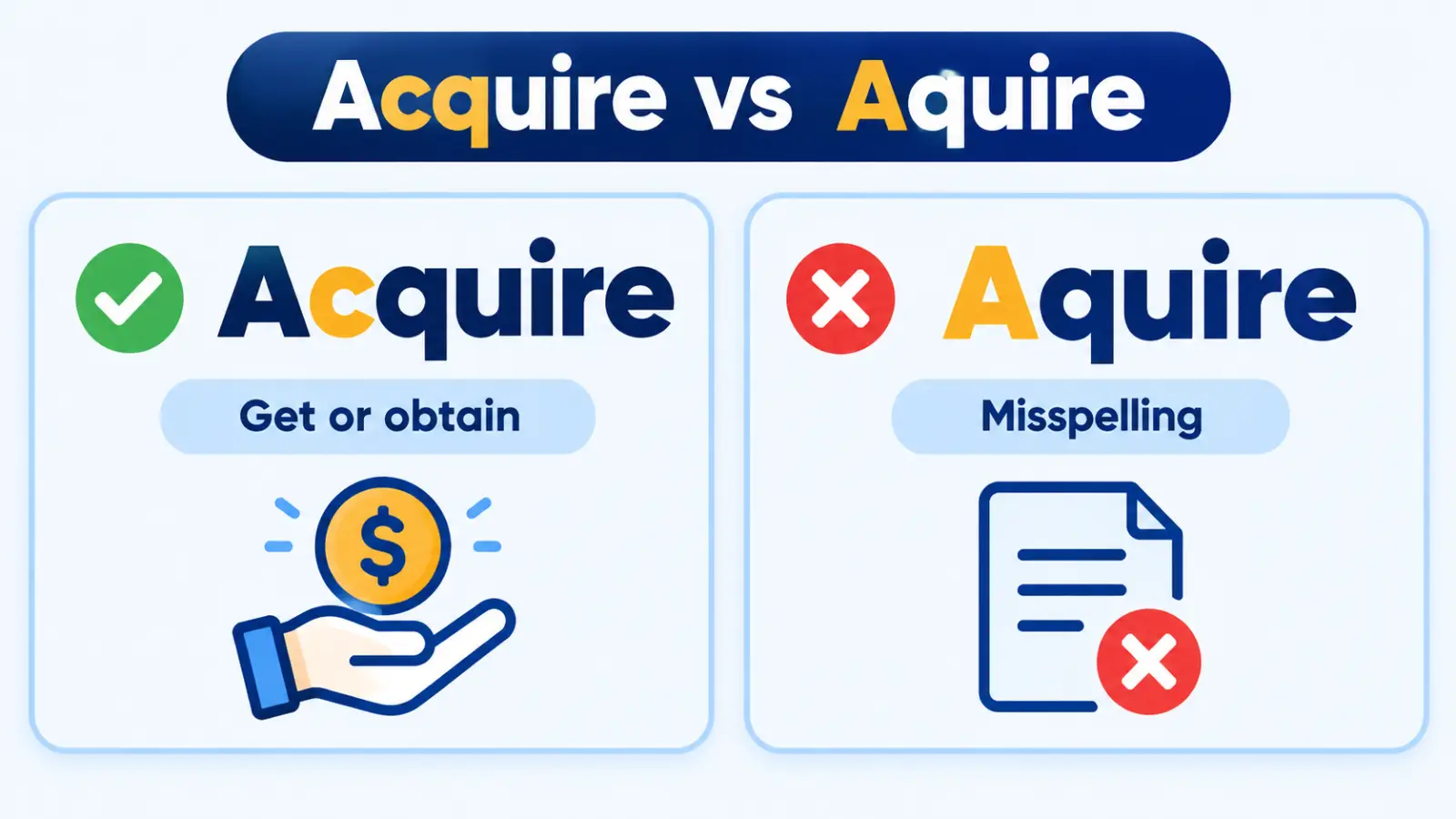
Acquire is the correct spelling. Aquire is a misspelling of it, not a variant or an alternate form. The word starts with “ac,” and that “c” is the letter people drop when they type too fast or spell by ear.
The Short Answer at a Glance
| Form | Status | What it does | Example |
|---|---|---|---|
| acquire | Correct | Verb meaning to gain, obtain, or come to own or learn something | Priya acquired a used camera for her film class. |
| aquire | Misspelling | Not a word in standard English | Correct it to acquire every time. |
Only one word exists here. The confusion comes from spelling, not meaning, so there’s nothing to weigh between two options. Just add the missing “c.”
What Acquire Means and How It Works
Acquire is a verb that means to come into possession of something, whether by buying it, earning it, receiving it, or building it up over time. What you acquire can be physical (a warehouse, a violin), legal (a license, a stake in a company), or personal (a skill, a habit, an accent).
Grammatically, acquire is a transitive verb. That means it needs an object, something that gets acquired. You can’t just say “She acquired.” You have to say what she acquired: a passport, a reputation, a fluency in Portuguese.
The verb changes form the way most regular verbs do:
- acquire (base form)
- acquires (third-person present)
- acquired (past tense and past participle)
- acquiring (present participle)
The noun form is acquisition, which is where the spelling trap gets even more interesting. That word keeps the “c” too, and it adds an “s” sound before the ending. Someone who writes “aquisition” has made the same mistake in a different word.
Acquire also carries a slightly different feel from simpler verbs like get or buy. It suggests effort, process, or significance. You get a coffee. You acquire a coffee shop chain. Both are technically about obtaining something, but acquire signals that the process took some doing.
That’s why the word turns up so often in business, law, science, and education. Companies acquire competitors. Museums acquire paintings. Children acquire language. In each case, something valuable comes into someone’s hands or mind.
Is “Aquire” Ever Correct?
No. Aquire isn’t a word in standard American English, and no major dictionary lists it as an accepted variant. It shows up because of how the word sounds when spoken.
Say acquire out loud and notice what your mouth does. The “c” and the “q” blend into one hard “k” sound, so the word comes out as “uh-KWYRE.” Your ear hears one “k” sound and assumes one letter is responsible. The spelling, though, uses two letters to produce it.
The same thing happens in a few other English words. Acquaint, acquit, and acquiesce all start with “acq” and all get misspelled with a missing “c” for the exact same reason. If you learn the pattern once, it protects you across the whole family.
Treating aquire as a legitimate alternative would be a mistake. It isn’t regional, dated, or informal. It’s simply an error, and spellcheck will flag it in nearly every program.
Acquire vs Aquire: Key Differences Side by Side
| Feature | Acquire | Aquire |
|---|---|---|
| Recognized word | Yes | No |
| Part of speech | Transitive verb | None |
| Core meaning | To obtain, gain, or come to possess | No meaning |
| Typical use | Business, law, learning, collecting | Appears only as a typo |
| Register | Works in formal and casual writing | Never appropriate |
| Example | The startup acquired a smaller rival. | The startup aquired a smaller rival. (wrong) |
The table makes it look like a comparison between two things, but it’s really a comparison between a word and a slip of the keyboard. What the table can’t show you is why the slip feels so natural. Because the spelling and the sound don’t line up cleanly, even confident writers second-guess themselves. The good news is that you only have to learn the correct form once, and the rest is habit.
Correct Examples in Real-Life Contexts
These sentences all use the correct spelling, acquire and its related forms, across a range of situations.
Everyday speech
- My grandfather acquired his taste for spicy food during two years in Hyderabad.
- We finally acquired a couch that doesn’t sag in the middle.
- It took Devon three summers to acquire a decent tan line and a bad sunburn.
- Some hobbies you pick up. Others you acquire slowly, one failed attempt at a time.
Workplace writing
- Harlow Logistics acquires regional trucking firms and folds them into its national network.
- Please confirm that we’ve acquired the signed contract before Friday’s call.
- The design team acquired new licensing rights for the stock photo library this quarter.
- After acquiring the Denver office lease, the company hired twelve additional staff.
Texting
- just acquired the last ticket to the show, don’t tell anyone
- did you ever acquire that vintage jacket or did someone snag it first
School and academic
- Toddlers acquire vocabulary at a remarkable pace between ages two and three.
- Students in the nursing program acquire clinical hours through supervised rotations.
- The museum’s board voted to acquire a collection of nineteenth-century maps.
- Learners typically acquire the sound system of a new language before its grammar feels natural.
Formal writing
- The agency may acquire property only through the procedures outlined in the statute.
- The defendant acquired the shares lawfully and disclosed the transaction on schedule.
- Having acquired significant expertise in coastal engineering, she was appointed to lead the review.
- Citizenship may be acquired by birth, by descent, or through a formal application.
Common Mistakes People Make (and How to Catch Them)
Each of these errors has a specific cause. Knowing the cause helps you spot it in your own writing.
Dropping the “c” because of how the word sounds
Wrong: The firm plans to aquire two smaller studios next year. Right: The firm plans to acquire two smaller studios next year.
This is the most common error by far. The “c” is silent in the sense that no separate sound belongs to it, so the ear tells you it isn’t needed.
Typing too fast and skipping a letter
Wrong: She aquired her nursing license last spring. Right: She acquired her nursing license last spring.
Fast typists often drop the second letter in a cluster. Autocorrect sometimes catches it, but not always, especially in a phone’s notes app or a form field with no spellcheck.
Misspelling the noun form
Wrong: The aquisition closed on Tuesday. Right: The acquisition closed on Tuesday.
Writers who correctly spell the verb sometimes still miss the noun. The same missing “c” is the culprit, and it’s worth checking any time you write about a business deal.
Overcorrecting with an extra letter
Wrong: He accquired a reputation for being late. Right: He acquired a reputation for being late.
Once people learn that acquire needs a “c,” some overcorrect and add a second one. The word has exactly one “c” and one “q,” with the “c” before the “q.”
Confusing acquire with similar words
Wrong: Kids adquire new words quickly at that age. Right: Kids acquire new words quickly at that age.
This one comes from the prefix. English borrowed acquire from Latin, and some writers confuse it with other words that begin with “ad.” The safe approach is to memorize the actual spelling instead of guessing from the sound.
A Fast Trick to Choose the Right One
Use the “ACQ” anchor. Every time you write the word, picture the three letters A, C, Q as a unit and let them stay together. If you see “AQ” without the middle letter, the word is incomplete.
A second trick works through word families. Acquisition, acquaintance, and acquit all share the same “acq” opening. If you can spell any one of them, you can spell them all. Try it: if you know acquaintance is right, then acquire follows the same pattern.
There’s also a quick substitution test. Replace the word in question with “obtain” or “gain.” If the sentence still makes sense, the word you need is acquire, and it starts with “acq.” For example, “The bakery plans to obtain a second oven” works, so “acquire” is the right verb there.
The tricks have one limit. They confirm the spelling, but they won’t tell you whether acquire is the best word for the sentence. For everyday situations, get or buy may sound more natural. That’s a style choice, not a spelling one.
How They Sound in Real Situations
A text exchange
Marcus: Did you ever get that turntable?
Jo: Yes! I finally acquired one at the estate sale on Saturday. Ninety bucks.
Marcus: Nice. Does it work?
Acquired fits here because Jo is being a little playful about an ordinary purchase, and the word gives it a mock-serious tone.
A workplace email
Subject: Updated vendor terms
Hi Renata,
We acquired the final signatures from the supplier this morning, so the revised terms are now in effect. I’ve attached the executed copy for your files. Let me know if finance needs anything else before the end of the quarter.
Best, Tom
Acquired works well because the signatures were something Tom had to actively obtain, not just receive.
An article-style excerpt
Over the past decade, the regional grocery chain has acquired more than forty independent stores across three states. Analysts say the strategy gives it purchasing power that smaller competitors can’t match, though some longtime customers miss the neighborhood feel of the original shops.
Acquired is the right choice because this is a business context involving ownership and transfer, which is exactly where the word is strongest.
Formal Writing vs Casual Writing
The spelling doesn’t change with register. Acquire is correct in a legal brief, a text to a friend, a news article, and a college essay. Aquire is wrong in all of them.
What does shift is how natural the word sounds. In formal and professional writing, acquire is at home. It suits contracts, financial reports, academic papers, and journalism about mergers or collections. In casual conversation, people more often say get, buy, pick up, or land, and acquire can sound slightly stiff unless you’re using it for effect.
That doesn’t make acquire inappropriate in casual settings. It just means you’re choosing a more deliberate word. If you’d never say it aloud to a friend, a plainer verb might read better in a text message.
Major style guides such as AP and Chicago don’t treat acquire differently from any other standard verb. They simply expect it to be spelled correctly.
Related Mix-Ups People Also Search For
Acquire vs Require
These look alike and share an ending, but they do different jobs. Acquire means to obtain. Require means to need or demand. A job might require a degree, and you acquire that degree by studying. Example: The role requires a commercial license, which Nadia acquired last year.
Acquisition vs Aquisition
Acquisition is the noun form, and it keeps the “c” just like the verb. It names the act of obtaining something or the thing obtained. Example: The museum’s newest acquisition is a sketchbook from the 1920s.
Acquaint vs Aquaint
Acquaint and acquaintance fall into the same silent-c trap, so both need the “c” before the “q.” Example: Let me acquaint you with the new filing system.
Acquiesce vs Aquiesce
Acquiesce means to go along with something reluctantly, and it also opens with “acq.” Example: After hours of debate, the board acquiesced to the revised budget.
Exceptions, Edge Cases, and Tricky Situations
Acquire in language learning
Linguists often use acquire in a specific way, distinguishing language acquisition, the natural absorption of a language through exposure, from language learning, which is more deliberate and classroom-based. Both terms are used in the field, though how sharply people separate them varies. The spelling stays the same either way.
Company names and brand spellings
Occasionally a business or product will use a deliberately altered spelling for branding. That’s a stylistic choice by the brand and doesn’t make aquire a legitimate general spelling. In normal prose, stick to acquire.
Acquire as a “soft” verb
Some writers overuse acquire in place of simpler words, which can make the writing feel padded. “She acquired a sandwich” reads oddly because the effort implied by acquire doesn’t match the ordinary act of buying lunch. Use it when the process or significance justifies it.
Acquired taste
The phrase acquired taste refers to something you learn to enjoy over time, like black coffee or blue cheese. It’s a fixed phrase, and the spelling follows the same rule. Example: Sardines are an acquired taste in our house, and the acquiring has been slow.
Quick Practice: Test Yourself
Choose the correct spelling for each blank.
- The university hopes to ______ a rare manuscript collection before the end of the year. (acquire / aquire)
- After months of practice, Ingrid ______ a near-perfect French accent. (acquired / aquired)
- The board approved the ______ of the family-owned bakery. (acquisition / aquisition)
- Kids ______ their first words at different speeds, and that’s normal. (acquire / aquire)
- Please ______ the necessary permits before construction begins. (acquire / aquire)
- It took him a decade to ______ the confidence to speak in public. (acquire / aquire)
Answer Key
- acquire: the correct spelling always includes the “c,” and the verb follows “to.”
- acquired: past tense of acquire, with the “c” intact.
- acquisition: the noun keeps the “c” too.
- acquire: plural subject, present tense, correct spelling.
- acquire: an imperative, and the same spelling applies.
- acquire: again after “to,” and aquire is never correct.
Frequently Asked Questions
Is Aquire Ever an Acceptable Spelling?
No. Aquire is a misspelling, not a regional or informal variant. The standard spelling in American English is acquire.
Why Is Acquire Spelled With a C?
The word comes from Latin roots, and the c is part of its inherited spelling. English spelling often preserves letters that do not have a distinct sound, as seen in acquire.
How Do You Pronounce Acquire?
It is pronounced with the stress on the second syllable. The c and q together produce a kw sound.
Does Acquire Mean the Same Thing as Buy?
Not exactly. Acquire is broader. You can acquire something through purchase, effort, inheritance, a gift, or learning. Buy specifically means obtaining something by paying for it.
Is Acquired the Past Tense of Acquire?
Yes. Acquired works as both the simple past tense and the past participle. It can also function as an adjective, as in acquired skill.
What Is the Noun Form of Acquire?
The noun form is acquisition. It keeps the c and follows the spelling pattern a c q u i s i t i o n.

Sophia Bennett writes educational content about English vocabulary, grammar, slang, and communication. She is passionate about making complex language topics accessible to students, professionals, and curious readers around the world.