MK Meaning in Text: Does It Mean Okay or End the Conversation?
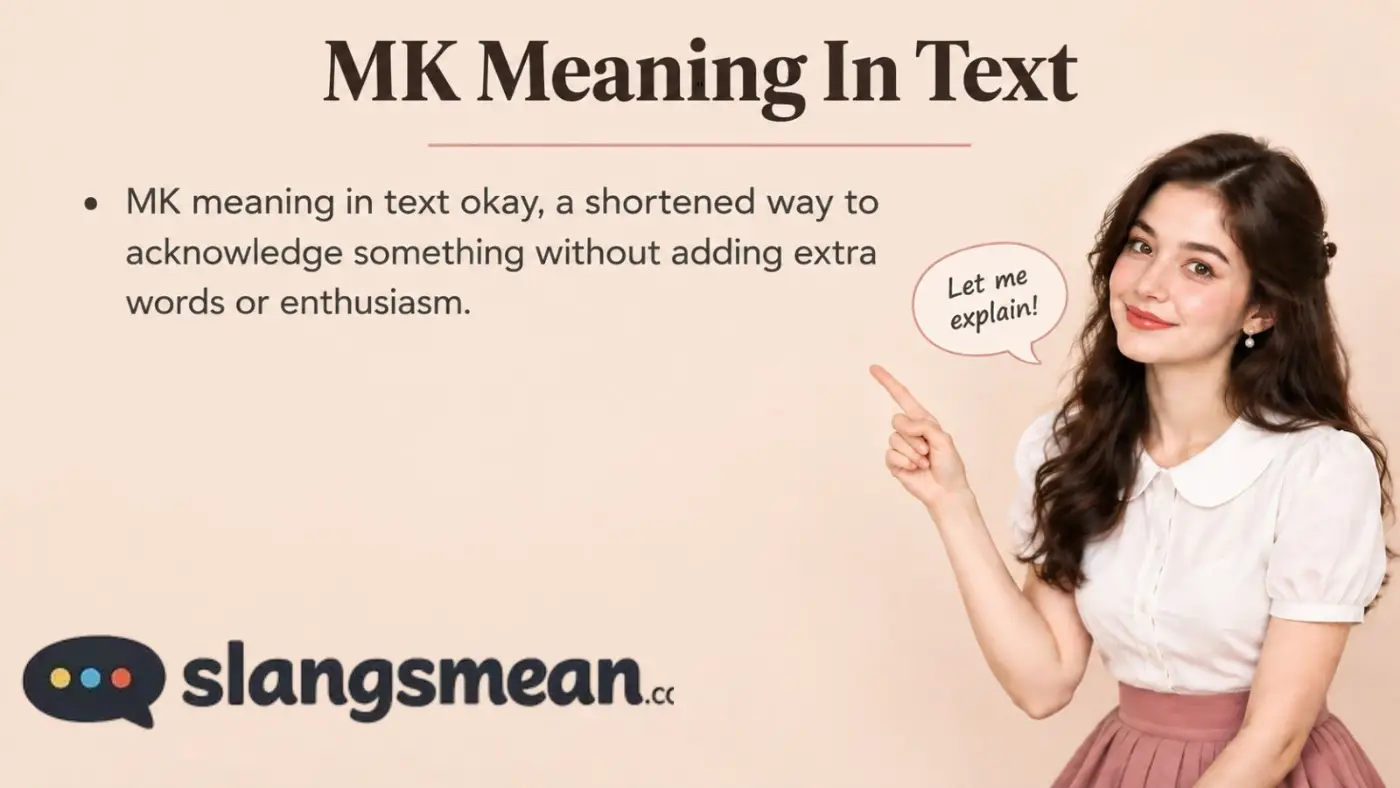
MK usually means “okay” or “mm-kay” in text messages. It is an informal response people use to acknowledge something, accept a suggestion, or show they have understood a message. Depending on the situation, it can sound neutral, casual, hesitant, or slightly dismissive.
A short reply like “mk” can sometimes make a conversation feel finished because it does not give the other person much to respond to. However, it does not automatically mean someone is angry, annoyed, or trying to end the conversation. The surrounding messages and the sender’s usual texting style help explain the tone.
Related Meaning: JP Meaning In Text
What Does MK Mean in Text?
In everyday texting, MK is a shortened written form of “mm-kay” or “m’kay,” informal ways of saying “okay.” It is generally used as a quick acknowledgment rather than as an abbreviation in which M and K stand for two separate words.
Depending on the message, MK can communicate:
- Okay.
- Alright.
- I understand.
- Got it.
- Sure.
- Fine.
For example:
Person A: “I’ll meet you outside the library at 5.”
Person B: “mk”
Here, Person B is acknowledging the plan. The reply probably means “Okay, I understand.”
The same two letters can carry a different feeling in another conversation. If someone shares a serious concern and receives only “mk” in response, the short reply may seem uninterested or dismissive.
Does MK Mean Someone Wants to End the Conversation?
Sometimes, but not always. MK can act as a conversation-ending response when someone acknowledges a message without adding a question, explanation, or new topic.
For example:
Person A: “I think we should leave early tomorrow.”
Person B: “mk”
The conversation may naturally stop because Person B has accepted the suggestion and has nothing else to add.
However, a short acknowledgment does not prove that someone wants to stop talking. They might be busy, tired, distracted, or simply comfortable with brief replies.
Consider another example:
Person A: “I had a difficult day and wanted to talk about it.”
Person B: “mk”
This response may feel cold because the message called for empathy or a more thoughtful answer. The sender might not intend to be rude, but the lack of engagement can make the other person feel ignored.
The important distinction is that MK communicates acknowledgment more clearly than it communicates emotion. You cannot determine someone’s feelings from those two letters alone.
Why Does MK Sometimes Sound Cold or Dismissive?
Text messages do not include the same vocal tone, facial expressions, or body language found in face-to-face conversations. As a result, very short replies can leave room for interpretation.
MK may sound distant for several reasons.
It Gives Very Little Information
A reply such as “mk” does not explain whether the sender is excited, disappointed, uncertain, or simply agreeing.
Compare these responses:
- “MK, sounds good!”
- “mk”
- “mk.”
All three can acknowledge the same message, but they may create different impressions. The first sounds more engaged because it includes an extra expression of agreement. The second is brief and neutral. The third may feel more abrupt in a tense conversation.
These are possible interpretations rather than fixed texting rules.
It May Follow a Serious Message
A short acknowledgment can feel dismissive when the previous message requires more attention.
Illustrative example:
Person A: “I felt hurt when you canceled our plans without telling me.”
Person B: “mk”
Person A may interpret the reply as a lack of concern because it does not address the problem.
A more engaged response would be:
“I understand why you’re upset. I’m sorry I didn’t let you know.”
The difference is not the basic meaning of MK. It is the amount of attention shown in the response.
It May Reflect the Sender’s Usual Style
Some people regularly use short replies such as “ok,” “k,” and “mk.” They may not intend any negative message.
If someone normally sends brief responses to everyone, MK may be ordinary for them. If they usually write detailed messages but suddenly switch to one-word replies during an argument, the change may be more meaningful.
Look at the person’s usual communication style instead of judging one message in isolation.
What Is the Difference Between MK, Mmk, and M’Kay?
These spellings are related because they represent informal ways of saying “okay.” However, they can create slightly different impressions.
- MK: A very short acknowledgment.
- Mmk: A more noticeable version of the humming sound before “okay.” It can suggest agreement, hesitation, or skepticism.
- M’kay: A casual spelling that represents the spoken pronunciation of “okay.”
- Mmkay: A longer spelling of the same informal expression.
For example:
Person A: “I think this restaurant is better than the one we visited last week.”
Person B: “Mmk, maybe.”
The response sounds less certain than a straightforward “Okay, let’s go there.”
These spellings do not have strict, universal emotional definitions. People use them differently, and the surrounding conversation still matters.
How Is MK Used in Different Conversations?
MK is most useful in informal exchanges where a short acknowledgment is enough. The meaning becomes clearer when you consider what the other person said first.
Confirming Plans
Situation: Two friends are arranging a meeting.
Alex: “I’ll pick you up at seven.”
Jordan: “mk”
Jordan is confirming the arrangement. There is no obvious sign of annoyance or hesitation.
Accepting a Suggestion
Situation: Friends are deciding what to eat.
Taylor: “We could order pizza instead.”
Morgan: “MK, that’s fine.”
Here, MK communicates acceptance. The additional words make the reply sound more cooperative.
Responding During an Argument
Situation: Two people disagree about a decision.
Alex: “I’ve explained why I don’t think that is a good idea.”
Jordan: “mk.”
Jordan’s reply may sound like a reluctant acknowledgment or an attempt to stop discussing the subject. Still, the letters alone cannot confirm whether Jordan is angry.
Acknowledging Instructions
Situation: Someone gives a simple reminder.
Person A: “Please send me the document before lunch.”
Person B: “mk, will do.”
The reply means the person has understood the request.
Reacting to an Unexpected Statement
Situation: Someone makes a surprising claim.
Person A: “I might move to another state next month.”
Person B: “Mmk?”
The question mark may suggest surprise or a request for more information. The sender might be asking the other person to explain further.
What Does MK Mean on Snapchat, Instagram, TikTok, and Discord?
MK generally carries the same basic meaning across messaging services: okay, mm-kay, or a brief acknowledgment. It does not have a separate universal definition on each platform.
The type of conversation matters more than the app.
MK on Snapchat
Someone may send MK in a private chat to confirm a plan or acknowledge a message.
For example:
“Send me the picture when you get home.”
“mk”
The sender is probably saying they understand.
MK on Instagram
On Instagram, MK may appear in direct messages or casual conversations. A person might use it to accept an invitation or respond briefly to a suggestion.
For example:
“Are you coming to the event tonight?”
“MK, I’ll be there.”
MK on TikTok
In a TikTok conversation, MK can work as a short reaction to a comment or message. It may also appear as a dry or sarcastic acknowledgment when someone is responding to a surprising statement.
The intended tone depends on the exchange rather than a special TikTok definition.
MK on Discord
In a Discord server or private message, MK may be used to confirm instructions or acknowledge something during a game.
For example:
“Join the next match after this round.”
“mk”
Here, the reply simply confirms that the message was received.
Does MK Mean the Same Thing for a Girl or a Boy?
Yes. MK does not have a different standard meaning based on the sender’s gender. Whether a girl, boy, or another person sends it, the usual interpretation remains “okay” or “mm-kay.”
The tone depends on the relationship and conversation.
For example, a friend might send “mk” because they agree with your suggestion. Someone else might use the same reply after an argument because they do not want to continue discussing the issue.
Instead of trying to interpret the sender’s gender, consider:
- What did you say immediately before receiving MK?
- Was the conversation friendly or tense?
- Does the person usually send short replies?
- Did they add punctuation, an emoji, or another phrase?
- Did they continue the conversation afterward?
These clues are more useful than assuming that everyone uses the abbreviation in the same way.
Is MK Rude, Passive-Aggressive, or Sarcastic?
MK is not inherently rude or passive-aggressive. It is a casual acknowledgment that can sound different depending on the situation.
It may come across as:
- Neutral: The sender simply agrees or understands.
- Reluctant: The person accepts something without sounding enthusiastic.
- Dismissive: The response gives little attention to an important message.
- Sarcastic: The sender uses it to react ironically to a statement.
- Friendly: Additional words or an emoji make the acknowledgment warmer.
For example:
Person A: “We can meet at the coffee shop tomorrow.”
Person B: “MK, sounds good!”
This is a straightforward agreement.
Now consider:
Person A: “I don’t think you understood what I was trying to explain.”
Person B: “mk.”
In this situation, the reply may sound dismissive because it does not address the concern.
It is better to consider the full exchange before deciding that someone is being rude.
How to Reply When Someone Says MK
Your response should depend on what you were discussing and whether you want the conversation to continue.
If They Are Confirming a Plan
You do not need to send another long message.
For example:
You: “See you at six, then.”
Them: “MK”
You: “See you!”
This keeps the exchange simple.
If You Want to Continue Talking
Add a question or introduce another topic.
You: “MK. What are you doing after work?”
This gives the other person something new to respond to.
If Their Reply Feels Dismissive
Avoid assuming that the person is upset. Ask for clarification in a calm way.
Possible replies include:
- “Everything okay?”
- “Are you sure?”
- “You seem a little quiet. Is something wrong?”
- “I can’t tell if you’re agreeing or still thinking about it.”
These responses give the other person an opportunity to explain their tone.
If the Conversation Is Serious
A short MK may not be enough to resolve an important disagreement. You can explain what kind of response you need.
For example:
“I understand you said okay, but I want to know how you actually feel about it.”
This is clearer than arguing over the abbreviation itself.
MK vs. OK, K, KK, and Other Short Replies
Several common texting responses can communicate agreement or acknowledgment. However, their tone and typical use can differ.
| Texting term | Usual meaning | Possible tone |
|---|---|---|
| MK | Mm-kay or okay | Casual, neutral, or flat |
| OK | Okay | Neutral and clear |
| K | Okay | Very brief; may sound abrupt |
| KK | Okay, understood | Often casual and friendly |
The differences are tendencies, not strict rules. A person may use any of these expressions without intending a particular emotional message.
MK vs. K
Both can mean okay, but K is even shorter. Some readers interpret a single K as more abrupt because it contains no additional sound or wording.
MK can feel slightly more conversational because it is associated with “mm-kay.”
MK vs. KK
KK is another casual way to acknowledge a message. It often feels lighter or more upbeat than a bare MK, although individual texting habits vary.
MK vs. OK
OK is a widely understood spelling of okay. MK is more informal and is associated with the spoken expression “mm-kay.”
If you want to avoid confusion in a professional or serious message, writing “okay,” “understood,” or “sounds good” is usually clearer.
Where Did MK Come From?
MK is best understood as a shortened written form of the informal expression “m’kay” or “mm-kay,” rather than a newly created acronym with two separate words.
The expression imitates a spoken way of saying “okay.” The initial M represents a brief humming sound before the word.
The longer forms include “mkay,” “mmkay,” and “m’kay.” Wiktionary lists MK among the alternative spellings of “m’kay” and describes the expression as an informal form of okay. It also notes that the expression can sometimes be used ironically or condescendingly.
The phrase is familiar in American pop culture through the character Mr. Mackey from South Park, who is known for saying “m’kay.” However, that association should not be treated as proof that the character invented the expression.
The exact first use of the two-letter texting form “MK” is not firmly established. It is safer to describe it as an informal written shortening than to assign it a specific creator, platform, or year.
Does MK Have Other Meanings?
Yes. The same letters can represent different things in other subjects or conversations. However, the meaning depends on the topic.
Mortal Kombat
MK can refer to Mortal Kombat, the video game franchise, especially in gaming discussions.
For example:
Person A: “Have you played the latest MK game?”
Person B: “Yes, I’ve been playing it all weekend.”
Here, MK refers to the game franchise rather than the texting response “okay.”
Initials or Personal Abbreviations
MK may also be someone’s initials or a shortened label used within a particular group.
For example, a person might use MK to refer to someone whose first and last names begin with those letters.
Medical and Technical Contexts
MK can have specialized meanings in medical, scientific, or technical material. Those meanings depend on the subject and the specific document.
A message that says “mk” after a dinner invitation is very different from the same letters appearing in a medical note or technical discussion. Do not assume the texting definition applies outside casual conversation.
Common Mistakes When Understanding MK
A few misunderstandings can make a simple reply seem more meaningful than it really is.
- Assuming MK always means annoyance: It can be a completely ordinary acknowledgment.
- Treating it as a formal acronym: In casual texting, it is generally associated with “mm-kay” or “okay.”
- Assuming it always ends a conversation: It may close an exchange, but the sender might simply have nothing else to add.
- Confusing it with Mortal Kombat: The gaming meaning is relevant when the conversation is about video games.
- Judging the sender’s feelings from two letters: The full conversation and the person’s usual communication style provide better clues.
Frequently Asked Questions
What does MK mean in text?
MK usually means “okay” or “mm-kay.” It is a casual way to acknowledge a message, agree with something, or show that you understand.
Does MK mean someone is ending the conversation?
It can bring an exchange to a natural stopping point because it does not invite much discussion. However, it does not automatically mean the sender wants to stop talking.
Is MK a rude response?
Not necessarily. It can sound neutral, but a bare MK after an emotional or serious message may feel dismissive.
What does MK mean from a girl or a boy?
The basic meaning is the same regardless of who sends it. The surrounding conversation helps determine whether the reply is friendly, neutral, hesitant, or cold.
What is the difference between MK and Mmk?
Both are informal forms associated with “mm-kay” or “okay.” Mmk includes an extra M sound and may feel more drawn out, but neither spelling has a fixed emotional meaning.
Does MK mean Mortal Kombat?
It can. In a gaming conversation, MK commonly refers to Mortal Kombat. In an ordinary text exchange, it usually means okay.
Final Takeaway
MK means “okay” or “mm-kay” in casual texting. It can confirm a plan, acknowledge a message, or serve as a brief response that brings a conversation to a pause.
Although it may sometimes sound cold or dismissive, the abbreviation does not reveal someone’s feelings by itself. Read the surrounding messages and consider the sender’s usual style before deciding what they intended.

Sophia Bennett writes educational content about English vocabulary, grammar, slang, and communication. She is passionate about making complex language topics accessible to students, professionals, and curious readers around the world.