
Affect vs Effect: Which Word Do You Need?
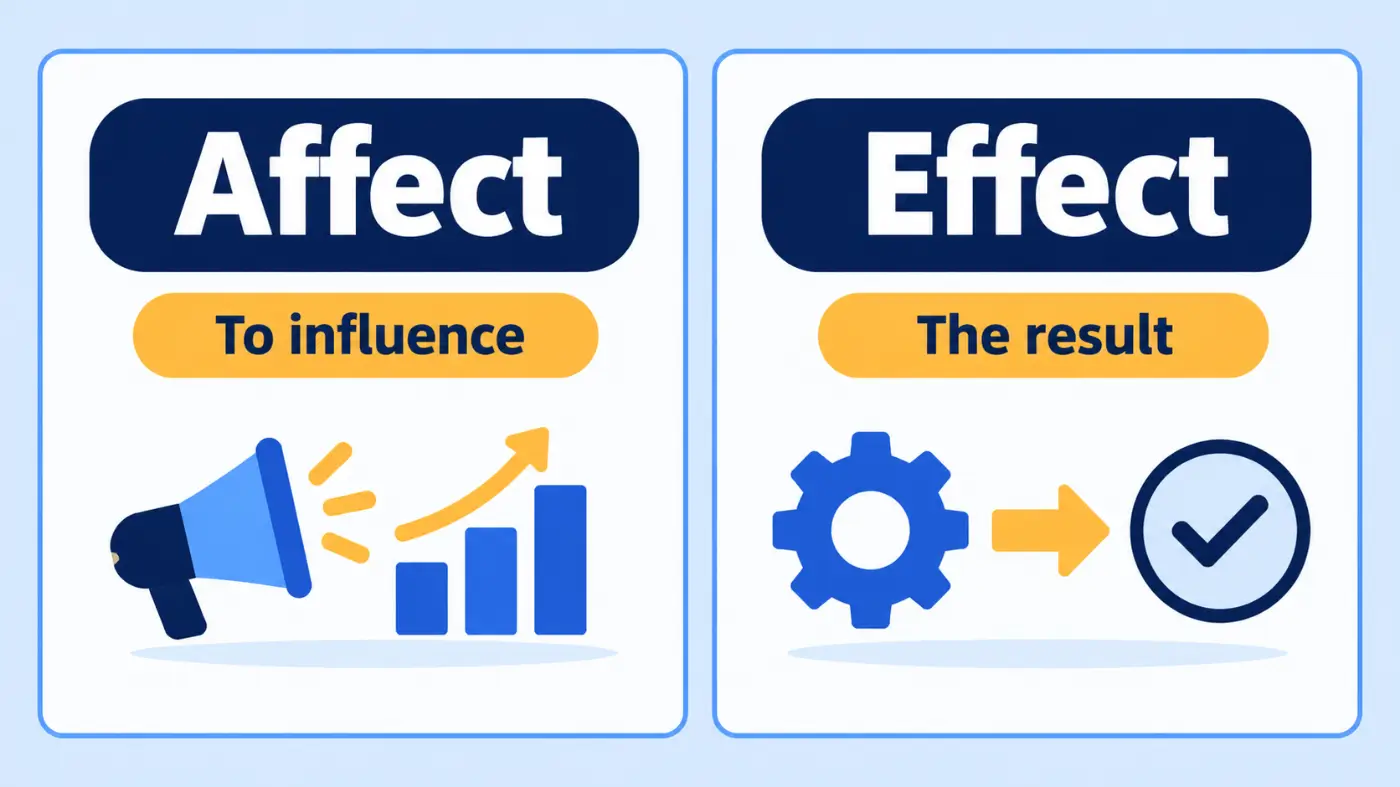
Affect is usually a verb that means to influence something. Effect is usually a noun that means the result of something. If you can swap in influence, write affect. If you can swap in result, write effect.
Related Post: skill set vs skillset
The Short Answer at a Glance
| Word | Usual Part of Speech | Core Meaning | Example |
|---|---|---|---|
| Affect | Verb | To influence or change | Humidity affects how my hair behaves. |
| Effect | Noun | A result or outcome | The new thermostat had an immediate effect on our heating bill. |
Both words have rarer uses that flip these roles. The usual pattern covers most sentences you’ll write, and the exceptions appear later in this guide.
What Affect Means and How It Works
Affect is most often a verb that means to influence, change, or have an impact on something. The thing being influenced follows the verb directly. Late buses affect attendance, noise affects focus, and a rumor can affect a stock price.
Because it’s a verb, affect changes form with tense and subject. You’ll see affects, affected, and affecting. It doesn’t take a preposition before its object, so you write affects the schedule, not affects on the schedule.
Affect has two rarer meanings. As a verb, it can mean to put on a manner for show, as in he affected a British accent for the whole dinner. The related adjective affected describes behavior that feels artificial.
As a noun, affect is a technical term in psychology. It names a person’s visible emotional expression, and it’s pronounced with the stress on the first syllable, AF-ekt. Most writers will never need it outside academic or clinical settings.
What Effect Means and How It Works
Effect is most often a noun that means a result, an outcome, or an impact. It answers the question of what happened because of something else. A new rule has an effect, a medicine has an effect, and a sunset can have a calming effect.
As a noun, effect behaves like other nouns. It takes articles and adjectives (a strong effect, the main effect), and it takes the plural effects. The usual preposition pairing is the effect of one thing on another.
Effect also has a verb use that means to bring about or cause to happen. You effect change, you effect a settlement, and you effect repairs. This verb is formal and uncommon, and it’s the main reason people think the rule has exceptions.
The plural effects has special meanings too. Special effects are techniques that create illusions in films, personal effects are belongings, and sound effects are noises added to a recording.
Affect vs Effect: Key Differences Side by Side
| Feature | Affect | Effect |
|---|---|---|
| Usual part of speech | Verb | Noun |
| Core meaning | Influence or change | Result or outcome |
| Rarer use | Pretend (verb); emotional expression (noun) | Bring about (verb) |
| Takes an article? | No | Yes: an effect, the effect |
| Example | The delay will affect every passenger on the flight. | The delay had a small effect on the schedule. |
The words look alike and sound nearly identical in fast speech. The first syllable collapses into a short uh or ih sound, so your ear can’t separate them. Only grammar can.
The table also can’t show how the two words depend on each other. Something affects something, and the result is an effect. Nearly every sentence about cause and consequence can use both words, and that’s exactly why people mix them up.
Correct Examples in Real-Life Contexts
Affect
- Everyday speech: Humidity affects how my hair behaves, so I never trust a sunny forecast.
- Texting: does it affect the battery if i leave it plugged in overnight?
- Workplace writing: The server upgrade will affect login times between 9 and 11 p.m.
- School or academic: How does sleep loss affect memory in teenagers?
- Formal writing: The proposed zoning change would affect roughly four hundred households in the district.
- Pretending sense: Marcus affected a British accent for the entire dinner.
Effect
- Everyday speech: The new thermostat had an immediate effect on our heating bill.
- Texting: the effect of that last episode is going to haunt me for weeks
- Workplace writing: Please document the effect of the policy change on response times.
- School or academic: The lab report measures the effect of light color on seedling growth.
- Formal writing: The ordinance takes effect on January 1.
- Film sense: The movie’s best effects were built with miniatures, not software.
Common Mistakes People Make (and How to Catch Them)
Mistake 1: Using effect as a verb for influence. Wrong: The weather effects my mood. → Right: The weather affects my mood. The words sound the same, and effects looks natural as a plural noun. The sentence needs a verb, so the right choice is affects.
Mistake 2: Using affect as a noun for result. Wrong: The medication had a positive affect. → Right: The medication had a positive effect. Writers see the article and the adjective before the word, which signals a noun. Only effect works in that slot.
Mistake 3: Spelling the past tense by habit. Wrong: The storm effected thousands of travelers. → Right: The storm affected thousands of travelers. Effected is a real word, but it means brought about. Use affected when you mean influenced.
Mistake 4: Writing affect on. Wrong: The delay had an affect on the schedule. → Right: The delay had an effect on the schedule. The pattern the effect on goes with the noun. The verb affect takes its object directly.
Mistake 5: Overcorrecting fixed phrases. Wrong: Check the side affects before you take it. → Right: Check the side effects before you take it. A writer who has memorized the verb rule may apply it everywhere. Side effects, special effects, and personal effects are all nouns.
Mistake 6: Trusting the spellchecker. Both words are real, so no red line appears. A tool can’t tell which meaning you intended, so you’ll need to reread the sentence yourself.
A Fast Trick to Choose Between Affect and Effect
Use a substitution test. Replace the word with influence. If the sentence still works, you need affect. Replace it with result. If that works, you need effect.
Try it on a real sentence. Late buses ___ attendance. Swap in influence, and the sentence still works, so the answer is affect. Now test a second one: the delay had a negative ___ on attendance. A negative result fits there, so the answer is effect.
A second check looks at what sits before the word. If you can put the, an, any, or an adjective in front of it, you need the noun effect. If a subject sits before it and an object follows, you need the verb affect.
For a memory image, picture a row of dominoes. The first push is the action that affects the line, and A is for action. The last domino falling is the end result, and E is for end result.
The trick has limits. It won’t help with the rare verb effect, as in effect change, because that sentence means bring about, not influence. It also won’t help with the psychology noun affect.
How They Sound in Real Situations
A text exchange
Priya: Does late coffee affect your sleep that much? Jonah: Yes. The effect lasts until about 2 a.m. Priya: Okay, no more espresso after lunch.
Affect is the verb that means influence, and effect is the noun for the result. Priya asks about the cause, and Jonah describes the consequence.
An email snippet
Subject: Planned maintenance on Friday
Hi team, the server upgrade will affect login times for about thirty minutes on Friday evening. The effect should be minimal, but please save your work early. I’ll send an update once the upgrade finishes.
Affect describes the action of the upgrade, and effect names the outcome. The email also shows the common pairing of the two words.
An article excerpt
A county report examines how late bus arrivals affect student attendance. The strongest effect shows up in first period classes, where absences climb after a delay of more than ten minutes.
Affect is the verb that links the delay and the attendance. Effect is the noun that names what the report found.
Formal Writing vs Casual Writing
Both words belong in every register. Academic papers, business emails, journalism, social media, and texts all use affect and effect the same way. The rules don’t loosen in casual writing, though the mixup is more likely to slip through there.
Formal writing uses a few specialized forms more often. Effect as a verb, as in effect change, and effect size in statistics both appear in academic and policy writing. Affect as a psychology noun shows up in clinical and research papers.
No spelling difference exists between American and British English for either word. Both varieties use the same forms and the same meanings, so no regional choice is needed.
Related Mix-Ups People Also Search For
Affective vs Effective
Affective is an adjective that relates to emotions and feelings. Effective is an adjective that means working well or producing the intended result. They look similar, but they live in different parts of the dictionary.
The study measured the affective response to the music, and the quiet song proved more effective at calming the room.
Affected vs Effected
Affected means influenced, and it can also describe behavior that feels artificial. Effected means brought about. In ordinary writing, you want affected nearly every time.
Heavy rain affected the commute, and the new route effected a real improvement.
Affect vs Impact
Impact has been used as a verb in business writing, as in the change will impact sales. Many editors prefer affect for that sense and keep impact for the noun. Using impact as a verb is common, though some readers dislike it.
The merger will affect every department, and the impact on morale remains unclear.
Exceptions, Edge Cases, and Tricky Situations
Effect as a verb. To effect something means to bring it about. A manager can effect a policy change, and a lawyer can effect a settlement. If you see effect in a verb position, check whether bring about fits.
Affect as a noun. In psychology, affect names visible emotional expression, as in a flat affect or a bright affect. The word is pronounced AF-ekt. Outside that field, you’ll almost never need the noun.
Fixed phrases. Cause and effect, in effect, to that effect, and take effect are all standard. Side effect, special effect, and personal effects are also set phrases. In each one, effect is a noun.
The pretend sense. Affect can mean to put on a manner or a style, as in she affected indifference. The adjective affected can describe behavior that seems fake. Context usually prevents any confusion.
Prepositions. Effect takes on after it (the effect on morale), and affect takes no preposition. If you catch yourself writing affect on, change it to effect on.
Quick Practice: Test Yourself
Choose affect, effect, or the correct form for each sentence.
- The new schedule will ___ every night shift nurse. (affect or effect)
- The lab studies the ___ of caffeine on reaction time. (affect or effect)
- The law takes ___ in March. (affect or effect)
- She ___ a calm voice to hide her nerves. (affected or effected)
- Which is correct? A) The storm effected our travel plans. B) The storm affected our travel plans.
- The reformers hoped to ___ lasting change in the department. (affect or effect)
Answer key
- Affect. The sentence needs a verb that means influence.
- Effect. The noun follows the article and names a result.
- Effect. Take effect is a fixed phrase with the noun.
- Affected. In this sense, it means put on for show.
- B. Affected means influenced, and effected would mean brought about.
- Effect. Here it’s a verb that means bring about.
Frequently Asked Questions
Is it affect or effect?
Usually, affect is the verb and effect is the noun. Affect means to influence, and effect means a result.
Can effect be a verb?
Yes. As a verb, it means to bring about, as in effect change. It’s formal and less common than the noun.
Can affect be a noun?
Yes, in psychology. It names visible emotional expression, and it’s pronounced AF-ekt.
What does effected mean?
Effected means brought about or caused to happen. If you mean influenced, use affected.
Is it side effect or side affect?
Side effect is correct. In this phrase, effect is a noun that names a result.
What is the quickest way to choose?
Swap in influence or result. If influence fits, use affect, and if result fits, use effect.

Sophia Bennett writes educational content about English vocabulary, grammar, slang, and communication. She is passionate about making complex language topics accessible to students, professionals, and curious readers around the world.
One Comment