Among vs Amongst: Which One Is Correct and When to Use Each
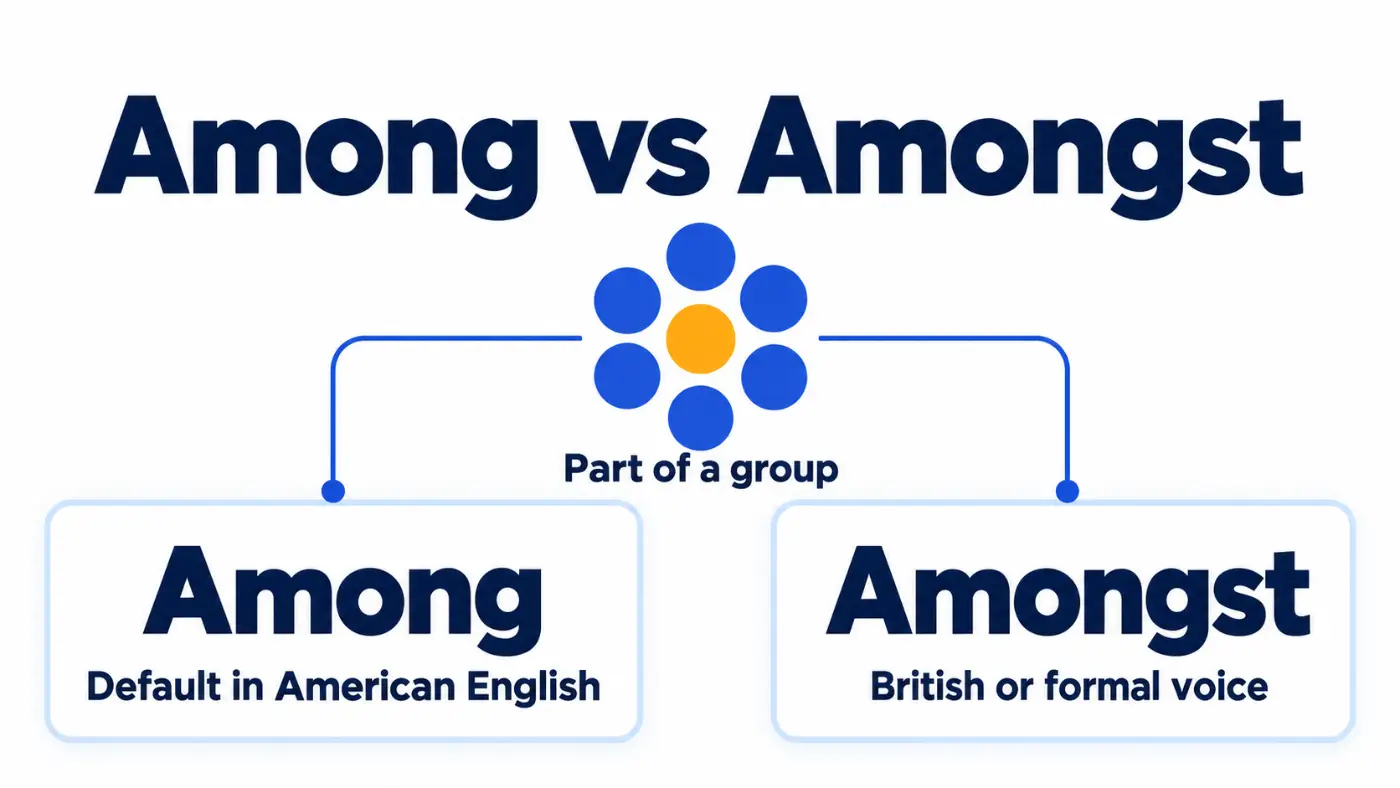
Both words are correct and mean exactly the same thing: in the midst of, surrounded by, or part of a group. Use among as your default, especially in American English, and reserve amongst for a British voice, a formal register, or a rhythm that genuinely needs the extra syllable.
Related Post: counsel vs council
The Short Answer at a Glance
| Question | Answer |
|---|---|
| Do they mean the same thing? | Yes, with no difference in meaning |
| Which is safer in any context? | Among |
| Which dominates American writing? | Among, by a wide margin |
| Which appears more in British writing? | Amongst, though among still leads |
| Is amongst an error? | No, but it can sound dated or affected in the US |
What Among Means and How It Works
Among is a preposition that places something inside a group of three or more items, people, or things that are not individually singled out. It answers the question “within which collection?” rather than “between which specific points?”
Its core uses fall into a few patterns:
- Location within a crowd or cluster: Priya found her umbrella among the coats piled on the bed.
- Membership in a set: Lagos is among the fastest-growing cities in Africa.
- Sharing or division across a group: The estate was split among five grandchildren.
- Mutual activity inside a group: The residents argued among themselves for an hour.
- Selection from a larger pool: Marcus chose the oldest map from among dozens in the archive.
The word is old, descending from Old English on gemang, meaning “in the crowd.” That history explains why it works naturally with collective ideas: crowds, teams, families, populations, piles. The object that follows it is almost always plural or a collective noun, since you cannot be in the midst of a single indivisible thing.
What Amongst Means and How It Works
Amongst does every job among does. It is the same preposition wearing an extra -st. That ending grew out of a quirk in Middle English, where an adverbial -es ending picked up a stray t, a pattern that also gave English whilst and against. The -st forms never left, and British speakers kept them in circulation far more than Americans did.
Because the meaning is identical, any sentence that accepts among accepts amongst without changing what it communicates:
- Dr. Okafor sat amongst the first-year students.
- The letter was hidden amongst old tax returns.
- Resentment spread amongst the night-shift staff.
What does change is tone. In Britain, amongst can feel natural, mildly literary, or simply habitual. In the United States, it tends to read as formal, archaic, or deliberately British. It also tends to appear before words beginning with a consonant or a soft the, where speakers like the sound of the trailing t leading into the next word.
Among vs Amongst: Key Differences Side by Side
| Feature | Among | Amongst |
|---|---|---|
| Meaning | In or surrounded by a group | Identical |
| Part of speech | Preposition | Preposition |
| Origin | Old English on gemang | Later variant with added -st |
| US frequency | Very high | Low |
| UK frequency | High | Moderate to high |
| Tone | Neutral | Slightly formal, older, or British-flavored |
| Safe in all dialects | Yes | Mostly, with a US caveat |
| Syllables | 2 | 2 (the extra sound is a consonant cluster) |
The practical gap is stylistic, not grammatical. A reader will never misunderstand you either way, but in American prose amongst can pull attention toward the word itself, which is rarely what you want. If you are writing for a mixed or international audience, among travels without friction.
Correct Examples in Real-Life Contexts
Among
- The coach divided the prize money among the twelve players who traveled to Denver.
- A single red scarf stood out among the gray commuters on the Chicago platform.
- Among her many talents, Dolores could fix a carburetor blindfolded.
- Tensions among the board members delayed the merger by a quarter.
- The recipe card was tucked among Grandma’s cookbooks in a Savannah attic.
- Malik was among the last volunteers to leave the flood shelter.
Amongst
- Rumors circulated amongst the staff at the Edinburgh hotel before the new manager arrived.
- The botanist found a rare orchid amongst the ferns on the Cornish cliffs.
- Hannah felt at ease amongst strangers in a way her brother never did.
- Discontent was growing amongst the fans after a third straight defeat at Anfield.
- He counted himself fortunate to be amongst friends on the longest night of the year.
Common Mistakes People Make (and How to Catch Them)
1. Misspelling the word as “amoung.” The o comes before the n. A memory hook: among has mon in it, and a crowd is “a mong” of people. Spell-checkers usually catch this, but autocorrect sometimes swaps it for the wrong word.
2. Using among with only two things. Among suggests a group of three or more. “The argument among Sofia and Ravi” is off, because there are only two people. Use between: the argument between Sofia and Ravi.
3. Following among with a singular, non-collective noun. “She disappeared among the traffic” works because traffic acts as a mass of vehicles. “He stood among the lamppost” does not, because a lamppost is one object. If the noun cannot represent a crowd, the preposition does not fit.
4. Treating amongst as a mistake in British text. In UK writing, amongst is not an error to be “fixed.” Editors changing a British author’s amongst to among are altering voice, not correcting grammar.
5. Mixing both forms in one document without reason. Writing “among the staff” in paragraph one and “amongst the staff” in paragraph four looks careless. Pick one and keep it consistent unless a deliberate rhythm demands otherwise.
6. Writing “among each other.” Many editors prefer among themselves for groups of three or more and reserve each other for pairs, so “the villagers argued among themselves” reads more cleanly than “among each other.” Both appear in respectable print, but the first sounds sharper.
7. Using amongst in an American business email to sound polished. The effect is often the opposite. A plain among signals clarity.
A Fast Trick to Choose the Right One
Run a three-second check:
- Pick among. It is correct in every dialect and every register.
- Ask whether you have a reason to switch. The valid reasons are a British-style voice, a quoted or historical passage, or a sentence whose rhythm benefits from the extra consonant.
- If you have no reason, stay with among.
For the separate among versus between decision, count the participants. Two points, use between. A crowd or three-plus items treated as a mass, use among. But if three or more items are being related to one another individually, between still works: “a treaty between France, Spain, and Portugal” treats each pairing as distinct.
How They Sound in Real Situations
Passage 1: A newsroom in Cleveland
The mayor’s proposal found little support among council members. Three of the nine voted against it, and others were undecided, spreading doubt among colleagues who had initially backed the plan.
Note: American journalism style defaults to among. Amongst would draw an editor’s pencil here.
Passage 2: A village pub in Yorkshire
“There’s been a fair bit of grumbling amongst the regulars,” Beryl said, wiping down the bar. “Not that anyone will say it to his face. They’d rather keep it amongst themselves.”
Note: In spoken British English, amongst slides easily into dialogue and sounds natural. Using it twice in a short stretch fits the character’s voice.
Passage 3: A university lecture in Toronto
Scholars still debate who deserves credit for the discovery. Among the candidates, Elena Marsh stands out, though amongst her contemporaries she remained largely unknown.
Note: This mixes both forms, which is inconsistent but mirrors how some Canadian and international writers actually behave. In edited prose, choosing one would be tidier.
Formal Writing vs Casual Writing
In casual speech and writing, among is overwhelmingly common in North America, and even in Britain people say it more than they say amongst in everyday texts and emails. Amongst is not casual in the US; it carries a slightly bookish flavor.
In formal writing, such as academic papers, legal documents, and reports, among remains the conservative choice for American readers. British formal writing tolerates and sometimes favors amongst, particularly in older legal or literary traditions, but modern UK style guides increasingly prefer the shorter form too.
For business writing across borders, among is the neutral pick. Reserve amongst for creative or period pieces where the voice is part of the point, such as a Victorian-style short story or a British character’s narration.
US vs UK English Differences
This is one of the few genuine regional splits in the pair.
American English: Among is standard. Amongst appears rarely and often marks a writer as imitating British style or aiming for an elevated tone. Major American style references recommend the shorter form.
British English: Both are accepted. Amongst appears more often than in the US, particularly in literary writing, journalism with a traditional bent, and speech. Still, among is common in the UK as well, so you will see both in a single newspaper.
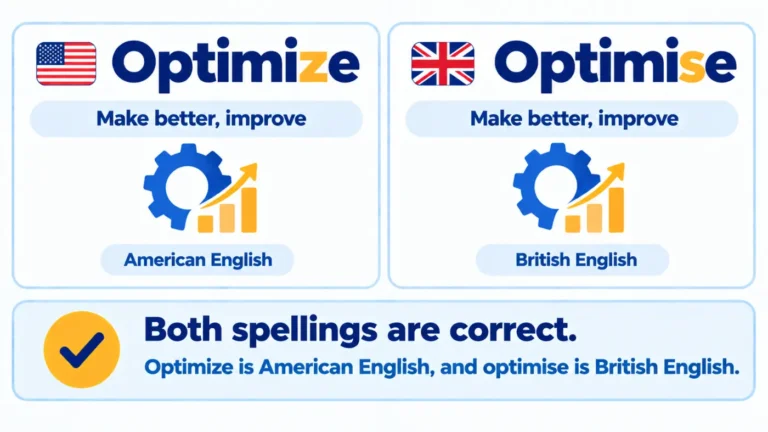
The same split applies to related pairs. Whilst sits beside while, amidst beside amid, and amongst beside among. In each case, British English keeps the longer variant alive and American English mostly drops it.
Canadian, Australian, and Irish English tend to sit between the two poles, with among leading and amongst available.
Related Mix-Ups People Also Search For
- Among vs between: Use between for two items or distinct pairings, among for a group. “Split the cake between the twins” but “split the cake among the cousins.”
- Amid vs amidst: Same relationship as among and amongst. Amid is the default in US writing, and it means “in the middle of,” often with abstract situations: “amid the chaos.”
- While vs whilst: Whilst is a British variant of while, and it is rare in American English.
- Among vs amongst vs amoung: The last is simply a misspelling.
- Amongst us vs among us: Same meaning; only tone differs.
- Between vs betwixt: Betwixt is archaic and belongs in poetry or deliberate period voice.
- Amongst vs a mongst: “A mongst” is not a word. It sometimes appears as a typo from splitting the word during typing.
Exceptions, Edge Cases, and Tricky Situations
Mass nouns. Among generally wants plural or collective objects, but mass nouns that suggest a scattered group can work: “Among the debris, firefighters found a locket.” Debris behaves like a collective. Compare “among the water,” which sounds wrong because water lacks discrete parts here.
From among. The phrase “from among” is standard when selecting from a pool: “The committee will choose a chair from among its members.” From amongst is possible in British usage.
Among other things. This fixed expression introduces one item from a longer list: “The package includes, among other things, a charger.” Its British equivalent is “amongst other things.” Note that “among others” refers to people or items after the example, not to “other things.”
Among the first, among the best. In superlative phrases, among signals inclusion in a top tier without claiming the top spot: “Ines was among the best chess players in Madrid.” For a sole title, drop the preposition and say the best.
Among with three items related individually. If a treaty, a rivalry, or a calculation connects each item to each other item, between can still fit. “The rivalry between Brazil, Argentina, and Uruguay” is correct, because the relationships are pairwise.
Proper names and titles. If Amongst appears in a title, brand name, or quoted text, preserve it exactly. Do not “correct” it to among in a citation.
Video game “Among Us.” The title uses among, which is a fixed proper name and not a style decision.
Quick Practice: Test Yourself
Choose the best word for a US audience. Where both are acceptable, pick among and note whether amongst would also work in British English.
- The inheritance was divided ______ the three nephews. (among / between)
- There was a rift ______ the two founders. (among / between)
- A British novelist writes: “She felt lost ______ the crowd on Oxford Street.” (among / amongst — which fits the voice?)
- Which is a misspelling: among, amoung, or amongst?
- Fix this sentence: “The kids shared the toys among each other.”
- True or false: Amongst is grammatically incorrect in American English.
Answer key
- among. Three nephews form a group.
- between. There are two founders.
- Either works, but amongst suits a British literary voice.
- amoung.
- “The kids shared the toys among themselves” (or “with each other”).
- False. It is grammatical, just uncommon and stylistically marked.
Frequently Asked Questions
Is amongst a real word?
Yes. It is a standard English preposition recorded in major dictionaries, with the same meaning as among.
Which is more formal among or amongst?
Amongst often feels slightly more formal or literary, particularly in American English. In British English the formality gap is narrower and depends on the writer’s habits.
Can I use amongst in American writing?
You can, and nobody will call it wrong. Still, American readers and editors generally prefer among, so use amongst only when you want a British or elevated tone.
Is it among us or amongst us?
Both are correct. Among us is the everyday standard, and amongst us sounds more British or solemn.

Sophia Bennett writes educational content about English vocabulary, grammar, slang, and communication. She is passionate about making complex language topics accessible to students, professionals, and curious readers around the world.