Optimize vs Optimise: Which Spelling Is Correct?
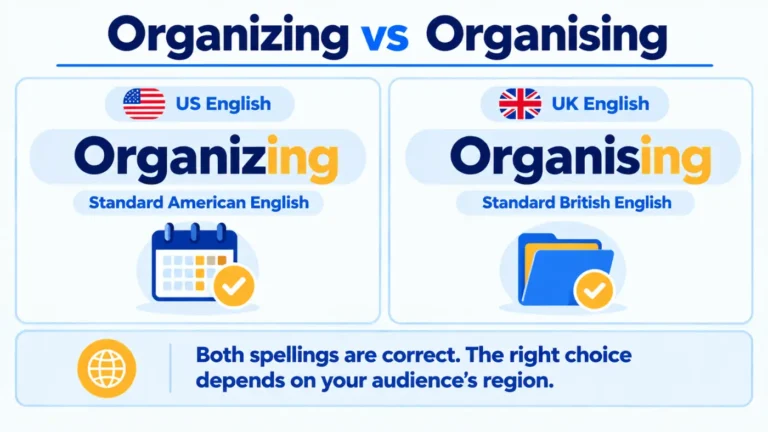
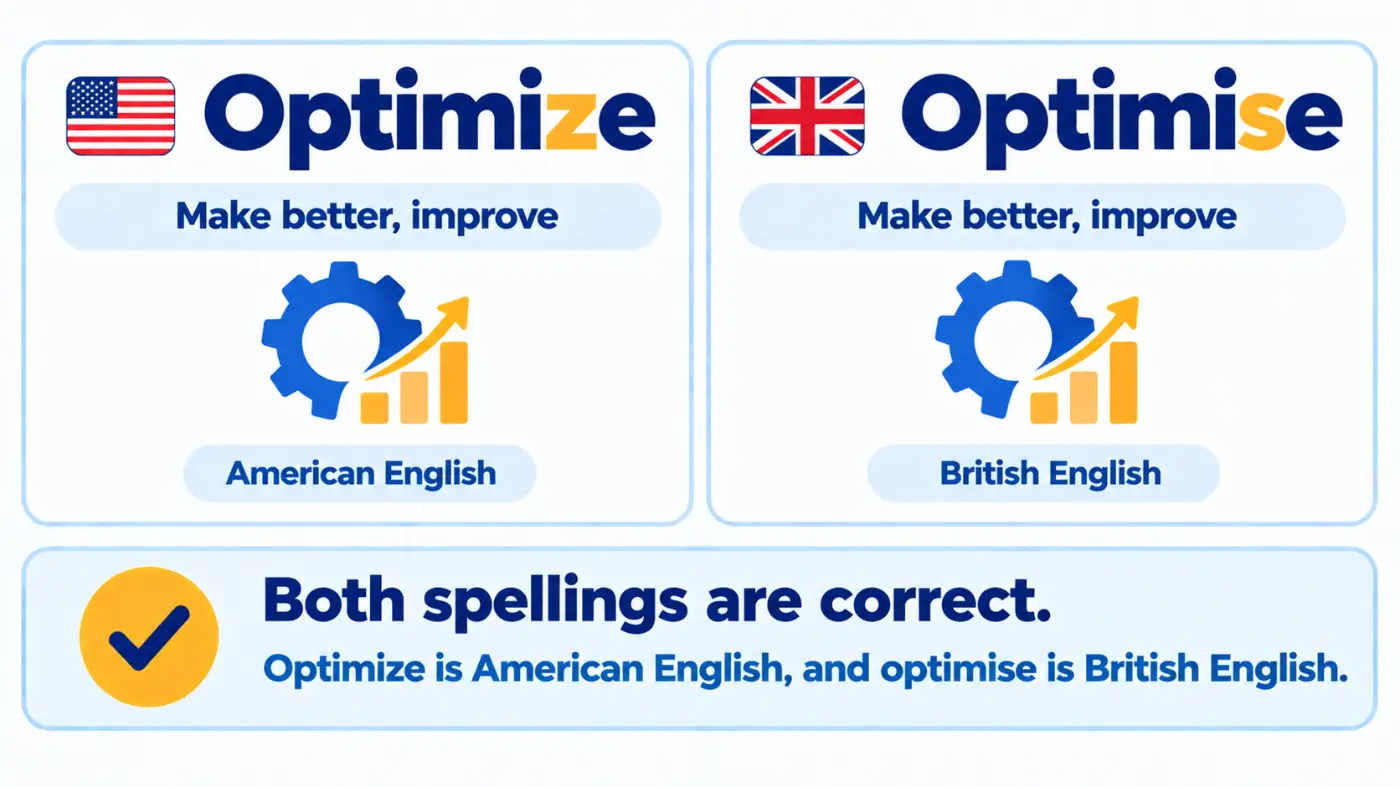
Both spellings are correct. Optimize is standard American English, and optimise is standard British English, and the right choice depends entirely on which regional spelling convention your audience expects.
The Short Answer at a Glance
| Form | Region | What it does | Example |
|---|---|---|---|
| optimize | American English | Verb meaning to make something as effective or efficient as possible | The team worked to optimize the app’s loading speed. |
| optimise | British English | Identical meaning to optimize | The team worked to optimise the app’s loading speed. |
Choose based on your reader’s regional spelling convention, not on which one seems more technical or correct. Neither spelling outranks the other.
What Optimize Means and How It Works
Optimize is a verb meaning to make something as effective, efficient, or functional as possible, often by adjusting variables until the best possible outcome is reached. It shows up constantly in technology, business, fitness, marketing, and everyday problem-solving, anywhere something can be improved through careful adjustment.
Grammatically, optimize is almost always transitive, meaning it takes a direct object. You optimize a website, a schedule, a workout routine, or a supply chain. It’s rare to see the verb standing completely alone without naming what’s being improved.
The verb follows the regular pattern:
- optimize (base form)
- optimizes (third-person present)
- optimized (past tense and past participle)
- optimizing (present participle)
The related noun is optimization, referring to the process or result of making something more effective, as in “search engine optimization” or “route optimization.” The adjective optimal, meaning the best or most favorable, is closely related in meaning, though it comes from a slightly different word history and doesn’t follow the same “-ize” versus “-ise” spelling pattern.
Optimize is standard in American English, appearing in US textbooks, software documentation, business writing, and everyday technical conversation. American style guides consistently use the “-ize” ending across this whole family of words, not just for optimize specifically.
What Optimise Means and How It Works
Optimise means exactly the same thing as optimize: to make something as effective or efficient as possible through careful adjustment. The definition, grammatical behavior, and typical usage are identical to the American form.
The spelling difference comes from a broader pattern affecting many English verbs ending in this sound. British English has historically used “-ise” as the default ending for a large group of verbs derived from Greek and Latin roots, including realise, organise, and recognise, alongside optimise. American English standardized on “-ize” for this same group instead.
It’s worth noting that this isn’t a completely clean split. Even within British English, some publishers and style guides, most notably Oxford University Press, prefer “-ize” spellings for etymological reasons, arguing that many of these words derive from Greek roots that originally used a “z” sound. This is sometimes called Oxford spelling. So while “-ise” is the more common British convention overall, “-ize” isn’t exclusively American.
Optimise is standard throughout most British and Commonwealth publishing, appearing in UK business writing, marketing materials, and everyday technical conversation across the UK, Australia, and similar English-speaking regions that generally favor British spelling conventions.
Optimize vs Optimise: Key Differences Side by Side
| Feature | Optimize | Optimise |
|---|---|---|
| Part of speech | Verb | Verb |
| Core meaning | To make something as effective or efficient as possible | Identical meaning |
| Typical use | American business, tech, and everyday writing | British and Commonwealth business, tech, and everyday writing |
| Register | Standard in all registers | Standard in all registers |
| Example | She optimized the ad campaign for better click-through rates. | She optimised the ad campaign for better click-through rates. |
What the table can’t fully capture is how closely this split tracks the broader American versus British “-ize” versus “-ise” pattern across dozens of related words. If a document already uses American spellings like organize and realize, optimize will match. If it uses British spellings like organise and realise, optimise is the expected companion.
Correct Examples in Real-Life Contexts
Everyday speech (American)
- I’ve been trying to optimize my morning routine so I actually get to work on time.
- We should optimize the seating chart so the kids aren’t all sitting together.
- He’s constantly optimizing his fantasy football lineup, it’s a little excessive.
Everyday speech (British)
- I’ve been trying to optimise my morning routine so I actually get to work on time.
- We should optimise the seating chart so the kids aren’t all sitting together.
Workplace writing (American)
- The engineering team is optimizing the checkout flow to reduce cart abandonment.
- Please optimize these product descriptions for search before the site relaunch.
- Our goal this quarter is to optimize warehouse operations and cut shipping delays.
- The marketing team optimized the email subject lines based on last month’s open rates.
Workplace writing (British)
- The engineering team is optimising the checkout flow to reduce cart abandonment.
- Our goal this quarter is to optimise warehouse operations and cut shipping delays.
Texting (American)
- trying to optimize my sleep schedule before finals week, wish me luck
- app update supposedly optimizes battery life, we’ll see
School and academic (American)
- The engineering thesis focuses on algorithms designed to optimize energy consumption in electric vehicles.
- Students were asked to optimize their study schedules using time-blocking techniques.
- The lab experiment tested different methods to optimize crop yield under limited water conditions.
School and academic (British)
- The engineering dissertation focuses on algorithms designed to optimise energy consumption in electric vehicles.
- The coursework required students to optimise their study schedules using time-blocking techniques.
Formal writing (American)
- The report outlines strategies to optimize resource allocation across departments.
- Regulatory guidelines require companies to optimize safety protocols in high-risk facilities.
- The proposed algorithm optimizes delivery routes based on real-time traffic data.
Formal writing (British)
- The report outlines strategies to optimise resource allocation across departments.
- The proposed algorithm optimises delivery routes based on real-time traffic data.
Common Mistakes People Make (and How to Catch Them)
Mixing spellings within one document
Wrong: The team decided to optimize the homepage, and later they optimised the checkout page. Right: The team decided to optimize the homepage, and later they optimized the checkout page.
Switching between spellings mid-document looks inconsistent and often happens when writers copy text from sources using different regional conventions without checking for consistency.
Assuming one spelling is more technical or modern
Wrong belief: Optimize is the newer, more tech-industry term, while optimise is old-fashioned. Right understanding: Both are equally current and equally technical, differing only by region, not by era or industry.
Because so much software documentation originates from American companies, some writers assume optimize is inherently the “correct” tech term. It’s simply the American spelling, not a more advanced or accurate one.
Ignoring your organization’s established style guide
Wrong: A UK-based company’s website uses optimize in some sections and optimise in others, depending on which writer created the content. Right: The company consistently uses one spelling throughout its site, matching its stated brand style guide.
This isn’t really a language error, but an inconsistency problem that becomes noticeable at scale, especially for companies operating across multiple English-speaking markets.
Autocorrect flipping the spelling unexpectedly
Wrong: A writer types optimize, but a British-English spellcheck setting quietly changes it to optimise mid-document. Right: Checking your document’s language settings before finalizing content meant for a specific regional audience.
This is a formatting hazard rather than a language mistake, but it can slip through unnoticed in shared documents or templates used internationally.
A Fast Trick to Choose the Right One
Match it to your audience’s broader spelling system. If your document already uses American spellings like organize, realize, and color, stick with optimize. If it uses British spellings like organise, realise, and colour, use optimise.
A second trick: think of optimize and optimise as part of the same family as organize and organise, or realize and realise. If you already know which spelling convention you’re using for those words, optimize and optimise will follow the identical pattern.
This trick works well because the “-ize” versus “-ise” split applies consistently across this entire group of verbs in each regional standard. Its only real limitation is the Oxford spelling exception mentioned earlier, where some British publishers use “-ize” endings for etymological reasons even while following otherwise British conventions.
How They Sound in Real Situations
A text exchange (American)
Priya: Did you finish tweaking the landing page?
Marcus: Yep, optimized it for mobile this afternoon.
Priya: Perfect, let’s see how conversions look tomorrow.
Optimized is correct here because the conversation uses standard American spelling throughout.
A workplace email (British)
Subject: Website performance update
Hi Tom,
I’ve optimised the product pages for faster load times, and early data looks promising. Could you review the analytics dashboard before our call on Thursday?
Regards, Priya
Optimised is correct because the email follows British spelling conventions consistently.
An article-style excerpt (American)
Engineers say the updated software optimizes battery usage by adjusting background processes based on how frequently an app is used. Early testing suggests users could see meaningfully longer battery life without changing their habits.
Optimizes fits naturally here in a piece written for an American technology audience.
Formal Writing vs Casual Writing
The spelling choice doesn’t shift based on formality. Both optimize and optimise are fully standard in academic papers, business reports, casual conversation, and technical documentation within their respective regions.
What matters more than formality is audience and publication standard. A US-based tech company will expect optimize consistently throughout its documentation, marketing, and internal writing. A UK-based company will expect optimise in the same spots. Mixing the two within one formal document, regardless of tone, tends to look like an editing oversight rather than a deliberate stylistic choice.
AP style, which is American, uses optimize consistently. Most British style guides favor optimise, though as noted, some UK publishers following Oxford spelling conventions use “-ize” instead. Neither approach treats the other spelling as incorrect; they simply reflect different, equally legitimate editorial standards.
US vs UK English Differences
This is a genuine US versus UK spelling split, following the same broader pattern as many other “-ize” versus “-ise” verb pairs. Optimize is standard throughout American English, appearing in US textbooks, software documentation, and business writing. Optimise is standard throughout most British English and Commonwealth writing, including much of the UK, Australia, and similar regions that generally favor British spelling conventions.
This pattern mirrors other well-known American versus British pairs like organize versus organise and realize versus realise. If you’re already familiar with that broader pattern, you already understand this one. The one added wrinkle is that some British publishers, notably those following Oxford University Press style, use “-ize” spellings across this whole word family for historical reasons, even while otherwise using British English.
Related Mix-Ups People Also Search For
Organize vs Organise
This pair follows the identical US versus UK pattern as optimize and optimise. Organize is standard American English, and organise is standard British English. Example: The American event planner organized the schedule, while her British counterpart organised the venue logistics.
Realize vs Realise
Another verb in the same “-ize” versus “-ise” family, following the same regional split. Example: It took him a while to realize, or realise, depending on which side of the Atlantic you’re on, that the meeting had already started.
Optimize vs Optimal
Optimize is the verb describing the action of making something as effective as possible, while optimal is an adjective describing the best or most favorable state itself. Example: After weeks of testing, the team finally reached the optimal settings by continuing to optimize the algorithm.
Optimization vs Optimisation
This pair mirrors the verb split exactly, since the noun form follows the same regional spelling convention as the verb it comes from. Example: The American report focused on cost optimization, while the British version of the same study used cost optimisation throughout.
Quick Practice: Test Yourself
Choose the spelling that fits each context.
- A US-based software company’s blog explains how to ______ app performance. (optimize / optimise)
- A British marketing agency’s case study describes how they ______ a client’s ad spend. (optimize / optimise)
- An American engineering textbook includes a chapter on how to ______ fuel efficiency. (optimize / optimise)
- A UK university’s research paper discusses methods to ______ crop yields. (optimize / optimise)
- A US patent application describes a process to ______ manufacturing output. (optimize / optimise)
- An Australian business report recommends ways to ______ supply chain logistics. (optimize / optimise)
Answer Key
- optimize: American context calls for the American spelling.
- optimised: British context calls for the British spelling.
- optimize: matches the American textbook’s regional convention.
- optimise: matches UK academic spelling standards.
- optimize: US patents follow American spelling conventions.
- optimise: Australian business writing typically follows British spelling conventions.
Frequently Asked Questions
Is optimize or optimise the correct spelling?
Both are correct. Optimize is standard American English, and optimise is standard British English, so the right choice depends on your audience’s regional spelling convention.
Do optimize and optimise mean the same thing?
Yes. Both words describe the process of making something as effective or efficient as possible, with no difference in meaning or grammatical function.
Why does British English sometimes use “-ize” instead of “-ise”?
Some British publishers, most notably Oxford University Press, use “-ize” spellings across this word family for etymological reasons, since many of these verbs derive from Greek roots that historically used a “z” sound. This is often called Oxford spelling.
Which spelling should I use for a US-based audience?
Use optimize for American audiences, since it matches standard US spelling conventions used in business, technology, and academic writing.
Is one spelling more technically correct than the other?
No. Neither spelling is more accurate or more advanced than the other. The difference is regional, not a matter of correctness or technical precision.
Can I use optimize and optimise interchangeably in the same document?
It’s best to choose one and use it consistently throughout a single document, since mixing the two regional spellings can look inconsistent even though both are individually correct.

Sophia Bennett writes educational content about English vocabulary, grammar, slang, and communication. She is passionate about making complex language topics accessible to students, professionals, and curious readers around the world.