Anytime vs Any Time Which One Is Correct
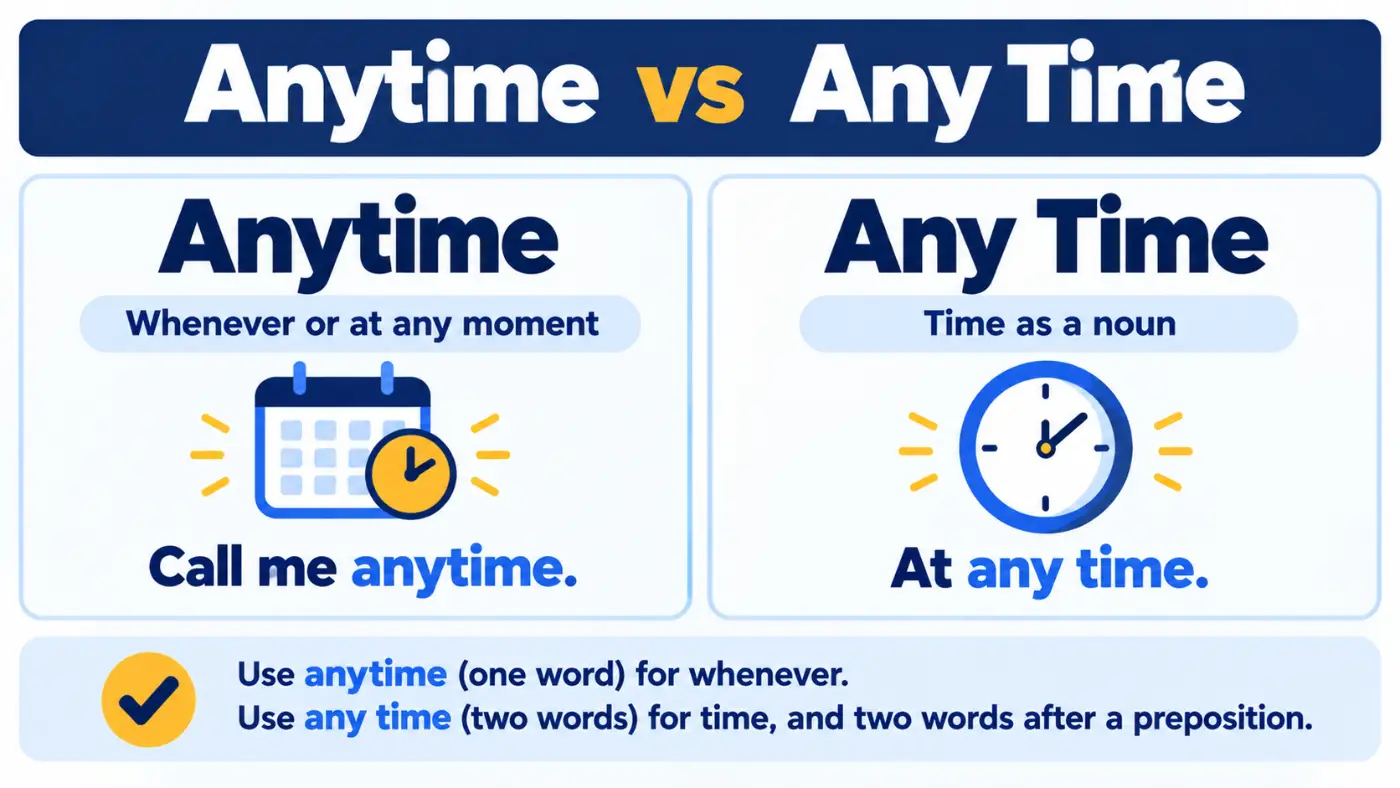
Anytime is one word, an adverb that means whenever or at any moment, as in call me anytime. Any time is two words when time works as a noun, as in at any time or do you have any time. If a preposition sits in front of it, always write two words.
The Short Answer at a Glance
Both forms are real. The difference is whether time is part of a bigger word or stands alone as a noun.
| Form | What it does | Example |
|---|---|---|
| Anytime | Adverb meaning whenever or at any moment. | Stop by anytime after four. |
| Any time | Noun phrase meaning any moment or any amount of time. | The offer can end at any time. |
What Anytime Means and How It Works
Anytime is an adverb, which is a word that tells you when or how something happens. It means at whatever moment, and it usually lands right after a verb. You can call anytime, visit anytime, or ask anytime.
It also acts like a joining word. Many dictionaries list it as a conjunction too, which means it can introduce a clause, as in anytime the power flickers, the router restarts. In that job, it works like whenever.
A casual reply uses it too. When someone thanks you for a ride, you can answer with a quick anytime and mean you’d happily do it again.
The word never needs a helper. It carries the meaning of at any moment inside it, so adding at in front of it doubles up the idea. That’s why a preposition and anytime don’t usually travel together in careful writing.
What Any Time Means and How It Works
Any time is a noun phrase made of two parts. Any is a small word that points to something unspecified, and time is the noun it points to. Together they mean any moment or any amount of time.
Because time is a real noun here, the phrase behaves like other noun phrases. It follows prepositions, as in at any time, before any time, or for any time at all. It works as an object, as in I don’t have any time this week. It pairs with extra words, as in any time of day or any time soon.
It can also work like an adverb without a preposition. Call me any time is correct and means the same thing as call me anytime. That overlap is where most of the confusion lives, and in that spot both forms are accepted.
Think of any time as the sturdy default. It’s correct in nearly every sentence where time is doing noun work, and it’s safe in formal writing too.
Anytime vs Any Time Key Differences Side by Side
| Feature | Anytime | Any time |
|---|---|---|
| Part of speech | Adverb, and informally a conjunction. | Noun phrase, sometimes used like an adverb. |
| Core meaning | Whenever, at any moment. | Any moment, or any amount of time. |
| After a preposition | Not standard. | Always correct. |
| Works as an object | No. | Yes, as in I have no time. |
| Typical register | Everyday and business English, especially American. | Neutral and fine at every level. |
| Example | Call anytime you need a hand. | Call at any time you need a hand. |
The table can’t show how often the two forms overlap. After a verb with no preposition, both are accepted, so call anytime and call any time mean the same thing. The table also can’t show how readers react. Some editors prefer the two word form in formal writing, while many everyday readers never notice the difference.
Correct Examples in Real Life Contexts
Anytime in Action
- Everyday speech: Stop by anytime after four, because Marisol keeps the porch light on.
- Workplace writing: Our support line stays open anytime during the holiday week.
- Texting: Anytime! I’m happy to pick you up from the airport.
- School: Anytime a variable changes, the spreadsheet recalculates every total.
- Customer notice: Members may reschedule anytime before the class begins.
Any Time in Action
- Everyday speech: Tomas doesn’t have any time to cook this week.
- Workplace writing: The contract may be amended at any time with written notice.
- Texting: Got any time Friday to look over my slides?
- School: Students may submit questions at any time before the lab session.
- Formal writing: Any time spent on the appeal will not extend the filing deadline.
- Adverb use: You can reach me any time after nine.
Common Mistakes People Make and How to Catch Them
- Writing at anytime. Wrong → The policy can change at anytime. Right → The policy can change at any time. The preposition needs a noun phrase after it, and anytime is an adverb.
- Using anytime as a noun object. Wrong → I don’t have anytime on Tuesday. Right → I don’t have any time on Tuesday. Time is the thing being possessed, so it has to stand alone as a noun.
- Writing for anytime. Wrong → Is the pool open for anytime this weekend? Right → Is the pool open at any time this weekend? A prepositional phrase calls for the two word form.
- Gluing the words in a modified phrase. Wrong → We’ll leave anytime of the morning. Right → We’ll leave any time of the morning. Of the morning attaches to time as a noun, so time can’t be fused into another word.
- Pluralizing the wrong piece. Wrong → I’ll check in at anytimes. Right → I’ll check in at any time. Neither form takes a plural s in this meaning, and anytimes isn’t standard English.
- Switching forms inside one document. Wrong → Call anytime today, and any time next week. Right → Pick one form and stay with it when the meaning is the same. Switching reads like carelessness.
- Trusting spellcheck. Both forms are real, so nothing gets flagged. Only the sentence structure tells you which one fits.
A Fast Trick to Choose the Right One
Use the preposition test. If a preposition such as at, for, in, before, or after sits right in front of the phrase, write two words. At any time, before any time, and for any time all work, and the fused spelling doesn’t belong there.
Then use the whenever swap. If you can replace the word with whenever and the sentence still works, anytime is available. Call me whenever works, so call me anytime is correct.
For a third check, try any amount of time. If it fits, you want two words. Do you have any amount of time works, so do you have any time is right.
The tests have limits. In a sentence like call me any time, both forms pass every test, and either is accepted. When both work, choose by tone and stay consistent.
How They Sound in Real Situations
A text exchange
Jess: Can I borrow your ladder this weekend?
Marco: Sure, grab it anytime. I won’t have any time to use it until Sunday.
Jess: Perfect, I’ll come by Saturday morning.
Marco’s anytime means whenever and follows the verb. His any time names an amount of time he lacks.
An email snippet
Hi Priya, thanks for the update. The vendor can cancel the order at any time before shipment, so let’s confirm quantities today. If you have questions, reach out anytime, and I’ll answer as soon as I’m out of meetings.
At any time follows a preposition, so it takes two words. The second sentence uses anytime as an adverb after reach out.
An article excerpt
The park stays open anytime between dawn and dusk, but staff say crowds peak midday. Visitors don’t need to book in advance, though the shuttle may stop running at any time if winds pick up.
Anytime acts as an adverb in the first sentence. At any time follows a preposition in the second.
Formal Writing vs Casual Writing
Both forms are correct in every setting, but the two word form is the safer choice in formal writing. Contracts, legal notices, academic papers, and official letters lean on at any time, and that phrase is standard in all of them.
Anytime is common in American business email, marketing copy, news writing, and everyday speech. Major American dictionaries list it as an adverb, and many writers use it freely. Some editors and style guides still prefer two words in formal prose, so follow the guide your publication uses.
Casual writing is the most flexible. Texts, social posts, and chat messages use anytime constantly, and the quick reply anytime is as natural as it gets. The only firm point is the preposition rule. Even in a text, at anytime tends to look like a slip.
Anytime vs Any Time in American and British English
There’s a mild regional lean. Anytime is more common in American writing, where the one word adverb has become ordinary in everyday and business English. British writers tend to prefer two words, and some British editors treat the fused form as an Americanism.
The lean isn’t a strict rule. You’ll find anytime in British writing and any time in American writing, and neither one will confuse a reader. If you’re writing for a British publication, follow its house style. For American readers, either form works where both are accepted, and two words remain the safer choice in formal documents.
Related Mix Ups People Also Search For
Sometime vs Some Time
Sometime means at an unspecified moment, and some time means an amount of time. We should meet sometime next month, and I need some time to think it over.
Anyone vs Any One
Anyone means any person at all. Any one means a single item from a group. Anyone can join the club, but any one of the three plans would work.
Anyway vs Any Way
Anyway is an adverb that means regardless or in any case. Any way is a noun phrase meaning any method. We left anyway, and I’m open to any way of fixing the schedule.
Everyday vs Every Day
Everyday is an adjective meaning ordinary. Every day means each day. Her everyday routine starts with a walk, and she walks every day before work.
Exceptions Edge Cases and Tricky Situations
- At any time is a fixed phrase. It works as a unit, and the fused form doesn’t replace it after a preposition.
- Any time soon is standard, and anytime soon appears in informal writing. Many editors prefer two words there, so choose the two word form in anything formal.
- Any time now is a fixed phrase that means very soon. It almost always appears as two words.
- Anytime can introduce a clause. Anytime the alarm sounds, everyone heads to the lot. The two word version, any time the alarm sounds, is also acceptable.
- Quick replies favor the one word form. Anytime! is far more common than Any time! as a friendly answer to thanks, though both appear.
- Noun uses need two words. I don’t have any time, any time you save is a bonus, and any time spent on this is wasted all keep the pieces apart.
- Brand names and titles keep their own spelling. If a company writes AnyTime or Any Time in its name, quote it exactly.
- Consistency beats cleverness. In a single document, use one form for the same meaning.
Quick Practice Test Yourself
Choose anytime or any time for each sentence.
- The offer can be withdrawn at ____ without notice.
- Do you have ____ to review my draft this afternoon?
- In a casual reply to thanks, which is more common, Anytime or Any time?
- Rosa hasn’t had ____ to herself since March.
- Choose the correct phrase, at anytime or at any time.
- There’s no way I’ll finish ____ soon. Choose the form most editors prefer.
Answer Key
- Any time. A preposition comes before it, so it needs two words.
- Any time. It means an amount of time and acts as a noun.
- Anytime. The one word form is more common in casual replies, though both appear.
- Any time. It’s the object of had, and time is a noun.
- At any time. After a preposition, the noun phrase stays in two words.
- Any time. Anytime soon appears informally, but many editors prefer two words.
Frequently Asked Questions
Is anytime one word or two?
Both forms exist. Anytime is a one word adverb meaning whenever, and any time is a two word noun phrase used after prepositions or as an amount of time.
Is at anytime correct?
Most editors would change it to at any time. A preposition needs a noun phrase after it, and the two word form supplies one.
Is it any time soon or anytime soon?
Any time soon is the form many editors prefer. Anytime soon shows up in informal writing and speech.
Can I use anytime in a business email?
Yes. It’s common in American business email, though some formal style guides prefer two words, so check yours.
Is anytime a real word?
Yes. Major American dictionaries list it as an adverb, and some also list it as a conjunction.
Do British writers use anytime?
They do, but British writers tend to prefer two words, and some editors see the fused form as more American.

Sophia Bennett writes educational content about English vocabulary, grammar, slang, and communication. She is passionate about making complex language topics accessible to students, professionals, and curious readers around the world.