Resume vs CV Which One Do You Need
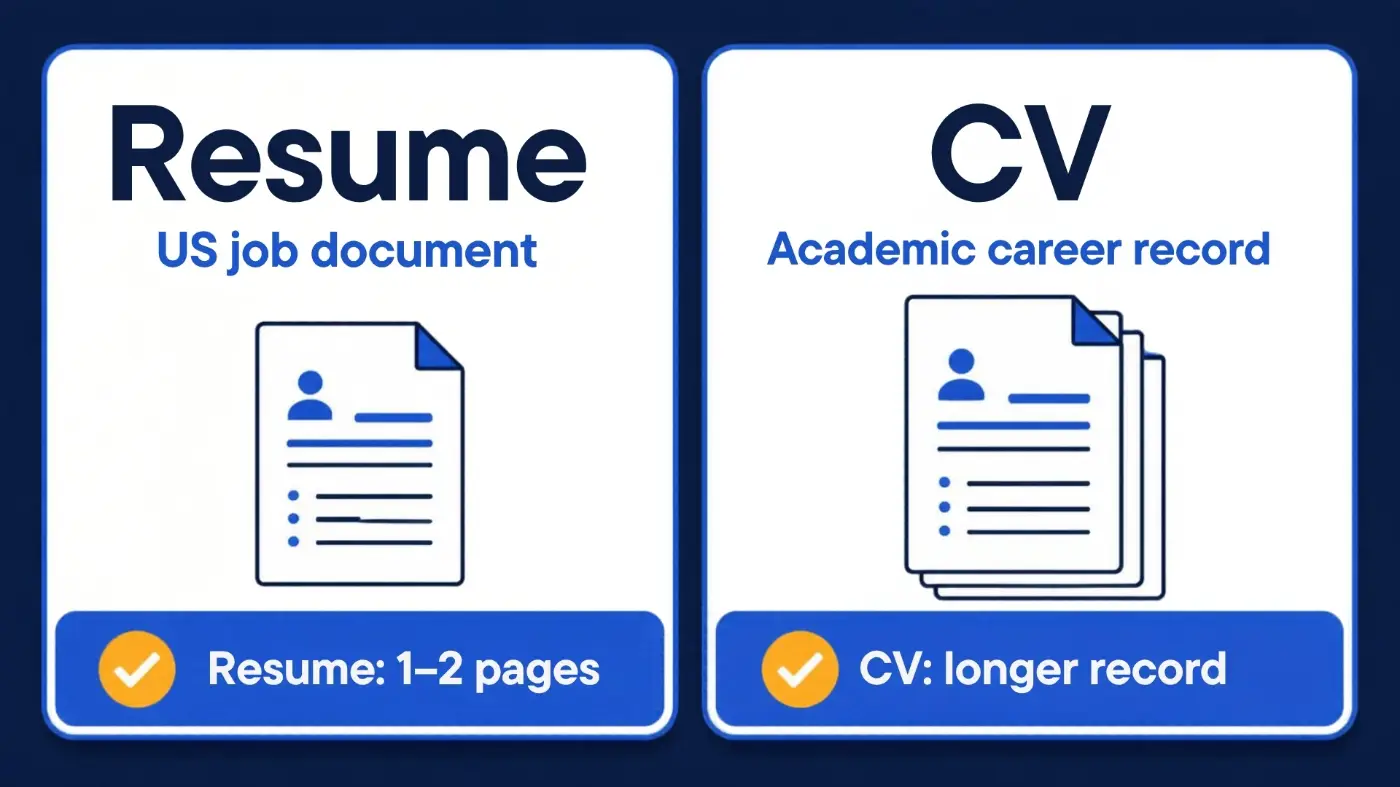
A resume is a short, targeted summary of your work history, usually one or two pages, and it’s the standard job document in the United States. A CV, short for curriculum vitae, is a longer and more complete record of your career. It’s expected in academia, medicine, and research, and it’s the ordinary job application document in many countries outside North America.
The Short Answer at a Glance
Think of the resume as a highlight reel and the CV as the full archive.
| Document | Typical length | Where it’s expected | Example |
|---|---|---|---|
| Resume | One to two pages. | Most US jobs outside academia. | Dana cut her resume to one page before applying to the marketing role. |
| CV | Two pages to many, and it grows over time. | Academic, medical, and research roles, plus everyday job applications in the UK and many other countries. | Dr. Okoye added two new journal articles to her CV. |
What a Resume Means and How It Works
A resume is a brief document that lists your work experience, education, and skills, shaped to fit one specific job. It’s a noun, and you submit it, tailor it, update it, or send it along with an application.
In the United States, early career workers usually keep it to one page. People with a long track record often stretch to two. Employers expect a focused document, so older or less relevant jobs get trimmed or dropped. A typical resume holds contact details, a short summary, work history in reverse order, key skills, and education.
The word comes from French, where résumé means summary, and that’s a handy clue to its job. A resume summarizes. It doesn’t try to tell the whole story.
The spelling needs a note. The accented form résumé is the traditional spelling in print. Plain resume is extremely common in everyday typing, and it’s identical to the verb meaning to begin again. Context sorts them out, and so does pronunciation. The noun sounds like REZ-uh-may, and the verb sounds like ri-ZOOM. This guide uses the plain spelling because it’s what most people type and search.
What a CV Means and How It Works
A CV is a comprehensive record of your education, positions, and professional achievements. The abbreviation stands for curriculum vitae, a Latin phrase that means course of life. The plural is CVs or curricula vitae.
A CV doesn’t shrink to fit a job. It keeps growing. A new graduate’s CV might fill two pages, while a senior professor’s can run to dozens. That length isn’t a flaw. Hiring committees in academia expect to see every publication, conference talk, grant, course taught, award, and committee role.
Outside North America, the word means something more everyday. In the UK, Ireland, and many other countries, a CV is simply the document you send for any job. It’s usually kept to about two pages and trimmed for the role, so it behaves much like an American resume.
Always write the abbreviation in capital letters as CV. The full phrase stays lowercase unless it begins a sentence.
Resume vs CV Key Differences Side by Side
| Feature | Resume | CV |
|---|---|---|
| Core meaning | A short summary tailored to one job. | A full record of your career and credentials. |
| Typical length | One to two pages. | Two pages or more, with no fixed limit in academia. |
| Content | Relevant experience, skills, and education. | Everything, including publications, grants, teaching, and presentations. |
| Customization | Rewritten and trimmed for each application. | Updated by adding items, not cutting them. |
| Where expected | Most US and Canadian jobs. | Academia, medicine, research, and everyday job hunting in the UK and many other countries. |
| Register | Neutral and fits every setting. | Neutral and fits every setting. |
| Example | Send a one page resume to the hiring manager. | Submit your CV to the faculty search committee. |
The table can’t show how much the label depends on geography. The same two page document can be called a resume in Boston and a CV in Birmingham. What changes is the word, not always the paper. The table also can’t show how often job postings use the terms loosely, so the safest habit is to follow the instructions in each posting.
Correct Examples in Real Life Contexts
Resume in Action
- Everyday speech: Tomas kept his resume to a single page, even though he had worked at four restaurants.
- Workplace writing: Please attach your resume and a short cover note to the application form by Friday.
- Texting: Can you look over my resume before I send it to the hospital recruiter?
- School: The career center runs a Tuesday workshop on turning class projects into strong resume lines.
- Formal writing: Applicants for the analyst position must submit a resume that shows measurable results from previous roles.
CV in Action
- Everyday speech: Dr. Anand’s CV lists forty conference talks, and she still adds new ones every semester.
- Workplace writing: Send your CV and a covering letter to the hiring manager in Manchester by the end of the month.
- Texting: The Lisbon lab asked for a CV, so I’m digging out my old conference list tonight.
- School: The graduate handbook explains how to format a CV, with peer reviewed articles listed separately from book chapters.
- Formal writing: Committee members will review each finalist’s CV, teaching statement, and three letters of reference.
Common Mistakes People Make and How to Catch Them
- Sending a long CV to an ordinary US employer. Wrong → A seven page CV attached to a retail management application in Ohio. Right → A one page resume. People assume CV sounds more impressive, but US recruiters expect a short, focused document.
- Shrinking an academic CV into a resume for a faculty job. Wrong → A one page resume sent to a university search committee. Right → A full CV with publications and grants. Habits from industry job hunting carry over without anyone noticing.
- Writing curriculum vita for the full phrase. Wrong → Please attach your curriculum vita. Right → Please attach your curriculum vitae. The final e belongs there, though vita alone is also used as a short form in academia.
- Adding an apostrophe to the plural. Wrong → We received twelve CV’s this week. Right → We received twelve CVs this week. Abbreviations form plurals with a plain s.
- Treating the two words as identical in every posting. Wrong → Sending whichever document you have handy. Right → Sending the document the posting names. Some recruiters read the label literally.
- Writing the abbreviation in lowercase. Wrong → Update your cv before the deadline. Right → Update your CV before the deadline. It stands for two Latin words, so it takes capitals.
- Mixing accented and plain spellings. Wrong → A résumé and a resume in the same document. Right → One spelling used consistently. Switching mid page looks like a typo.
A Fast Trick to Choose the Right One
Use the summary and record rule. A resume summarizes, and the word is French for summary. A CV records, and the phrase is Latin for the course of your life. If you’re cutting things out to fit a page, you’re writing a resume. If you’re adding every new achievement to a running list, you’re keeping a CV.
For a second check, ask two questions. Where is the job, and who is reading? A US employer outside academia wants a resume. A university, a research institute, a grant committee, or an employer in a country where CV is the standard word wants a CV.
The trick has limits. Some employers use both words for the same thing, especially international companies. When the posting is unclear, read the length and content instructions, or ask the recruiter directly.
How They Sound in Real Situations
A text exchange
Ayesha: The job posting says CV. Do I send the same thing I used for the bank?
Ben: Check where the job is. A bank in Chicago wants a resume. A university lab in Edinburgh wants a CV with all your publications.
Ayesha: It’s the lab. Time to dig out the old conference list.
Ben uses resume for the American job and CV for the academic one. The choice follows the place and the reader.
An email snippet
Hi Marcus, thanks for applying. Please send an updated resume by Thursday, ideally one page, so the panel can compare candidates quickly. If you have research experience, mention it in a short note and we’ll ask for a full CV later if we move you forward.
The first request is for a short, focused document. The second shows that a CV can be requested as a later, fuller step.
An article excerpt
Job seekers who relocate often discover that the same document goes by two names. A candidate applying to a Texas startup sends a resume, while a candidate applying to a London firm sends a CV of about two pages. A professor seeking tenure submits a full CV that lists every grant and course.
The excerpt uses each word where its audience expects it.
Formal Writing vs Casual Writing
The choice depends on your audience, not on how formal the setting is. Resume and CV are both neutral words that work in a text, a business email, and an academic paper.
Capitalization is the main style point. Resume stays lowercase. CV is always capitalized. The full phrase curriculum vitae stays lowercase unless it begins a sentence.
Spelling follows a mild formality pattern. Many dictionaries and style guides list the accented résumé first, and it looks polished in print. Unaccented resume is common everywhere else. Online application forms and plain text systems can sometimes scramble accented letters, so unaccented spelling is the practical choice for digital files and filenames.
If your reader might not know the abbreviation, write curriculum vitae in full on first mention and use CV afterward.
Resume vs CV in American and International English
The difference is real and tied to geography. Americans say resume for the standard job document and keep CV for academic, medical, and research settings. Much of the rest of the world uses CV for the ordinary job document.
| Setting | Usual term for a job application | Notes |
|---|---|---|
| United States | Resume | CV for academic, medical, and research roles. |
| Canada | Resume, leaning American | CV for academic roles. |
| United Kingdom and Ireland | CV | Resume is understood but uncommon. |
| Australia and New Zealand | Both appear | Follow the wording in the posting. |
| Many other countries | CV is common | Conventions vary by employer. |
Content conventions also differ. Some countries expect details such as a photo or personal information that US employers generally don’t want on a resume. If you’re applying abroad, check local norms for the specific country and industry.
Related Mix Ups People Also Search For
Resume Noun vs Resume Verb
The noun means a job summary, and the verb means to begin again or continue. They share a spelling when the accents are dropped. Classes resume on Monday, so send your resume tonight.
CV vs Cover Letter
A cover letter is a short note that explains why you want the job and what you offer. It travels with your resume or CV but doesn’t replace either one. British writers often call it a covering letter. The cover letter introduced Priya, and her CV supplied the detail.
Curriculum Vitae vs Vita
Vita is a short form common in academia, and it means the same thing as CV. Some universities ask applicants to submit a vita along with a teaching statement.
Resume vs Bio
A bio is a short paragraph about you, written in sentences, for websites, conference programs, and speaker pages. A resume is a structured list of your work history. The conference asked for a fifty word bio, not a full resume.
Exceptions Edge Cases and Tricky Situations
- US federal job applications usually call for a resume, but it can run longer and carry more detail than a corporate one. The label stays the same.
- Some US industry research roles, such as scientific and medical positions, ask for a CV. Follow the posting.
- Postings sometimes say resume or CV and mean the same thing. This happens most at international companies.
- Some online forms cap length or file size. Those limits beat any general rule about how long a document should be.
- Moving from academia to industry means converting your CV into a tight resume. Keep the highlights and cut the long lists.
- The accented résumé, the plain resume, and the single accent resumé all appear in print. Pick one and stay with it.
- Plurals vary. Resumes and résumés both work, and CVs and curricula vitae both work. Avoid CV’s.
- Mid career professionals sometimes keep both documents. A master CV holds everything, and tailored resumes draw from it.
Quick Practice Test Yourself
Choose the best word or form for each sentence.
- A software company in Denver asks for a one page ____.
- A London recruiter writes, Please send your ____ and a covering letter.
- A faculty search committee at a state university wants your ____ with publications and grants.
- Choose the correct plural: CV’s or CVs.
- Choose the correct phrase: curriculum vita or curriculum vitae.
- Which sentence uses the verb? The resume is due Friday. Classes resume on Monday.
Answer Key
- Resume. A short document for an American corporate job.
- CV. It’s the standard UK term for a job application.
- CV. Academic hiring expects a full record.
- CVs. Abbreviations form plurals with a plain s.
- Curriculum vitae. The full Latin phrase ends in e.
- Classes resume on Monday. It means begin again, so it’s a verb.
Frequently Asked Questions
Is a CV the same as a resume?
Not exactly. A resume is a short summary tailored to a job, while a CV is a longer, complete record of your career. In some countries, though, CV is simply the everyday word for a job application document.
Which is longer, a resume or a CV?
A CV is usually longer, especially in academia, where it can run many pages. A US resume is typically one or two pages.
Do I need accents on resume?
No. Résumé with accents is the traditional spelling in print, but plain resume is widely accepted and very common. Choose one and stay consistent.
What does CV stand for?
It stands for curriculum vitae, a Latin phrase meaning course of life.
Should I send a CV or a resume to a US company?
Send a resume unless the posting asks for a CV. Academic, medical, and research roles are the usual exceptions.
Is the plural CVs or CV’s?
CVs. Abbreviations form plurals with a plain s, so no apostrophe is needed.

Sophia Bennett writes educational content about English vocabulary, grammar, slang, and communication. She is passionate about making complex language topics accessible to students, professionals, and curious readers around the world.