Setup vs Set Up: One Word Is a Thing, Two Words Are an Action
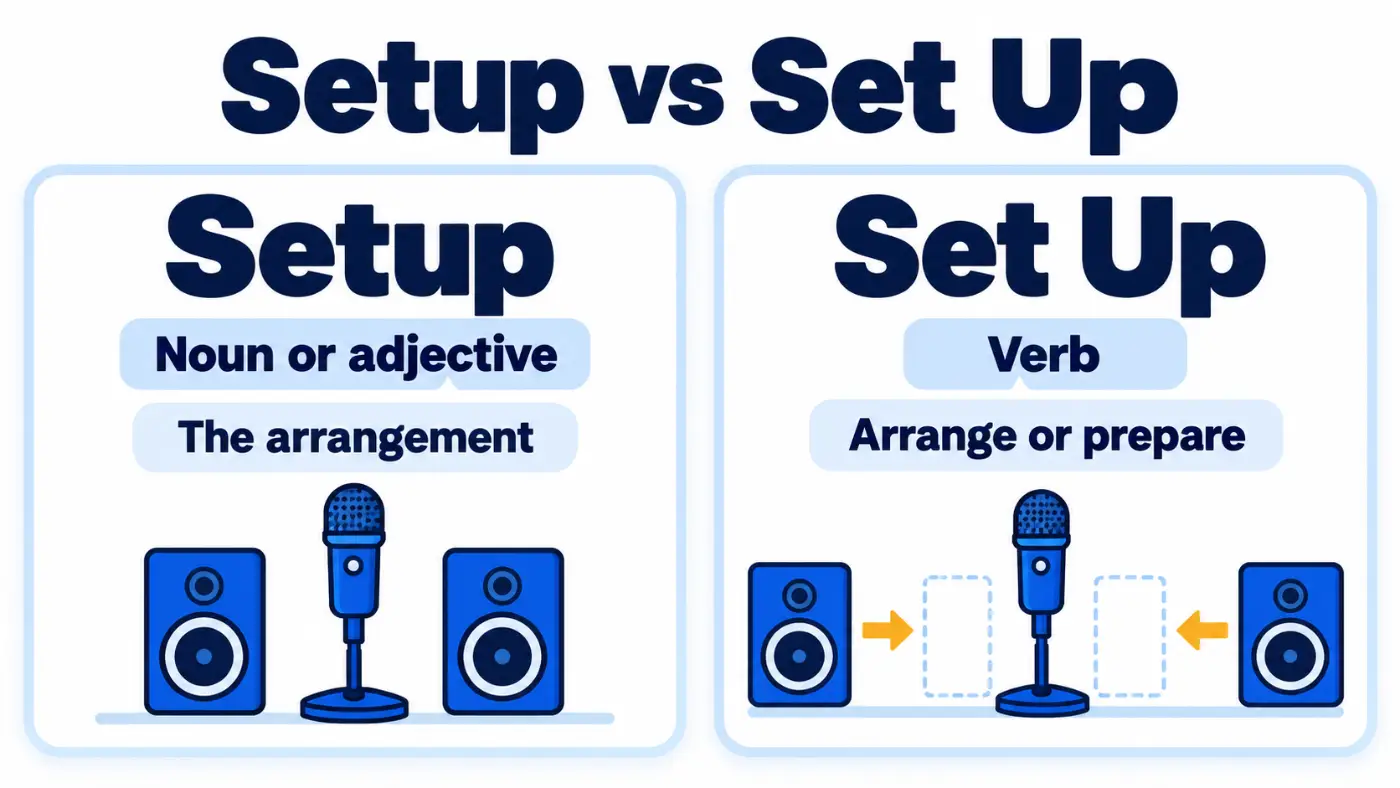
Set up, written as two words, is a verb that means to arrange, establish, or prepare something. Setup, written as one word, is a noun or adjective that names the arrangement itself. If you can put the or your before it, write setup. If it follows to, will, or a subject like I or we, write set up.
Related Post: advice vs advise
The Short Answer at a Glance
| Form | Part of Speech | Meaning | Example |
|---|---|---|---|
| Setup | Noun, adjective | The arrangement, configuration, or first stage | My desk setup now includes a second monitor. |
| Set up | Verb | To arrange, establish, or prepare | We set up the tent before the rain started. |
The two forms sound almost alike, but the stress differs. The noun stresses the first syllable, and the verb stresses the second.
What Setup Means and How It Works
Setup is a noun that names an arrangement, a configuration, or the process of getting something ready. A desk setup, a camera setup, and a one time setup fee all point to a thing that already exists or a stage that happens once.
It also works as an adjective, placed before another noun. A setup wizard, a setup file, and setup instructions describe items connected to the arrangement stage. Writers sometimes call this a noun adjunct, which means a noun that does the job of an adjective.
Setup has two more senses outside technology. In comedy, the setup is the lead in that prepares an audience for the punchline. In everyday talk, a setup can mean a plot designed to trick someone, as in the whole meeting was a setup.
The word is pronounced with the stress on the first syllable, SET-up. That stress marks a noun, and it’s the same pattern seen in pickup, backup, and login.
What Set Up Means and How It Works
Set up is a phrasal verb, which means a verb joined to a small word that changes its meaning. It means to arrange, to establish, or to prepare something for use. You set up a tent, a meeting, an account, or a business.
It’s an irregular verb. The forms are set up, sets up, set up, and setting up, and the past tense matches the base form. You write we set up the room yesterday, not we setted up or we setupped.
Set up is also separable, so a pronoun can slide into the middle. You can set up the printer, set it up, or set me up with a login. The verb can’t take that split when it’s written as one word, which is why the two forms matter.
The word has a second verb sense, to frame someone. In he claims the rival set him up, the meaning is closer to trap than to arrange. The pronunciation stresses the second word, set UP.
Setup vs Set Up: Key Differences Side by Side
| Feature | Setup | Set up |
|---|---|---|
| Part of speech | Noun, adjective | Verb (phrasal) |
| Core meaning | The arrangement or first stage | To arrange, establish, or prepare |
| Stress | First syllable (SET-up) | Second word (set UP) |
| Forms | Setup, setups | Set up, sets up, set up, setting up |
| Example | The setup takes about ten minutes. | Please set up the projector before noon. |
The table makes the split look simple, and in most sentences it is. The confusion comes from speech, where no space shows up and the two forms sound close.
The table also can’t show how the pattern repeats. English has many pairs where the noun is one word and the verb is two, such as login and log in, or backup and back up. Once you learn the pattern, you can apply it across the language.
Correct Examples in Real-Life Contexts
Setup
- Everyday speech: My desk setup now includes a standing mat and a second monitor.
- Texting: new router setup took like 5 mins, no joke
- Workplace writing: The setup for Thursday’s demo needs two microphones and a backup laptop.
- School or academic: The experimental setup used a ramp, a timer, and a steel ball.
- Formal writing: The vendor will charge a one time setup fee of $200.
- Joke sense: The comedian’s setup ran long, but the punchline landed.
- Adjective use: Run the setup wizard before you plug in the printer.
Set Up
- Everyday speech: We set up the tent before the rain started.
- Texting: can u set up the group chat for saturday?
- Workplace writing: Please set up a meeting with the design team before Friday.
- School or academic: Students set up the lab equipment at the start of each session.
- Formal writing: The city plans to set up a task force to review the zoning proposal.
- Framing sense: He claims the rival set him up.
Common Mistakes People Make (and How to Catch Them)
Mistake 1: Using setup as a verb. Wrong: Please setup your password before Friday. → Right: Please set up your password before Friday. Setup is far more common as a noun in technology writing, so the one word form feels natural. A request needs the verb.
Mistake 2: Using set up as a noun. Wrong: The set up took about an hour. → Right: The setup took about an hour. In speech, no space shows. A noun after the needs the closed form.
Mistake 3: Treating the verb as regular. Wrong: We setuped the router last night. → Right: We set up the router last night. Set is irregular, so the past tense matches the base form. Forms like setted up and setupped aren’t standard.
Mistake 4: Splitting a one word verb. Wrong: Can you setup me with an account? → Right: Can you set me up with an account? A phrasal verb allows a pronoun in the middle. A single word doesn’t, so the verb needs two words.
Mistake 5: Using a two word noun after the. Wrong: Check the set up before the guests arrive. → Right: Check the setup before the guests arrive. A noun that follows the article needs the closed form. The test is easy once you spot the article.
Mistake 6: Trusting the spellchecker. Both forms are accepted by most spellcheckers, so no tool will flag the wrong one. Reread every sentence that contains either.
A Fast Trick to Choose Between Setup and Set Up
Look at what comes before the word. If the, a, my, or your comes before it, write setup. If to, will, or a subject like I, we, or they comes before it, write set up.
Test it on a real sentence. Our new ___ is simple. Our is followed by a noun, so the answer is setup. We need to ___ the tent. To signals a verb, so the answer is set up.
A second check uses swap words. If arrangement fits, write setup. If arrange or establish fits, write set up.
A third aid is the stress. Say the noun with a strong first syllable, SET-up, and the verb with a strong second word, set UP. The sound matches the spelling.
The trick has limits. In a headline or a label, the grammar clues can be missing, so check the meaning. A few phrases also use the closed form as an adjective, as in setup wizard, where swap words won’t help.
How They Sound in Real Situations
A text exchange
Maya: Can you set up the projector before the meeting? Dev: Sure. The setup only takes five minutes. Maya: Perfect. I’ll set up the chairs.
Set up is a verb in Maya’s lines, and setup is a noun in Dev’s reply. Each form matches its part of speech.
An email snippet
Subject: New hire onboarding
Hi Elena, please set up a laptop and an email account for Jordan before Monday. The setup guide is in the shared folder, and it lists every step. Let me know if anything looks unclear.
Set up is the verb for the request. Setup guide uses the closed form as an adjective.
An article excerpt
At dawn, volunteers set up a row of tables along the riverbank. The setup took about two hours, and by nine o’clock the first customers were lining up for coffee.
Set up is the verb in the first sentence. Setup is the noun in the second sentence.
Formal Writing vs Casual Writing
Register doesn’t change the choice. Setup and set up are standard in academic papers, business emails, journalism, social media, and texts. The grammar decides the form in every setting.
Technology writing makes the distinction especially visible. Many style guides use setup for the noun and adjective and set up for the verb. That convention appears in manuals, help pages, and interface text.
In casual writing, the slip is more common because speed hides it. A careful editor will fix it, so check each use before you publish.
Setup vs Set Up in US vs UK English
American dictionaries favor the closed noun setup. In British writing, you’ll often see the noun spelled with a hyphen, and some British dictionaries list it that way. The verb set up is the same on both sides of the Atlantic.
The pattern is a matter of convention, so neither form is an error. If you write for a British audience, check the house style before you choose.
Both groups use the verb in the same way. A British speaker and an American speaker will both say set up a meeting, and both will understand setup as a noun.
Related Mix-Ups People Also Search For
Login vs Log In
Login is the noun and adjective, as in login page or login details. Log in is the verb, as in please log in to your account. The same stress pattern applies.
Use your login to log in after the update.
Backup vs Back Up
Backup is the noun and adjective, as in a backup copy. Back up is the verb, as in back up your files before the update. Again, the one word form names the thing, and the two word form names the action.
Back up your files tonight so you have a backup if the update fails.
Checkout vs Check Out
Checkout is the noun and adjective, as in the checkout line. Check out is the verb, as in check out the new menu. The same rule decides the spelling.
The checkout is open, so check out the sale items before you pay.
Exceptions, Edge Cases, and Tricky Situations
Separable verb. Set up allows an object in the middle, as in set it up or set me up. That’s one more sign that it’s a two word verb. If the sentence needs the split, the two word form is the only choice.
Setting up as a gerund. A form such as setting up can act like a noun, as in setting up the stage takes time. In that case, the verb form stays, even though the phrase acts as a noun.
Set up for. The phrase set up for means prepared for or arranged to bring about a result, as in the team is set up for success. The words stay separate because the sense is verbal.
British adjective. In some British speech, well set up means well equipped, as in she’s well set up with tools and storage. The form uses the two word spelling.
Product and brand names. A product may use Setup as part of its title. Follow the spelling of the name when you refer to it.
Quick Practice: Test Yourself
Choose setup or set up for each sentence.
- Please ___ a time to review the budget.
- The ___ for the demo needs two microphones.
- We ___ the tent before the rain began.
- Which is correct? A) Can you setup me with a login? B) Can you set me up with a login?
- The comedian’s ___ was long, but the punchline landed.
- Run the ___ wizard before you plug in the printer.
Answer key
- Set up. It follows please, so it’s a verb.
- Setup. It follows the, so it’s a noun.
- Set up. It follows we, so it’s a verb.
- B. A phrasal verb allows a pronoun in the middle.
- Setup. It follows the possessive, so it’s a noun.
- Setup. It works as an adjective before wizard.
Frequently Asked Questions
Is it setup or set up?
Setup is the noun and adjective, and set up is the verb. Use the closed form for a thing and the open form for an action.
Is setup a verb?
No. Setup is a noun or an adjective. The verb is set up, written as two words.
What is the past tense of set up?
Set up. The verb is irregular, so the past tense matches the base form.
Is it set me up or setup me?
Set me up is correct. The pronoun goes in the middle of the two word verb.
Is setup one word or two?
It depends on the part of speech. The noun is one word, and the verb is two.
Is the noun setup hyphenated?
American dictionaries favor the closed form. Some British writing uses a hyphen, so check your house style.

Sophia Bennett writes educational content about English vocabulary, grammar, slang, and communication. She is passionate about making complex language topics accessible to students, professionals, and curious readers around the world.