Capital vs Capitol: Meaning, Differences And Examples
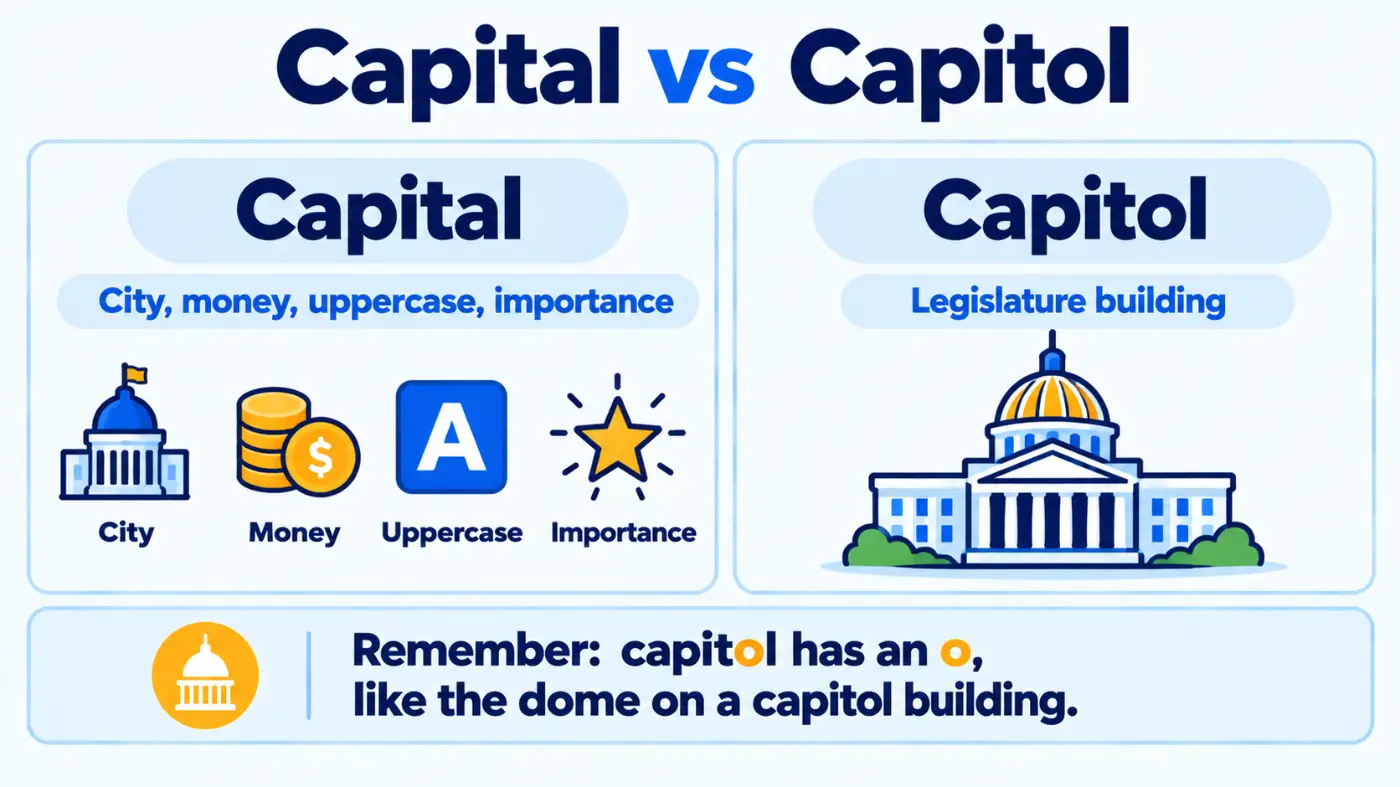
Capital refers to a city that serves as a seat of government, money or financial assets, an uppercase letter, or something of primary importance. Capitol refers specifically to a building where a legislature meets, such as the U.S. Capitol in Washington, D.C. The easiest way to remember the difference is that capitol has an o, like the dome often found on a capitol building.
The Short Answer at a Glance
Although capital and capitol sound identical in American English, they have distinct meanings and uses. Choosing the correct spelling depends on what you are describing.
| Word | Meaning | Example |
|---|---|---|
| Capital | A city where a government is based | Islamabad is the capital of Pakistan. |
| Capital | Money, wealth, or financial resources | The business needs additional capital to expand. |
| Capital | An uppercase letter | Begin the sentence with a capital letter. |
| Capital | Something of major importance | Safety is a capital concern. |
| Capitol | A building where a legislature meets | The lawmakers gathered at the state capitol. |
The central distinction: A capital is a city, resource, letter, or important thing, while a capitol is a legislative building. If you are referring to a government building rather than the city surrounding it, capitol is usually the correct choice.
What Capital Means and How It Works
Capital is a versatile noun and adjective with several established meanings. Its correct interpretation depends on the context, but its spelling never changes across these uses.
1. Capital as a City
A capital is a city that serves as the primary seat of a national, state, provincial, or other regional government. It is often the location of important government institutions, administrative offices, and diplomatic missions.
Examples:
- Islamabad is the capital of Pakistan.
- Canberra is the capital of Australia.
- Madrid is the capital of Spain.
- Sacramento is the capital of California.
A capital city does not have to be the country’s largest, most populated, or wealthiest city. Canberra, for instance, serves as Australia’s capital even though Sydney has a larger population.
The word describes the city or administrative center, not necessarily the building where legislators meet. Islamabad is Pakistan’s capital, while the Parliament House is the building where the country’s parliament meets.
2. Capital as Money or Financial Resources
In business, economics, and finance, capital refers to money, assets, or resources used to establish, operate, or grow an enterprise. It can include cash, equipment, property, and other resources that support economic activity.
Examples:
- The startup raised $750,000 in capital from private investors.
- Nadia used her savings as the initial capital for her bakery.
- The manufacturer invested additional capital in automated machinery.
- Limited working capital prevented the company from expanding its inventory.
Capital can take different forms, including financial capital, physical capital, and human capital. Financial capital includes funds available for investment, physical capital includes productive assets such as machinery, and human capital refers to people’s knowledge, skills, and experience.
In each case, capital refers to resources that contribute to productive activity, rather than a physical government building.
3. Capital as an Uppercase Letter
In writing, capital can refer to an uppercase letter, such as A, B, or C, as opposed to a lowercase letter, such as a, b, or c.
Examples:
- Write your surname with a capital letter at the beginning.
- The editor changed the first letter of the heading to a capital.
- Proper nouns, including London and Maria, begin with capital letters.
- The teacher reminded the class to capitalize the first word of every sentence.
The related verb capitalize means to write a letter in uppercase or, in finance, to treat an expenditure as a capital asset.
4. Capital as Something Important or Essential
As an adjective, capital can describe something of primary importance, fundamental value, or serious consequence. This use is more common in formal, literary, or specialized writing than in everyday conversation.
Examples:
- Accurate evidence is of capital importance to the investigation.
- The report identified a capital error in the original calculations.
- Protecting customer information is a capital concern for the organization.
The word also appears in the expression capital offense, which refers to a crime punishable by death in jurisdictions that authorize capital punishment.
In ordinary writing, however, major, critical, or essential may sound more natural, depending on the intended meaning.
What Capitol Means and How It Works
Capitol is a noun that refers to a building in which a legislative body meets. In the United States, it is commonly used for the building housing a state legislature or the federal Congress.
Unlike capital, capitol has a much narrower meaning. It is not a general term for a capital city, a government office, or a financial resource.
1. Capitol as a Legislative Building
A capitol is a building specifically associated with the work of a legislature. It may contain legislative chambers, committee rooms, offices for elected representatives, and public galleries.
Examples:
- Congress convened inside the U.S. Capitol.
- The Texas Legislature meets at the Texas State Capitol in Austin.
- Visitors toured the Georgia State Capitol during their trip to Atlanta.
- Construction crews completed repairs to the historic capitol building.
In the United States, the federal Capitol is located in Washington, D.C., and serves as the meeting place of the U.S. Congress. State capitols serve comparable functions for state legislatures.
A capitol is therefore a physical structure, not the city in which the government is located.
2. Capitol in Official Names
The word Capitol is often capitalized when it forms part of the official name of a particular building.
Examples:
- The United States Capitol is a landmark in Washington, D.C.
- The Colorado State Capitol stands in Denver.
- The Oregon State Capitol is located in Salem.
When capitol is used generically, it is usually lowercase.
For example:
- The state capitol is undergoing renovations.
- Several visitors gathered outside the capitol before the legislative session.
Capitalization depends on whether the word is part of a proper name or a general reference, not on whether the building is politically significant.
3. Capitol as a Symbol of Government
A capitol building can also represent legislative authority, civic identity, or the political history of a region.
Examples:
- The capitol became a symbol of the state’s democratic institutions.
- Students gathered on the capitol grounds to observe a public ceremony.
- The historic capitol represents generations of legislative debate.
This symbolic meaning still relates to the building. It does not make capitol interchangeable with capital when referring to a city or a government’s broader administrative center.
Capital vs Capitol: Key Differences Side by Side
| Feature | Capital | Capitol |
|---|---|---|
| Part of speech | Noun and adjective | Noun |
| Primary meaning | City, money, uppercase letter, or something important | Legislative building |
| Refers to a city? | Yes | No |
| Refers to financial resources? | Yes | No |
| Refers to uppercase letters? | Yes | No |
| Refers to a legislature’s building? | No, not in standard U.S. usage | Yes |
| Common context | Geography, finance, grammar, formal writing | Government, architecture, history |
| Example | Denver is the capital of Colorado. | The legislature meets at the Colorado State Capitol. |
Both words are pronounced identically in standard American English, so the distinction is primarily written rather than spoken. The right spelling depends on the thing being described: a city or resource is a capital, while the legislative building is a capitol.
Correct Examples in Real-Life Contexts
The clearest way to distinguish capital from capitol is to see how each word functions in everyday situations.
Examples of Capital
- Geography: Tokyo is the capital of Japan and a major center of commerce, culture, and government.
- Business: Omar needed more capital to purchase delivery vehicles for his growing logistics company.
- Education: The instructor asked students to write the first letter of each proper noun as a capital.
- Government: The country’s capital houses several foreign embassies and national administrative offices.
- Economics: Investors provided the capital needed to develop a renewable energy project.
- Formal writing: The committee considered public safety a matter of capital importance.
Examples of Capitol
- National government: The U.S. Congress met at the Capitol to debate proposed legislation.
- State government: Visitors photographed the Michigan State Capitol during their visit to Lansing.
- Architecture: The capitol’s white dome was visible from several blocks away.
- Civic events: Local residents gathered outside the state capitol for a public demonstration.
- History: The original capitol was replaced after the legislature approved plans for a larger building.
- Public administration: The committee held a hearing in a conference room inside the capitol.
These examples show why substituting one spelling for the other can change the meaning of a sentence. A city may contain a capitol, but the city itself is the capital.
Common Mistakes People Make (and How to Catch Them)
Even experienced writers sometimes use capital and capitol interchangeably, especially when writing quickly or discussing government.
Mistake 1: Calling a Capitol Building a Capital
Incorrect: The senators entered the capital to begin the session.
Correct: The senators entered the capitol to begin the session.
The sentence refers to the physical building where legislators meet. Therefore, capitol is the appropriate word.
Mistake 2: Calling a Capital City a Capitol
Incorrect: Islamabad is the capitol of Pakistan.
Correct: Islamabad is the capital of Pakistan.
Islamabad is a city that serves as the country’s seat of government. It is not itself a legislative building.
Mistake 3: Using Capitol for Financial Resources
Incorrect: The company needs more capitol to fund its expansion.
Correct: The company needs more capital to fund its expansion.
Financial resources are described as capital, regardless of whether the money comes from savings, loans, or investors.
Mistake 4: Using Capital for a Legislative Building
Incorrect: The governor delivered a speech inside the state capital.
Correct: The governor delivered a speech inside the state capitol.
The corrected sentence specifies a building. If the intended location were the city itself, capital would be correct.
Mistake 5: Assuming Every Government Building Is a Capitol
Incorrect: The mayor’s office is located inside the city capitol.
Correct: The mayor’s office is located inside city hall.
Not every building associated with government is a capitol. The word specifically identifies a legislative building, rather than a city hall, courthouse, or administrative office.
A useful proofreading question: Am I describing a city, money, a letter, or something important—or am I describing a building where legislators meet? That distinction usually resolves the spelling immediately.
A Fast Trick to Choose the Right One
The simplest memory trick is to associate the o in capitol with the o in dome.
Capitol = dome.
Many capitol buildings have prominent domes, particularly those in the United States. When you are writing about the legislative building itself, picture a dome and choose capitol.
<escape> </escape>
- Capital: A city, money, an uppercase letter, or something important.
- Capitol: A legislative building, often pictured with a dome.
For example, Washington, D.C., is the national capital, while the U.S. Capitol is the building where Congress meets.
The trick is a memory aid, not a strict architectural rule. Some capitol buildings do not have domes, and some buildings with domes are not capitols. The meaning of the word, rather than the building’s design, determines the correct spelling.
How They Sound in Real Situations
In standard American English, capital and capitol are homophones. Both are pronounced approximately KAP-i-tuhl, with the stress on the first syllable.
Because they sound the same, listeners rely on context to determine which word a speaker intends.
Passage 1: Discussing Government
“After arriving in Washington, D.C., we visited the Capitol and learned about its role in the legislative process. The tour guide explained how the capital became the center of the federal government.”
Notes: The first sentence uses Capitol for the legislative building. The second uses capital to describe Washington, D.C., as the seat of the federal government.
Passage 2: Discussing Business
“Our company is headquartered in the state capital, but our investors recently met with lawmakers at the state capitol. The additional capital they provided will help us expand our operations.”
Notes: The passage uses capital for the city and financial resources, and capitol for the legislative building.
Passage 3: Discussing Education
“The students traveled to the capital for a government studies program. During the visit, they toured the capitol and practiced identifying capital letters in the historical documents on display.”
Notes: All three uses are correct. Capital refers first to a city and then to uppercase letters, while capitol refers to the legislative building.
In conversation, neither spelling can be distinguished by pronunciation alone. In writing, the intended meaning makes the distinction clear.
Formal Writing vs Casual Writing
The spelling distinction between capital and capitol remains the same in formal and casual English. What changes is the surrounding vocabulary, sentence structure, and level of precision.
Formal Writing
In academic papers, government reports, news articles, legal documents, and business communications, use each word according to its precise meaning.
Examples:
- The national capital serves as the administrative center of the federal government.
- The state legislature convened at the capitol to consider the proposed amendments.
- The organization secured additional capital to finance its infrastructure project.
Formal writing may also require capitalization of official building names, such as United States Capitol or Texas State Capitol.
Casual Writing
In emails, text messages, informal conversations, and social media posts, the distinction still applies.
Examples:
- We’re heading to the state capital this weekend.
- I took some great pictures of the capitol.
- The new business needs more capital before it can open.
Informal writing does not make the two spellings interchangeable. Even in a quick message, using the correct word helps readers understand whether you mean a city, a building, or financial resources.
Related Mix-Ups People Also Search For
Capital and capitol are part of a wider group of English words that have similar spellings or pronunciations but different meanings.
| Word pair | Difference | Example |
|---|---|---|
| Capital vs. capitol | A city, money, or uppercase letter vs. a legislative building | The capital contains the capitol. |
| Principal vs. principle | A main person or thing vs. a fundamental rule | The principal explained the school’s principles. |
| Stationary vs. stationery | Not moving vs. writing materials | The stationary vehicle contained stationery. |
| Council vs. counsel | A governing or advisory group vs. advice or a lawyer | The council sought legal counsel. |
| Complement vs. compliment | Something that completes vs. praise | Her compliment was a complement to his presentation. |
| Ensure vs. insure | Make certain vs. provide financial protection | Please ensure the policy will insure the property. |
The best way to manage these pairs is to identify the intended meaning before selecting a spelling. Pronunciation and visual similarity can be useful clues, but neither replaces understanding how a word functions in a sentence.
Exceptions, Edge Cases, and Tricky Situations
The difference between capital and capitol is straightforward in most situations, but a few contexts require additional attention.
1. The U.S. Capitol vs. the Capital City
Washington, D.C., is the capital of the United States, while the U.S. Capitol is the building where Congress meets.
Both terms refer to places in the same city, but they identify different things. A person can visit the capital without entering the Capitol building.
2. State Capitols and Capital Cities
Every U.S. state has a capital city, and each has a building associated with its state legislature, commonly called a state capitol.
For example, Albany is the capital of New York, while the New York State Capitol is the legislative building in Albany.
The same distinction applies to other states, including California, Texas, and Colorado.
3. Capitol as Part of a Proper Name
When Capitol appears in an official building name, it is capitalized. When referring to a capitol building generically, lowercase is normally appropriate.
Examples:
- The visitors entered the United States Capitol.
- The state capitol was closed for maintenance.
The capitalization of the word does not change its underlying meaning.
4. Capital in Expressions and Compounds
Capital appears in many established expressions that have no connection to legislative buildings.
Examples include:
- Capital city: A city that serves as a seat of government.
- Capital investment: Money or resources committed to a long-term project.
- Capital gains: Profits from selling assets such as stocks or property.
- Capital letter: An uppercase letter.
- Capital punishment: A legal penalty involving execution.
These expressions always use capital, not capitol.
5. Capitol and Non-Legislative Government Buildings
A building may be important to government without qualifying as a capitol. A courthouse, executive mansion, parliament office, city hall, and government ministry are not automatically capitols.
Use capitol only when the building is a legislative meeting place or is officially named as a capitol.
6. Capitol in Other English-Speaking Countries
The word capitol is especially associated with U.S. legislative buildings. Other countries may use terms such as parliament building, legislative assembly, or parliament house for similar structures.
The word capital remains the standard term for a city serving as a seat of government across English varieties.
Quick Practice: Test Yourself
Choose capital or capitol to complete each sentence. Pay attention to what the sentence describes.
- Ottawa is the __________ of Canada.
- The lawmakers gathered inside the state __________ to discuss the new bill.
- The entrepreneur raised enough __________ to open a second restaurant.
- Visitors admired the marble dome of the United States __________.
- Remember to begin each proper noun with a __________ letter.
- The governor traveled to the state __________ for an official meeting.
Answer Key
- Capital — Ottawa is Canada’s capital city.
- Capitol — The lawmakers are meeting inside a legislative building.
- Capital — The sentence refers to financial resources.
- Capitol — The United States Capitol is a legislative building.
- Capital — An uppercase letter is called a capital letter.
- Capital — The governor is traveling to the state capital city, not necessarily entering its capitol building.
Scoring guide: If you answered all six correctly, you understand the main distinction. If you missed any, return to the key differences table and identify whether the sentence refers to a city, resources, a letter, or a legislative building.
Frequently Asked Questions
Use capitol when referring to a building where a legislature meets, such as the U.S. Capitol or a state capitol. Use capital when referring to the city that serves as the seat of government.
For example, Washington, D.C., is the capital of the United States, while the U.S. Capitol is where Congress meets.
Washington, D.C., is the capital of the United States. It is a city and the seat of the federal government, not a legislative building. The U.S. Capitol is a separate building located within the city.
The o in capitol can be remembered by associating it with the o in dome. Many capitol buildings feature prominent domes, making this a convenient spelling aid. However, the memory trick does not describe the historical origin of the word.
Yes. In standard American English, capital and capitol are homophones, pronounced approximately KAP-i-tuhl. Their meanings and spellings differ even though their sounds are identical.
No. Capitalize Capitol when it forms part of an official proper name, such as United States Capitol. Use lowercase capitol when referring to a legislative building generically, unless a particular style or official naming convention requires otherwise.
Both expressions are correct, but they refer to different things. A state capital is the city where the state government is based, while a state capitol is the building where the state legislature meets. For example, Austin is the capital of Texas, and the Texas State Capitol is the legislative building located there.

Sophia Bennett writes educational content about English vocabulary, grammar, slang, and communication. She is passionate about making complex language topics accessible to students, professionals, and curious readers around the world.