Die vs Dye: What’s the Difference?
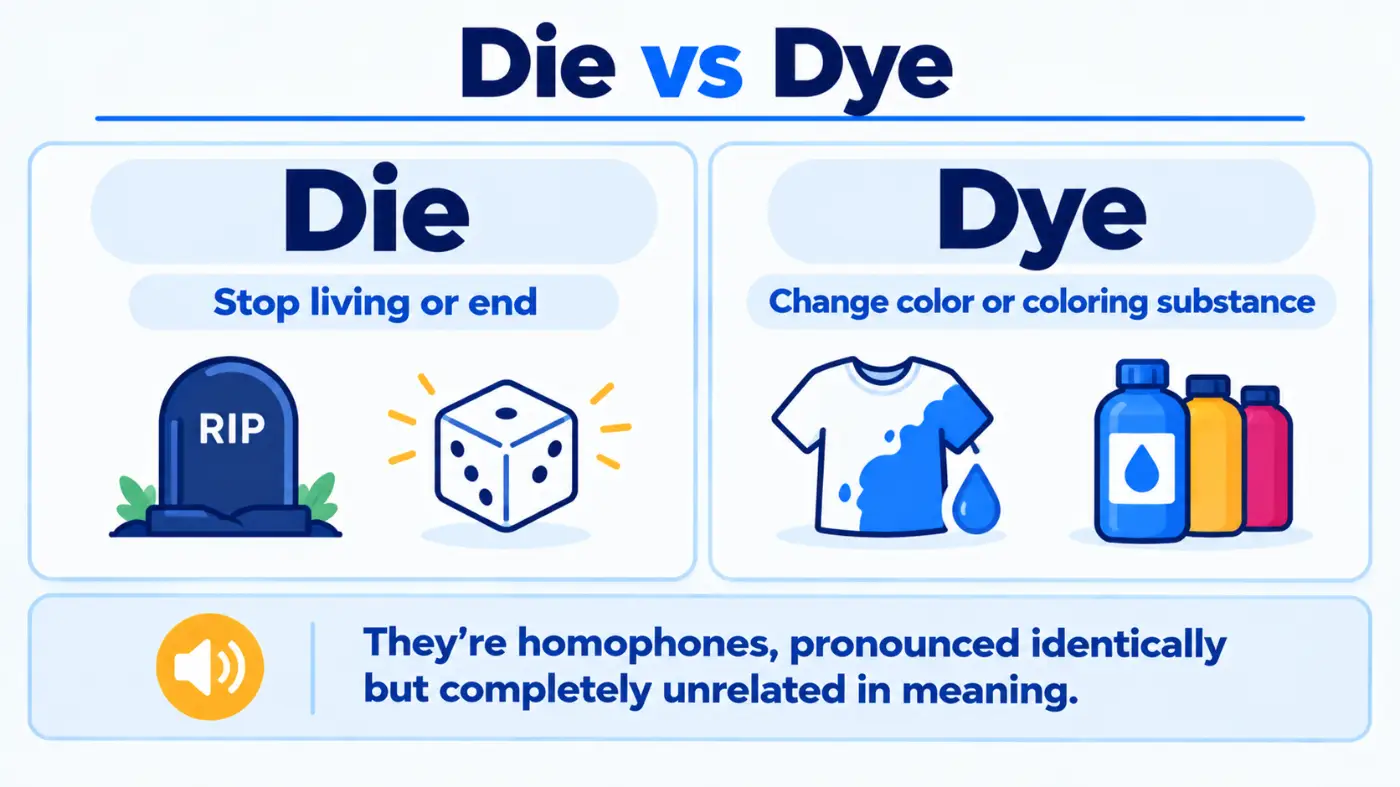
Die means to stop living, to come to an end, or refers to a small cube used in games. Dye means to change the color of something, or refers to the coloring substance itself. They’re homophones, pronounced identically but completely unrelated in meaning.
The Short Answer at a Glance
| Form | Part of speech | Core meaning | Example |
|---|---|---|---|
| die | Verb or noun | To stop living or come to an end; a small cube used in games | The plant will die if it doesn’t get more sunlight. |
| dye | Verb or noun | To change the color of something; the coloring substance itself | She decided to dye her hair a deep auburn. |
If you mean stopping living, ending, or a gaming cube, you want die. If you mean changing a color or the substance used to do it, you want dye.
What Die Means and How It Works
Die is most commonly a verb meaning to stop living, to cease to exist, or to come to an end. It’s used literally to describe the death of a living thing, and figuratively to describe something ending, fading, or losing its force, as in “the conversation died down” or “the engine died on the highway.”
As a noun, die also refers to a small cube marked with numbers or symbols, used in games of chance, with “dice” serving as its plural form. This noun sense is unrelated in meaning to the verb, though both share the same spelling and pronunciation.
Grammatically, the verb die follows an irregular pattern in its spelling, though its sounds remain predictable:
- die (base form)
- dies (third-person present)
- died (past tense and past participle)
- dying (present participle)
Notice that the present participle, dying, drops the “e” and changes the “i” before adding “-ing,” which is a spelling quirk specific to this verb and a few others ending in “-ie,” like “tie” becoming “tying” and “lie” becoming “lying.”
Die extends into many common figurative expressions, including “dying to know,” “die laughing,” and “old habits die hard,” all of which draw on the core sense of ending or fading intensity rather than literal death.
What Dye Means and How It Works
Dye functions as both a verb and a noun, and both uses relate to color. As a verb, to dye means to change the color of something, typically fabric, hair, or other materials, by applying a coloring substance. As a noun, dye refers to that coloring substance itself, as in “a bottle of fabric dye” or “natural plant-based dyes.”
The verb conjugates slightly differently from die, despite the similar spelling, because dye already ends in a different letter pattern:
- dye (base form)
- dyes (third-person present)
- dyed (past tense and past participle)
- dyeing (present participle)
Notice that dyeing keeps the “e” before adding “-ing,” specifically to avoid confusion with “dying,” the present participle of die. This is one of the rare cases in English where a spelling convention exists specifically to prevent two unrelated words from looking identical in a particular form.
Dye appears constantly in contexts involving fabric, hair coloring, food coloring, and industrial processes, and it also shows up in a few fixed expressions, most notably “dyed-in-the-wool,” describing someone whose beliefs or characteristics are deeply ingrained and unlikely to change.
Die vs Dye: Key Differences Side by Side
| Feature | Die | Dye |
|---|---|---|
| Part of speech | Verb, also a noun (gaming cube) | Verb and noun (coloring) |
| Core meaning | To stop living or end; a small cube for games | To change color; the coloring substance itself |
| Typical use | Describing death, endings, or dice in games | Describing hair, fabric, or food coloring |
| Present participle | Dying | Dyeing |
| Example | The flowers began to die after the frost. | She dyed the curtains a rich navy blue. |
The table draws a clean line, but what it can’t fully capture is how the two words diverge specifically in their “-ing” forms, dying and dyeing, which is one of the few places in English where spelling rules were shaped specifically to keep two homophones from colliding in writing.
Correct Examples in Real-Life Contexts
Everyday speech
- I think this houseplant is finally starting to die no matter what I do.
- She wants to dye her hair before the wedding next month.
- The battery in my phone always seems to die at the worst possible moment.
- We used onion skins to dye the eggs naturally this year.
Workplace writing
- The old server finally died over the weekend, and IT is working on a replacement.
- The textile company specializes in eco-friendly fabric dye processes.
- Sales for that product line began to die down after the holiday season.
- Please confirm whether the client wants the garments dyed before or after stitching.
Texting
- omg my phone is about to die, call you later
- just dyed my hair pink and I’m obsessed
School and academic
- The biology lab examined how quickly certain bacteria die under different temperature conditions.
- Her art project explored traditional plant-based dye techniques used historically.
- Students rolled a die repeatedly to study probability outcomes in the statistics unit.
- The chemistry experiment tested how different dyes react with various fabric types.
Formal writing
- The patient’s condition stabilized after doctors feared he might die from complications.
- The manufacturer confirmed that all dyes used meet current safety regulations.
- Economic growth in the region appears to be dying down after years of expansion.
- The textile industry report highlights emerging trends in sustainable dye production.
Common Mistakes People Make (and How to Catch Them)
Confusing die and dye in writing due to identical pronunciation
Wrong: She wants to die her hair blonde for summer. Right: She wants to dye her hair blonde for summer.
Since die and dye sound exactly alike, writers relying purely on pronunciation can easily swap one for the other, especially in casual or fast typing.
Misspelling the present participle forms
Wrong: The fabric is dying in that big vat over there. Right: The fabric is dyeing in that big vat over there.
This is one of the most consequential mix-ups, since “dying” and “dyeing” mean completely different things, and mixing them up can create a genuinely confusing or even alarming sentence.
Using “die” when describing a color change
Wrong: He died his jacket a darker shade for the costume. Right: He dyed his jacket a darker shade for the costume.
This error often stems from simple homophone confusion rather than any deeper misunderstanding, since the intended meaning is clearly about color, not death.
Autocorrect not catching the swap
Wrong: Autocorrect suggests “die” when a writer means “dye,” since both are correctly spelled words. Right: Manually reviewing the sentence to confirm the intended meaning before sending or publishing.
Because both words are legitimate, correctly spelled English words, spellcheck tools won’t flag this kind of substitution, making careful proofreading the only reliable safeguard.
A Fast Trick to Choose the Right One
Connect dye to “color” through their shared letter pattern: both words contain the letter “y” in a similar position, and dye specifically relates to adding color. If your sentence is about color, hair, fabric, or coloring substances, dye is almost certainly the word you need.
For die, connect it to “death” or “end,” both of which share that same core “d” sound and concept of stopping or finishing. If your sentence involves something ending, stopping, or ceasing, die is the correct choice.
The trickiest moment comes with the “-ing” forms. Remember that dyeing keeps its extra “e” specifically to avoid looking like dying, so if you’re ever unsure, picture the two side by side: dying ends in life, dyeing keeps that defining “e” for color.
This trick works well for separating the two words by meaning, but it won’t help with occasional edge cases in creative or wordplay-driven writing, where authors sometimes intentionally play on the similarity between die and dye for stylistic effect.
How They Sound in Real Situations
A text exchange
Priya: Guess what I did today
Sam: Dyed your hair again?
Priya: Yes!! Purple this time
Dyed is correct here, describing a hair color change in casual conversation.
A workplace email
Subject: Equipment update needed
Hi team,
The printer on the third floor finally died this morning, and IT has ordered a replacement. In the meantime, please use the printer near the break room.
Thanks, Devon
Died is correct here, describing the printer ceasing to function.
An article-style excerpt
The textile factory has shifted toward plant-based dyes in response to growing consumer demand for sustainable fashion. Industry experts say the transition could reshape how clothing is colored on a large scale.
Dyes is correct here, referring to the coloring substances used in textile production.
Formal Writing vs Casual Writing
The correct spelling doesn’t shift based on formality. Die is right in a medical report, a business memo, a text message, and a casual conversation when describing death or an ending. Dye follows the identical pattern when describing color changes, regardless of how formal or casual the writing is.
What does shift with register is tone, particularly around die, since discussions of death often call for more careful, measured language in formal or sensitive contexts. Dye, by contrast, carries no particular emotional weight and appears comfortably across every register without special consideration.
AP and Chicago style both treat die and dye as standard words requiring no special formatting, and both carefully preserve the distinct dying versus dyeing spelling specifically to avoid confusion between the two meanings.
Related Mix-Ups People Also Search For
Dying vs Dyeing
This is the most consequential related confusion, since these two “-ing” forms look nearly identical but mean completely different things. Dying relates to death or ending, while dyeing relates to changing color. Example: The dyeing process took hours, a stark contrast to the dying embers of the fire nearby.
Die vs Dice
Die is the singular form of the small cube used in games, while dice is its plural. In casual speech, many people use “dice” for both singular and plural, though “die” remains the traditional singular form. Example: Roll the die once to start, then switch to two dice for the rest of the game.
Dye vs Die (Industrial Tool Sense)
In manufacturing and metalworking, “die” also refers to a specialized tool used to cut or shape materials, a meaning entirely unrelated to both death and color. Example: The factory uses a custom die to stamp metal parts, a completely different tool from the dye used in the fabric department down the hall.
Exceptions, Edge Cases, and Tricky Situations
Die as an industrial tool
Beyond its meanings related to death and gaming, die also refers to a tool used in manufacturing to cut, shape, or stamp materials like metal or plastic. This specialized use has nothing to do with dye or coloring at all, and context within manufacturing or engineering writing makes the meaning clear.
Dice versus die in casual speech
While die is technically the correct singular form of dice, many casual speakers use “dice” for both singular and plural, as in “roll the dice” even when referring to just one. This usage is common and widely understood, though more formal or precise writing still favors “die” for the singular.
Quick Practice: Test Yourself
Choose the correct word for each blank.
- The old houseplant finally started to ______ after weeks of neglect. (die / dye)
- She wants to ______ her hair a brighter shade of red. (die / dye)
- The fabric is currently ______ in that large vat. (dying / dyeing)
- He rolled the ______ and got a six on the first try. (die / dye)
- The battery in my laptop keeps ______ no matter how often I charge it. (dying / dyeing)
- The company switched to plant-based ______ for its new clothing line. (die / dye)
Answer Key
- die: correct spelling describing the plant’s decline toward death.
- dye: correct spelling describing a hair color change.
- dyeing: correct spelling describing the color process, keeping the extra “e.”
- die: correct singular form of the gaming cube.
- dying: correct spelling describing the battery’s failure, not a color process.
- dye: correct spelling referring to the coloring substance used.
Frequently Asked Questions
What’s the difference between die and dye?
Die means to stop living, to come to an end, or refers to a small cube used in games. Dye means to change the color of something, or refers to the coloring substance itself.
Why are dying and dyeing spelled differently?
Dyeing keeps its “e” specifically to distinguish it from dying, which relates to death. This spelling convention exists to prevent confusion between two completely unrelated meanings.
Is dice the plural of die?
Yes, traditionally. Die is the singular form, and dice is the plural, though many casual speakers use “dice” for both singular and plural in everyday conversation.
Can die refer to something other than death?
Yes. Die can also refer to a small cube used in games, or to a specialized tool used in manufacturing to cut or shape materials.
Is dye only used for hair and fabric?
No. While those are the most common uses, dye also applies to food coloring, industrial processes, and various other contexts involving changing or adding color.
How can I avoid mixing up die and dye in writing?
Double-check your sentence’s meaning before finalizing it, especially with the “-ing” forms, since dying and dyeing are easy to mix up but mean entirely different things.Die vs Dye FAQ
What’s the difference between die and dye?
Die means to stop living, to come to an end, or refers to a small cube used in games. Dye means to change the color of something, or refers to the coloring substance itself.

Sophia Bennett writes educational content about English vocabulary, grammar, slang, and communication. She is passionate about making complex language topics accessible to students, professionals, and curious readers around the world.