
5starsstocks com Review: Stock Ratings, Features, and Trust
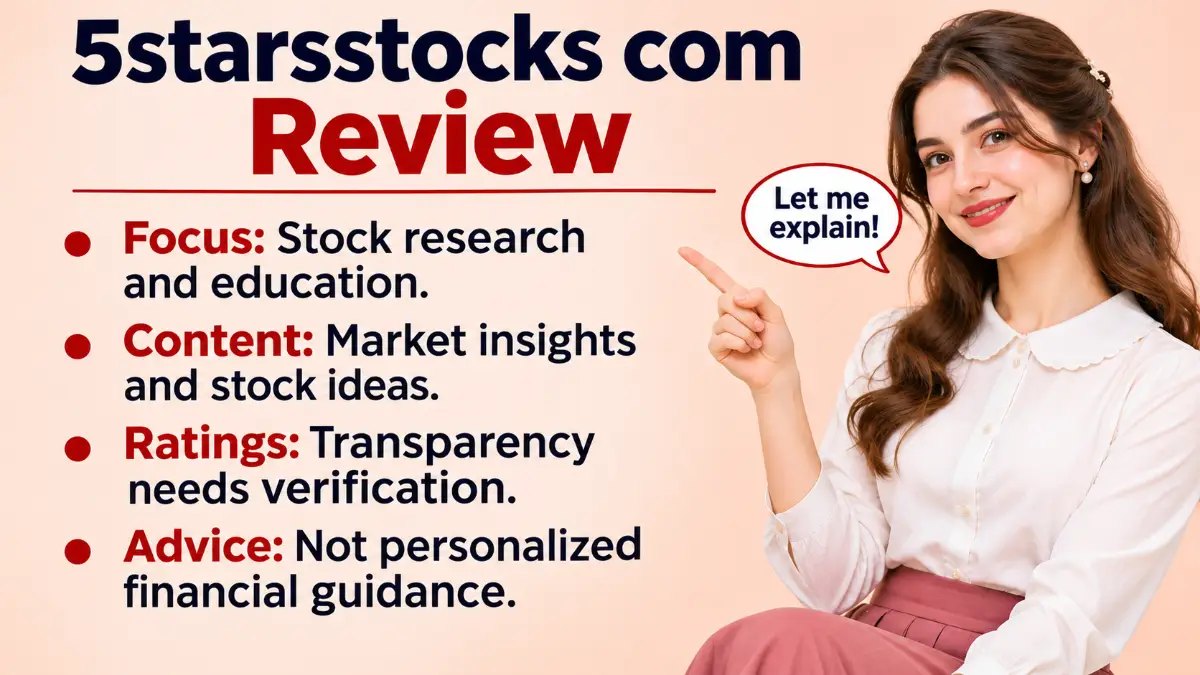
5StarsStocks.com is a stock-market research and educational publishing website, not a brokerage. It organizes articles around stock sectors, investment styles, market commentary, and ideas for further investigation. Its official disclaimer says its material is general information rather than personalized financial advice. The key question for readers is not simply whether the website exists, but whether its ratings and stock ideas come with enough transparent evidence to support financial decisions. This review examines its publicly visible content, the five-star concept, author and ownership information, pricing uncertainty, and competing research tools. It also explains how to check any investment idea independently before risking money.
Related Post: Zingyzon Com
What Is 5starsstocks com?
5StarsStocks.com presents itself as a financial research publisher for people interested in equities and market trends. Its homepage displays articles about individual investment themes, sectors, and portfolio approaches. Public navigation includes Sectors and Industries, Investment Styles, Investors, Market News, Stock Analysis, Stocks to Invest, and Trading.
The distinction between publishing and brokerage services matters. The website’s disclaimer expressly says it is not a licensed financial advisory firm or brokerage. Its Contact page also says it cannot provide account management or real-time trading support. Readers should therefore approach it as a source of articles and ideas, not as a place to open a brokerage account or execute an order.
The audience may include beginners learning investing vocabulary, investors comparing sectors, and experienced readers gathering alternative perspectives. Those are potential uses, not proof that the site’s selections outperform the market.
How Does 5StarsStocks.com Work?
Finding Stock Research
Visitors can browse the homepage, use the visible search field, or choose a navigation category. The homepage shows recent posts with titles, dates, categories, and bylines. This familiar publishing format makes it possible to start with a subject rather than a specific stock ticker.
For example, a reader curious about dividend income can seek income-related articles, while someone interested in technology can explore AI-focused coverage. A category label identifies a topic; it does not mean every company mentioned within that category is suitable for every investor.
Reading Articles Critically
Start by identifying the publication date, the companies discussed, and the assumptions supporting the argument. A market article can become outdated when earnings, interest rates, regulations, or company guidance change. The site’s own disclaimer warns that information may lose relevance after publication.
Treat optimistic language as a hypothesis to test. If an article calls a stock promising, ask what earnings growth, valuation, cash generation, and risks support that judgment. A persuasive headline is not a substitute for current financial statements.
Turning Ideas Into a Research List
A practical approach is to record the company name, ticker, publication date, and reason it appeared interesting. Then compare the claim with company filings and independent financial information. This creates a watchlist without confusing reading a recommendation with making an investment decision.
Main Features and Content Categories
Sector and Industry Coverage
The official homepage highlights AI stocks, cannabis stocks, crypto-related topics, and broader market sectors. These categories can help readers explore how different industries respond to regulation, consumer demand, technological change, and economic conditions.
Sector articles require particular care. A rapidly growing industry does not automatically make every company in it profitable, and a promising business can still be an overpriced stock. Readers should distinguish an industry’s prospects from an individual company’s financial position.
Dividend, Income, and Passive Investing
The site also features income and passive-investing articles. Dividend investors generally focus on the sustainability of distributions, while passive investors may prefer diversified, rules-based exposure instead of selecting individual stocks.
A dividend yield by itself is not enough to judge quality. A rising yield can reflect a falling share price, and a company can reduce or suspend payments. Useful checks include free cash flow, payout ratios, debt obligations, and the stability of underlying earnings.
Blue-Chip, Growth, and Value Topics
Visible articles cover blue-chip companies and broader investment styles. Blue-chip is a conventional label for large, established businesses, not a guarantee of safety. Growth investing emphasizes future expansion, whereas value investing asks whether the market price is attractive relative to underlying business worth.
These approaches can overlap. A mature company can offer growth, and a fast-growing business can occasionally trade at a reasonable valuation. The best comparison uses financial evidence rather than relying on labels alone.
Market Commentary and Education
The homepage also links to market news, analysis, trading-related topics, and educational discussions. Some articles examine interest rates, retirement allocations, and risk management. That breadth can be useful for building vocabulary and generating research questions.
However, educational coverage should not be confused with a structured course or a personalized portfolio review. Readers who need a step-by-step curriculum may prefer dedicated investor education resources, while those needing tailored advice should consult an appropriately qualified professional.
How Does the Five-Star Stock Rating Work?
The five-star branding suggests an easy-to-read evaluation scale, but a fully reproducible scoring formula and weighting system could not be established from the official pages reviewed. The website describes research-driven analysis, yet the available material does not show how each input translates into a particular number of stars.
This distinction is central to assessing any ratings service. A transparent methodology would ideally specify its financial inputs, how frequently ratings change, the role of analyst judgment, the treatment of missing data, and how the results are tested against an appropriate benchmark.
What Investors Would Need to Verify
Common inputs in fundamental stock analysis include profitability, sales growth, cash flow, balance-sheet strength, valuation, and competitive position. These are general research considerations, not a confirmed list of variables in a 5StarsStocks scoring algorithm.
Even if a publisher considers these factors, their relative importance matters. A highly profitable company may be expensive; a cheap company may have declining earnings; and an emerging business may carry risks not captured by recent financial ratios.
Why Five Stars Do Not Predict Returns
A high rating represents an assessment at a particular moment. It does not lock in a future price, eliminate volatility, or guarantee that an investor will earn money. Changes in business performance, investor expectations, and broader markets can overwhelm an apparently favorable analysis.
For that reason, the star label should begin a question: What specific evidence would justify owning this business at today’s price? If that question cannot be answered, the rating alone offers too little information for a serious decision.
Is 5starsstocks com Legit and Trustworthy?
The website is an accessible research publisher with visible articles and an investment-risk disclaimer. That establishes a public publishing presence, not independently demonstrated investment skill. A site can publish real articles and still have an unproven forecasting record.
Website Transparency
The official navigation includes About Us, Contact Us, and Disclaimer pages. The Contact page provides an email route and states a New York office address. The existence of a stated address should not be confused with independent verification of the business operating there.
The website also identifies Anthony Walker as the byline on multiple homepage articles. A published byline is useful for attribution, but it does not independently establish the author’s qualifications or identify the site’s legal owner.
Financial Disclosures
The disclaimer clearly describes the content as informational and educational. It says the website is not a licensed advisory firm or brokerage and cautions that investors can lose money. It also encourages readers to verify important information and consult a qualified financial adviser where appropriate.
These disclosures are relevant, but disclaimers do not prove that every analysis is correct. They also do not settle every regulatory question. Publishing general commentary and offering individualized securities advice can raise different legal considerations depending on the actual activities involved.
Editorial Credibility
Readers should look beyond polished formatting to the quality of evidence inside individual articles. Strong research identifies a company’s financial reporting period, separates historical results from forecasts, explains assumptions, and discusses what could go wrong.
A dated article with a named author is easier to evaluate than an anonymous undated claim. Still, bylines and timestamps are starting points, not proof of expert review. Check whether the central numbers match the company’s own filings.
Privacy and Security
The pages reviewed do not establish every detail of the site’s data handling or technical security. Visitors should review any current privacy terms before submitting information, especially through forms or a potential payment flow.
HTTPS helps protect data in transit but does not independently establish editorial reliability or investment performance. Avoid sharing brokerage credentials, identity documents, or payment details with a research website unless there is a clear, legitimate reason and the recipient has been carefully verified.
Who Owns 5StarsStocks.com?
The reviewed official pages did not establish a verified legal owner or a complete roster of analysts with independently confirmed credentials. The Contact page refers to a research team, while visible articles carry a named byline. Those facts should not be combined into an unsupported claim about who owns or controls the company.
A reader assessing financial content may reasonably want to know whether contributors have relevant experience, whether they own securities they discuss, and how conflicts of interest are handled. Where those details are unavailable, the appropriate response is to recognize the uncertainty rather than assume misconduct.
The site states an office address in New York, but this review did not independently verify that address as an operating business location. Readers considering any paid service can ask for the legal business name, billing terms, cancellation policy, and responsible editorial contact before making a purchase.
How Accurate Are Its Stock Picks?
A dependable, independently audited long-term accuracy rate could not be verified. Competing reviews circulate conflicting percentages and describe supposed outside tests, but the reports examined do not consistently provide original datasets, complete trade lists, or reproducible calculations.
Accuracy Is Not the Same as Profit
A service could predict the direction of many stocks correctly while losing money overall if its losing picks fall much more than its winners rise. Conversely, a strategy with fewer winning positions could still earn a positive return if gains on winners exceed losses.
A useful performance evaluation should define the recommendation date, purchase price, holding period, exit rules, dividends, transaction costs, and benchmark. It should also include unsuccessful recommendations rather than showcasing only successful examples.
How to Evaluate a Claimed Track Record
Ask whether every historical rating can be retrieved with its original date and whether the record includes revisions. Compare performance with a relevant benchmark over the same period, using a consistent calculation method.
Also consider risk. A portfolio that earns a similar return to a broad index while experiencing much larger losses along the way may not offer an attractive trade-off. Short samples and cherry-picked winners cannot establish a repeatable edge.
Why Unverified Percentages Matter
Several independent-looking articles repeat precise success rates, but repetition does not turn an unsupported figure into verified evidence. Without a clear primary source and method, readers should not treat those numbers as facts about 5StarsStocks.com.
This is especially important when evaluating stock ideas in volatile industries. A few dramatic gains or losses can dominate a short sample and distort impressions of how a service performs across different market conditions.
Is 5StarsStocks.com Free or Paid?
Publicly accessible articles were visible during the research. However, a current official subscription price and a complete set of paid-plan terms could not be verified from the reviewed pages.
Some third-party reviews discuss subscriptions, but their figures conflict. Publishing any one of those amounts as the site’s current price would mislead readers. Before paying, confirm the exact amount, renewal frequency, refund rules, included features, and cancellation process directly with the provider.
The presence of free reading material does not prove that every service is free. Likewise, a mention of premium access in an outside review does not prove that a particular plan is currently offered.
Advantages and Limitations
The site’s clearest potential advantage is its range of publicly visible investing topics. Readers can discover sector themes, investing styles, and basic concepts in one publishing environment. Its disclaimer also openly acknowledges investment risk and the absence of personalized advice.
The main limitations concern independent verification. The exact star-scoring formula, an audited historical record, a fully verified ownership structure, and stable official subscription terms were not established in the research reviewed here.
These limitations do not make the website automatically worthless or fraudulent. They do mean its stock ideas should carry less weight than primary financial records and transparent, independently testable analysis.
5StarsStocks.com vs Other Research Platforms
Different services serve different research needs. The following comparison describes their general roles rather than claiming that any provider guarantees successful picks.
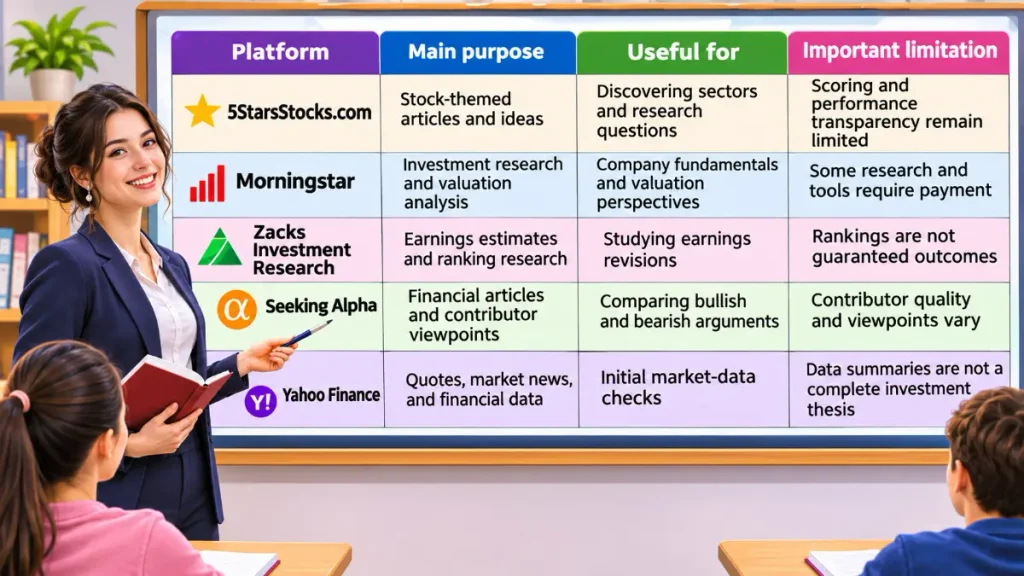
A reader may use more than one source. The important principle is to compare independently produced evidence instead of counting repeated opinions as separate confirmation.
How to Verify a Five-Star Stock Before Investing
Step 1: Read Official Company Filings
For US public companies, the SEC’s EDGAR database provides access to annual reports, quarterly reports, and important company disclosures. The annual Form 10-K is especially useful for understanding the business, financial statements, and major risks.
Check the ticker and reporting period carefully. An article written before the latest earnings release may rely on figures that have since changed.
Step 2: Examine Financial Health
Review revenue, operating profit, cash flow, debt, and liquidity. A company may report rising sales while consuming substantial cash, or it may show accounting profits without enough cash to fund operations comfortably.
Look at several years when possible. One strong quarter does not necessarily establish a durable business trend, and a temporary setback does not always imply permanent weakness.
Step 3: Evaluate the Price
A good company can be a poor investment at an excessive valuation. Compare its price with earnings, cash flow, growth expectations, and the valuations of relevant competitors.
No single ratio works for every business. Young companies, banks, utilities, and cyclical manufacturers require different assumptions, so understand what the valuation measure actually captures.
Step 4: Challenge the Investment Thesis
Write down why the stock might rise and what evidence would prove the thesis wrong. Consider competition, regulation, financing needs, customer concentration, management execution, and changes in demand.
Seek a credible opposing argument rather than reading only supportive commentary. An investment idea becomes more useful when it survives serious scrutiny.
Step 5: Consider Portfolio Risk
Even a well-researched stock can decline sharply. Think about diversification, the amount of money at risk, liquidity needs, and whether the investment fits your time horizon.
Avoid building an entire portfolio around a single sector or a small number of high-conviction ratings. For decisions involving substantial savings, qualified personalized advice may be more appropriate than online articles.
Who Might Benefit From 5StarsStocks.com?
Beginners may find the site’s category-based articles useful for learning the language of markets. Readers exploring dividend, AI, blue-chip, or passive-investing themes may also use the coverage to generate questions for further research.
More experienced investors can treat articles as alternative viewpoints, provided they independently check the figures. The website is less suitable as a sole decision source for anyone who requires documented rating weights, verified analyst credentials, or a fully audited performance history.
People who need actual trade execution must use an appropriate brokerage rather than assuming a research publisher handles orders. Investors who want personalized portfolio guidance should seek a properly qualified professional whose services and regulatory status can be checked.
Frequently Asked Questions
What is 5starsstocks com?
It is a website publishing stock-market research, sector articles, and investing education. Its own disclaimer describes the material as general information rather than personalized advice.
Is 5starsstocks com legitimate?
It is an accessible publishing website with articles, contact information, and a disclaimer. That does not independently verify its ratings or establish a successful investment record.
Is 5StarsStocks.com free?
Some articles are publicly accessible without payment. Current official pricing for any premium service could not be confirmed.
Can I buy stocks through 5StarsStocks.com?
The site says it is not a brokerage and does not provide trading support. Investors need a separate brokerage to place stock orders.
How does its five-star rating system work?
The exact scoring formula and weights were not established from the reviewed official material. Treat a star rating as a research prompt rather than a forecast.
Are its stock recommendations accurate?
No independently audited long-term accuracy rate was verified. Published percentages without original data and clear methods should be treated cautiously.
Who owns 5StarsStocks.com?
A verified legal owner could not be established from the official pages reviewed. The website displays author bylines and contact information, but those do not prove ownership.
Is 5StarsStocks.com suitable for beginners?
Its educational articles may help beginners explore investing concepts. Beginners should confirm financial claims independently and avoid buying solely because of a rating.
What are alternatives to 5StarsStocks.com?
Morningstar, Zacks, Seeking Alpha, and Yahoo Finance offer different kinds of financial research. Choose based on the data, methodology, and tools you actually need.
Final Verdict: Is 5StarsStocks.com Worth Exploring?
5StarsStocks.com can be useful as a starting point for stock research, but not as a stand-alone investment decision system. Its public content covers multiple sectors and investing styles, and its official disclaimer acknowledges market risk and the limits of general commentary. The biggest unanswered questions concern the reproducibility of its star ratings, independently verified performance, ownership transparency, and current premium pricing. Readers should treat stock picks as ideas to investigate, then consult company filings, compare independent perspectives, and assess valuation and risk. No website rating removes the possibility of financial loss.

Sophia Bennett writes educational content about English vocabulary, grammar, slang, and communication. She is passionate about making complex language topics accessible to students, professionals, and curious readers around the world.





One Comment